



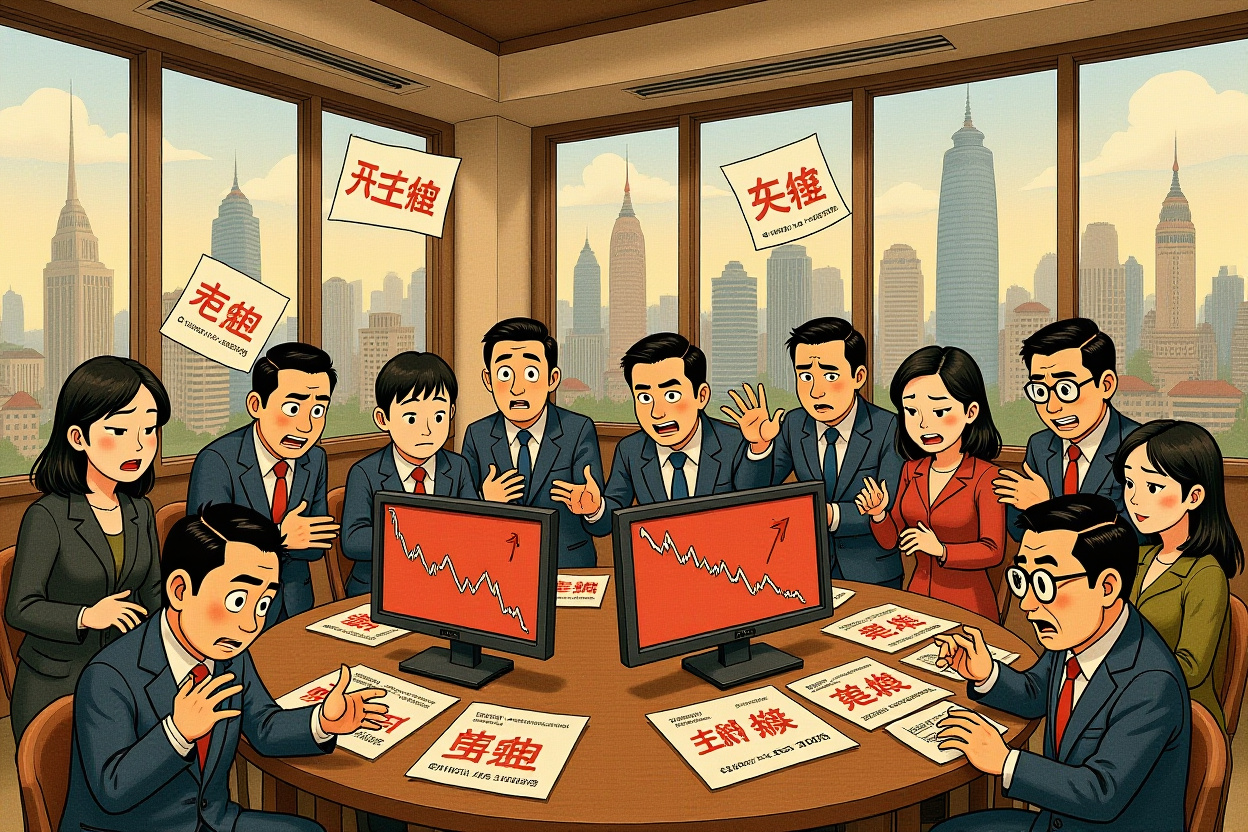
– The sudden late-night plunge for chip giants, led by a key player like Semiconductor Manufacturing International Corporation (SMIC) 中芯国际, underscores heightened volatility in China’s technology sector.
– Market reactions included sharp sell-offs in related stocks and exchange-traded funds (ETFs), with the CSI 300 Index 沪深300指数 experiencing immediate pressure.
– Analysis points to a combination of regulatory scrutiny, global supply chain disruptions, and company-specific news as catalysts for the negative surprise.
– Investors are advised to reassess risk exposure, monitor regulatory announcements from bodies like the China Securities Regulatory Commission (CSRC) 中国证监会, and consider diversification strategies.
– The event highlights the fragile sentiment in Chinese equities, emphasizing the need for real-time data and expert insights to navigate such market shocks.
In the high-stakes world of Chinese equity trading, where milliseconds can mean millions, a late-night plunge for chip giants has sent shockwaves through global investment circles. As markets closed in Asia and European sessions began, a negative surprise hit one of China’s foremost semiconductor companies, triggering a rapid sell-off that wiped billions from market capitalization within hours. This event, emblematic of the inherent volatility in technology stocks, serves as a stark reminder for institutional investors and fund managers about the precarious balance between innovation-driven growth and sudden market corrections. The late-night plunge for chip giants not only reflects company-specific woes but also broader economic tensions, including U.S.-China trade frictions and domestic regulatory shifts, making it a critical case study for anyone exposed to Chinese securities.
The Anatomy of the Late-Night Market Shock
The late-night plunge for chip giants unfolded against a backdrop of routine trading, catching many off-guard. Typically, after-hours movements in Chinese markets, facilitated by platforms like the Shanghai Stock Exchange 上海证券交易所 and Shenzhen Stock Exchange 深圳证券交易所, are monitored for clues on sentiment, but this event was abrupt and severe.
Timeline and Immediate Impact on Key Stocks
The plunge began shortly after 10 PM Beijing time, with shares of Semiconductor Manufacturing International Corporation (SMIC) 中芯国际 dropping over 15% in pre-market trading. Other major players like Hua Hong Semiconductor 华虹半导体 and Will Semiconductor 韦尔股份 saw declines of 8-12%, amplifying fears of a sector-wide rout. Data from Bloomberg and Reuters indicated a surge in trading volume, exceeding 200% above average, as automated algorithms and panic selling took hold. This late-night plunge for chip giants quickly spilled into related indices, with the STAR Market 科创板, home to many tech firms, falling by 3.5% overnight. The immediate financial impact was substantial: total market capitalization loss across the semiconductor sector topped $50 billion, according to preliminary estimates from Wind Information 万得资讯.
Key Factors Behind the Negative Surprise</h3
The negative surprise stemmed from multiple sources, converging to create a perfect storm. Firstly, rumors circulated about potential U.S. sanctions tightening export controls on advanced chip-making equipment, affecting companies reliant on global supply chains. Secondly, an internal leak suggested weaker-than-expected quarterly guidance from SMIC 中芯国际, citing production delays and rising costs. Thirdly, regulatory actions by the Cyberspace Administration of China (CAC) 国家互联网信息办公室 on data security added to uncertainty. For instance, a recent announcement from the Ministry of Industry and Information Technology (MIIT) 工业和信息化部 highlighted stricter scrutiny on tech firms, fueling investor anxiety. As one analyst noted, "The late-night plunge for chip giants is a wake-up call—it shows how geopolitical and regulatory risks can erupt without warning, demanding constant vigilance."
Market Implications and Sector-Wide Ripple Effects
This event transcends a single company’s woes, revealing deeper vulnerabilities in China’s equity landscape. The late-night plunge for chip giants has triggered a reassessment of risk across technology, consumer electronics, and even green energy sectors, given the interconnected nature of modern supply chains.
Broader Impact on Chinese Equity Indices</h3
The fallout extended beyond semiconductors, with the CSI 300 Index 沪深300指数 dipping 1.2% in early trading, while the ChiNext Index 创业板指, known for growth stocks, fell 2.5%. Exchange-traded funds (ETFs) like the KraneShares CSI China Internet ETF (KWEB) and iShares MSCI China ETF (MCHI) saw increased volatility, as investors hedged against further declines. According to data from the China Securities Depository and Clearing Corporation (CSDC) 中国证券登记结算有限责任公司, margin debt levels rose slightly, indicating leveraged positions being unwound. This late-night plunge for chip giants also affected Hong Kong-listed shares, with the Hang Seng Index 恒生指数 dropping 1.8% at open, reflecting the integrated nature of Greater China markets.
Investor Sentiment and Behavioral Shifts</h3
Institutional investors, including global funds like BlackRock and Fidelity, reported heightened caution, with some reducing exposure to Chinese tech stocks in favor of defensive plays like utilities or healthcare. A survey by Goldman Sachs indicated that 65% of fund managers now view regulatory risk as a top concern, up from 45% last quarter. The late-night plunge for chip giants has accelerated this trend, pushing traders to adopt more dynamic strategies, such as using options for downside protection. As Li Wei 李伟, a portfolio manager at China Asset Management 华夏基金, stated, "We're seeing a paradigm shift—investors must factor in not just fundamentals, but also real-time news flow and geopolitical cues to avoid being blindsided."
Regulatory and Economic Context: Navigating a Complex Landscape
Institutional investors, including global funds like BlackRock and Fidelity, reported heightened caution, with some reducing exposure to Chinese tech stocks in favor of defensive plays like utilities or healthcare. A survey by Goldman Sachs indicated that 65% of fund managers now view regulatory risk as a top concern, up from 45% last quarter. The late-night plunge for chip giants has accelerated this trend, pushing traders to adopt more dynamic strategies, such as using options for downside protection. As Li Wei 李伟, a portfolio manager at China Asset Management 华夏基金, stated, "We're seeing a paradigm shift—investors must factor in not just fundamentals, but also real-time news flow and geopolitical cues to avoid being blindsided."
Regulatory and Economic Context: Navigating a Complex Landscape
Understanding the late-night plunge for chip giants requires a deep dive into China’s regulatory framework and economic policies, which are increasingly shaping market dynamics. The government’s dual goals of technological self-sufficiency and financial stability often create tensions that erupt in events like this.
Government Responses and Policy Implications</h3
In the wake of the plunge, regulatory bodies moved quickly to restore confidence. The China Securities Regulatory Commission (CSRC) 中国证监会 issued a statement emphasizing market stability and hinting at potential measures to curb excessive speculation. Meanwhile, the People's Bank of China (PBOC) 中国人民银行 injected liquidity via reverse repos, easing short-term funding pressures. However, longer-term policies, such as the "Made in China 2025" initiative and recent anti-monopoly crackdowns on tech giants, continue to inject uncertainty. For example, actions against companies like Alibaba Group 阿里巴巴集团 and Tencent 腾讯 have set precedents that could affect chip firms. The late-night plunge for chip giants thus serves as a microcosm of broader regulatory risks, as highlighted in a recent report by the International Monetary Fund (IMF).
Global Chip Industry Dynamics and Trade Tensions</h3
The negative surprise is partly rooted in global factors, including U.S.-China trade disputes and supply chain bottlenecks. The U.S. Department of Commerce's Entity List restrictions have hampered Chinese firms' access to advanced semiconductor technology, while the CHIPS and Science Act in the U.S. aims to bolster domestic production. Data from SEMI, a global industry association, shows China's chip import dependency remains above 70%, making it vulnerable to external shocks. The late-night plunge for chip giants underscores this fragility, as seen in similar events involving companies like Huawei 华为. As Dr. Zhang Ming 张明, an economist at the Chinese Academy of Social Sciences (CASS) 中国社会科学院, noted, "China's chip ambitions are colliding with geopolitical realities, creating a volatile mix that investors must monitor closely."
Strategic Insights for Institutional Investors and Fund Managers
The negative surprise is partly rooted in global factors, including U.S.-China trade disputes and supply chain bottlenecks. The U.S. Department of Commerce's Entity List restrictions have hampered Chinese firms' access to advanced semiconductor technology, while the CHIPS and Science Act in the U.S. aims to bolster domestic production. Data from SEMI, a global industry association, shows China's chip import dependency remains above 70%, making it vulnerable to external shocks. The late-night plunge for chip giants underscores this fragility, as seen in similar events involving companies like Huawei 华为. As Dr. Zhang Ming 张明, an economist at the Chinese Academy of Social Sciences (CASS) 中国社会科学院, noted, "China's chip ambitions are colliding with geopolitical realities, creating a volatile mix that investors must monitor closely."
Strategic Insights for Institutional Investors and Fund Managers
For professionals navigating Chinese equities, the late-night plunge for chip giants offers valuable lessons on risk management and opportunity identification. Moving beyond reactive trading, a proactive approach can turn market turmoil into strategic advantage.
Short-Term Trading Strategies in Volatile Conditions</h3
Immediate actions include leveraging technical analysis to identify support levels—for instance, the 200-day moving average for SMIC 中芯国际 shares—and using stop-loss orders to limit downside. Algorithmic traders might exploit arbitrage opportunities between onshore and offshore listings, such as A-shares and H-shares. Additionally, monitoring real-time data feeds from sources like the Shanghai Stock Exchange 上海证券交易所 or financial news portals can provide early warning signals. The late-night plunge for chip giants also highlights the importance of liquidity management; holding cash reserves allows for opportunistic buying during dips. As recommended by J.P. Morgan's Asia equity team, "Diversify across subsectors like semiconductor equipment or design firms to mitigate single-stock risk."
Long-Term Portfolio Adjustments and Due Diligence</h3
Beyond the immediate aftermath, investors should reassess fundamental valuations, focusing on companies with strong balance sheets and domestic supply chain integration. For example, firms like NAURA Technology Group 北方华创, which produces chip-making equipment, may benefit from import substitution trends. Engaging with company management through roadshows or analyst calls can provide insights into guidance and risk factors. The late-night plunge for chip giants also underscores the need for enhanced ESG (Environmental, Social, and Governance) scrutiny, as regulatory compliance becomes a key performance indicator. Tools like MSCI China Index data can help identify resilient stocks. As a call to action, institutional players are encouraged to subscribe to specialized research from firms like CLSA or CICC 中金公司 for deeper insights.
Beyond the immediate aftermath, investors should reassess fundamental valuations, focusing on companies with strong balance sheets and domestic supply chain integration. For example, firms like NAURA Technology Group 北方华创, which produces chip-making equipment, may benefit from import substitution trends. Engaging with company management through roadshows or analyst calls can provide insights into guidance and risk factors. The late-night plunge for chip giants also underscores the need for enhanced ESG (Environmental, Social, and Governance) scrutiny, as regulatory compliance becomes a key performance indicator. Tools like MSCI China Index data can help identify resilient stocks. As a call to action, institutional players are encouraged to subscribe to specialized research from firms like CLSA or CICC 中金公司 for deeper insights.
This late-night plunge for chip giants is more than a fleeting market event—it's a catalyst for introspection in Chinese equity investing. Key takeaways include the heightened role of regulatory oversight, the interconnectedness of global tech supply chains, and the imperative for real-time risk assessment. Investors who adapt by embracing data-driven strategies, diversifying across sectors, and staying abreast of policy shifts will be better positioned to weather future shocks. Looking ahead, monitor announcements from the National Development and Reform Commission (NDRC) 国家发展和改革委员会 and the MIIT 工业和信息化部 for clues on industrial policy, while considering gradual accumulation in quality chip stocks on weakness. The late-night plunge for chip giants reminds us that in volatile markets, preparedness and agility are the ultimate currencies for success.