



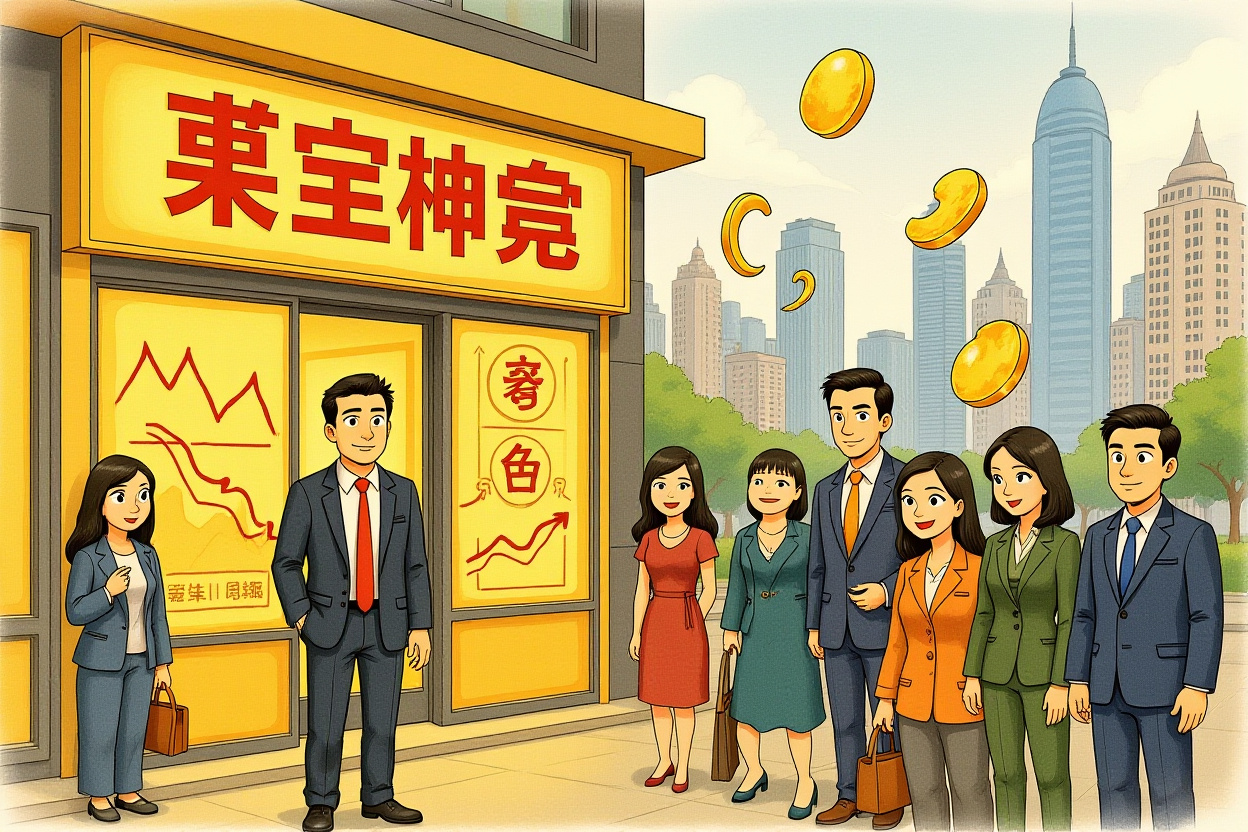
As global gold prices experienced a dramatic plunge in March 2026, sending shockwaves through markets, one Chinese jewelry retailer reported staggering financial results seemingly detached from the commodity cycle. Laopu Gold (老铺黄金), often dubbed the “Hermès of Gold,” unveiled a 221% year-on-year revenue surge for 2025, solidifying its status as a darling of affluent Chinese consumers. Yet, beneath the glittering surface of record profits and frenzied store queues lies a stark financial contradiction: the company is hemorrhaging cash. This divergence between booming profits and a deepening cash flow deficit defines the old gold store’s financial paradox, raising critical questions about its business model and long-term viability as it attempts to transcend its origins as a mere purveyor of gold.
The Spectacle of Growth: Record Sales and Storefront Frenzy
Laopu Gold’s ascent in the Chinese luxury landscape has been nothing short of meteoric. According to data from Frost & Sullivan, by 2025 it ranked as the second-largest luxury group by revenue in mainland China, surpassing Hermès and approaching LVMH. Its financial trajectory over the past three years paints a picture of explosive, sustained growth.
Financial Performance: A Three-Year Surge
- 2023: Revenue of 3.18 billion yuan, net profit of 416 million yuan.
- 2024: Revenue skyrocketed to 8.51 billion yuan, with net profit climbing to 1.47 billion yuan.
- 2025: Revenue accelerated further to 27.30 billion yuan, generating a net profit of 4.87 billion yuan.
The company attributes this “hyper-growth” to expanding brand influence, a dual online-offline sales push, and an accelerated product launch cycle. This growth is mirrored in tangible market heat. In February 2026, ahead of a scheduled price hike, consumers across major cities like Beijing, Shanghai, and Hangzhou queued for hours—some even camping overnight—to purchase items before the increase. This phenomenon repeats with each announced price adjustment, creating a self-reinforcing cycle of urgency and perceived value.
Contrast with a Slumping Sector
This fervor stands in stark contrast to the broader Chinese gold jewelry sector, which is mired in a collective downturn. Established giants like Chow Tai Fook (周大福), Chow Tai Seng (周大生), and Lao Feng Xiang (老凤祥) have reported declining or stagnant revenues. For instance, Lao Feng Xiang’s 2025 revenue fell 6.99%, while Chow Tai Seng saw a 37.35% drop in the first nine months of the same year. This divergence highlights Laopu Gold’s successful carving of a unique niche, but also underscores the atypical nature of its success, central to understanding the old gold store’s financial paradox.
Deconstructing the Business Model: From Commodity to “Luxury”
The core of Laopu Gold’s strategy is a fundamental break from industry norms, primarily through its pricing and branding approach.
The “One-Price” Model and Strategic Hikes
Traditional gold jewelry is priced based on daily gold weight plus a processing fee, tethering its value directly to international bullion prices. Laopu Gold employs a “one-price” (一口价) model, setting a fixed retail price for each piece irrespective of daily gold fluctuations. This simple shift transforms the product from a commodity-linked asset into a branded luxury good, creating space for significant brand premium. Since 2024, the company has implemented five price increases, cumulatively raising prices over 64%, with single hikes reaching 20-30%. This strategy mirrors that of heritage luxury houses like Hermès and Chanel, using regular price increases to signal exclusivity and investment potential.
Crafting the Luxury Experience
Every operational detail is engineered to reinforce this premium positioning. Stores are exclusively located in high-end malls like Beijing SKP and Shanghai’s Plaza 66. Interiors are designed with a museum-like aesthetic, and sales associates provide one-on-one service with deep knowledge of product history and craftsmanship. The hiring process for these associates is remarkably selective, reportedly favoring candidates with specific, refined appearances and demeanors, further distancing the brand from mass-market competitors. This holistic approach aims to isolate Laopu Gold from the red-ocean competition of traditional gold shops and anchor itself in the mindset of high-net-worth clients.
The Architect and the Ascent: From Humble Beginnings to Market Darling
The vision behind Laopu Gold stems from its founder, Xu Gaoming (徐高明). Born in 1964 in Yueyang, Hunan province, Xu worked within the state system before venturing into entrepreneurship. His early businesses in tourism and cultural products immersed him in the traditional artisanal market, shaping his appreciation for aesthetics and cultural narrative. The first Laopu Gold store opened in Beijing’s Wangfujing in 2009, but its distinct identity crystallized later through key product innovations.
Product Innovation as a Differentiator
In December 2019, Laopu Gold launched a series of pure gold pieces inlaid with diamonds, challenging the industry standard of using harder K-gold as a base. Marketed as a return to ancient techniques, this created a powerful point of differentiation. In 2022, it further cemented its “East-meets-craftsmanship” identity by独创ing a “gold-body enamel” (金胎烧蓝) technique, integrating cloisonné methods into gold jewelry. These innovations, coupled with savvy marketing, paved the way for a blockbuster Hong Kong IPO in June 2024. The stock soared post-listing, briefly giving the company a market capitalization exceeding that of Chow Tai Fook. Despite operating only 45 self-owned stores across 16 cities by end-2025, its average store sales are astronomical, reportedly nearing 1 billion yuan per location annually.
The Cracks in the Gilded Façade: Profit vs. Cash Flow
Here lies the crux of the issue. While Laopu Gold’s income statement dazzles, its cash flow statement tells a worrying tale, perfectly illustrating the old gold store’s financial paradox. For 2025, the company reported a net cash outflow from operating activities of 6.85 billion yuan, a dramatic increase from the 1.23 billion yuan outflow in 2024. This occurred in the same year it posted 4.87 billion yuan in net profit.
The Inventory Trap
The primary driver of this cash burn is explosive growth in inventory. By the end of 2025, Laopu Gold’s inventory ballooned to 16.04 billion yuan, nearly quadruple the previous year’s level. Company executives, including CFO Li Jia (李佳), have stated that cash is primarily used to replenish reserves of gold and other raw materials to support sales growth and prepare for peak seasons like Chinese New Year. This reveals that despite its luxury branding, Laopu Gold’s operational foundation remains heavily tied to the physical gold market. It operates on a buy-sell-rebuy cycle, where its fully direct-owned model and high inventory requirements create an immense, continuous demand for working capital. Much of the proceeds from its repeated equity financing rounds in 2025 were funneled into raw material procurement. This creates a precarious cycle where the company is 越赚钱,越缺钱 (the more it earns, the more short of cash it becomes), as profits are constantly reinvested—or trapped—in inventory.
Luxury Pretender or Contender? The Uncrossed Threshold
Laopu Gold’s success has not gone unnoticed. Competitors like Chow Tai Fok are expanding their own heritage-inspired collections, and even global luxury conglomerates like Richemont have acknowledged Laopu Gold’s disruptive creativity. However, several critical challenges prevent it from being recognized as a true luxury brand on par with European houses.
The Test of the Secondary Market
The most honest arbiter of luxury status is the secondary market. A Hermès Birkin or a Patek Philippe watch often commands prices far above retail, demonstrating that consumers pay for the brand, not just the raw materials. For Laopu Gold, this is not yet the case. Investigations into Shanghai’s luxury resale markets reveal that Laopu Gold pieces are typically recycled based on the day’s gold price, with little to no brand premium, similar to traditional gold jewelry. This indicates that its pricing power, while impressive at retail, remains intrinsically linked to the underlying value of gold. Its current success is still significantly buoyed by a multi-year bull run in gold prices. A sustained reversal in the gold cycle would severely test consumer confidence in its products’ value retention.
The Weight of the Gold Anchor
True luxury brands operate on a “light asset + brand溢价” model, where margins are driven by intellectual property and desirability, not by holding massive inventories of raw materials. Laopu Gold’s model is the opposite: it is capital-intensive and commodity-dependent. The old gold store’s financial paradox—stellar profits paired with negative cash flow—is a symptom of this fundamental structure. It has successfully created a luxury narrative and retail experience, but its balance sheet is still that of a premium gold trader.
Synthesis and Forward Look: A Gilded Gamble
Laopu Gold’s story is a fascinating case study of ambition and contradiction in China’s evolving consumer market. It has masterfully crafted desire, leveraging cultural heritage and scarcity marketing to command premium prices in a slumping sector. Its profit growth validates a disruptive and lucrative niche. However, its severe and growing cash flow deficit exposes the fragile foundation of this success. The company is engaged in a high-stakes race against time and the commodity cycle.
The ultimate test will be whether Laopu Gold can fully decouple its brand value from the price of gold before a potential market downturn. It must transition the consumer perception of its products from “gold investment pieces” to “luxury collectibles” with independent value. Until its secondary market reflects a true brand溢价 and its operations require less capital tied up in inventory, its remarkable profits will remain precariously balanced on a foundation of leveraged gold.
For investors and market watchers, Laopu Gold serves as a potent reminder to look beyond the income statement. Scrutinize cash flow, understand inventory dynamics, and question the sustainability of growth fueled by continuous capital infusion. The coming years will reveal if this golden phenomenon can solidify into a enduring luxury empire, or if the old gold store’s financial paradox will ultimately define its limits.