



Executive Summary
Key insights into Kappa’s dramatic decline in the Chinese sportswear market:
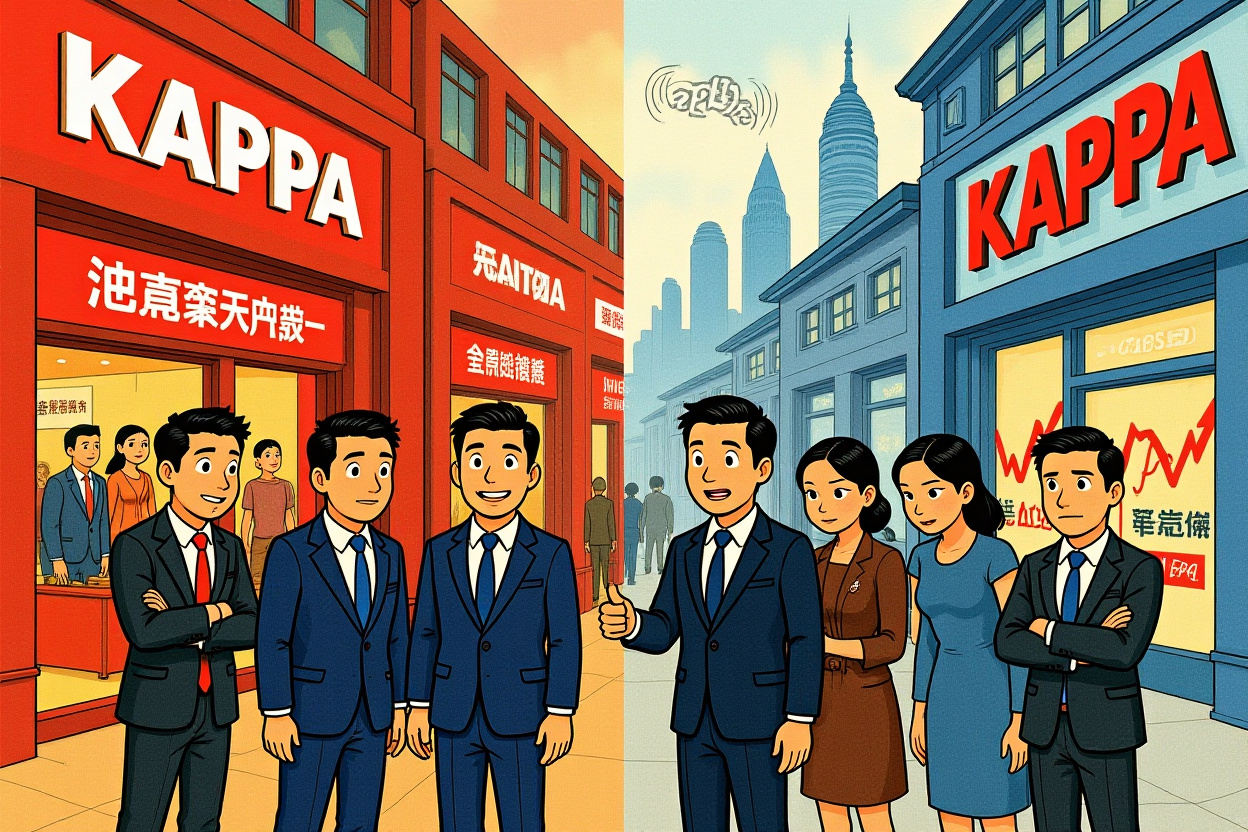
- Kappa’s peak annual sales reached 42.6 billion yuan with 3,751 stores, surpassing competitors like Anta and Li Ning, but now faces monthly losses exceeding 100 million yuan.
- Critical strategic errors include over-reliance on dealer networks, lack of supply chain control, and failure to innovate in product technology and brand positioning.
- The brand’s shift from fashion-forward to professional sports was poorly executed, leading to identity confusion and loss of market share.
- Investors should monitor companies with weak operational oversight and outdated business models in rapidly evolving consumer markets.
- Kappa’s parent company, China Dongxiang, resorted to selling trademarks to survive, highlighting deeper financial distress.
The Rise and Fall of an Iconic Brand
Remember the iconic ‘back-to-back’ logo? For millions of Chinese consumers, Kappa represented fashion-forward sportswear that once dominated shopping malls and street fashion. From its peak as China’s top sportswear brand to its current struggle with massive monthly losses, Kappa’s journey offers critical lessons for investors in Chinese equities. The brand’s dramatic Kappa’s strategic missteps serve as a cautionary tale in an industry where adaptation is key to survival.
From Italian Heritage to Chinese Takeover
Founded in Italy in 1916, Kappa built its reputation through sports sponsorships, including legendary football clubs like Juventus and AC Milan. The brand entered China in 2002 through a licensing agreement with Li Ning Company, but initial results were disappointing due to product designs that failed to resonate with local consumers. The turning point came in 2005 when Chen Yihong (陈义红) acquired the Chinese rights from Li Ning, transforming Kappa into what effectively became a domestic brand. Chen’s vision focused on filling the gap in fashionable sportswear, a move that would initially pay massive dividends.
The Perfect Storm of Success Factors
Chen Yihong (陈义红) implemented several innovative strategies that drove Kappa’s rapid ascent:
- Market Research: Teams were dispatched to nightlife venues to understand youth preferences, leading to bold color schemes and designs that stood out from competitors’ traditional offerings.
- Talent Acquisition: Recruited designer Hong Xuan (洪宣) from Korean Kappa with a 300,000 USD annual salary, significantly higher than executive compensation.
- Marketing Innovation: Expanded beyond athlete endorsements to include celebrities and lifestyle integration rather than straightforward advertisements.
- Dealer Incentives: Eliminated upfront payments for distributors while offering high commissions and performance bonuses, minimizing their inventory risk.
These strategies, combined with a 2006 bet with Morgan Stanley that brought 38 million USD in investment, propelled Kappa to IPO in 2007 with a market capitalization exceeding 20 billion USD. By 2010, the brand operated 3,751 stores with annual sales of 42.6 billion yuan, outperforming both Anta and Li Ning.
The Downward Spiral Begins
Following the 2008 Beijing Olympics, the Chinese sportswear market experienced a significant downturn as post-Olympic enthusiasm waned. Industry-wide inventory crises emerged, with six major companies holding 37.21 billion yuan in excess stock by 2012. Kappa’s inventory turnover days reached 54, well above industry averages, exposing fundamental weaknesses in its business model. While competitors like Anta and Li Ning successfully transitioned to direct retail operations, Kappa remained trapped in its outsourced approach, leading to the first major Kappa’s strategic missteps in operational control.
The Dealer Network Disaster
Kappa’s lightweight supply chain, once its greatest strength, became its Achilles’ heel. With only one internal factory in Jiangsu and production outsourced to approximately 100 suppliers, the company had limited control over quality and distribution. More critically, the dealer system backfired when:
- Dealers began cross-regional selling of goods without authorization
- Some outlets openly sold counterfeit products
- Quality control issues led to multiple administrative penalties
Store count plummeted from nearly 4,000 to just 1,000 as consumer trust eroded. The company’s failure to maintain brand integrity through its distribution channels represented one of the most damaging Kappa’s strategic missteps in retail management.
Competitive Pressures Intensify
Meanwhile, the sportswear landscape transformed dramatically. Global giants Nike and Adidas expanded aggressively in China, while international fashion sports brands like FILA, Champion, and New Balance entered the market. Domestic competitors successfully embraced trend-driven strategies, with Li Ning’s ‘China Chic’ movement particularly resonating with young consumers. The industry shifted toward technical innovation and frequent limited-edition releases, areas where Kappa lacked both the infrastructure and cultural relevance to compete effectively.
Failed Revival Attempts
Kappa’s management recognized the need for transformation but executed poorly conceived revival strategies. In 2016, the brand signed Korean superstar G-Dragon (权志龙) and introduced retro ‘string logo’ designs, generating brief social media buzz but minimal sales impact. A 2017 three-year reform plan promised channel, operational, and marketing upgrades, while 2018 saw a Paris Fashion Week collaboration with Japanese designer Kashiwa Kazuki (仓石一树). Unfortunately, these efforts were overshadowed by Li Ning’s spectacular ‘China Chic’ showcase at the same event, demonstrating another of Kappa’s strategic missteps in timing and execution.
Identity Crisis Deepens
By 2019, Kappa announced a formal shift to fashion positioning with four upgrade dimensions: product, digital operations, channel format, and youth marketing. The brand partnered with young idols like Huang Minghao, VAVA, and Curley Gao (希林娜依·高) to attract Generation Z consumers. However, these initiatives failed because:
- Product differentiation remained superficial without deeper consumer insight
- Color-based designs had become commonplace across the market
- Marketing failed to translate into distinctive product advantages
When consumer preferences shifted toward technical performance during the pandemic, Kappa attempted to return to professional sports by featuring national skateboard team members in advertisements and launching skate shoe collections. This positioning whipsaw confused consumers and highlighted the brand’s lack of consistent direction.
Innovation Deficit Becomes Critical
Kappa’s fundamental problem stemmed from its early decision to prioritize lightweight operations over research and development. While competitors invested heavily in technical fabrics, sustainable materials, and proprietary technologies, Kappa’s R&D spending remained minimal throughout its history. The brand found itself unable to compete with Nike and Adidas in the premium segment while losing the value battle against Anta and Li Ning in the mass market. This innovation gap represented perhaps the most fundamental of Kappa’s strategic missteps, leaving the brand without competitive moats in either fashion or performance categories.
Financial Consequences and Asset Liquidation
The financial deterioration has been severe and sustained. For the fiscal year ending March 2025, China Dongxiang reported revenues of 16.8 billion yuan, down 3.7% year-over-year, with continuing substantial losses. The company’s profitability metrics tell a grim story:
- 2022 fiscal year: 17.83 billion yuan loss
- 2024 fiscal year: 6.39 billion yuan loss
- 2025 fiscal year: Continued losses despite asset sales
With its core clothing business generating minimal profits, China Dongxiang became increasingly dependent on financial investments rather than operational improvements. The situation deteriorated to the point where trademark sales became necessary for survival, marking the ultimate manifestation of Kappa’s strategic missteps in brand management.
The Trademark Fire Sale
Desperate for liquidity, China Dongxiang embarked on a series of asset disposals:
- Sold Kappa Japan trademark and intellectual property assets
- Licensed Phenix brand rights in Japan, Korea, Australia, US and select European markets
- Granted 10-year exclusive Kappa Kids trademark rights to Quanzhou Pingbu Footwear Co., Ltd. (泉州平布鞋业有限公司)
These moves provided temporary financial relief but fundamentally undermined the brand’s long-term value. For investors, such trademark monetization typically signals deeper troubles than operational challenges alone. The company’s 2022 announcement regarding the Kids trademark sale particularly highlighted the extent of the financial pressure.
Comparative Performance Analysis
While Kappa struggled, competitors demonstrated more resilient business models. Anta Sports diversified through multi-brand strategy including FILA China, which generated 21.85 billion yuan in 2020 revenue alone. Li Ning’s focused ‘China Chic’ repositioning drove comparable store sales growth of 10-20% during the same period Kappa was contracting. The divergence highlights how Kappa’s strategic missteps in brand positioning and operational control created vulnerabilities that better-managed competitors avoided.
Investment Implications and Future Outlook
Kappa’s dramatic decline from market leader to distressed asset offers several critical lessons for investors in Chinese consumer brands. The brand’s failure illustrates the dangers of over-reliance on third-party distribution, lack of innovation investment, and inconsistent brand positioning. In China’s rapidly evolving retail environment, companies must balance operational efficiency with brand building and product development to maintain competitiveness.
Key Warning Signs for Investors
When evaluating Chinese consumer brands, investors should monitor:
- Dealer concentration and control mechanisms
- R&D investment as percentage of revenue
- Brand consistency across market cycles
- Inventory management efficiency
- Adaptability to consumer trend shifts
Kappa’s experience demonstrates how quickly competitive advantages can erode when these elements are neglected. The company’s Kappa’s strategic missteps in these areas provide a template for what to avoid when analyzing similar investments.
Path Forward for the Brand
While Kappa’s current situation appears dire, potential recovery paths exist. The brand retains some recognition value, particularly among older consumers who remember its heyday. A potential strategy could involve:
- Focusing on niche segments where heritage brands have advantage
- Partnering with strong operational partners for market re-entry
- Leveraging digital channels to rebuild direct consumer relationships
- Developing limited collaborations that capitalize on nostalgia trends
However, any turnaround would require significant investment and strategic clarity that has been notably absent in recent years. For now, Kappa serves as a case study in how market leadership can evaporate when companies fail to evolve with their consumers and industry.
Synthesizing the Kappa Experience
Kappa’s journey from industry leader to financial distress underscores the relentless pace of change in China’s consumer markets. The brand’s initial success through fashionable positioning and innovative distribution was ultimately undermined by operational weaknesses and strategic inconsistency. As Chinese sportswear continues its evolution toward technical innovation and brand authenticity, Kappa’s experience offers valuable insights for both operators and investors. The most successful companies will be those that balance creative marketing with operational excellence and continuous innovation. For market participants, maintaining vigilance regarding business model vulnerabilities remains essential in identifying sustainable investment opportunities in this dynamic sector.