



Executive Summary
Kao Jiang’s (烤匠) launch in Shanghai, marked by 13-hour queues and over 6,300 reservations, highlights a potent but risky marketing phenomenon in China’s consumer sector.
– The brand’s ‘northern expansion’ into Beijing and Shanghai has consistently leveraged extreme queuing data as a core marketing tool, fueling social media buzz and instant brand recognition.
– This strategy has spawned a secondary market with ticket scalpers (黄牛) charging premiums and exposing operational vulnerabilities in crowd management and consumer fairness.
– Early consumer feedback indicates a significant gap between inflated expectations from long waits and the actual dining experience, risking口碑 (word-of-mouth) erosion.
– The case mirrors broader trends in China’s ‘first-store economy’ and网红餐饮 (internet-famous dining), where brands face the critical challenge of transitioning from short-term流量 (traffic) to sustainable loyalty and复购率 (repurchase rate).
– For market observers and investors, Kao Jiang’s trajectory offers key lessons on evaluating the durability of consumer brands beyond initial hype cycles.
The Anatomy of a Dining Frenzy: Kao Jiang’s Record-Breaking Queues
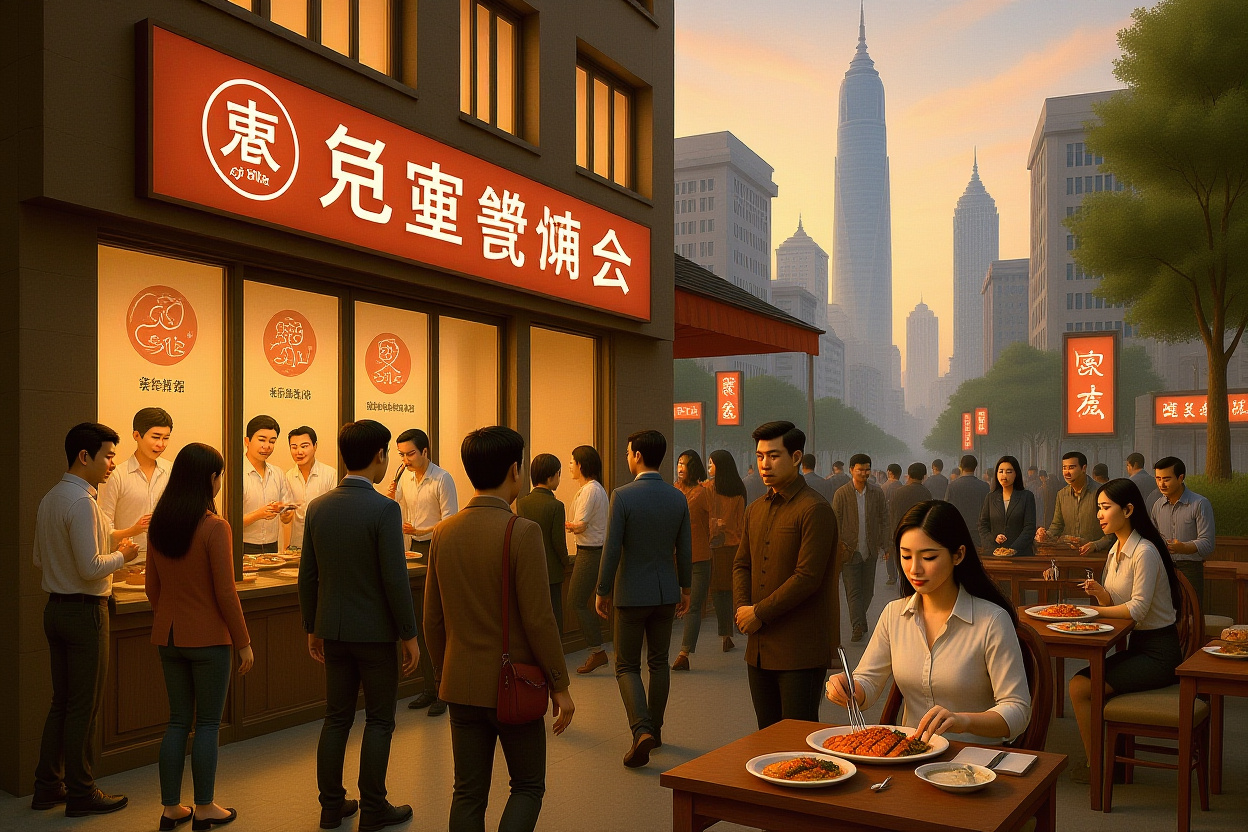
The recent debut of Sichuan-Chongqing grilled fish brand Kao Jiang in Shanghai wasn’t just a restaurant opening; it was a spectacle. Patrons reported wait times soaring to 13 hours, with over 6,300 tables booked on the first day and thousands still queuing past midnight. This isn’t an isolated event. Kao Jiang’s marketing phenomenon has become a carefully curated part of its brand identity during its ‘northern expansion’ into Beijing and Shanghai.
Data-Driven Hype: Beijing Precedents and Shanghai Peak
Every step of Kao Jiang’s expansion has been quantified by staggering queue metrics. When it entered Beijing in 2024, promotional materials highlighted continuous customer flow from 10 a.m. to midnight without discounts. Its second Beijing store boasted 450 reservations in one hour and an average wait of 6.5 hours. The Shanghai launch has shattered these records, creating a viral loop where the queue itself becomes the story. This Kao Jiang marketing phenomenon is engineered, relying on pre-launch campaigns involving social media teasers, celebrity endorsements like川渝品鉴官 (Sichuan-Chongqing tasting ambassador) Zhang Yanqi (张颜齐), and trial tastings to seed demand.
The Social Media Amplifier and Consumer Psychology
Platforms like Xiaohongshu (小红书) are flooded with user experiences. Posts detail waits of 7.6 hours and express a mix of dedication and dismay. The psychology at play is powerful: the sunk cost of time invested in line often pressures consumers to see it through, even if their initial interest was casual. As one Beijing mall security guard observed, many weren’t initially there for Kao Jiang but joined the queue out of curiosity, only to become trapped by their own commitment. This aspect of the Kao Jiang marketing phenomenon demonstrates how visibility can create its own gravity, but one that may not correlate with genuine product appeal.
The Dark Side of Demand: Scalpers, Service Gaps, and Rising Expectations
While long lines signal popularity, they also introduce significant operational and reputational risks. The Kao Jiang marketing phenomenon has inadvertently fueled a灰色产业 (grey industry) that threatens brand integrity and customer satisfaction.
Ticket Scalpers and System Vulnerabilities
Following the Beijing launch, reservation tickets were reportedly scalped for up to 300 RMB. In Shanghai, ‘runner’ services emerged where people could pay 16 RMB to have someone queue for them. Despite brand claims of implementing countermeasures, consumers complain that verification processes for代排队 (proxy queuing) are rudimentary and easily exploited. The ‘Hei Jin Jiang’ (黑金匠) priority membership program has also faced criticism for loopholes that undermine fair access. These issues highlight a core weakness in hype-centric models: when demand is artificially inflated or manipulated, it can corrode trust.
The Expectation-Reality Gap and Early口碑 (Word-of-Mouth) Signals
The enormous time investment dramatically heightens consumer expectations. Early reviews suggest Kao Jiang is struggling to meet them. Feedback on social media and third-party complaint platforms includes descriptions of the signature grilled fish as ‘too salty and oily’ and overall meals as ‘mediocre.’ One diner who waited 7.5 hours concluded the restaurant’s primary function was to ‘provide emotional value’ for social media打卡 (check-ins), not culinary excellence, and stated they would not return for the food alone. This divergence between hype and experience is a critical pressure point for the Kao Jiang marketing phenomenon. If not managed, it can lead to rapid sentiment reversal.
Beyond the Hype Cycle: The Sustainable Growth Challenge
The fundamental question for Kao Jiang, and for investors analyzing similar consumer plays, is whether this marketing phenomenon can evolve into a sustainable business model. History in China’s fiercely competitive餐饮行业 (food and beverage sector) is littered with brands that flared brightly but faded fast.
Case Study: The Rise and Plateau of Tai Er Suan Cai Yu (太二酸菜鱼)
A poignant parallel is Tai Er Suan Cai Yu, which once commanded similar queues with its single-focused menu, cartoonish decor, and quirky house rules. Its热度 (heat) has significantly cooled. Facing market saturation and evolving tastes, the brand has had to expand its menu beyond酸菜鱼 (sour cabbage fish). Notably, in 2025, its total store count saw a net decrease of 135 locations. This trajectory illustrates a common arc: meteoric rise on differentiation and marketing, followed by a ‘traffic backlash’ phase where high expectations meet mundane reality, ultimately requiring a difficult pivot to brand substance.
Founder’s Vision and Inherent Dependencies
Kao Jiang’s approach is deeply influenced by its founder, Leng Yanjun (冷艳君). With a background in television advertising, Leng transitioned to餐饮 (F&B). Public records note that the first Chengdu store struggled until shortcomings in ‘store design’ and ‘brand marketing’ were addressed. This heritage underscores a foundational reliance on marketing prowess over pure culinary innovation. The Kao Jiang marketing phenomenon is thus a deliberate strategy, not an accident. However, this dependency becomes a vulnerability when consumer curiosity wanes and the brand must compete on product consistency, innovation, and operational excellence alone.
Market Implications: Reading the Queues for Investment Signals
For institutional investors and analysts focused on Chinese consumer equities, phenomena like Kao Jiang’s offer more than a cultural curiosity; they provide real-time data points on market sentiment, brand resilience, and operational risk.
Evaluating ‘First-Store Economy’ and网红 (Internet-Famous) Brand Valuations
The ‘首店经济’ (first-store economy) strategy, where cities compete to host exclusive brand debuts, creates temporary monopolies on novelty. Brands like Kao Jiang capitalize on young consumers’ desire for novelty and social currency. Investors must discern whether impressive launch metrics translate into comparable same-store sales growth and regional expansion viability. The Kao Jiang marketing phenomenon tests whether流量 (traffic) can be monetized beyond the initial burst. Key metrics to watch include customer复购率 (repurchase rate), average spend per customer post-hype, and the speed of口碑 (word-of-mouth) normalization across multiple locations.
Operational and Regulatory Risks in High-Visibility Launches
The chaos surrounding queue management and scalping presents tangible risks. Poor crowd control can lead to safety incidents, attracting scrutiny from local commerce bureaus like the上海市市场监督管理局 (Shanghai Administration for Market Regulation). Consumer complaints about unfair practices could prompt regulatory intervention. Furthermore, the immense pressure on kitchen and service staff during perpetual peak times can lead to quality inconsistencies, damaging the brand’s core value proposition. For investors, these are not merely PR issues but factors that can impact operational costs, legal liabilities, and ultimately, valuation multiples.
Navigating the Future: From Spectacle to Substance
The Kao Jiang marketing phenomenon presents a clear dichotomy: spectacular short-term success versus uncertain long-term prospects. The brand currently enjoys unprecedented awareness, but the path to longevity requires mastering a difficult transition.
The most critical task is bridging the gap between marketing promise and everyday delivery. This means investing heavily in supply chain consistency, staff training, and continuous menu innovation to ensure that the product justifies the wait, even when the queues inevitably shorten. Secondly, Kao Jiang must develop a more sophisticated customer relationship strategy that builds loyalty beyond the initial打卡 (check-in). This could involve robust membership programs, community engagement, and personalized marketing that rewards repeat visits.
For the investment community, the lesson is to look beyond the headline queue numbers. Scrutinize unit economics, customer satisfaction scores over time, and the brand’s agility in adapting its model. The true test of the Kao Jiang marketing phenomenon will be its performance in the quarters following the launch frenzy, when it operates in a normalized competitive environment. Brands that survive this phase do so by embedding quality and experience into their DNA, ensuring that when the novelty fades, a solid foundation of consumer trust remains.
As China’s consumer market continues to evolve, discerning between fleeting trends and enduring brands will be paramount. Monitor Kao Jiang’s next moves closely—its ability to evolve from a排队王 (queue king) into a staple will serve as a key case study in sustainable brand building for years to come.