



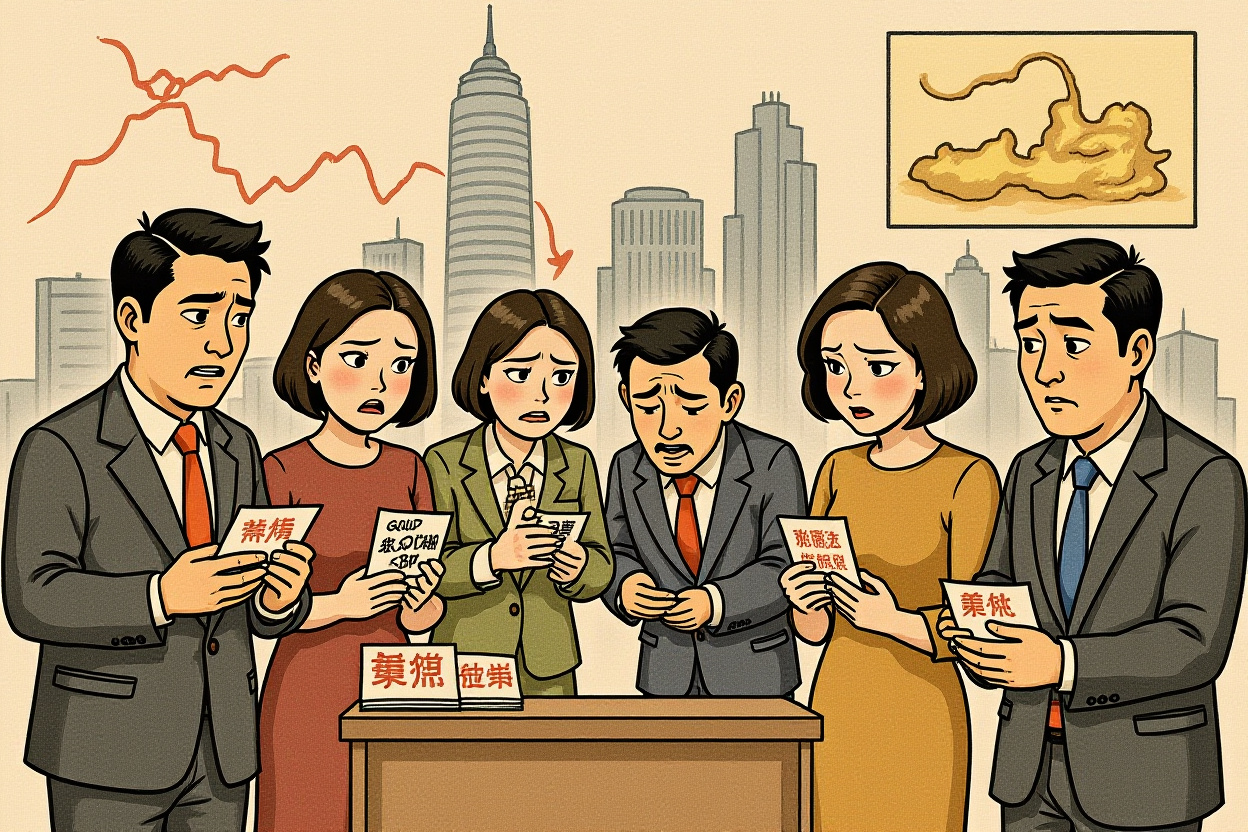
Summary of Key Takeaways
As the dust settles on one of China’s most startling financial disappearances, several critical points emerge for investors and market watchers:
– The Jinyafu (金雅福) gold investment scandal has resulted in an estimated 7-8 billion yuan in defaults, equivalent to approximately 8,000 kilograms of gold at current prices, highlighting severe risks in alternative wealth management products.
– Investors were drawn to schemes promising over 10% annualized returns through “gold entrustment” and private equity funds, but these products lacked transparency and regulatory compliance, with funds potentially diverted to real estate ventures.
– The company’s liquidity crisis was exacerbated by a massive urban redevelopment project in Sanshou Village, Foshan, where 250 million yuan in demolition funds were defaulted, revealing intertwined financial vulnerabilities.
– Regulatory authorities, including the Shenzhen Financial Office (深圳金融办), have intervened, underscoring ongoing gaps in oversight for non-bank financial activities in China’s equity markets.
– This case serves as a stark reminder for global investors to conduct rigorous due diligence on Chinese corporate entities, especially those offering high-yield products tied to physical assets like gold.
A Golden Mirage Turns to Dust
While global gold prices scale unprecedented heights, a sinister counterpart has emerged in China’s financial landscape: the sudden evaporation of Jinyafu (金雅福), a revered Top 500 Chinese enterprise. This gold investment scandal has not only wiped out billions in investor funds but also exposed the fragile foundations of seemingly robust corporate giants. In recent weeks, social media platforms have been flooded with distress calls from individuals who purchased Jinyafu’s gold-backed wealth management products, only to face indefinite redemption delays. What began as a promising venture in precious metals has unraveled into a classic case of corporate disappearance, leaving behind empty offices, shuttered museums, and a trail of financial ruin.
The scale of this gold investment scandal is staggering, with estimates pointing to 7-8 billion yuan in unmet obligations. At current market rates, this translates to roughly 8,000 kilograms of gold—a fortune that has ostensibly vanished into thin air. Jinyafu’s operations, spanning gold jewelry creation, manufacturing, retail, recycling, and refining, once generated 56.1 billion yuan in revenue in 2024, earning it a spot among China’s elite corporate ranks. Its founder, Huang Shikun (黄仕坤), was reportedly worth over 9 billion yuan, adding to the allure of stability. However, beneath this glittering facade, liquidity strains had been brewing for months, culminating in a collapse that has sent shockwaves through China’s financial community.
The Vanishing Act: From Flagship Stores to Ghost Offices
Investors seeking answers have encountered a haunting reality: Jinyafu’s online official flagship store has ceased operations, its headquarters building in Shenzhen stands deserted, and landlords confirm the company’s withdrawal. A subsidiary posted a notice of office relocation, but the new address remains uninhabited, while Jinyafu’s黄金珠宝博物馆 (Gold Jewelry Museum) sits locked, with exhibits largely removed. In essence, the company has executed a “people gone, building empty” maneuver, with Huang Shikun (黄仕坤) whereabouts unknown, though senior executives are believed to remain within China. This abrupt disappearance underscores the opacity that often plagues China’s alternative investment sector, where regulatory oversight can lag behind innovation.
Prior to the collapse, Jinyafu projected an image of growth and technological prowess. In June 2024, despite early redemption delays, the company launched “smart gold shops” and gimmicks like “gold AI robots” and “gold ATMs,” while Huang Shikun (黄仕坤) spent 1 billion Hong Kong dollars to acquire a Hong Kong-listed firm, rebranded as Shangshan Gold (上善黄金). These moves, coupled with its status as a supplier to 300 banks, reassured many investors, leading to substantial commitments—including one individual who mortgaged their home to invest over 7 million yuan. Now, those funds are trapped in what may become one of China’s most infamous financial scandals.
Deconstructing the Gold Investment Schemes
At the heart of the Jinyafu gold investment scandal lie two primary mechanisms: “gold entrustment” and private equity funds, both promising double-digit returns that ultimately proved unsustainable. These products exemplify the high-risk, high-reward culture that can permeate China’s wealth management landscape, often bypassing traditional banking safeguards. As investors grapple with losses, understanding these structures is crucial for assessing broader market vulnerabilities and regulatory responses.
The “Gold Entrustment” Illusion
Jinyafu’s “gold entrustment” business operated on a deceptively simple premise: investors would sign a “gold sales contract” with the company, technically purchasing gold but not taking physical delivery. Instead, the gold was entrusted to a第三方 (third-party) company—later revealed to be a Jinyafu affiliate, with legal representatives even being company employees—for sale through “cultural gold channels.” During the entrustment period, investors were guaranteed annualized returns exceeding 10%, with options to redeem physical gold and profits or cash out at prevailing market prices upon maturity. In practice, few participants ever saw the underlying gold, highlighting the scheme’s reliance on financial engineering rather than tangible asset backing.
This model raised immediate red flags, as selling gold alone cannot consistently generate such high yields. According to public records, the Shenzhen Financial Office (深圳金融办) issued risk warnings about similar products, noting their potential for misuse and lack of transparency. For Jinyafu, the “gold entrustment” operations likely functioned as a shadow financing tool, with funds possibly diverted to other ventures, including real estate. This gold investment scandal thus mirrors broader trends in China where commodity-backed products are repurposed for speculative ends, often evading strict regulatory scrutiny.
Private Equity Funds and Regulatory Arbitrage
Complementing the gold schemes, Jinyafu offered private equity funds focused on gold recycling and company equity, again touting returns above 10%. These products were marketed as “no-loss” investments, bolstered by implicit buyback guarantees from Jinyafu, effectively transforming limited partnerships into “明股实债” (debt in equity’s clothing). However, private equity in China requires “合格投资者” (qualified investors), with stringent criteria: minimum single investments of 1 million yuan, net assets of 10 million yuan, financial assets of 3 million yuan, or annual income of 500,000 yuan. To circumvent these rules, Jinyafu facilitated “pooling” arrangements, where one qualified investor fronted for multiple contributors through代持协议 (nominee agreements).
This practice introduced severe risks, including questions about whether the funds were properly registered with authorities, where capital was actually deployed, and if资金池 (fund pools) were used to mask liquidity shortfalls. The Shenzhen authorities have now介入 (intervened), launching investigations into these aspects, as highlighted in their recent announcements. For global investors, this gold investment scandal underscores the perils of regulatory gaps in China’s private equity space, where oversight often struggles to keep pace with innovative—and sometimes fraudulent—structures.
The Real Estate Connection: A Tangled Web of Finance
Beyond gold, Jinyafu’s troubles were deeply rooted in real estate, revealing how cross-sector investments can amplify financial instability. The company’s foray into urban redevelopment through subsidiaries Jinfurong (金福荣) and Jinfusheng (金福盛)—both 55%-owned by Jinyafu, according to Tianyancha (天眼查) data—proved a catalyst for its downfall. This dimension of the gold investment scandal illustrates the interconnectedness of China’s corporate ecosystems, where diversification into property can backfire amid market downturns.
The Sanshou Village Project: Ambition Meets Reality
In 2022, Jinfurong won a “giant”旧改 (urban renewal) project in Sanshou Village,伦教街 (Lunjiao Street),顺德 (Shunde),佛山 (Foshan), with Jinfusheng acquiring adjacent land for a “黄金珠宝生态城” (Gold Jewelry Ecological City). The project demanded a total investment of 30 billion yuan, including 1.67 billion yuan for demolition compensation and 100,000+ square meters of commercial property返 (returned) to the village. Such scale typically requires trillion-yuan级 (level) developers, but Jinyafu leveraged its Top 500 reputation to position itself as a credible investor, promising lucrative returns from residential and commercial plots along the riverfront.
However, by June 2024, after paying over 900 million yuan, Jinyafu defaulted on a 250 million yuan二期 (second-phase) demolition payment. The developer promised deferred payment by year-end, with附加 (additional) 6.87 million yuan in “interest” and 6.95 million yuan in “dividends” as compensation. With real estate markets slumping and gold operations failing to反哺 (replenish) property ventures, Jinyafu’s liquidity crumbled. Sanshou Village officials, still owed 750 million yuan and 100,000 square meters of commercial space, hesitated to pursue legal action for fear of Jinyafu exiting the project entirely—a cautionary tale of how local economies can become entangled with corporate malfeasance.
Fund Flows and Fallout
Investigators suspect that a significant portion of the defaulted wealth management funds flowed into this real estate endeavor, blurring lines between investment products and corporate financing. The village, however, had safeguarded itself by not transferring any land to Jinfurong, and the 900 million yuan already paid covered demolished structures, minimizing local losses. Nonetheless, the remaining compensation and promised properties are now in jeopardy, exacerbating the gold investment scandal’s ripple effects. This case highlights a common pitfall in China: companies using short-term, high-yield products to fund long-term, capital-intensive projects, creating maturity mismatches that can trigger systemic failures.
Regulatory Response and Market Implications
The Jinyafu gold investment scandal has prompted swift action from Chinese regulators, signaling a tightening oversight environment that could reshape investment norms. As the Shenzhen Financial Office (深圳金融办) leads probes into Jinyafu’s activities, broader questions arise about the resilience of China’s financial markets and the responsibilities of institutional investors. For global professionals, understanding these dynamics is key to navigating the complexities of Chinese equities.
Authorities Step In
深圳方面 (Shenzhen authorities) have公开 (publicly)介入 (intervened), focusing on whether Jinyafu’s private equity funds were properly备案 (registered), the actual use of investor capital, and the existence of unauthorized资金池 (fund pools). These inquiries align with China’s broader crackdown on financial risks, as seen in recent guidelines from the People’s Bank of China (中国人民银行) and the China Securities Regulatory Commission (中国证券监督管理委员会). The gold investment scandal may accelerate regulatory reforms, such as stricter disclosure requirements for commodity-backed products and enhanced scrutiny of cross-industry investments. Investors should monitor official channels for updates, as outcomes could set precedents for similar cases nationwide.
Broader Risks for Chinese Equities
This incident underscores latent vulnerabilities in China’s corporate sector, where prestigious rankings like “Top 500 Enterprises” can mask underlying weaknesses. For international fund managers and executives, it emphasizes the need for enhanced due diligence, particularly when evaluating companies with diversified operations in high-risk areas like alternative finance and real estate. The gold investment scandal also reflects broader trends of rising defaults in China’s shadow banking system, which could pressure equity valuations if confidence erodes. Data from sources like the National Bureau of Statistics (国家统计局) show that private investment growth has slowed, partly due to such scandals, suggesting a cautious approach may be warranted.
Lessons for Global Investors
The collapse of Jinyafu offers invaluable insights for anyone engaged with Chinese markets, from institutional investors to corporate strategists. By dissecting this gold investment scandal, stakeholders can refine their risk assessment frameworks and advocate for greater transparency, ultimately fostering more resilient investment practices.
Due Diligence Imperatives
First, investors must look beyond surface metrics like revenue rankings and delve into the substance of business models. For Jinyafu, the reliance on off-balance-sheet vehicles and关联企业 (related-party transactions) should have raised alarms. Tools such as equity research reports from firms like China International Capital Corporation Limited (中金公司) can provide deeper analysis, but independent verification remains crucial. Second, understanding regulatory landscapes is essential; products like “gold entrustment” often operate in gray areas, requiring scrutiny of local financial office directives. This gold investment scandal serves as a reminder that high returns in China often correlate with elevated risks, necessitating a balanced portfolio approach.
The Future of Alternative Investments
Moving forward, the gold investment scandal may dampen appetite for non-traditional wealth management products, pushing capital toward more regulated avenues like stock markets or bonds. However, innovation in fintech and asset-backed securities could fill the void, provided regulators enforce robust standards. For investors, diversifying across sectors and geographies while maintaining liquidity buffers can mitigate exposure to similar shocks. As China’s economy evolves, staying informed through reputable news sources and industry forums will be vital for capitalizing on opportunities while avoiding pitfalls.
Navigating the Aftermath
In summary, the Jinyafu gold investment scandal reveals profound flaws in China’s financial ecosystem, where corporate prestige, speculative ventures, and regulatory lapses can converge into catastrophic losses. The disappearance of 7-8 billion yuan in funds—tied to both gold and real estate—highlights the urgent need for enhanced oversight and investor education. As authorities investigate, the case will likely influence policy discussions on wealth management product reforms and corporate governance standards.
For global business professionals, this episode underscores the importance of vigilance when engaging with Chinese equities. By prioritizing transparency, conducting thorough due diligence, and advocating for stronger regulatory frameworks, investors can better protect their interests. As the gold investment scandal unfolds, staying updated on developments via trusted financial news platforms will be crucial. Let this be a call to action: scrutinize high-yield promises, demand clarity on asset backing, and collaborate to foster a more secure investment landscape in China’s dynamic markets.