



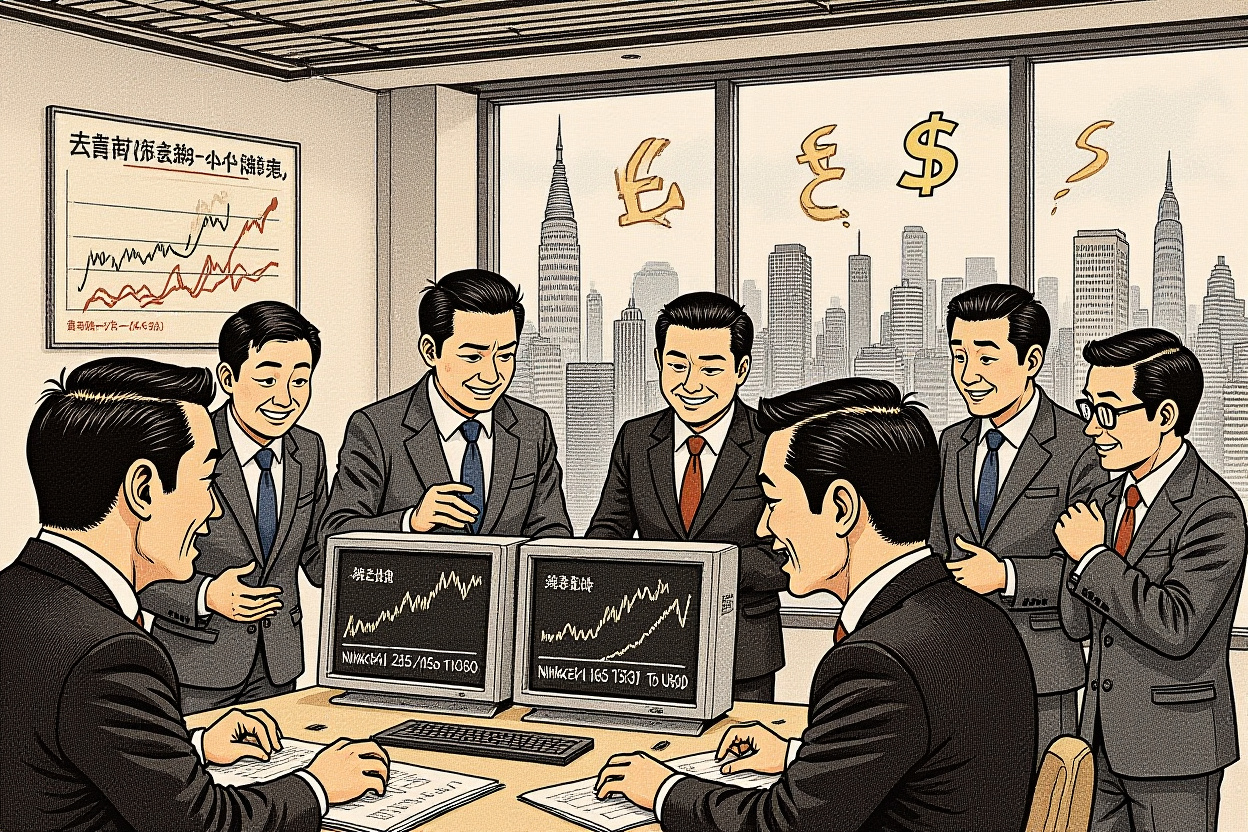
The Japanese stock market is celebrating a historic rally, but beneath the surface, a storm may be brewing in bonds and currency markets. With the Nikkei 225 Index soaring 5% this week following Takagi Sanae’s (高市早苗) electoral victory, investors are grappling with a critical question: is the so-called ‘Takagi trade’ a fleeting opportunity or a dangerous trap? This disconnect between equity joy and relative calm in debt and forex underscores deep-seated anxieties about Japan’s fiscal path and its implications for global portfolios. As markets oscillate between optimism and caution, understanding the nuances of this ‘Takagi trade’ becomes paramount for sophisticated investors navigating Asian equities.
Executive Summary: Key Takeaways from Japan’s Market Crossroads
– The ‘Takagi trade’ refers to the market rally driven by expectations of fiscal stimulus under Prime Minister Takagi Sanae (高市早苗), but it masks significant risks in Japan’s bond and currency markets.
– A sharp disconnect exists: stocks hit record highs while Japanese Government Bonds (JGBs) and the yen show unusual calm, suggesting investor skepticism about the sustainability of fiscal expansion.
– Core risks include potential yen depreciation to 160 against the dollar, which could spur inflation and force the Bank of Japan (日本銀行) into a policy dilemma, balancing government spending with monetary normalization.
– Japan’s public debt, at 237% of GDP per the International Monetary Fund (IMF), raises feasibility concerns over Takagi’s promises, such as a two-year food消费税 (consumption tax) cut without new bond issuance.
– Market views are deeply divided: domestic investors may be complacent due to high JGB ownership, but foreign investors, dominating derivatives, signal alarm that could precipitate a crisis if warnings are ignored.
The Market Disconnect: Equity Euphoria vs. Debt and Forex Calm
Japan’s stock markets are in a state of euphoria, with the Nikkei 225 Index climbing 5% this week to consecutive all-time highs. This surge, dubbed the ‘Takagi trade’ by traders, stems from renewed optimism after Takagi Sanae (高市早苗) secured a solid majority in the lower house, empowering her to advance a fiscal agenda aimed at tackling cost-of-living issues. Investors are betting that her proposed 1350亿美元 (USD 135 billion) spending package will spur economic growth, buoying corporate earnings and equity valuations. However, this narrative overlooks a critical anomaly: the bond and currency markets, which typically react sharply to fiscal news, have displayed a puzzling tranquility post-election.
Post-Election Stock Rally and Its Drivers
The ‘Takagi trade’ is fueled by expectations of aggressive government spending. During the campaign, Takagi Sanae (高市早苗) pledged to suspend the food消费税 (consumption tax) for two years, a move estimated to cost 5万亿日元 (JPY 5 trillion or approximately USD 32 billion). This promise, coupled with broader fiscal stimulus, has driven risk-on sentiment in equities. Data from the Tokyo Stock Exchange shows increased foreign inflows into Japanese stocks, with sectors like consumer discretionary and industrials leading gains. For instance, companies like Toyota Motor Corporation (丰田汽车公司) and Sony Group (索尼集团) have seen significant upticks, reflecting hopes for domestic demand revival. Yet, this optimism is not mirrored in other asset classes, raising red flags about the durability of the ‘Takagi trade’.
Unsettling Calm in Bonds and the Yen: A Prelude to Volatility?
In contrast to equities, the Japanese Government Bond (JGB) market has shown relative stability, with the 40-year yield retreating from pre-election highs above 4%. Similarly, the yen has hovered around 153 per dollar, a level that officials deem manageable despite prior fears of sharp depreciation. A Tokyo-based trader, who requested anonymity, warns: ‘We should view this as a temporary phenomenon. The core issue is how she will pay for these promises. This isn’t a honeymoon; it’s more like the calm before the storm.’ This divergence suggests that some investors believe Takagi Sanae (高市早苗) will exercise restraint in implementing her plans, but history shows that such political mandates often lead to expansive fiscal actions. The ‘Takagi trade’ thus hinges on a delicate balance between stimulus and sustainability.
Understanding the ‘Takagi Trade’: Opportunity or Trap?
The term ‘Takagi trade’ encapsulates the market’s bet on Japan’s fiscal expansion under its new leadership. On one hand, it presents an opportunity for equity gains driven by government spending and potential economic rejuvenation. On the other, it risks morphing into a trap if fiscal overreach triggers currency devaluation, inflation, and debt crises. For global investors, deciphering this ‘Takagi trade’ requires a nuanced analysis of political commitments and market mechanics. The current rally may offer short-term profits, but the long-term implications could be severe if risks materialize, making the ‘Takagi trade’ a double-edged sword in portfolio strategies.
The Promise of Fiscal Stimulus and Market Optimism
Takagi Sanae’s (高市早苗) electoral platform centered on addressing Japan’s stagnant wages and rising living costs, resonating with voters and sparking market optimism. Her proposed fiscal package, including infrastructure investments and tax cuts, aims to boost GDP growth, which has languished below 1% annually. Proponents argue that this ‘Takagi trade’ could revitalize Japan’s economy, similar to past Abenomics rallies. For example, increased public spending might lift sectors like construction and retail, benefiting stocks such as Kajima Corporation (鹿岛建设) and Seven & i Holdings (柒和伊控股). However, this optimism assumes that stimulus will be funded responsibly, a claim Takagi has made by vowing not to issue new bonds for tax cuts—a pledge met with widespread skepticism.
Market Skepticism and the Core Risks of the ‘Takagi Trade’
Despite the stock market cheer, analysts warn that the ‘Takagi trade’ is fraught with perils. Benjamin Shatil, senior economist at JPMorgan Chase & Co., notes: ‘Given the scale of her mandate, how can she realistically withdraw such promises? Unlike other prime ministers, she cannot use parliamentary resistance as an excuse.’ The primary risk is that expansive fiscal spending, if unfunded, could weaken the yen further, importing inflation via costlier energy and food imports. This could erode consumer purchasing power and corporate margins, ultimately undermining equity performance. Moreover, the ‘Takagi trade’ ignores Japan’s structural challenges, such as an aging population and low productivity, which require more than short-term stimulus. Investors engaging in this ‘Takagi trade’ must weigh these risks against potential rewards.
The Yen Dilemma and Central Bank Constraints
Japan’s currency and monetary policy are at the heart of the ‘Takagi trade’ debate. The yen’s vulnerability to fiscal expansion poses a significant threat, as depreciation could trigger a vicious cycle of inflation and economic instability. Darren Tay, head of Asia-Pacific Country Risk at BMI, highlights the ‘Takagi trap’: higher government spending elevates the risk of currency devaluation. With the yen trading near 153 per dollar, officials like Finance Minister Katayama Satsuki (片山皋月) have issued verbal warnings about possible intervention, but market forces may overpower such efforts. This puts the Bank of Japan (日本銀行) in a precarious position, caught between supporting growth and containing currency-driven inflation.
Currency Depreciation Risks and Intervention Scenarios
The yen has already weakened substantially over the past year, and further declines could exacerbate Japan’s import bills. Osamu Takashima, forex strategist at Citigroup, suggests that government intervention is likely if the yen rebounds to 160 per dollar. Such a move would involve selling dollars and buying yen, but as one trader quipped, ‘Any intervention under these conditions would amount to a temporary subsidy for short-sellers.’ This is because if the Bank of Japan (日本銀行) maintains its ultra-loose monetary policy while the Ministry of Finance intervenes, the fundamental drivers of yen weakness—like interest rate differentials with the US—remain intact. For investors, the ‘Takagi trade’ must account for potential currency volatility that could wipe out equity gains.
Bank of Japan’s Policy Quandary in the ‘Takagi Trade’ Era
The Bank of Japan (日本銀行) faces mounting pressure to normalize policy after years of negative interest rates and yield curve control. Market expectations point to at least two rate hikes by 2026, but the ‘Takagi trade’ could delay this timeline. If the government ramps up spending, the central bank may feel compelled to keep rates low to accommodate fiscal stimulus, risking inflation overshoots. Conversely, hiking rates too soon could strengthen the yen, dampening export competitiveness and growth. Governor Ueda Kazuo (植田和男) has emphasized a data-dependent approach, but political influences cannot be ignored. This dilemma underscores why the ‘Takagi trade’ is not just an equity story but a broader macro bet on Japan’s policy coordination.
Fiscal Feasibility and Mounting Debt Concerns
At the core of the ‘Takagi trade’ skepticism lies Japan’s colossal public debt, which the IMF estimates at 237% of GDP—the highest among developed nations. Takagi Sanae’s (高市早苗) promise to fund tax cuts without new bond issuance appears increasingly untenable, given the scale of her commitments. Analysts question how she can reconcile populist pledges with fiscal discipline, especially when global bond markets are sensitive to debt sustainability. The ‘Takagi trade’ thus hinges on a fragile assumption: that Japan’s domestic ownership of debt insulates it from market pressures, but history shows that investor sentiment can shift rapidly, as seen in past emerging market crises.
Analysts’ Doubts on Fiscal Promises and Market Realities
In her post-election press conference, Takagi Sanae (高市早苗) sought to calm markets by stating that her消费税 (consumption tax) cut plan would not involve new bond issuance, relying instead on existing revenues and efficiency gains. However, economists remain unconvinced. Shusuke Yamada, head of Japan forex and rates strategy at Bank of America, argues: ‘The election did not change the structural drivers of yen weakness. Companies and investors will continue to seek returns outside aging, slow-growing Japan.’ He emphasizes that reversing yen carry trades requires ‘years’ of evidence that Japan is a better investment destination. This skepticism challenges the viability of the ‘Takagi trade’, as fiscal overreach could trigger a loss of confidence among both domestic and foreign investors.
Japan’s Public Debt: A Ticking Time Bomb?
Japan’s debt burden is often cited as a key risk in the ‘Takagi trade’. According to IMF data, gross public debt exceeds 237% of GDP, though net debt is lower due to government assets. Nicholas Smith, analyst at CLSA, notes that foreign investors hold only 6.6% of JGBs but account for 71% of futures trading, suggesting that external perceptions may drive market volatility more than domestic holdings. He contends that foreign investors ‘have no skin in the game, and all signs indicate they don’t truly understand this market.’ However, Takahide Kiuchi, economist at Nomura Research Institute, warns: ‘I have never experienced such a sharp rise in long-term yields as before the election.’ He urges the government to heed these signals to avoid a crisis. For participants in the ‘Takagi trade’, debt dynamics are a critical factor that could unravel the rally.
Divergent Market Views and Investment Implications
The ‘Takagi trade’ has exposed a stark divide in market sentiment. Domestic investors, who hold the majority of JGBs, may exhibit complacency, believing Japan’s debt is manageable due to home bias and the Bank of Japan’s (日本銀行) backstop. In contrast, foreign investors, through derivatives and equity positions, are more vocal about risks, as seen in pre-election bond sell-offs. This divergence creates opportunities and pitfalls for global fund managers. Understanding these perspectives is essential for navigating the ‘Takagi trade’, as missteps could lead to significant portfolio losses if market calm gives way to turmoil.
Foreign vs. Domestic Investor Perspectives on the ‘Takagi Trade’
Foreign investors often view Japan through a lens of global benchmarks, focusing on currency risks and debt sustainability. Their dominance in futures markets means they can amplify volatility, as evidenced by the spike in JGB yields last year. Darren Tay of BMI cautions that the perception of Japan’s debt being domestically held ‘may give the government a dangerous sense of insulation,’ leading it to ignore warning signs from global bond markets. On the other hand, domestic institutions like Japan Post Bank and life insurers are steady holders, providing stability but also potentially masking underlying stresses. For those evaluating the ‘Takagi trade’, this split necessitates a balanced approach, monitoring both local sentiment and international flows.
Forward-Looking Scenarios for Global Investors
As the ‘Takagi trade’ unfolds, investors should prepare for multiple scenarios. In an optimistic case, Takagi Sanae (高市早苗) implements measured fiscal stimulus that boosts growth without destabilizing debt or currency markets, sustaining equity gains. In a pessimistic scenario, excessive spending triggers yen depreciation to 160, forcing aggressive BOJ intervention or rate hikes that spark market corrections. Practical steps for investors include:
– Diversifying currency exposure through hedged equity ETFs or options strategies to mitigate yen risk.
– Monitoring key indicators such as JGB yield curves, inflation data from the Statistics Bureau of Japan (统计局), and intervention signals from the Ministry of Finance (财务省).
– Consulting research from firms like Morgan Stanley MUFG Securities or Daiwa Securities for on-the-ground insights into the ‘Takagi trade’.
– Considering allocations to sectors less sensitive to currency swings, such as technology exporters, while avoiding overexposure to domestic-centric stocks.
Synthesizing the ‘Takagi Trade’: Navigating Risks and Rewards
The ‘Takagi trade’ represents a pivotal moment for Japanese markets, blending opportunity with profound risk. While equity rallies offer short-term gains, the underlying fissures in bonds and forex demand cautious optimism. Investors must recognize that market calm may be fleeting, and the true test will come as Takagi Sanae (高市早苗) translates campaign rhetoric into policy action. Key takeaways include the importance of currency hedging, vigilance on debt metrics, and a nuanced understanding of political dynamics. As global capital flows pivot, the ‘Takagi trade’ could define Japan’s economic trajectory for years to come—making informed decisions critical for portfolio resilience. To stay ahead, subscribe to our market insights for real-time analysis on Asian equities, or contact our advisory team for personalized strategies tailored to the evolving ‘Takagi trade’ landscape.