



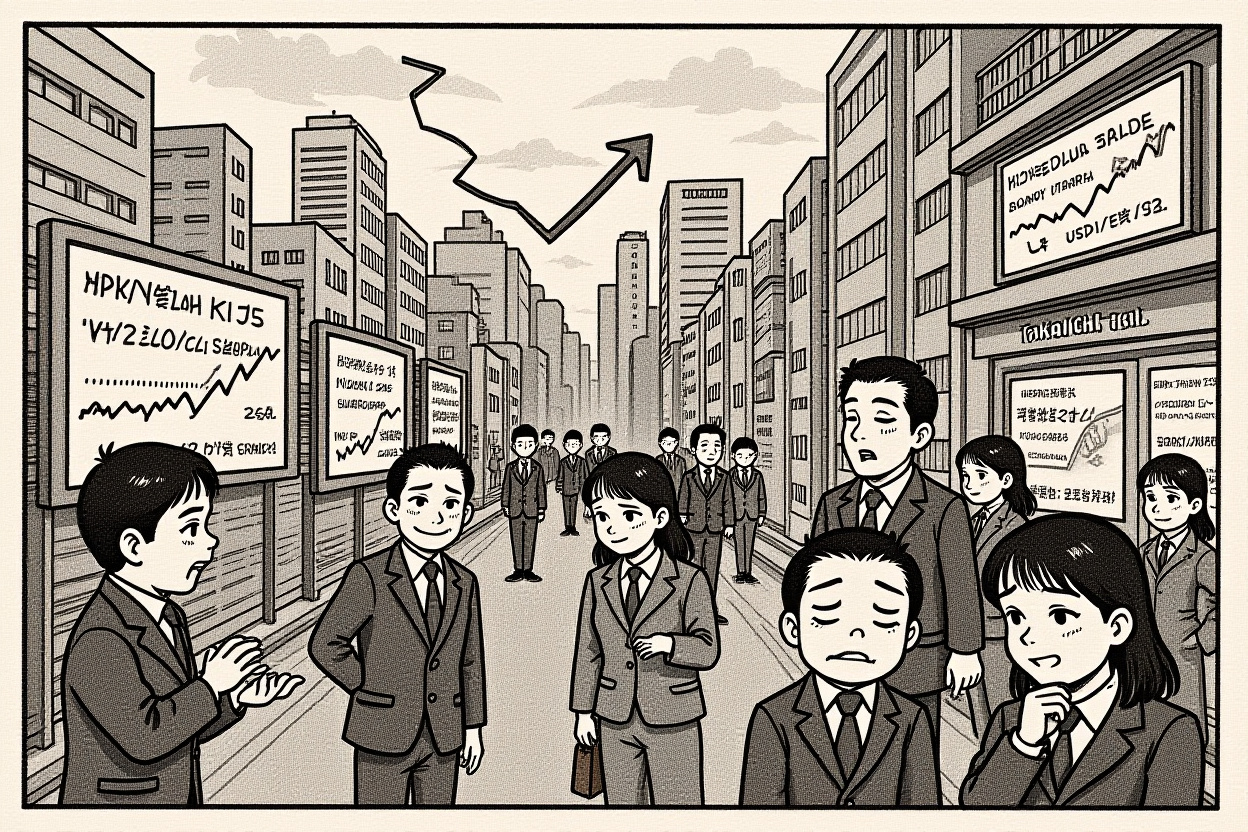
Executive Summary
– Japanese equities, led by the Nikkei 225, have rallied to record highs following the electoral victory of Prime Minister Takaichi Kazue (高市早苗), a move markets have dubbed the ‘Takaichi trade’.
– Bond and foreign exchange markets have responded with unusual calm, suggesting investor skepticism about the sustainability of fiscal expansion without triggering volatility.
– Analysts warn of a potential ‘Takaichi trap,’ where aggressive government spending could further weaken the yen, stoke inflation via higher import costs, and ultimately undermine stock market gains.
– The Bank of Japan (日本銀行) faces a policy dilemma, caught between supporting growth and preventing excessive currency depreciation, with intervention risks looming.
– Global investors must weigh Japan’s massive public debt, divergent market signals, and political mandates to navigate the opportunities and risks embedded in the ‘Takaichi trade’.
A Stock Market Frenzy Amid Political Triumph
The week following Prime Minister Takaichi Kazue’s (高市早苗) decisive election victory has been marked by historic gains in Japanese equities. The Nikkei 225 index surged 5%, closing at record highs as investors cheered the political stability and perceived pro-growth agenda. This rally, quickly labeled the ‘Takaichi trade’ by market participants, reflects optimism that her government will push forward with fiscal stimulus to address economic stagnation and cost-of-living pressures. However, this euphoria stands in stark contrast to the subdued reactions in other asset classes, hinting at underlying anxieties that could define Japan’s financial landscape in the coming months.
Nikkei 225’s Record-Breaking Rally
Driven by bullish sentiment, the Nikkei 225 index’s ascent to all-time highs underscores the market’s initial endorsement of Takaichi Kazue’s (高市早苗) leadership. The rally was broad-based, with sectors like technology, automotive, and financials leading the charge, as traders anticipated policies favoring domestic consumption and infrastructure spending. Data from the Tokyo Stock Exchange (東京証券取引所) shows trading volumes spiked by over 20% compared to the pre-election period, indicating heightened institutional interest. Yet, seasoned observers note that such rapid gains often precede periods of consolidation or correction, especially when fundamental concerns remain unaddressed.
The Political Mandate and Market Expectations
The Deceptive Calm in Bond and Forex MarketsWhile stocks celebrate, Japan’s government bond (JGB) and currency markets have exhibited remarkable tranquility, a phenomenon that some traders describe as ‘the calm before the storm.’ Prior to the election, concerns over Takaichi Kazue’s (高市早苗) expansive fiscal plans had driven volatility, with the yen weakening and long-term bond yields rising. Now, with yields stabilizing and the yen hovering around 153 per dollar, market participants are questioning whether this peace is sustainable or merely a temporary lull before broader turbulence erupts.
Yen Weakness and the ‘Takaichi Trap’
The Japanese yen remains vulnerable, with analysts like Darren Tay, BMI’s Asia-Pacific Country Risk Director, warning of a ‘Takaichi trap.’ He notes that higher government spending could exacerbate currency depreciation, as seen in the run-up to the election when the yen fell sharply on fears of unchecked fiscal expansion. Currently, officials from the Ministry of Finance (財務省) have issued verbal warnings about potential intervention if the yen weakens excessively. Citigroup forex strategist Osamu Takashima suggests that intervention might be triggered if the USD/JPY rate approaches 160, highlighting the precarious balance between policy goals and market stability. This dynamic is central to the ‘Takaichi trade,’ as currency moves directly impact import costs, inflation, and corporate earnings.
Bond Yield Dynamics and Investor Sentiment
Scrutinizing Fiscal Promises and Economic RealitiesIn her post-election press conference, Takaichi Kazue (高市早苗) sought to reassure markets by stating that her proposed two-year suspension of the food consumption tax would not involve new bond issuance. This pledge, estimated to cost ¥5 trillion (about $32 billion), is a cornerstone of her populist agenda aimed at alleviating living-cost pressures. Yet, financial analysts remain deeply skeptical, questioning the feasibility of such measures without exacerbating Japan’s already staggering debt burden.
Funding Challenges and Analyst Doubts
Benjamin Shatil, Senior Economist at J.P. Morgan, pointedly asked, ‘Given the scale of her mandate, how can she realistically withdraw such promises? Unlike other prime ministers, she cannot use parliamentary gridlock as an excuse.’ His skepticism echoes broader concerns that the ‘Takaichi trade’ might unravel if fiscal discipline falters. Additionally, Shusuke Yamada, Bank of America’s Head of Japan FX and Rates Strategy, argues that the election hasn’t altered the structural drivers of yen weakness, such as Japan’s aging population and slow growth, which encourage capital outflows. He emphasizes, ‘Investors need concrete evidence that Japan is a better long-term investment destination… that takes years.’
The Debt Overhang and Market Divergence
Japan’s public debt, at 237% of GDP according to International Monetary Fund (IMF) data, looms large over any fiscal discussion. CLSA analyst Nicholas Smith contends that debt worries primarily reflect foreign investor perspectives, noting they hold just 6.6% of JGBs but account for 71% of futures trading volume. He argues that these investors ‘have no skin in the game, and all signs indicate they don’t truly understand this market,’ highlighting Japan’s net debt position is lower and projected to decline. Conversely, BMI’s Darren Tay warns that domestically held debt might instill a ‘dangerous insulation,’ causing the government to ignore global bond market signals. Nomura Research Institute economist Takahide Kiuchi adds that while debt levels alone may not be problematic, the pre-election spike in long-term yields was unprecedented, urging vigilance to avoid a crisis.
Monetary Policy Dilemmas and Intervention Risks
The Bank of Japan (日本銀行) finds itself in a bind, torn between normalizing monetary policy after years of ultra-loose settings and accommodating potential fiscal expansion. Market expectations had priced in at least two rate hikes by 2026, but some traders now fear the central bank may delay tightening to give Takaichi Kazue (高市早苗) more fiscal space, a move that could further weaken the yen and complicate the ‘Takaichi trade’ calculus.
Bank of Japan’s Constrained Policy Options
Potential Forex Intervention and Its ImplicationsIf the yen weakens significantly, the Ministry of Finance (財務省) might intervene by selling dollars and buying yen, as hinted by officials. One trader bluntly noted that such intervention, if coupled with a dovish BOJ, would amount to ‘a temporary subsidy for short-sellers,’ as it may only provide fleeting relief without addressing fundamental imbalances. Historical data shows that past interventions have had mixed success, often requiring coordination with global counterparts. For participants in the ‘Takaichi trade,’ monitoring intervention triggers and BOJ communications is crucial for risk management.
Investment Implications and Strategic Outlook
As the ‘Takaichi trade’ unfolds, global investors must navigate a complex web of opportunities and pitfalls. The stock market rally offers potential gains, especially in sectors benefiting from fiscal stimulus, but currency and debt risks demand careful hedging and diversification strategies. Institutional players should prepare for scenarios ranging from orderly policy implementation to market upheaval, keeping the ‘Takaichi trade’ at the forefront of their Japan allocation decisions.
Navigating Scenarios in the ‘Takaichi Trade’
– Bull Case: If Takaichi Kazue (高市早苗) balances fiscal stimulus with credible debt management, and the BOJ supports growth without triggering hyper-inflation, Japanese equities could sustain gains while the yen stabilizes. This would validate the ‘Takaichi trade’ as a strategic opportunity.
– Bear Case: Aggressive spending without adequate funding leads to yen depreciation beyond 160 per dollar, soaring bond yields, and inflationary spikes that erode corporate profits. In this scenario, the ‘Takaichi trade’ becomes a trap, prompting capital flight and market corrections.
– Base Case: A mixed outcome with periodic volatility, where policy adjustments and market interventions create trading ranges. Investors should focus on selective stock picks, currency hedges, and duration management in bonds.
Recommendations for Global Investors
– Monitor key indicators: Watch for monthly fiscal announcements, BOJ meeting minutes, and inflation data to gauge policy directions. Utilize resources like the IMF’s Japan reports and Ministry of Finance updates.
– Diversify exposures: Consider currency-hedged equity funds or ETFs to mitigate yen risk, while maintaining allocations to global assets to reduce concentration in Japanese markets.
– Engage with local insights: Consult with on-the-ground analysts and attend investor briefings to understand domestic sentiment nuances, as foreign and local views often diverge on the ‘Takaichi trade.’
– Stay agile: Prepare contingency plans for sudden market moves, such as setting stop-loss orders on Japanese equity positions or using options for downside protection.
Synthesizing the ‘Takaichi Trade’ Landscape
The ‘Takaichi trade’ encapsulates the dual nature of Japan’s current financial environment—a stock market buoyed by political change yet shadowed by profound fiscal and currency uncertainties. While initial gains are enticing, the calm in bond and forex markets signals deeper caution among savvy investors. The path forward hinges on Takaichi Kazue’s (高市早苗) ability to deliver on populist promises without destabilizing Japan’s debt trajectory or triggering a yen crisis. As the BOJ navigates its policy tightrope, global market participants must remain vigilant, blending optimism with prudence. Ultimately, success in the ‘Takaichi trade’ will require a nuanced approach, continuous monitoring of economic indicators, and a readiness to pivot as new data emerges. For those engaged in Japanese markets, the call to action is clear: deepen your analysis, hedge your risks, and stay informed to capitalize on opportunities while sidestepping potential traps.