



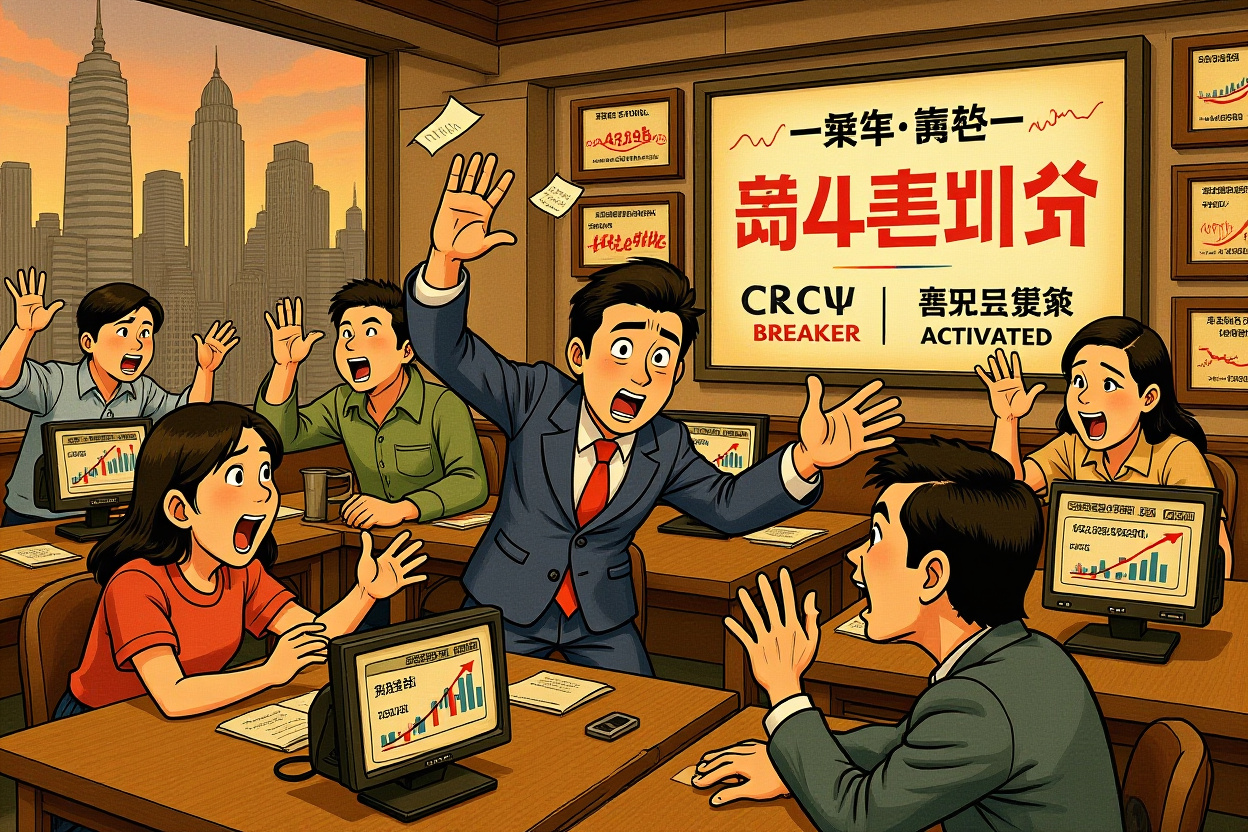
Asian markets jolted awake on Thursday with a powerful surge emanating from its developed northern economies. The Japanese and South Korean stock markets opened dramatically higher, with the rally in Seoul proving so intense it triggered a temporary market-wide trading halt. This synchronized leap forward signals a potent shift in regional investor sentiment, driven by external catalysts and internal dynamics that demand close scrutiny from global asset allocators. The spectacle of Japanese and South Korean Stocks Surge at Open, South Korea Triggers Circuit Breaker is not merely a headline but a critical event unpacking the interplay between global monetary policy expectations, corporate earnings resilience, and automated trading mechanisms in East Asia’s most sophisticated bourses.
Executive Summary: Key Market Implications
- A surprisingly dovish pivot from the U.S. Federal Reserve, hinting at potential rate cuts, served as the primary catalyst, driving a massive risk-on rally across global markets that supercharged Asian openings.
- South Korea’s KOSPI index soared over 3% at the open, triggering a market-wide circuit breaker—a 5-minute trading halt—designed to curb excessive volatility, a rare event underscoring the ferocity of the buying pressure.
- Japan’s Nikkei 225 and Topix indices mirrored the surge, buoyed by a significantly weakened Japanese Yen (JPY) which promises to turbocharge export-oriented corporate earnings.
- The rally exhibited clear sector leadership, with technology, automotive, and financial stocks—the most rate-sensitive and globally integrated sectors—leading the charge in both markets.
- This event creates a pivotal moment for international investors to reassess exposure to North Asian equities, with implications for currency hedging strategies and sector rotation within the APAC region.
The Overnight Catalyst: A Fed-Driven Risk-On Tsunami
The immediate trigger for the explosive opening was not domestic but trans-Pacific. Remarks from U.S. Federal Reserve Chair Jerome Powell, interpreted as decidedly less hawkish than feared, combined with softer-than-expected inflation data, ignited a powerful rally on Wall Street. U.S. indices soared, Treasury yields plummeted, and the dollar weakened. This created a perfect macro setup for Asian risk assets.
Interpreting the Fed’s Signal for Asia
For export-dependent economies like South Korea and Japan, the implications are twofold. First, looser financial conditions in the U.S. ease pressure on global liquidity, making it cheaper for Asian corporations to service dollar-denominated debt and for investors to fund carry trades. Second, the prospect of a softer U.S. economic landing reduces fears of a sharp drop in demand for Asian exports. The market’s violent reaction suggests investors are front-running a full pivot in the monetary policy cycle, pouring into equities seen as prime beneficiaries.
Seoul’s Supercharged Open: Anatomy of a Circuit Breaker Event
The phrase Japanese and South Korean Stocks Surge at Open, South Korea Triggers Circuit Breaker was epitomized in Seoul. The Korea Composite Stock Price Index (KOSPI) catapulted at the opening bell, swiftly crossing the threshold that activates the exchange’s volatility guardrails.
Understanding Korea Exchange’s (韩国交易所, KRX) Circuit Breaker Mechanism
The KRX employs a multi-tiered circuit breaker system to prevent market crashes and panics. The key level triggered during this event is the “Market Circuit Breaker,” which halts all stock trading across the exchange.
- Trigger Threshold: A 8% drop or a 10% rise in the KOSPI index compared to the previous day’s close.
- Action: A 5-minute trading halt across all equities and equity-linked products.
- Purpose: To provide a cooling-off period, disseminate information, and allow market participants to reassess orders.
The fact that this mechanism was triggered by a surge is statistically rare and highlights an overwhelming, concentrated wave of buy orders at the open, likely from both domestic institutions and foreign inflows chasing the overnight U.S. momentum.
Japan’s Parallel Ascent: The Yen’s Crucial Role
Across the Sea of Japan, the Nikkei 225 and Topix indices staged a similarly impressive gap higher. While fueled by the same global risk-on impulse, the Japanese rally had an additional, powerful domestic accelerator: the Yen.
Currency Tailwinds for Export Giants
The Bank of Japan’s (日本銀行, BOJ) persistently ultra-loose monetary policy stance stands in stark contrast to the Fed’s hinted pivot. This divergence pushed the USD/JPY pair sharply higher, significantly depreciating the Yen. A weaker Yen is a direct boon for Japan’s heavyweight export manufacturers, as it increases the Yen-value of their overseas earnings and makes their products more competitive abroad.
- Automotive: Stocks like Toyota Motor (丰田汽车) and Honda (本田) surged on the open.
- Technology & Precision: Giants such as Sony (索尼) and Tokyo Electron (东京电子) also saw aggressive buying.
- Financials: Banks and insurers rose on expectations of a steeper yield curve and reduced pressure from global bond market volatility.
This currency dynamic made the Japanese rally particularly potent, creating a double-benefit scenario from both global liquidity and domestic competitive advantages.
Sectoral Leadership and Capital Flows Analysis
The rally was not broad-based in a uniform sense; it displayed intelligent sector rotation indicative of professional capital allocation. The moves provide a roadmap to where smart money perceives the highest post-pivot returns.
Winners: Cyclical and Growth at the Forefront
Capital flooded into the most pro-cyclical and interest-rate-sensitive segments of the market. In South Korea, semiconductor behemoths like Samsung Electronics (三星电子) and SK Hynix (SK海力士) led the KOSPI’s charge, benefiting from the dual tailwinds of a global tech rebound and easier financial conditions. In Japan, alongside exporters, financial stocks outperformed as lower global yields reduce mark-to-market losses on their vast bond holdings and improve lending margins outlook.
The clear sector leadership underscores a thematic bet on a revival of global tech demand and capital expenditure cycles, with Japanese and South Korean Stocks Surge at Open, South Korea Triggers Circuit Breaker acting as the day’s most visible manifestation of this thesis.
Contrast with Chinese A-Shares: A Diverging Regional Narrative
The dramatic moves in Tokyo and Seoul stood in sharp contrast to the more muted performance in mainland Chinese equity markets. While the Shanghai and Shenzhen composites opened higher, the magnitude paled in comparison. This divergence is telling for regional investors.
Decoupling Drivers: Policy and Structure
Several factors explain the relative underperformance. First, China’s monetary policy cycle is out of sync with the West; the People’s Bank of China (中国人民银行, PBOC) has been in an easing mode for some time, so a Fed pivot is less of a new stimulus shock. Second, the domestic economic recovery narrative in China remains challenged by property sector concerns and deflationary pressures, which outweigh pure liquidity benefits. Third, the market structure differs, with a larger proportion of retail investors who may not react as instantaneously to global macro cues as the institutionally-dominated markets of Japan and South Korea. This divergence highlights the need for nuanced, country-specific strategies within Asia, rather than treating the region as a monolithic bloc.
Forward Outlook: Sustainability and Strategic Implications
The critical question for investors is whether this represents a sustainable breakout or a spectacular one-day momentum spike. The Japanese and South Korean Stocks Surge at Open, South Korea Triggers Circuit Breaker event must be contextualized within longer-term trends.
Monitoring Key Variables for Durability
The rally’s sustainability hinges on several factors confirming the initial signal:
- Fed Follow-Through: U.S. economic data must continue to support the disinflation and soft-landing narrative, allowing the Fed to enact projected cuts.
- Earnings Delivery: Q4 and forward guidance from Japanese and Korean corporate giants must validate the optimism, showing tangible benefit from weaker currencies and improving demand.
- Currency Stability: A controlled, steady depreciation of the Yen is positive; a disorderly collapse could trigger capital flight and BOJ intervention, creating volatility.
- Geopolitical Calm: The region remains sensitive to tensions. A flare-up could swiftly reverse risk-on flows.
The dramatic surge that defined the Asian trading session is a powerful reminder of how interconnected global capital markets have become. The event where Japanese and South Korean Stocks Surge at Open, South Korea Triggers Circuit Breaker was fundamentally imported from Washington D.C., yet its expression was uniquely Asian, filtered through local circuit breakers and currency dynamics. For institutional investors, this is not a signal to chase momentum blindly, but to engage in disciplined strategic reassessment.
The rally validates North Asian equities as prime conduits for global liquidity shifts. It argues for an overweight stance in high-quality, export-oriented Japanese names and Korean technology champions within a diversified Asia-Pacific portfolio. However, it also underscores the critical importance of active currency management and sector selection. The circuit breaker in Seoul served its purpose—it forced a pause. Investors worldwide should take a similar moment to pause, analyze the fundamental drivers now in play, and strategically position for what may be the beginning of a significant recalibration of capital towards the manufacturing and technology powerhouses of Northeast Asia. Review your regional allocations, stress-test your currency exposure, and ensure your portfolio is structured to capitalize on this evolving macro regime shift.