



Executive Summary: Key Takeaways from the HYROX Phenomenon
– HYROX, a hybrid fitness competition blending running and strength exercises, is experiencing explosive growth in China, with events in cities like Beijing and Shanghai attracting nearly 7,000 participants, signaling robust consumer demand in the wellness sector.
– High participation fees, ranging from 638 to 1,688 yuan, and strong social media appeal are driving revenue, but criticisms over commercialization and service quality highlight risks similar to past fitness fads like CrossFit.
– The trend reflects broader middle-class spending patterns on experiential and status-driven activities, with potential implications for listed companies in sports, leisure, and consumer discretionary segments within Chinese equity markets.
– Investors should monitor this space for opportunities in event management, fitness tech, and related industries, while assessing sustainability through regulatory compliance and market maturation.
– Long-term viability hinges on balancing social currency appeal with operational excellence, offering lessons for stakeholders in China’s rapidly evolving consumer economy.
The Urban Fitness Revolution: HYROX Captivates Chinese Metropolises
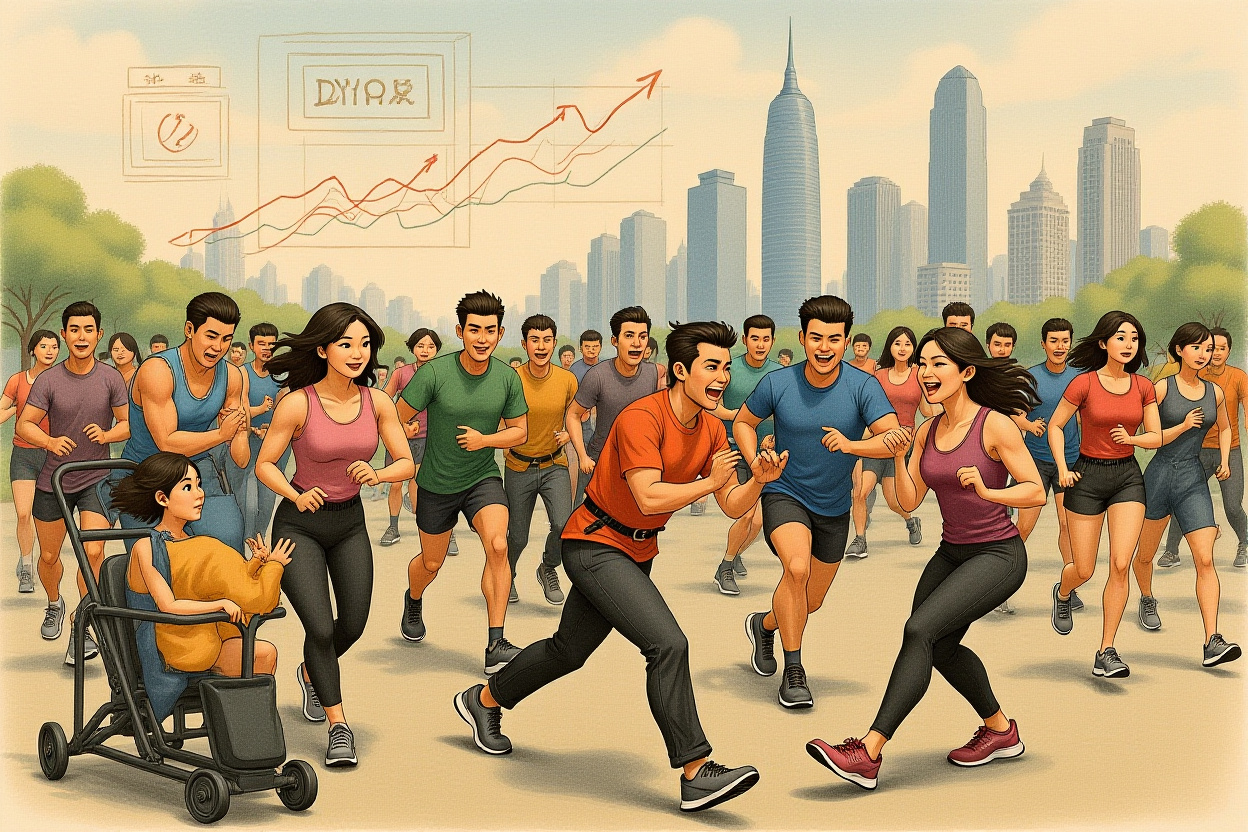
In the heart of China’s financial hubs, a new athletic spectacle is unfolding—one that merges grueling endurance with communal exhilaration. The HYROX fitness trend has swiftly moved from niche circles to mainstream consciousness, captivating urban professionals who seek both physical challenge and social validation. Unlike traditional marathons or gym routines, HYROX events pit thousands against a course of alternating one-kilometer runs and functional exercises, from ski ergometers to sled pushes. This fusion taps into a growing middle-class appetite for curated, shareable experiences, where spending 700 yuan for a finisher’s medal and a朋友圈 (WeChat moment) post is deemed a worthy investment. As financial analysts observe, such behaviors underscore shifting consumption drivers in China’s equity landscape, where leisure and wellness sectors are becoming critical barometers of economic vitality.
From Global Inception to Local Explosion: Growth Metrics
Since its founding in 2017, HYROX has scaled globally, but its ascent in China is particularly striking. The 2025 Shanghai event drew close to 7,000 athletes and 6,000 spectators, setting a national record since its introduction. Globally, annual participation has soared to 550,000 from a mere 650 in its inaugural year, demonstrating a compound annual growth rate that intrigues market watchers. In China, the rapid adoption mirrors broader trends in health-conscious spending, with the middle class increasingly allocating disposable income to fitness pursuits. Data from the National Bureau of Statistics of China (国家统计局) indicates that sports-related consumption grew by over 15% year-on-year in 2024, outpacing general retail sales. This HYROX fitness trend is not just a passing fad; it represents a microcosm of consumer resilience and the premium placed on lifestyle branding in post-pandemic economies.
The Social Currency Dynamic: Why Sharing Drives Demand
At its core, HYROX thrives on social validation. Participants like Yuan Jialiang (袁嘉亮), a professional photographer and HYROX commentator, describe events as “健身圈的嘉年华” (fitness circle carnivals), where networking and shared accomplishment fuel engagement. The finisher medal—a tangible trophy of endurance—becomes a potent social currency, broadcast across platforms like WeChat and Xiaohongshu (小红书). This phenomenon aligns with research from Goldman Sachs (高盛) on experiential consumption, which notes that Chinese millennials and Gen Z prioritize activities that enhance social capital. For investors, this suggests opportunities in digital marketing and social commerce tied to fitness trends, as companies leverage user-generated content to drive brand loyalty. However, the HYROX fitness trend also raises questions about authenticity, as some participants prioritize photo-ops over performance, potentially diluting the sport’s integrity.
Deconstructing the Business Model: Revenue Streams and Commercial Critiques
The HYROX fitness trend is underpinned by a lucrative yet contentious commercial framework. With entry fees averaging 700 yuan per person—significantly higher than many local marathons—the event generates substantial direct revenue. Additional income streams include paid photo packages, merchandise, and sponsorship deals with brands like Red Bull (红牛), which provided limited on-site补给 (supplies). Yet, this model has drawn scrutiny from participants who compare it unfavorably to established competitions. For instance, the CrossFit-inspired “全力游戏” (All-Out Games) offers inclusive perks like apparel and free photos, whereas HYROX charges 190 yuan for digital images. Such disparities highlight a key investment risk: consumer backlash can erode brand equity, especially in China’s sensitive social media environment where viral complaints can impact stock valuations of related companies.
Operational Challenges: Fairness and Service Shortfalls
As HYROX expands, operational hiccups have emerged. Videos from domestic events show inconsistent裁判 (referee) standards, such as overlooked form violations during medicine ball throws. Wu Shihong (吴世宏), a fitness industry veteran with seven years in coaching, points out that rapid scaling often strains quality control, a common pitfall for growth-stage ventures. Moreover, logistical issues like inadequate signage and sparse补给 (supplies)—only one Red Bull per participant in some cases—underscore a mismatch between premium pricing and perceived value. For institutional investors, these factors signal due diligence areas: companies involved in event management must demonstrate robust operational frameworks to mitigate reputational damage. The HYROX fitness trend thus serves as a case study in balancing expansion with excellence, a lesson relevant for portfolios exposed to China’s consumer services sector.
Monetization vs. Mission: The Commercialization Debate
Critics argue that HYROX’s commercial zeal risks overshadowing its athletic ethos. Yuan Fang (袁放), HYROX’s China regional head, has emphasized immersive venue designs that blend spectators and athletes, yet some perceive this as a strategy to maximize ticket sales rather than enhance competition. This tension mirrors broader debates in Chinese equity markets, where firms in lifestyle sectors grapple with short-term monetization versus long-term brand building. Historical parallels exist: the攀岩 (rock climbing) and滑雪 (skiing) booms initially drove stock surges for equipment makers like Anta Sports (安踏体育), but sustainability waned as safety concerns and high costs emerged. Similarly, the HYROX fitness trend must navigate over-commercialization to avoid becoming another transient middle-class indulgence, with implications for related publicly traded entities.
Market Implications: Investment Opportunities in China’s Fitness Ecosystem
The rise of HYROX is more than a cultural curiosity; it signals tangible economic shifts with ramifications for Chinese equity markets. Analysts project that China’s fitness industry could reach a market size of $100 billion by 2030, driven by urbanization and health awareness. This HYROX fitness trend catalyzes demand across multiple segments: event organizers, apparel brands like Li Ning (李宁), fitness equipment suppliers, and digital platforms facilitating training and social sharing. For fund managers, targeted exposure to companies like Keep (卡路里科技), a homegrown fitness app, or China Sports Industry Group (中体产业集团) could yield gains, provided they assess scalability and regulatory tailwinds. Additionally, the trend underscores the growing importance of ESG (Environmental, Social, and Governance) factors, as consumers favor brands promoting wellness and community engagement.
Sectoral Analysis: Where Capital Flows in the Wake of HYROX
– Event Management and Venue Operators: Firms specializing in large-scale sports logistics, such as those listed on the Shenzhen Stock Exchange (深圳证券交易所), may benefit from HYROX’s expansion, though margins depend on operational efficiency.
– Fitness Technology and Apps: Platforms offering HYROX training programs or virtual competitions could see user growth, akin to the surge in Peloton (派乐腾) during pandemic peaks, but must adapt to local preferences.
– Consumer Discretionary Stocks: Brands selling athletic wear or nutritional supplements, like Inner Mongolia Yili Industrial Group (内蒙古伊利实业集团) for protein products, might experience uplift from increased fitness participation.
– Tourism and Hospitality: As HYROX events draw out-of-town participants, hotel and travel sectors in host cities could see short-term boosts, relevant for investors in China’s tourism ETF (交易所交易基金).
However, risks abound, including potential regulatory oversight from bodies like the General Administration of Sport of China (国家体育总局) to standardize event safety and pricing.
Comparative Insights: Learning from Past Fitness Fads
The HYROX fitness trend echoes cycles seen with CrossFit, Pilates, and飞盘 (ultimate frisbee), each of which ignited investor enthusiasm before facing consolidation. For example, CrossFit’s global franchise model initially attracted venture capital, but governance issues led to volatility. In China, the普拉提 (Pilates) wave saw a proliferation of studios, yet inconsistent教练资质 (coach certifications) and high课程费用 (course fees) prompted consumer skepticism. Investors monitoring HYROX should study these precedents: sustainability often hinges on differentiation and community building, not just novelty. Data from market research firm iiMedia Research (艾媒咨询) indicates that 60% of fitness trends in China peak within three years, suggesting a cautious approach for equity positions in this space.
Strategic Outlook: Navigating the Future of Hybrid Fitness in China
As the HYROX fitness trend matures, its trajectory will influence broader investment themes in Chinese markets. Key indicators to watch include participant retention rates, partnership announcements with corporate sponsors, and any IPO (首次公开募股) filings from HYROX-affiliated entities. Yuan Fang (袁放) has hinted at plans to deepen roots in China, potentially through alliances with local sports associations, which could stabilize revenue streams and enhance credibility. For corporate executives and institutional investors, this presents a dual mandate: capitalize on near-term growth while hedging against cyclical downturns by diversifying into adjacent wellness verticals, such as mental health apps or corporate wellness programs.
Forward-Looking Recommendations for Market Participants
– Conduct thorough due diligence on companies leveraging the HYROX fitness trend, assessing their financial health via metrics like customer acquisition cost and lifetime value, particularly in volatile consumer sectors.
– Monitor regulatory developments, as Chinese authorities may introduce guidelines for emerging sports events, impacting compliance costs and market entry barriers for listed firms.
– Engage with industry experts, such as Wu Shihong (吴世宏), for insights on training standardization, which can inform investment theses on equipment manufacturers or certification providers.
– Consider thematic ETFs focused on China’s consumer upgrade narrative, where HYROX represents a subset of experiential spending drivers that align with long-term economic rebalancing away from manufacturing.
Ultimately, the HYROX fitness trend encapsulates the dynamism of China’s consumer economy, where lifestyle aspirations merge with commercial ambition. While its staying power remains untested, the lessons it offers—on social currency, operational scaling, and investment timing—are invaluable for stakeholders navigating the complexities of Chinese equity markets. As the dust settles on each event, savvy investors will look beyond the朋友圈 (WeChat moments) to the underlying fundamentals, ensuring their portfolios are as resilient as the athletes pushing through those final grueling kilometers.