



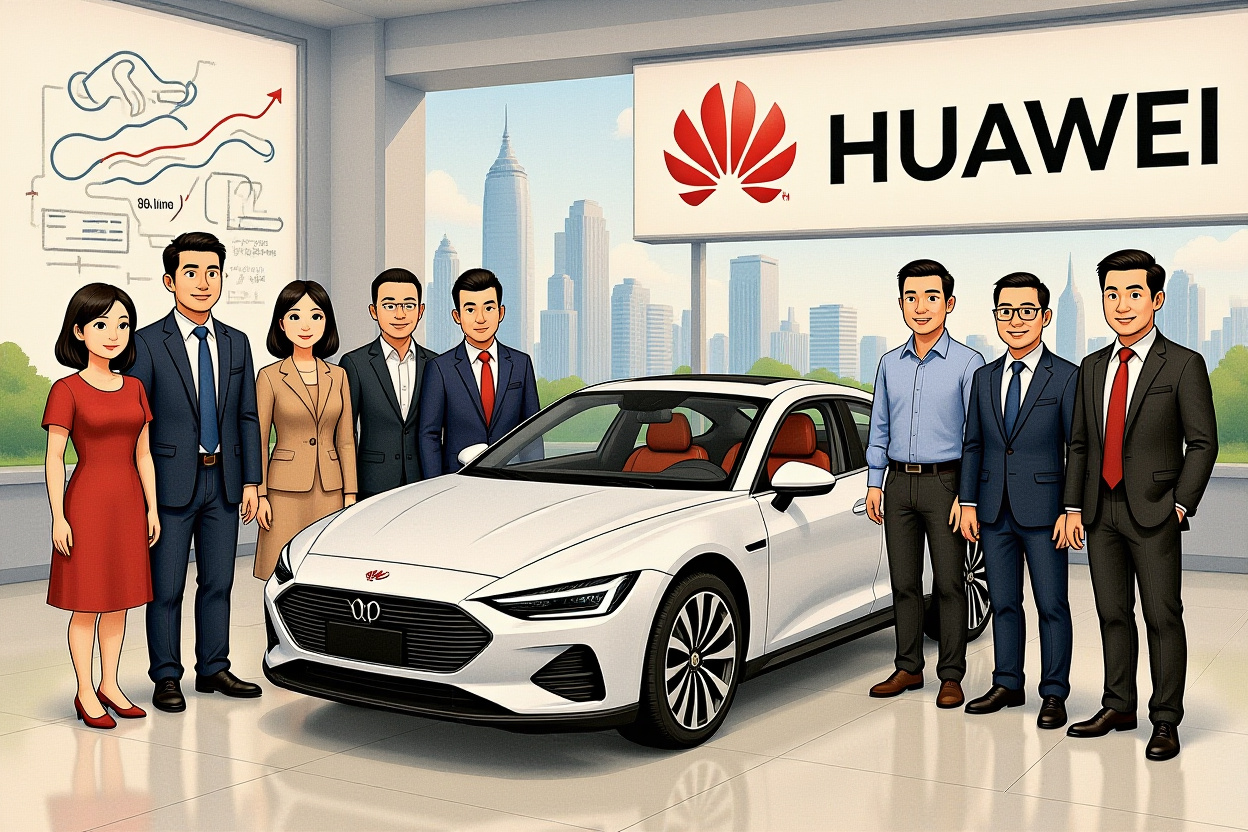
Key Takeaways and Market Implications
The launch of the Qijing (启境) brand by Huawei Qiankun (华为乾崑) and GAC Group (广汽集团) marks a pivotal moment in China’s electric vehicle (EV) landscape. This move signals deeper integration between tech and auto giants, with implications for investors and industry players worldwide. Here are the critical points to consider.
– The Qijing GT7 debut showcases Huawei’s full-stack smart car solutions, including 896-line lidar and L3 autonomous driving architecture, positioning it as a high-end competitor.
– Huawei’s commitment involves an 800-person team co-located with GAC, indicating a resource-intensive partnership beyond typical supplier relationships.
– The timing aligns with Huawei’s expansion of its “境系列” (Jing series) partnerships, such as with Dongfeng Motor for the Yijing (奕境) brand, to test technology across price segments.
– For GAC, Qijing represents a strategic bet to accelerate its EV transition amid market pressures, with Chairman Feng Xingya (冯兴亚) prioritizing it for success.
– Investors should monitor the rollout of 300 stores by May and upcoming models, as execution will determine market penetration and competitive edge.
A New Benchmark in Smart Mobility
The global unveiling of the Qijing GT7 on March 17, 2026, isn’t just another car launch—it’s a statement of intent from two industry titans. In a market saturated with EVs, the focus on advanced intelligence and design underscores a shift toward differentiated offerings. The question of why now for this launch is central to understanding its strategic importance.
Qijing, meaning “to open a new realm,” embodies this ambition. With its English name AISTALAND symbolizing “AI Start New Land,” the brand targets consumers seeking cutting-edge technology. This isn’t merely about transportation; it’s about creating an intelligent ecosystem that redefines user experience.
Vehicle Specifications: Setting a High Bar
The Qijing GT7 is a smart shooting-brake coupe that integrates Huawei’s latest innovations. Key features include the global mass-production highest 896-line lidar for precise environmental perception, the Huawei XMC digital chassis engine for enhanced handling, and the HarmonySpace (鸿蒙座舱) cockpit for seamless connectivity. Pre-installed L3 autonomous driving architecture allows for future upgrades, ensuring longevity in a rapidly evolving market.
– Performance metrics, though not fully disclosed, emphasize a balance of power and efficiency, appealing to premium segments.
– Design inputs from Huawei’s team highlight a collaborative approach from the product definition phase, unlike retrofitted solutions.
This technological showcase aims to challenge established players like Tesla and domestic rivals such as NIO (蔚来) and Xpeng (小鹏). For investors, the GT7’s reception will test Huawei’s ability to translate R&D into commercial success.
Brand Vision: More Than a Name
Qijing’s branding reflects a deeper narrative. The Chinese characters “启” (qi, meaning to initiate) and “境” (jing, meaning realm) convey a journey toward intelligent horizons. Official statements describe it as “opening a new, wiser, and more beautiful travel world,” targeting affluent, tech-savvy consumers.
– This positioning leverages Huawei’s reputation in consumer electronics to build trust in automotive domains.
– The emphasis on AI aligns with global trends toward autonomous and connected vehicles, making it relevant for international markets.
Understanding this vision is crucial for assessing brand equity. In China’s competitive auto sector, emotional resonance can drive loyalty, especially among early adopters willing to pay premiums for innovation.
Deepening Collaboration: Huawei’s Expanded Role
Why now for such an intensive partnership? The answer lies in the evolving dynamics of China’s auto industry. Huawei’s move from a technology supplier to a co-creator with GAC signals a strategic pivot. Jin Yuzhi (靳玉志), CEO of Huawei’s Intelligent Automotive Solution BU, revealed that Huawei Qiankun has deployed its “full family bucket” of resources—including design, R&D, and marketing—with an 800-person team stationed in Guangzhou for over a year.
This level of integration reduces time-to-market and enhances product cohesion. Unlike traditional vendor relationships, where technology is added late-stage, Huawei’s involvement from inception ensures that smart features are core to the vehicle’s identity. This approach mitigates risks of compatibility issues and accelerates innovation cycles.
Resource Commitment: A Model for Future Partnerships
The co-location of Huawei and GAC teams fosters real-time collaboration, crucial for agile development. This model contrasts with Huawei’s earlier partnerships, such as with Seres (赛力斯) for the Aito (问界) brand, which followed a more modular approach. The shift indicates Huawei’s confidence in scaling its automotive solutions.
– The 800-person team represents significant capital and human investment, underscoring Huawei’s long-term commitment.
– Joint operations facilitate knowledge transfer, potentially boosting GAC’s in-house capabilities over time.
For investors, this deep tie-up suggests reduced dependency on external suppliers for GAC, possibly improving margins. However, it also concentrates risk if the partnership faces execution hurdles.
Comparative Analysis: Huawei’s Diversifying Playbook
Huawei’s strategy extends beyond Qijing. The “境系列” (Jing series) includes partnerships with Dongfeng Motor (东风汽车) for Yijing and advanced collaborations with Avatr (阿维塔) under the Hi Plus model. This diversification allows Huawei to test its technology across different vehicle types and price points, from luxury SUVs to mass-market sedans.
– The “five realms” (五界)—Aito, Zhijie (智界), Xiangjie (享界), Zunjie (尊界), and Shangjie (尚界)—under the Harmony Smart Driving (鸿蒙智行)模式 have established a baseline, enabling more experimental ventures like Qijing.
– By partnering with multiple automakers, Huawei mitigates over-reliance on any single player, spreading R&D costs and learning from varied market feedback.
This群车战术 (group vehicle tactics) enhances Huawei’s data collection for AI training, crucial for refining autonomous systems. From an investment perspective, it positions Huawei as a pivotal enabler in China’s smart car ecosystem, akin to roles played by companies like NVIDIA in global markets.
Strategic Timing: Why Launch Qijing Now?
The timing of Qijing’s launch is no accident. It coincides with several macro and micro factors that make this moment opportune. Analyzing why now reveals insights into market readiness, competitive pressures, and regulatory tailwinds. For institutional investors, this context is vital for forecasting adoption rates and valuation impacts.
China’s EV market is transitioning from growth to maturation, with consumers demanding higher value and differentiation. The government’s push for technological self-sufficiency, under initiatives like “Made in China 2025,” supports domestic innovation in smart vehicles. Additionally, post-pandemic economic recovery has boosted disposable incomes in premium segments.
Market Conditions: Riding the EV Wave
EV penetration in China exceeded 30% in 2025, creating a fertile ground for new entrants. However, saturation in entry-level segments has pushed players like GAC to seek growth through upmarket moves. Qijing’s focus on high-end features taps into this trend, targeting consumers willing to pay for advanced technology.
– Competitive intensity: Rivals like BYD (比亚迪) and Li Auto (理想汽车) have solidified positions, making differentiation through intelligence a logical strategy.
– Global expansion: With plans for a global debut, Qijing aims to capture international demand, especially in Europe and Southeast Asia, where Chinese EVs are gaining traction.
Why now? Because delaying could mean missing the window to establish brand identity before competitors further entrench themselves. Huawei’s timing leverages its recent breakthroughs in lidar and HarmonyOS, ensuring a technological edge.
Regulatory and Economic Catalysts
Policy support is a key driver. China’s Ministry of Industry and Information Technology (MIIT, 工业和信息化部) has incentivized L3+ autonomous driving development, with pilot programs in cities like Shanghai and Beijing. Qijing’s pre-installed L3 architecture aligns with these regulations, positioning it for future compliance and subsidies.
– Economic indicators: Stabilizing consumer confidence and government stimulus for green vehicles reduce launch risks.
– Supply chain maturity: Localization of critical components, such as batteries from CATL (宁德时代), ensures cost control and resilience.
For fund managers, these factors lower perceived risk, making Qijing a compelling case for inclusion in portfolios focused on tech-driven autos. Monitoring regulatory updates, such as safety standards for autonomous features, will be essential.
Future Roadmap: Scaling Ambitions
Qijing’s launch is just the beginning. The brand has outlined an aggressive three-year plan, with implications for production capacity, sales networks, and investor returns. Understanding this roadmap helps assess long-term viability and market share potential.
The second model, a mid-to-large SUV, is slated for release later in 2026, expanding the portfolio to cater to family and luxury segments. By 2028, multiple vehicles are planned, ensuring a steady pipeline to sustain consumer interest and dealership revenues.
Product Pipeline: Diversifying Offerings
– The SUV segment is crucial in China, accounting for over 40% of EV sales, making it a logical next step for Qijing.
– Future models may incorporate advancements in solid-state batteries or V2X communication, as hinted by Huawei’s R&D pipelines.
This phased approach allows for iterative improvements based on GT7 feedback, reducing the risk of large-scale failures. For corporate executives, it highlights the importance of agility in product development cycles.
Channel Expansion: Building Market Presence
Qijing aims to open 300 stores across 76 Chinese cities by the end of May 2026, focusing on high-traffic commercial districts. This rapid rollout underscores confidence in demand and operational execution.
– Store formats will likely blend experiential zones with sales points, leveraging Huawei’s retail expertise from its consumer business.
– Test drives for the GT7 begin in April, providing early validation of consumer reception and quality benchmarks.
Investors should track sell-through rates and customer feedback from these channels, as they will be leading indicators of brand acceptance. High upfront costs for store development pose a risk if sales underperform, but success could quickly build market share.
Investment Insights and Forward Guidance
The Qijing launch reshapes the investment landscape for Chinese equities, particularly in the automotive and tech sectors. For sophisticated business professionals, this event offers actionable insights into emerging trends and partnership models. Why now? Because the convergence of technology and automotive is reaching an inflection point, with winners poised to capture significant value.
Key opportunities include upstream suppliers of smart components, such as lidar manufacturers, and downstream service providers in charging infrastructure. However, risks persist, including potential regulatory shifts on data security for connected vehicles and intensifying competition from global OEMs ramping up EV efforts.
Portfolio Considerations
– Overweight stocks linked to Huawei’s ecosystem, such as its semiconductor partners, given the scalable nature of its automotive solutions.
– Monitor GAC’s financials for margin improvements from cost-sharing with Huawei, but be wary of dilution if further capital raises are needed.
– Diversify across multiple EV brands to hedge against model-specific failures, while capitalizing on overall sector growth.
Quotes from industry analysts suggest cautious optimism. For instance, a report from China International Capital Corporation Limited (中金公司) highlights the potential for Huawei to capture 15-20% of China’s smart car market by 2030, driven by partnerships like Qijing.
Call to Action: Stay Informed and Agile
As the Qijing story unfolds, stakeholders must remain vigilant. Subscribe to updates from regulatory bodies like the China Association of Automobile Manufacturers (CAAM, 中国汽车工业协会) for sales data. Engage with quarterly earnings calls from GAC and Huawei for progress reports on production and partnerships.
Why now is the time to act: early movers in understanding these dynamics can position portfolios for alpha generation. Consider attending industry events, such as the Beijing Auto Show in April 2026, where Qijing and related brands will showcase innovations. For institutional investors, deep due diligence on supply chain resilience and technology roadmaps will separate winners from losers in this high-stakes arena.
In summary, the Qijing launch is a strategic move timed to capitalize on technological readiness, market gaps, and policy support. Its success will depend on execution, but the foundations are strong. By embracing this new era of collaboration, investors can navigate the complexities of China’s EV revolution with confidence.