



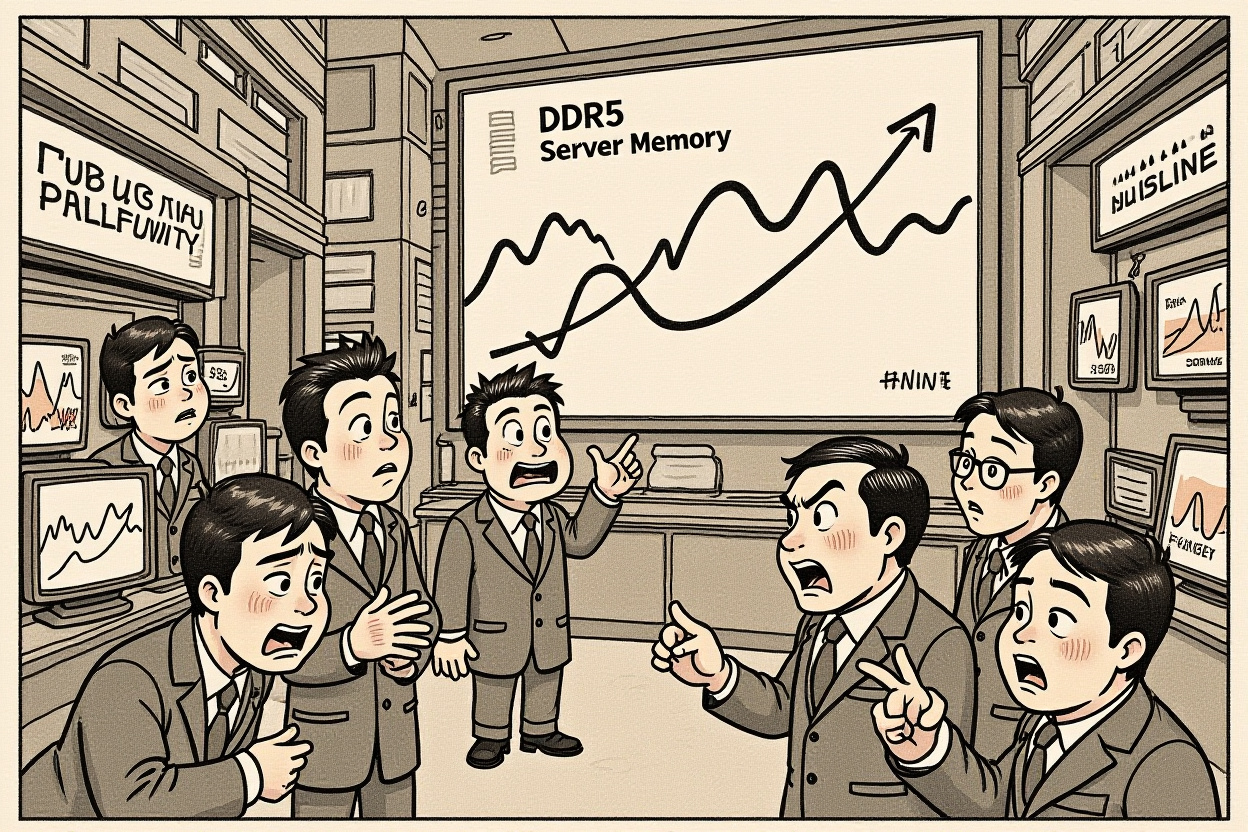
– Memory module prices in Huaqiangbei (华强北) saw a sharp two-week decline in late March 2026, followed by a swift rebound in early April, with server memory modules experiencing daily price increases of nearly 1000 yuan.
– The volatility was driven by speculative trading, cash flow pressures among inventory hoarders, and market panic over AI-related demand shifts, exemplified by Google’s TurboQuant algorithm announcement.
– Despite short-term fluctuations, industry analysts from TrendForce Jibang Consulting (集邦咨询) and others project continued upward price trends due to AI-driven demand and persistent supply constraints.
– Consumer-grade memory prices have stabilized, while server memory shows stronger recovery, highlighting divergent market segments and the impact of structural mismatches in the supply chain.
– Investors and consumers are advised to monitor contract price trends, differentiate between spot and long-term demand, and consider timing purchases based on market cycles rather than reacting to short-term swings.
The recent rollercoaster in Huaqiangbei memory module prices has captivated market watchers, with merchants describing the experience as “more exciting than stock trading.” This episode of memory module price volatility underscores the complex interplay of speculation, technological advancements, and supply chain dynamics in China’s electronics hub. As prices flash-crashed over two weeks only to rebound sharply, key questions arise about the sustainability of the ongoing memory bull market and the implications for global investors and consumers. This analysis delves into the causes, consequences, and future outlook of this dramatic price movement, providing actionable insights for navigating the turbulent waters of the memory market.
The Rollercoaster Ride of Huaqiangbei Memory Module Prices
The memory module price volatility in Huaqiangbei has been nothing short of spectacular, mirroring the frenetic energy of a stock market bubble. Within a span of weeks, prices for critical components like DDR4 and DDR5 memory modules swung wildly, leaving traders and investors grappling with significant gains and losses.
The Flash Crash: Triggers and Timeline
Contrary to initial reports that pinned the downturn solely on Google’s March 25 announcement of its TurboQuant memory compression algorithm, the price decline began earlier. According to multiple Huaqiangbei merchants, the slide started around March 20, 2026, triggered by inventory hoarders facing cash flow pressures. These players began offloading stock to lock in profits and repatriate funds, leading to a gradual but persistent price drop. For instance, a Samsung 64G DDR5 server memory module, which traded around 15,000 yuan in mid-March, fell to approximately 12,000 yuan by late March, with single-day declines reaching up to 1000 yuan. This memory module price volatility was exacerbated by weak consumer demand, as evidenced by slumping smartphone and laptop sales in early 2026, which reduced downstream procurement volumes.
The Rebound: Signs of Stabilization and Recovery
By early April, the market began to stabilize, with consumer-grade memory prices leveling off and server memory experiencing a pronounced rebound. On April 2, the same Samsung server memory module saw a near-1000 yuan price increase, jumping from 12,000 to 12,800 yuan, and it further climbed to 14,000 yuan by April 3—almost returning to its previous high. Huaqiangbei storage dealer Xiong Qing (熊庆) noted, “It falls fast and rises fast, more thrilling than trading stocks.” This recovery suggests that the underlying supply-demand imbalance, particularly for AI and server applications, remains intact, supporting prices despite short-term panic selling.
Market Dynamics: From Panic Selling to Strategic Holding
The recent episode of memory module price volatility reveals deep-seated market dynamics, where psychological factors and speculative behavior amplify price movements. Understanding these elements is crucial for anticipating future trends and avoiding costly missteps.
The Role of Speculators and New Entrants
The memory price surge that began in 2025, with modules often rising by hundreds or thousands of yuan, attracted a flood of non-professional speculators and new entrants seeking quick profits. These players, unfamiliar with the cyclical nature of the memory market, engaged in aggressive hoarding, only to face steep losses when prices corrected. Xiong Qing observed that many newcomers, drawn by the allure of high returns, neglected the risk of a downturn and ended up holding bags at peak prices. Zhang Wenqian (张文倩), another Huaqiangbei merchant, confirmed that losses of over 100,000 yuan in a single day were common among these groups. This influx of speculative capital intensified the memory module price volatility, creating a bubble-like environment prone to sharp corrections.
Psychological Factors in Price Volatility
The market is heavily influenced by a “buy high, sell low” mentality, where rising prices fuel FOMO (fear of missing out) buying, while falling prices induce caution and delayed purchases. Zhang Wenqian explained that during the uptrend, downstream customers rushed to secure inventory fearing further hikes, but once prices turned downward, they adopted a wait-and-see approach, expecting deeper discounts. This psychological feedback loop can accelerate both rallies and declines, making memory module price volatility more pronounced. The TurboQuant announcement acted as a catalyst for panic, but the fundamental driver was this herd behavior, compounded by macroeconomic headwinds like declining consumer electronics sales.
Underlying Drivers: AI Demand and Supply Constraints
Beyond the speculative froth, the long-term trajectory of memory prices is shaped by structural forces, primarily the explosive growth of artificial intelligence (AI) and persistent supply chain bottlenecks. These factors ensure that the current memory module price volatility is a temporary phenomenon within a broader bullish cycle.
AI’s Impact on Memory Capacity and Allocation
The AI revolution, particularly the training and inference of large language models (LLMs), has drastically increased demand for high-performance memory, such as high-bandwidth memory (HBM). Memory manufacturers have pivoted production to prioritize these high-margin segments, squeezing output for consumer-grade DDR4 and DDR5 modules. CFM Flash Memory Market General Manager Tai Wei (邰炜) emphasized at the MemoryS 2026 conference that storage original equipment manufacturers (OEMs) are focusing on profitable AI storage products, leading to compressed capacity for mature processes and consumer goods. This shift has driven industry inventory to historical lows, below safety lines, creating a supply shortage that may take 18-24 months to alleviate due to lengthy expansion cycles.
Supply Chain Bottlenecks: Contract vs. Spot Prices
The memory market operates on a dual pricing system: contract prices for large-scale OEMs and spot prices for the open market. TrendForce Jibang Consulting (集邦咨询) reports that DRAM suppliers are aggressively reallocating capacity to HBM and server applications, while employing a “catch-up” pricing strategy to narrow gaps between product categories. Consequently, despite risks of downward revisions in terminal market shipments, overall supply remains tight, supporting contract price increases. In a March 31 update, TrendForce raised its Q2 2026 memory contract price forecasts, estimating a 58-63% rise for general DRAM and a 70-75% increase for NAND Flash. These contract price trends provide a floor for spot market volatility, indicating that the recent memory module price volatility in Huaqiangbei may be short-lived against a backdrop of firm underlying demand.
Expert Insights and Industry Analysis
Industry experts and analysts offer nuanced perspectives on the TurboQuant algorithm’s impact and the sustainability of the memory price rally, helping to separate hype from reality in assessing memory module price volatility.
The TurboQuant Algorithm: Hype vs. Reality
Google’s TurboQuant, which claims to reduce key-value cache memory usage in LLMs by at least 60% without accuracy loss, initially spooked markets by suggesting reduced future memory needs. However, analysts have clarified that its effect is limited. Morgan Stanley analysts noted in a recent report that TurboQuant only optimizes inference-phase key-value caches, not the model weights stored in HBM, and it does not affect AI training tasks. The six-fold compression enhances per-GPU throughput rather than cutting total storage demand. TrendForce echoed this, stating that TurboQuant improves resource efficiency without diminishing demand; as inference costs drop, AI applications and model scales will expand, ultimately boosting long-term memory requirements. Thus, the algorithm is unlikely to derail the memory bull market, though it contributed to short-term sentiment-driven memory module price volatility.
Views from TrendForce and Other Market Observers
TrendForce maintains that the March price decline was a short-term fluctuation influenced by weak consumption, convergence between spot and contract prices, and channel inventory adjustments. The firm asserts that memory tightness persists, with Q2 2026 contract prices still poised to rise and the uptrend extending into the second half of the year. Similarly, a senior executive at a leading memory module listed company told Times Weekly that the sell-off was linked to sluggish short-term installation demand and merchants’ desire for quick turnover, but it does not alter the overall upward trajectory of the storage industry. These expert opinions reinforce the view that memory module price volatility is an expected feature of a market in transition, driven by secular growth trends.
Implications for Investors and Consumers
Navigating the current memory market requires a clear understanding of segment-specific dynamics and strategic timing. Whether you’re an institutional investor, a corporate procurement manager, or an end consumer, actionable insights can help mitigate risks associated with memory module price volatility.
Short-term Volatility vs. Long-term Trends
For investors, the key takeaway is to differentiate between noise and signal. The spot market’s wild swings, as seen in Huaqiangbei, offer trading opportunities but also carry high risks, especially for non-professionals. In contrast, the contract market provides a more stable indicator of underlying demand, with upward revisions signaling sustained tightness. Investors should focus on companies with exposure to high-growth segments like AI server memory or those with strong pricing power, while avoiding overleveraged speculators. Monitoring reports from firms like TrendForce (https://www.trendforce.com) or the China Academy of Information and Communications Technology (CAICT, 中国信通院) can provide data-driven guidance.
Recommendations for Different Market Participants
– For institutional investors: Consider allocating to memory manufacturers and upstream suppliers benefiting from AI-driven demand, but be wary of excessive speculation in the spot market. Diversify across the value chain to hedge against memory module price volatility.
– For corporate buyers: Lock in contract prices where possible to secure supply and mitigate cost spikes. Engage with multiple suppliers to avoid dependency on a single source, as suggested by Tai Wei’s call for diversified procurement.
– For consumers: If immediate need isn’t pressing, exercise patience. Zhang Wenqian advises waiting until at least the second half of 2026, as prices, though down from peaks, remain elevated compared to historical levels. For instance, a 16G DDR4 module at 700 yuan is still far above the sub-200 yuan price seen a year ago.
The whirlwind of memory module price volatility in Huaqiangbei serves as a microcosm of broader market forces, where AI euphoria, supply constraints, and human psychology collide. While short-term swings may tempt traders, the fundamental narrative remains bullish, anchored by relentless AI adoption and产能 limitations. Stakeholders should look beyond the daily price gyrations, focusing instead on contract price trends and long-term demand drivers. As the market matures, rational expansion from suppliers and optimized storage solutions from buyers will be key to navigating future cycles. Stay informed through reliable industry sources and adjust strategies to capitalize on the structural shifts defining the memory landscape.