



Executive Summary
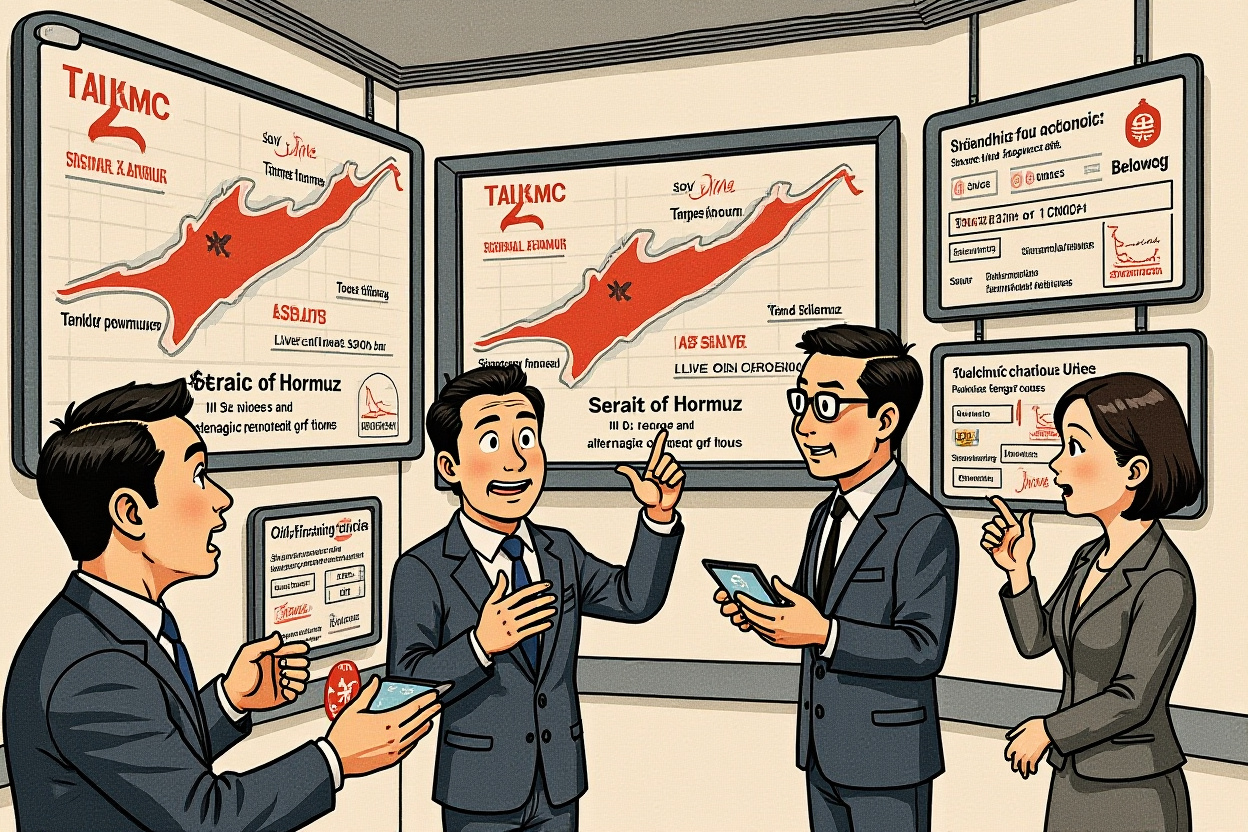
- The Strait of Hormuz, a chokepoint for 20% of global oil trade, has seen commercial traffic effectively halt, with no confirmed transits in 24 hours, pushing Brent crude near $100/barrel.
- This poses a direct threat to China’s energy security, as the world’s largest crude importer sources a significant portion of its oil from the Persian Gulf region via this route.
- Market volatility is imminent for Chinese energy, shipping, and petrochemical stocks, while broader inflationary pressures could constrain monetary policy and impact consumer sectors.
- Investors must immediately reassess exposure to sectors with high energy input costs and monitor strategic petroleum reserve releases and diplomatic efforts led by nations like India.
- The reliance on disrupted tracking data due to vessel AIS silence underscores the opacity and heightened risk in global energy logistics.
A Chokepoint Closes: Global Energy Markets Brace for Impact
The world’s most critical maritime oil artery has seized up. According to Bloomberg reports, commercial shipping traffic through the Strait of Hormuz has effectively ground to a complete halt over the past 24 hours, with no confirmed transits in either direction. This unprecedented event has immediately sent shockwaves through global energy markets, with Brent crude prices hovering around the psychologically significant $100 per barrel mark. For international investors, particularly those with exposure to the world’s second-largest economy, the implications extend far beyond headline oil prices, striking at the heart of China’s strategic energy security and economic stability.
The Strait of Hormuz, often dubbed the world’s “oil chokepoint,” is the conduit for approximately one-fifth of global petroleum trade. Its closure is not merely a geopolitical headline; it is a direct supply shock with immediate inflationary consequences. The situation remains fluid, with diplomatic efforts by countries including India ongoing but yet to yield tangible de-escalation or a resumption of normal shipping. The current Hormuz traffic at nadir represents a clear and present danger to the smooth flow of energy to Asia’s industrial engines.
Deciphering the Data Blackout: What “No Confirmed Transits” Really Means
The reported zero-transit figure requires careful interpretation, as it highlights a concurrent crisis in maritime information. Persistent electronic interference in the region has degraded the accuracy of ship positioning systems, prompting a significant number of vessels to switch off their Automatic Identification System (AIS) transponders and proceed under “radio silence.” This practice, while a safety precaution for crews, creates a data vacuum, meaning the actual number of transits is likely underreported, not zero, but certainly at a critically low level.
To compensate, tracking analysts have expanded signal collection to broader sea areas like the Gulf of Oman, the Arabian Sea, and the Red Sea. The goal is to capture vessels that have left or are approaching the Persian Gulf but have not yet reactivated their AIS. These ships often remain silent for extended periods, sometimes only resuming signal broadcasts near the Strait of Malacca roughly ten days later. Furthermore, every potential transit signal is now rigorously vetted to filter out “ghost” positions caused by the very electronic warfare measures disrupting the region. This data opacity itself is a market risk, fostering uncertainty and hindering accurate real-time assessment of supply flows.
Direct Implications for China: The Import Dependency Dilemma
For China, the world’s largest importer of crude oil, the Strait of Hormuz is not a distant waterway but a lifeline. A significant portion of China’s crude imports originate from suppliers like Saudi Arabia, Iraq, the United Arab Emirates, and Iran—all of which rely on the strait for exports. Any prolonged disruption directly threatens the volume and cost of energy reaching Chinese refineries and strategic reserves. This scenario forces a urgent reassessment of a core vulnerability in China’s economic model: its profound dependence on foreign energy to fuel growth.
The immediate effect is a dual squeeze on cost and logistics. Surging benchmark prices translate directly into higher import bills, worsening the trade balance and exerting downward pressure on the yuan (人民币). Simultaneously, shipping costs for tankers from the Middle East to China (known as Dirty Tanker rates on routes like Middle East Gulf to China, TD3C) are likely to spike due to increased war risk insurance premiums and potential rerouting delays. The Hormuz traffic at nadir event is a stark reminder that China’s energy security is intrinsically linked to global maritime stability.
Strategic Petroleum Reserve: A Cushion with Limits
In response to such shocks, market attention turns to China’s vast Strategic Petroleum Reserve (SPR). The government possesses the ability to release barrels from these reserves to calm domestic markets and cushion refiners. A coordinated release with other IEA members is also a possibility. However, analysts caution that SPRs are a finite buffer, not a permanent solution. The duration and severity of the Strait closure will determine the efficacy of this tool. Furthermore, any drawdown would need to be replenished later, potentially at even higher prices, locking in future fiscal costs.
Sectoral Impact on Chinese Equity Markets
The tremors from the Hormuz disruption will be felt unevenly across China’s stock markets, creating both clear losers and potential, albeit risky, winners. Sophisticated investors are now tasked with rapid portfolio repositioning based on exposure to energy input costs and pricing power.
Vulnerable Sectors: The Cost Squeeze
- Aviation & Transportation: Airlines (中国国际航空公司, Air China) and shipping lines are highly sensitive to fuel costs, which constitute a major operational expense. Their profit margins face immediate compression without an easy pass-through to consumers.
- Petrochemicals & Plastics: While integrated oil giants have upstream benefits, downstream chemical companies that use naphtha and other oil derivatives as feedstocks will see input costs soar, pressuring earnings.
- Automotive & Manufacturing: Broader manufacturing sectors face higher logistics and potential raw material costs, though the ability to pass these on varies widely.
- Consumer Discretionary: Persistent high energy costs feed into broader inflation, potentially reducing household disposable income and spending on non-essential goods.
Potential Beneficiary Sectors: Hedge Plays
- Integrated Oil & Gas Majors: Companies like 中国石油化工股份有限公司 (Sinopec) and 中国海洋石油总公司 (CNOOC) with substantial domestic or diversified international production can benefit from higher realized oil and gas prices, potentially offsetting refining headwinds.
- Coal & Domestic Energy Producers: Higher oil prices improve the competitive economics of coal. Companies in the coal sector and domestic natural gas producers may see renewed investor interest as substitutes.
- Renewable Energy & EVs: In the medium term, this crisis strengthens the strategic argument for energy independence through renewables and electrification of transport, potentially boosting related equities.
Macroeconomic and Policy Crosscurrents for the PBOC
The People’s Bank of China (中国人民银行, PBOC) now faces a more complicated policy landscape. The central bank, under Governor Pan Gongsheng (潘功胜), has been cautiously providing monetary support to stimulate the economy. However, a sustained oil price shock imported via the Hormuz traffic at nadir scenario directly fuels inflationary pressures. This could tie the PBOC’s hands, limiting its ability to enact further aggressive rate cuts or liquidity injections for fear of stoking stagflation—a combination of slowing growth and rising prices.
Furthermore, a widening trade deficit due to costlier energy imports could pressure the yuan exchange rate. The PBOC may need to utilize its foreign exchange reserves more actively to stabilize the currency (人民币), adding another layer of complexity to its policy toolkit. Investors must closely watch upcoming CPI and PPI data, as well as PBOC open market operation statements, for signs of shifting priorities between supporting growth and containing inflation.
Navigating the Uncertainty: Strategic Considerations for Investors
In this environment of heightened risk, passive observation is not a strategy. Institutional investors must adopt a dynamic and nuanced approach. The immediate priority is conducting thorough portfolio stress tests to identify holdings most susceptible to an extended period of elevated or volatile energy prices. This goes beyond simple sector classification to examine company-specific metrics like gross margins, energy cost as a percentage of expenses, and pricing power.
Secondly, attention must shift to alternative supply routes and sources. How quickly can Chinese buyers pivot to increase imports from Russia via pipelines, from Africa, or from the Americas? While these sources cannot fully replace Middle Eastern volumes overnight, the speed and premium of such diversification will be key market indicators. Monitoring freight rates and tanker tracking data for changes in trade flows will provide early signals.
Finally, the geopolitical dimension cannot be ignored. The effectiveness of diplomatic channels, the potential for a rapid de-escalation, or conversely, a protracted crisis will be the ultimate driver of the oil price trajectory. The current Hormuz traffic at nadir represents a peak of tension, but its resolution timeline remains the largest unknown.
Risk Management in a Time of Strategic Shock
The effective closure of the Strait of Hormuz is a classic “black swan” event with deep ramifications for global energy markets and, by direct extension, China’s economy and equity markets. The dual themes of supply shock and data opacity create a high-stakes environment for decision-makers. While China’s strategic reserves and financial buffers provide some short-term resilience, the core vulnerability of its import-dependent energy model has been exposed.
For investors, the path forward involves heightened vigilance, active sector rotation, and a keen eye on both macroeconomic data and geopolitical developments. The winners will be those who can accurately gauge the duration of the crisis, the efficacy of China’s policy response, and the secondary effects on corporate earnings across the supply chain. In the longer term, this event will undoubtedly accelerate strategic discussions in Beijing and boardrooms worldwide about energy diversification, efficiency, and the transition to more secure sources—themes that will define investment opportunities for years to come. Prudent portfolio managers should immediately review their exposure and establish clear triggers for action based on oil price levels, freight rate movements, and official statements from Beijing regarding strategic stockpiles.