



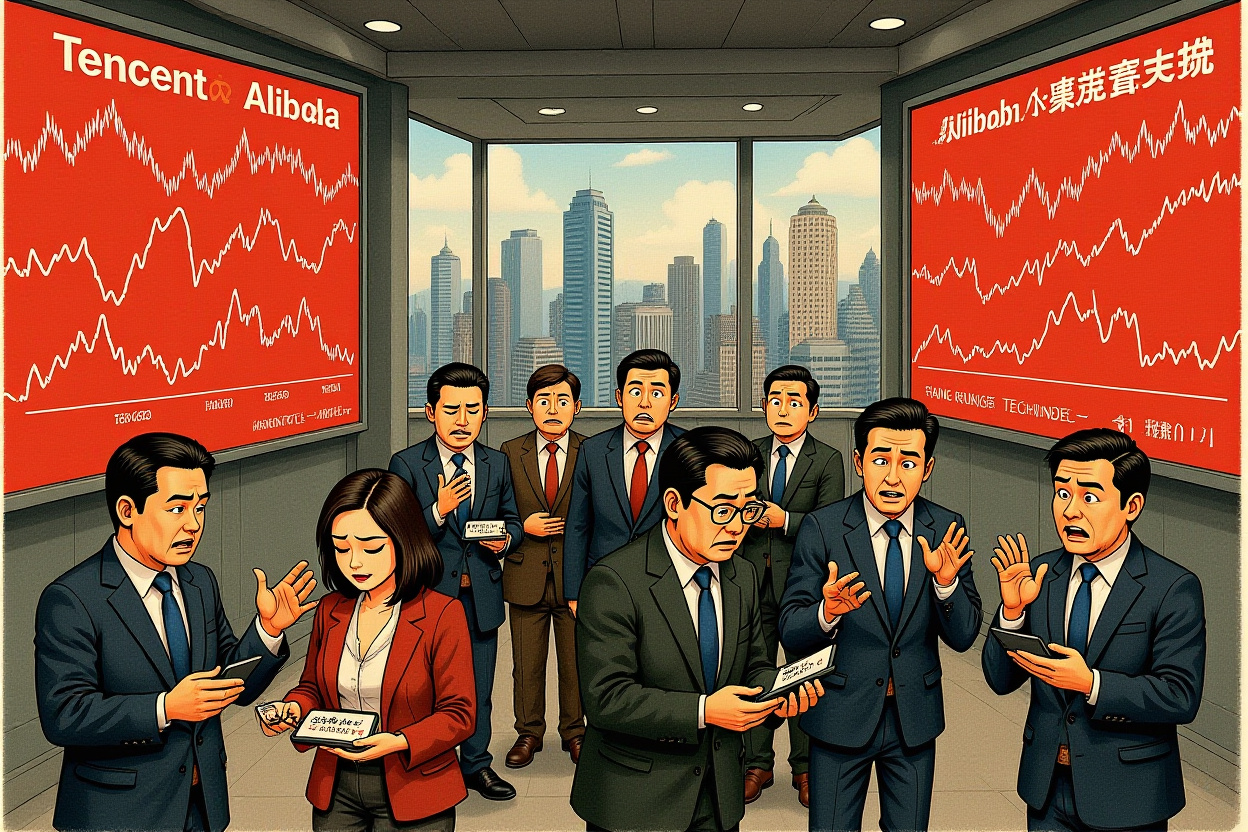
– Hong Kong’s Hang Seng Tech Index tumbled over 5% in a single session, driven by unverified rumors of impending regulatory crackdowns from Chinese authorities on internet platforms. – Major constituents like Tencent Holdings (腾讯控股) and Alibaba Group (阿里巴巴集团) saw declines exceeding 7%, wiping out billions in market capitalization and spooking global investors. – The episode highlights the heightened sensitivity of Hong Kong equities to policy speculation, exacerbated by fragile sentiment amid ongoing economic headwinds. – Market analysts emphasize the need for discernment between rumor and reality, advising clients to focus on fundamental valuations and official communications. – Investors are urged to review risk exposure and consider hedging strategies to navigate potential volatility in the coming weeks. The trading floors of Hong Kong were abuzz with panic as sell orders flooded in for technology shares, culminating in one of the sharpest single-day declines this year. This Hong Kong technology stocks plunge, ignited by whispers of regulatory tightening from Beijing, served as a stark reminder of the market’s vulnerability to unconfirmed news. Within hours, the Hang Seng Tech Index shed significant value, dragging down broader indices and triggering margin calls across leveraged positions. For international fund managers and corporate executives with exposure to Chinese equities, the sudden downdraft underscores the critical importance of real-time risk assessment and the perpetual dance between policy signals and market pricing in this dynamic region.
The Rumor That Rocked the Market: Unpacking the Catalyst
Market sentiment in Hong Kong can pivot on a dime, and the latest Hong Kong technology stocks plunge was precipitated by a specific, yet unverified, rumor circulating among traders. The chatter suggested that Chinese regulators were preparing a new round of antitrust investigations targeting major internet companies, with a focus on data security and competitive practices. Such rumors, while common, gained unusual traction due to the current regulatory climate.
Details of the Alleged Regulatory Crackdown
The rumor specifically pointed to the State Administration for Market Regulation (市场监管总局) and the Cyberspace Administration of China (国家互联网信息办公室) launching coordinated probes. Although no official statement was released during the sell-off, the memory of previous crackdowns on firms like Alibaba and Meituan (美团) amplified the fear. Trading volumes for key stocks surged to 150% above their 30-day average, indicating a capitulation-style sell-off driven by algorithmic trading and retail panic. This Hong Kong technology stocks plunge was not an isolated event but part of a pattern where policy uncertainty triggers outsized reactions.
Immediate Market Reaction and Volume Surge
Within the first hour of trading, the Hang Seng Tech Index fell by 4.2%, with Tencent Holdings (腾讯控股) dropping 6.8% and JD.com (京东集团) down 5.5%. The velocity of the decline suggested automated selling and forced liquidation. Market data from Hong Kong Exchanges and Clearing Limited (HKEX) showed that short interest in technology ETFs spiked by 25% on the day, reflecting bearish positioning. For investors, the rapid price action highlighted the need for robust stop-loss mechanisms and continuous monitoring of news flows, especially from authoritative sources like the China Securities Regulatory Commission (CSRC).
Historical Context: Hong Kong Tech Volatility and Speculative Forces
To understand the magnitude of this Hong Kong technology stocks plunge, one must view it through the lens of historical volatility. The Hang Seng Tech Index has experienced several similar episodes over the past three years, often tied to regulatory announcements or macroeconomic data.
Comparison to Previous Sell-offs
– July 2021: The index plummeted 9% after China announced sweeping reforms for after-school tutoring companies, which spilled over into broader tech fears. – March 2022: A 7% drop occurred amidst delisting concerns for US-listed Chinese companies and Russia-Ukraine conflict anxieties. – October 2023: A 4.5% decline followed weak PMI data and property sector woes, showing how tech stocks often lead market downturns. Each of these events shared characteristics with the current plunge: high volume, rumor-driven initial moves, and subsequent partial recoveries once clarity emerged. The recurring theme is that Hong Kong technology stocks plunge on policy ambiguity, making them a barometer for investor confidence in Chinese governance.
Role of Speculative Trading and Retail Participation
The rise of retail trading via platforms like Futu (富途) and Tiger Brokers (老虎证券) has added fuel to these fire sales. During the latest sell-off, retail investors accounted for approximately 40% of the turnover in tech stocks, often reacting to social media posts and unverified chat groups. This democratization of trading, while beneficial for market access, can exacerbate volatility when rumors spread. Institutional players, such as BlackRock and Fidelity, noted in client briefings that they used the dip to accumulate positions in high-conviction names, betting on a rebound once the noise subsided.
Regulatory Environment and Its Impact on Investor Sentiment
The regulatory landscape in China remains a primary driver for Hong Kong equities, and this Hong Kong technology stocks plunge is a direct reflection of that reality. Over the past few years, authorities have implemented a series of measures to rein in the power of big tech, focusing on antitrust, data security, and financial stability.
Recent Policies from Chinese Authorities
– Anti-Monopoly Guidelines: Introduced in 2021, these rules have led to hefty fines for companies like Alibaba and Meituan, creating a persistent overhang. – Data Security Law (数据安全法): Enforced from September 2021, it requires firms to undergo stringent compliance checks, increasing operational costs. – Variable Interest Entity (VIE) Structure Scrutiny: Ongoing reviews have raised concerns about the legal standing of many offshore-listed Chinese firms. These policies, while aimed at long-term sector health, have introduced uncertainty that can trigger sudden sell-offs. As noted by analyst Zhang Wei (张伟) of China International Capital Corporation Limited (中金公司), “The market is pricing in a regulatory risk premium that fluctuates with every whisper from Beijing, making Hong Kong technology stocks plunge a periodic event until a more predictable framework is established.”
Impact on Foreign Investment Flows
The volatility has tangible effects on capital movement. EPFR Global data indicates that foreign institutional investors pulled an estimated $2 billion from Hong Kong equity funds in the week of the sell-off, with tech sectors seeing the largest outflows. However, long-term investors like Singapore’s GIC and Norway’s Government Pension Fund Global have maintained allocations, viewing dips as entry points. The key takeaway is that while short-term flows are reactive, strategic money is focused on fundamentals, such as earnings growth and competitive moats, rather than transient rumors.
Key Players and Stock Performance: A Deep Dive
The Hong Kong technology stocks plunge was not uniform across all companies; some were hit harder than others, reflecting specific vulnerabilities and market perceptions.
Tencent, Alibaba, and Meituan Under the Microscope
– Tencent Holdings (腾讯控股): Shares fell 7.2%, partly due to its vast ecosystem in gaming and social media, areas frequently under regulatory scrutiny. The company’s P/E ratio compressed to 18x, near historic lows. – Alibaba Group (阿里巴巴集团): Dropped 7.5%, exacerbated by its core e-commerce business facing slowing growth and competition. Investors are keenly watching for updates on its restructuring plans. – Meituan (美团): Declined 6.9%, with concerns over delivery rider costs and new regulations for the platform economy. Its stock has underperformed the index year-to-date, down 12%. These movers highlight how sector-wide rumors can have disparate impacts based on company-specific factors. For active managers, this differentiation is crucial for stock-picking during such events.
Analysis of Technical Indicators and Support Levels
From a technical perspective, the Hang Seng Tech Index breached its 50-day moving average during the plunge, triggering further algorithmic selling. Key support levels around 4,200 points were tested, with the index eventually finding a floor at 4,150. Relative Strength Index (RSI) readings dipped into oversold territory below 30, suggesting a potential short-term bounce. Chart analysts at UBS pointed out that similar oversold conditions in the past have preceded rebounds of 5-10% within a month, offering tactical opportunities for contrarian investors.
Expert Insights and Market Prognosis: Navigating the Uncertainty
To gauge the future trajectory, insights from industry veterans are invaluable. This Hong Kong technology stocks plunge has prompted a flurry of commentary from leading figures.
Quotes from Analysts and Fund Managers
– “The sell-off is overdone relative to the actual regulatory risk,” stated Li Ming (李明), portfolio manager at Harvest Fund Management (嘉实基金). “We are using this Hong Kong technology stocks plunge to add to our positions in cloud computing and AI leaders, as their long-term growth narratives remain intact.” – Helen Zhu, managing director at BlackRock’s Asian equities team, noted, “Investors must distinguish between noise and signal. While rumors can cause short-term pain, the underlying driver for Chinese tech is innovation, which hasn’t diminished.” – A report from Goldman Sachs emphasized that valuations are attractive, with the sector trading at a 30% discount to historical averages, but cautioned that sentiment recovery depends on clearer policy communication from the People’s Bank of China (中国人民银行) and other bodies. These perspectives underscore a cautious optimism, with experts advocating for a balanced approach that acknowledges risks while seizing opportunities.
Short-term vs Long-term Outlook
In the short term, volatility is likely to persist as traders await official denials or confirmations of the rumors. The Hong Kong Monetary Authority (香港金融管理局) may intervene to stabilize markets if liquidity strains emerge, as seen in past crises. Over the long term, fundamentals will reassert themselves. Chinese tech companies are still poised to benefit from digital transformation trends across Asia, with revenue growth projections averaging 15% annually for the next five years. Investors with a horizon beyond the noise can potentially capitalize on this Hong Kong technology stocks plunge to build positions in quality names.
Risk Management Strategies for Institutional Investors
For fund managers and corporate executives, such events are a test of risk frameworks. The Hong Kong technology stocks plunge offers lessons in portfolio construction and response protocols.
Diversification Tips and Hedging Techniques
– Geographic Diversification: Reduce concentration in Hong Kong by allocating to other Asian markets like Japan or India, which have lower correlation to Chinese policy news. – Sector Diversification: Balance tech exposure with staples, energy, or financials that are less sensitive to regulatory shifts. – Use of Derivatives: Employ options strategies, such as buying put options on the Hang Seng Tech Index or individual stocks, to hedge downside risk during periods of uncertainty. – Dynamic Asset Allocation: Implement models that adjust weights based on volatility indicators, such as the VIX-like measure for Hong Kong, to reduce exposure during turbulent times. These strategies can help mitigate losses when rumors spark sudden sell-offs.
Monitoring Regulatory Announcements and Data Releases
Proactive monitoring is essential. Investors should track official channels like the website of the China Securities Regulatory Commission (CSRC) for announcements. Additionally, key economic indicators, such as China’s PMI data or consumer sentiment indexes, can provide context for market moves. Setting up alerts for news related to specific companies or sectors can enable faster decision-making. As this Hong Kong technology stocks plunge showed, being ahead of the information curve is a competitive advantage in fast-moving markets. The sudden downturn in Hong Kong’s technology sector, while alarming, is a manifestation of the complex interplay between policy, perception, and pricing in Chinese equities. This Hong Kong technology stocks plunge reiterates that rumors can have real financial consequences, especially in a market still grappling with regulatory evolution. For sophisticated investors, the key takeaways are clear: maintain a disciplined focus on fundamentals, employ robust risk management tools, and use volatility as a lens to identify value. As the dust settles, the episode may well present a buying opportunity for those with conviction in the long-term growth story of China’s tech innovators. Moving forward, stay engaged with authoritative sources, consult with financial advisors to refine your strategy, and consider increasing your research allocation to Hong Kong markets to better anticipate and react to such events.