



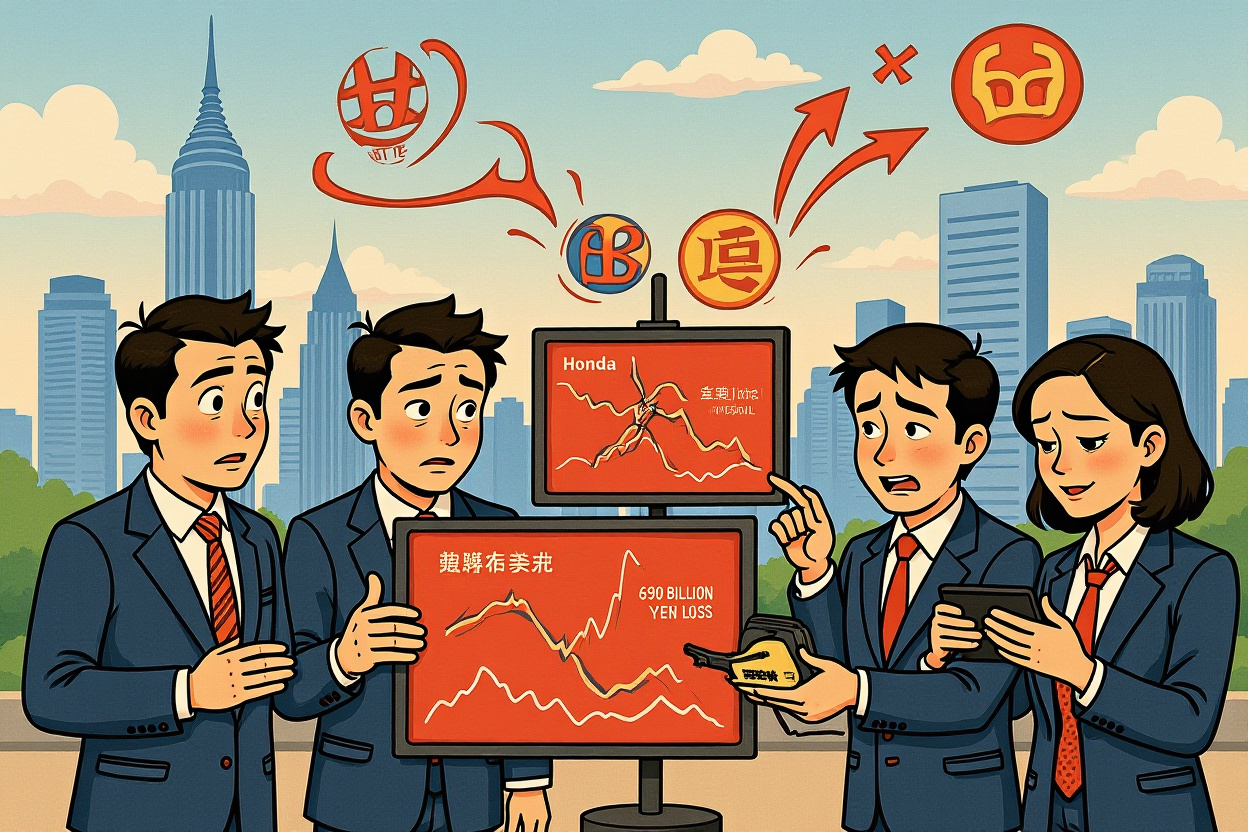
Key Takeaways: Honda’s Unprecedented Loss in Context
- Honda Motor Co., Ltd. (本田) projects a net loss of up to 690 billion yen (approximately $4.5 billion USD) for fiscal year 2025, marking its first annual loss since 1957.
- The loss stems from massive asset impairments: up to 2.5 trillion yen in North America due to cancelled EV projects, and significant writedowns in China amid plunging sales.
- Strategic errors include misjudging EV market readiness, over-relying on traditional mechanical expertise, and failing to adapt supply chains for cost-competitive electric vehicles.
- This Honda’s 690 billion yen loss is not isolated; it reflects broader distress in the traditional auto sector, with Nissan, Toyota, and Western giants facing similar pressures.
- Investors must reassess the viability of legacy automakers’ electrification strategies and monitor software capabilities as key differentiators in the evolving market.
The Staggering Announcement That Shook the Auto World
A single financial warning has sent shockwaves through global capital markets, revealing a profound crisis at one of Japan’s industrial icons. Honda Motor Co., Ltd. (本田) has forecast a net loss of up to 690 billion yen for the 2025 fiscal year—a figure that translates to roughly 30 billion Chinese yuan or $4.5 billion USD. This Honda’s 690 billion yen loss is not merely a bad quarter; it represents the first annual deficit for the company in 69 years, surpassing the impacts of the 2008 global financial crisis and the 2011 Great East Japan Earthquake. For a firm renowned for its engineering prowess and “engine-first” philosophy, this moment is a stark departure from decades of resilience. The immediate question for investors and industry watchers is clear: How did a titan stumble so dramatically, and what does it portend for the entire automotive sector? This analysis delves into the anatomy of the loss, the strategic miscalculations, and the urgent lessons for all traditional automakers navigating the electric and intelligent vehicle revolution.
Deconstructing the 690 Billion Yen Loss: A Two-Part Disaster
To understand the magnitude of Honda’s financial shock, one must dissect the two primary sources of this historic loss. It is a tale of two markets—North America and China—each contributing catastrophic write-downs that together form this Honda’s 690 billion yen loss.
North America’s Electric Vehicle Dream Derailed
Honda’s most painful decision involved abruptly cancelling three core pure-electric vehicle models under development for the North American market. This move triggered an asset impairment charge of up to 2.5 trillion yen, a colossal “tuition fee” for misreading the market. The rationale was brutal: the U.S. electric vehicle landscape shifted dramatically. Policy incentives wavered, consumer demand plateaued at less than half of prior projections, and EV penetration rates briefly retreated to single digits. Pushing forward with these models would have meant annual losses of billions for years to come. As a result, sunk costs in research and development, factory retooling, and supply chain investments were written off. For further details on U.S. EV policy volatility, refer to announcements from the U.S. Department of Energy.
China’s Market: From Cash Cow to Financial Black Hole
Once a dominant force in China’s auto market, where models like the CR-V and Accord commanded premiums and waiting lists, Honda now faces a stark reversal. In 2025, Honda’s China sales plummeted 24% year-over-year to 645,000 units, marking the fifth consecutive annual decline. Market share has been devoured by domestic champions like BYD (比亚迪) and Geely (吉利), forcing Honda to take substantial asset impairments on its Chinese investments. The region, historically a profit engine, has become a significant drag, compounding the overall Honda’s 690 billion yen loss. This downturn underscores the intensity of China’s EV price wars and the rapid shift toward smart, software-defined vehicles.
The Strategic Blunders Behind Honda’s Downfall
Honda’s crisis is not a simple twist of fate but the culmination of three critical strategic errors. These missteps reveal a deeper institutional struggle to adapt to the new automotive paradigm.
Overzealous Electrification: A Premature All-In Bet
Honda positioned itself as the most aggressive among Japanese automakers, announcing in 2021 a goal to cease sales of all gasoline-powered vehicles by 2040 and pledging 10 trillion yen toward electrification. This “all-in” stance thrilled investors initially but proved disastrously premature. The global EV market evolved unpredictably, with adoption rates slowing in key regions just as Honda ramped up spending. The company essentially slammed the accelerator only to find a cliff edge, necessitating an emergency brake. This Honda’s 690 billion yen loss is a direct result of betting big on a timeline that the market refused to follow.
Over-Reliance on Traditional Engineering in an Intelligent Era
Honda’s identity as a “tech geek” focused on mechanical excellence became a liability. The company assumed that superior engine and chassis technology would seamlessly translate to EV dominance. However, modern consumers prioritize智能化 (intelligence)—advanced driver-assistance systems, seamless software updates, and immersive cockpit experiences. While Chinese rivals competed on 8295 chips, high-level autonomous driving, and expansive touchscreens, Honda clung to its “buy an engine, get a car free” legacy. This disconnect led to uncompetitive products in critical markets like China, where tech-savvy buyers turned elsewhere.
Supply Chain Miscalculations in the EV Age
Accustomed to the tight cost controls of internal combustion engine supply chains, Honda failed to navigate the economics of electric vehicle production. Its pure-electric models, such as the e:Ny1 and upcoming cancelled North American vehicles, suffered from prohibitively high costs. In a market defined by brutal price competition, Honda found itself trapped: price too high and lose sales, price too low and incur losses. This fundamental miscalcation—using an old map for a new continent—left the company defenseless in the EV cost war, directly feeding into the Honda’s 690 billion yen loss.
Industry-Wide Implications: Is Honda the First Domino?
Honda’s financial shock is a potent signal, not an anomaly. It suggests that the entire traditional automotive industry is perched on a precipice, with Honda potentially acting as the first domino in a chain of failures.
Japanese Peers in Parallel Peril
Nissan Motor Co., Ltd. (日产) has already sounded alarms, reporting a staggering loss of 6709 billion yen for the 2024 fiscal year and announcing global factory closures and 20,000 job cuts. Toyota Motor Corporation (丰田), while buoyed by hybrid vehicle sales, faces its own electrification struggles. Models like the Lexus RZ and bZ4X have underwhelmed in key markets, indicating that even the industry leader is not immune. The Honda’s 690 billion yen loss thus mirrors a sector-wide vulnerability among Japanese automakers slow to pivot.
Western Giants Confronting Similar Headwinds
The pain extends globally. Porsche AG, synonymous with premium performance, saw its operating profit crater by 92% to just 4 billion euros in 2025. Ford Motor Company took a $19.5 billion special charge related to its EV business restructuring. General Motors and Stellantis NV (parent of Jeep and Chrysler) have also engaged in massive asset impairments. These examples underscore a brutal truth: in this once-in-a-century industry transformation, legacy brands with deep historical roots often carry the heaviest technological and cultural baggage. The next casualties could be slow-moving luxury marques or joint-venture brands lacking software prowess.
Pathways Forward: Lessons from Honda’s Missteps
The Honda’s 690 billion yen loss offers critical lessons for automakers, investors, and policymakers. Survival in the new era demands a fundamental rethink of strategy, capability, and timing.
Embrace Agile, Phased Electrification Strategies
Rather than grandiose, all-or-nothing commitments, successful automakers are adopting flexible, market-responsive electrification roadmaps. This involves:
- Continuous scenario planning for regulatory changes, as seen in the U.S. and EU.
- Modular platforms that can support multiple powertrains to hedge bets.
- Strategic partnerships, like Honda’s alliance with Sony for EV development, to share costs and risks.
Prioritize Software and User Experience
The battlefield has shifted from horsepower to processing power. Automakers must:
- Invest heavily in in-house software teams or acquire tech startups.
- Develop over-the-air update capabilities to enhance vehicles post-purchase.
- Focus on human-machine interface design to compete with tech companies entering the auto space.
Reengineer Supply Chains for Cost and Resilience
EV supply chains, particularly for batteries and semiconductors, require new approaches:
- Secure long-term agreements for critical minerals like lithium and cobalt.
- Localize production to mitigate geopolitical risks and tariffs.
- Adopt vertical integration where feasible, as demonstrated by BYD’s control over its battery supply.
Synthesizing the Crisis and Looking Ahead
Honda’s 690 billion yen loss is a watershed moment for the global automotive industry. It crystallizes the existential challenges facing legacy manufacturers: the need to balance aggressive electrification with market realism, to complement mechanical excellence with digital intelligence, and to overhaul century-old business models for a software-driven future. For investors, this episode underscores the importance of scrutinizing not just quarterly earnings but the depth of a company’s technological transformation and its adaptability to regional market dynamics. The coming years will likely see further consolidation, strategic retreats, and perhaps unexpected failures among traditional brands. As the industry navigates this turmoil, the survivors will be those who learn from Honda’s painful lessons—embracing agility, innovation, and a clear-eyed view of the new competitive landscape. Monitor upcoming financial disclosures from key players and regulatory shifts in major markets to gauge who is positioned to thrive in the post-crisis era.