



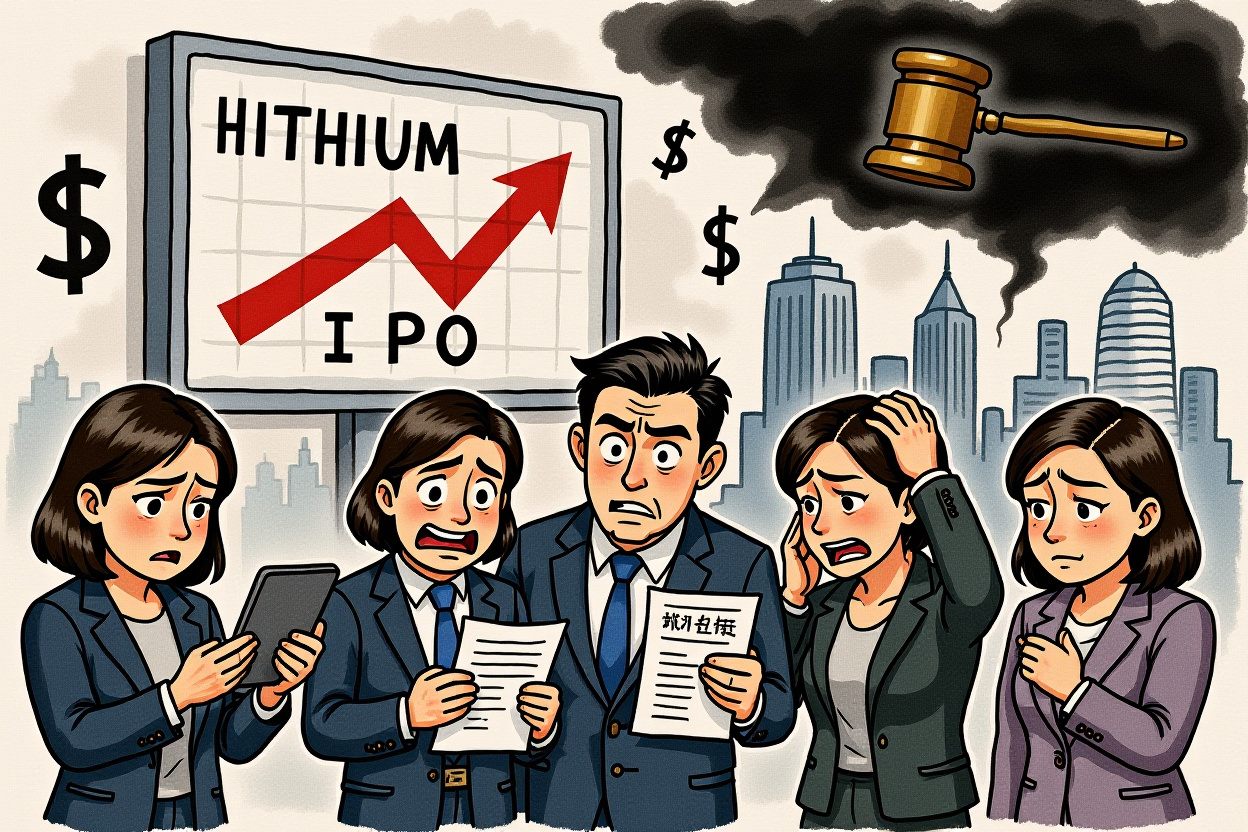
Legal Firestorm Engulfs HiTHIUM’s IPO Path
HiTHIUM’s ambitious Hong Kong IPO faces unprecedented headwinds as battery giant CATL launches multiple lawsuits against the energy storage upstart. The legal assault escalated dramatically in July when Fujian police detained HiTHIUM’s Office Director Feng Dengke (冯登科) on suspicion of trade secret theft. Simultaneously, CATL filed an unfair competition lawsuit targeting HiTHIUM founder Wu Zuyu (吴祖钰) and seven other defendants, strategically timed for an August 12 court hearing that coincides with HiTHIUM’s expected IPO聆讯 (listing hearing) window. This legal gauntlet threatens to derail one of China’s fastest-growing battery manufacturers during its most critical financial moment.
The Talent War Escalates
At the core of the dispute lies an intensifying battle for technical talent. HiTHIUM founder Wu Zuyu (吴祖钰), a former 8-year CATL veteran who led composite current collector development, established HiTHIUM just 10 months after leaving CATL. Multiple HiTHIUM executives including Executive Director Yi Ziqi and Deputy General Manager Pang Wenjie are CATL alumni. Legal documents reveal:
– CATL won a 2023 lawsuit against Wu for violating non-compete terms (¥1 million penalty)
– Former CATL employee Zhang Min allegedly secretly served HiTHIUM while employed at Xiamen Rare Earth Materials Institute
– Feng Dengke (冯登科) reportedly infiltrated CATL supplier GEM New Materials using the alias “Ma Gong”
HiTHIUM maintains its innocence, stating: “No effective legal document has determined our involvement in unfair competition.” Yet these legal salvos directly threaten the HiTHIUM IPO timeline.
Patent Disputes Intensify
Technical infringement claims form the second legal front. CATL alleges HiTHIUM’s 587Ah energy storage cell shows suspicious technical parallels to its patented technology, with only 4.4% energy density variance. More critically, CATL claims HiTHIUM appropriated composite current collector technology developed during Wu’s CATL tenure. HiTHIUM counters that its products are independently developed and the disputed technology “is publicly known.” With both civil and criminal proceedings unfolding, the HiTHIUM IPO faces regulatory uncertainty at the worst possible moment.
Financial House of Cards Emerges
Behind HiTHIUM’s impressive revenue surge—from ¥3.6 billion in 2022 to ¥12.9 billion in 2024—lurk alarming financial vulnerabilities that could jeopardize its public market debut. The company achieved paper-thin profitability in 2024 with ¥288 million net income, but this masks deeper issues. Remove ¥414 million in government subsidies, and HiTHIUM would have reported significant losses. This subsidy dependency raises sustainability questions for the HiTHIUM IPO narrative.
Debt Tsunami Approaches
HiTHIUM’s balance sheet reveals severe strain. The company carries:
– 73.1% debt-to-asset ratio (versus CATL’s 65.2% and Eve Energy’s 59.4%)
– ¥9.98 billion in bank loans against only ¥4.29 billion cash reserves
– Accounts receivable ballooning from ¥223 million (2022) to ¥8.32 billion (2024)
Payment collection efficiency collapsed from 12 days to 186 days—meaning HiTHIUM now waits over six months to receive payments. The company acknowledges in its prospectus: “If customers fail to settle timely, our financial condition may suffer material adverse effects.”
Profitability Mirage
HiTHIUM’s apparent margin improvement (11.3% to 17.9% from 2022-2024) stems entirely from overseas sales. Domestic margins actually eroded from 11.3% to 8.1% during this period. The export-driven margin boost appears fragile due to:
– Battery ASP freefall: Prices dropped 62.5% from ¥0.8/Wh to ¥0.3/Wh
– Concentration in two U.S. clients generating 80% of overseas revenue
– Credit loss provisions surging from ¥1.8 million to ¥660 million
These metrics suggest the HiTHIUM IPO prospectus may overstate sustainable profitability.
Overseas Expansion Hits Quicksand
HiTHIUM’s explosive international growth—from negligible 2022 exports to ¥3.7 billion (28.7% of revenue) in 2024—now faces collapse risks. The company’s heavy reliance on the U.S. market, where it booked 42.3% gross margins, has become its Achilles’ heel. Two American clients accounted for 80% of overseas income, including a single customer representing 17.3% of total revenue. Market intelligence suggests this key client is U.S. energy storage firm Powin LLC—currently undergoing bankruptcy proceedings while facing a separate ¥310 million lawsuit from CATL.
Powin Domino Effect
The potential Powin collapse threatens HiTHIUM with:
– ¥1.5 billion in undelivered 5GWh orders
– Massive accounts receivable exposure
– Reputational damage to overseas expansion strategy
HiTHIUM publicly claims “no outstanding debts” with Powin and asserts the bankruptcy “won’t adversely affect operations.” However, the company conspicuously avoided addressing the unfulfilled order book in its statement—a critical omission for HiTHIUM IPO investors evaluating revenue visibility.
Geopolitical Landmines
Beyond client risks, HiTHIUM faces escalating U.S.-China trade tensions. Potential impacts include:
– Section 301 tariffs exceeding 25% on Chinese batteries
– U.S. Inflation Reduction Act domestic content requirements
– Heightened customs scrutiny delaying shipments
These factors jeopardize the high-margin export model central to the HiTHIUM IPO valuation thesis. With battery prices continuing their global descent, the window for profitable exports may be closing rapidly.
Survival Strategies for a Precarious Position
As the HiTHIUM IPO hangs in limbo, management must address multiple simultaneous crises. The company requires urgent debt restructuring—particularly concerning its ¥9.98 billion loan burden that dwarfs cash reserves. Negotiating extended payment terms with creditors could prevent liquidity collapse. Simultaneously, HiTHIUM must accelerate collection of its ¥8.32 billion receivables, potentially offering discounts for early settlements to improve cash flow.
Client Diversification Imperative
Reducing reliance on volatile foreign markets demands:
– Aggressive domestic client acquisition to offset export risks
– Development of non-battery revenue streams like energy management software
– Strategic partnerships with state-owned utilities for stable contracts
The company should also reevaluate its pricing strategy. Maintaining premium export pricing appears unsustainable amid global oversupply and key client failures.
Legal Damage Control
Resolving the CATL litigation requires immediate action:
– Seeking settlement options to remove IPO roadblocks
– Proactively engaging Hong Kong regulators about case status
– Preparing contingency financing if IPO delays occur
Transparency with investors about potential liability exposure could prevent post-listing selloffs if the HiTHIUM IPO proceeds.
Navigating the Perfect Storm
HiTHIUM’s journey from founding to global top-three battery manufacturer in just six years remains remarkable. Securing ¥58 billion in credit facilities and achieving 89% revenue CAGR demonstrates impressive execution. Yet the company now faces a convergence of challenges that cast doubt on its public market transition. The CATL lawsuits strike at HiTHIUM’s technological legitimacy while the Powin bankruptcy undermines its growth narrative. Most alarmingly, the financial engineering behind its profitability—subsidy reliance and extended payment terms—creates fundamental sustainability questions.
For investors considering the HiTHIUM IPO, several red flags demand scrutiny: the 186-day collection cycle, negative operating cash flow if subsidies are excluded, and extreme client concentration. The company must urgently diversify revenue streams, shore up its balance sheet, and resolve legal entanglements before proceeding with its listing. Energy storage remains a promising sector, but HiTHIUM’s path to sustainable profitability requires fundamental restructuring beyond financial engineering. Monitor regulatory filings closely—this IPO battle will test whether rapid growth can overcome structural vulnerabilities in China’s battery sector.