



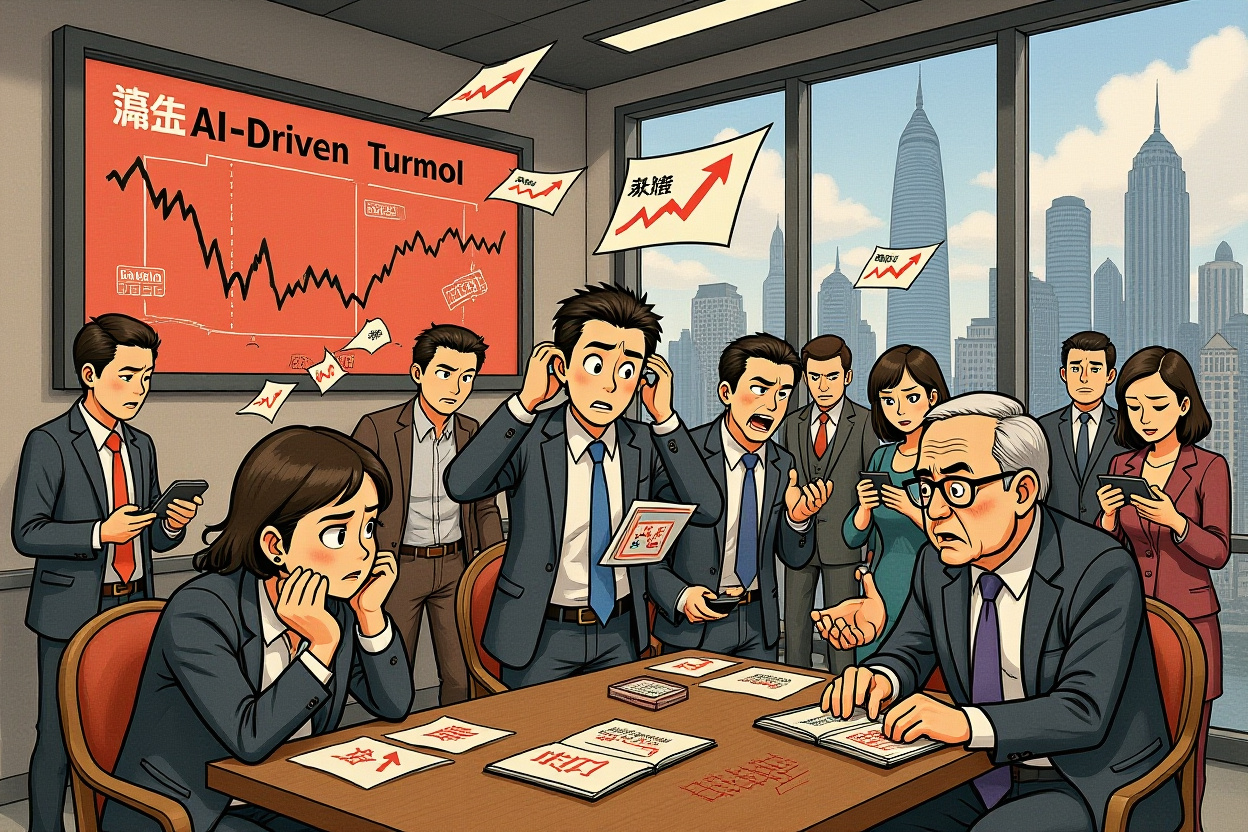
A seismic shift rattled global equity markets this week, as fears over the economic ramifications of artificial intelligence ignited a violent rotation that hammered hedge funds across multiple strategies. This hedge fund market turmoil, marked by the worst single-day losses for many managers in months, serves as a stark reminder of the latent vulnerabilities in tech-concentrated portfolios and the speed at which quantitative factors can reverse. For investors active in Chinese equities and beyond, the event underscores the critical need to monitor leverage, factor exposures, and the evolving narrative around AI profitability. The hedge fund market turmoil is not an isolated incident but a potential precursor to further instability as funds reassess risk.
Executive Summary: Key Takeaways from the Hedge Fund Rout
This week’s market moves deliver several urgent insights for institutional investors:
– Fundamental, systematic, and multi-strategy hedge funds recorded their worst single-day performance since at least November 2023, with losses comparable to periods of acute market stress.
– The primary catalyst was a sharp reassessment of artificial intelligence investments, raising doubts about cost returns and disruption to incumbent software business models.
– Momentum trading, a popular quant strategy, endured its worst day in three years, suggesting severe pressure on crowded tech positions.
– Despite the sell-off, value strategies and small-cap stocks outperformed, highlighting a rotation into undervalued and defensive segments.
– With gross and net leverage near elevated levels, prime brokers warn that further volatility could force significant hedge fund deleveraging, amplifying market moves.
The AI Shockwave: Anatomy of a Market Rotation
The hedge fund market turmoil this week found its genesis in growing investor anxiety over the AI investment cycle. After a stellar start to 2024, during which many large multi-strategy firms posted returns of 1% to 2% in January, the narrative shifted abruptly.
Cost Concerns and Business Model Disruption
Questions mounted regarding whether the colossal capital expenditures required to advance AI will generate adequate returns. Simultaneously, analysts began scrutinizing how generative AI might erode the competitive moats and profitability of established software giants. This dual concern triggered a rapid unwind of long positions in popular tech names and a flight from momentum factors. Data from prime brokerage desks indicated that the rotation was among the most violent in recent years, upending performance rankings almost overnight.
Quantitative Impact on Hedge Fund Strategies
The Goldman Sachs Group, Inc. (高盛集团) prime brokerage team, led by Vincent Lin (林文森), detailed the breadth of the damage. Their report noted that on Wednesday, both fundamentally-driven and systematic long/short equity hedge funds suffered their worst day since November. The firm estimated that multi-strategy equity portfolios also endured their most painful session since April 2023.
The team wrote, “Wednesday’s market moves hurt nearly all equity strategies simultaneously, with over two-thirds of funds in each index declining. The last time all three strategies fell more than 75 basis points in a single day was during the COVID-induced sell-off.” This historical parallel underscores the severity of the current hedge fund market turmoil.
Quant Strategies in the Crosshairs: The Momentum Unwind
At the epicenter of the sell-off was momentum trading, a quantitative strategy that buys recent winners and sells recent losers. This approach had been a significant source of alpha for funds heavily exposed to the technology sector.
Worst Day in Three Years for Momentum Factors
Analyses from major banks confirmed the scale of the reversal. JPMorgan Chase & Co. (摩根大通) prime brokerage, led by John Schlegel, concluded that momentum strategies faced their most severe single-day loss in three years. The velocity of the decline, combined with previously extended positioning, created a feedback loop that pressured funds to reduce exposure. The JPMorgan team stated, “Equity long/short and multi-strategy funds had been benefiting notably from alpha in tech. The potential for further volatility and deleveraging now looks quite elevated.”
Systematic and Multi-Strategy Funds Under Pressure
The hedge fund market turmoil was remarkably broad-based. Goldman Sachs noted that over 75% of funds across fundamental, quantitative, and multi-strategy categories lost money on Wednesday. Early estimates for February performance turned negative, with multi-strategy funds down approximately 1.9% for the month-to-date and equity long/short funds off by 1%. This rapid deterioration highlights how swiftly gains can evaporate in a factor-driven correction.
Winners Emerge Amid the Chaos: Value and Defensives Shine
While the hedge fund market turmoil devastated many popular trades, it also catalyzed a pronounced rotation into overlooked segments of the market. This dynamic is crucial for investors seeking to rebalance portfolios.
The Resurgence of Value and Small-Cap Stocks
As growth and momentum faltered, value strategies—which invest in stocks perceived to be undervalued—rallied strongly. Data from S&P Global (标普全球) indices suggested that value was on track for its best weekly performance since 2022. Similarly, small-cap stocks notably outperformed their large-cap counterparts, and defensive sectors beat high-volatility names. This shift indicates a move away from expensive, growth-oriented bets toward more reasonably priced and stable companies, a trend that may have legs if interest rate expectations remain fluid.
Implications for Portfolio Construction
The simultaneous punishment of momentum and revival of value offers a clear lesson on diversification. Portfolios overly reliant on a single factor or sector, particularly the high-flying tech names that have dominated returns, proved exceptionally vulnerable. Investors should review their allocations to ensure adequate exposure to value, small-cap, and defensive equities, which can act as a buffer during episodes of hedge fund market turmoil.
Leverage Levels: The Sword of Damocles Hanging Over Markets
A critical variable determining whether this hedge fund market turmoil escalates is the amount of leverage employed by funds. Elevated leverage can turn a correction into a crisis if forced selling ensues.
Current Exposure Remains High
Despite Wednesday’s sell-off representing the largest single-day hedge fund deleveraging in the U.S. single-stock market since October, analysts at Goldman Sachs described the move as “relatively modest.” Data shows that hedge fund gross and net exposure had been climbing steadily over the past year and remain at elevated levels. This high baseline of risk means that even a moderate shock can prompt outsized reactions as funds rush to meet margin calls or reduce risk-weighted assets.
The Deleveraging Risk Ahead
The prime brokerage commentary is unequivocal: the potential for further deleveraging is high. The JPMorgan team explicitly linked the current high leverage to the likelihood of continued volatility. If market conditions deteriorate or correlations break down further, a wave of systematic de-risking could exacerbate downward pressure, creating a volatile feedback loop. Monitoring prime brokerage reports and leverage metrics from sources like the Financial Industry Regulatory Authority (美国金融业监管局) will be essential in the coming weeks.
Historical Context and the Path Forward
Understanding this episode of hedge fund market turmoil requires placing it within a historical framework. The simultaneous, deep losses across multiple strategies harken back to crisis periods, yet the underlying economic backdrop today is different.
Comparison to Past Market Stresses
The Goldman Sachs analysis drew a direct comparison to the market panic during the initial COVID-19 outbreak in early 2020. While the current catalyst is different—AI reassessment versus a pandemic—the mechanistic outcome of broad-based, strategy-agnostic selling is similar. However, the absence of a systemic banking or liquidity crisis (so far) suggests the current stress may be more contained, provided leverage unwinds in an orderly fashion.
Strategic Guidance for Navigating Increased Volatility
For fund managers and institutional investors, the path ahead demands heightened vigilance. First, reassess concentration risk in technology and momentum factors. Second, closely monitor leverage ratios, both at the fund and systemic level. Third, stay attuned to regulatory developments from bodies like the China Securities Regulatory Commission (中国证券监督管理委员会) and the U.S. Securities and Exchange Commission, as policy shifts can alter market dynamics. Finally, maintain liquidity buffers to withstand further periods of hedge fund market turmoil without being forced sellers.
The events of this week are a powerful wake-up call. The hedge fund market turmoil triggered by AI fears demonstrates that markets can pivot with devastating speed, punishing consensus trades and rewarding contrarian positioning. While value and defensive stocks provided a haven this time, the landscape remains fluid. The key for sophisticated market participants is to move from reaction to proactive risk management. Diversify factor exposures, scrutinize leverage, and prepare for a regime where volatility is not an anomaly but a feature. The road ahead may be bumpy, but with disciplined strategy, investors can navigate the turbulence and identify new opportunities amid the chaos.