



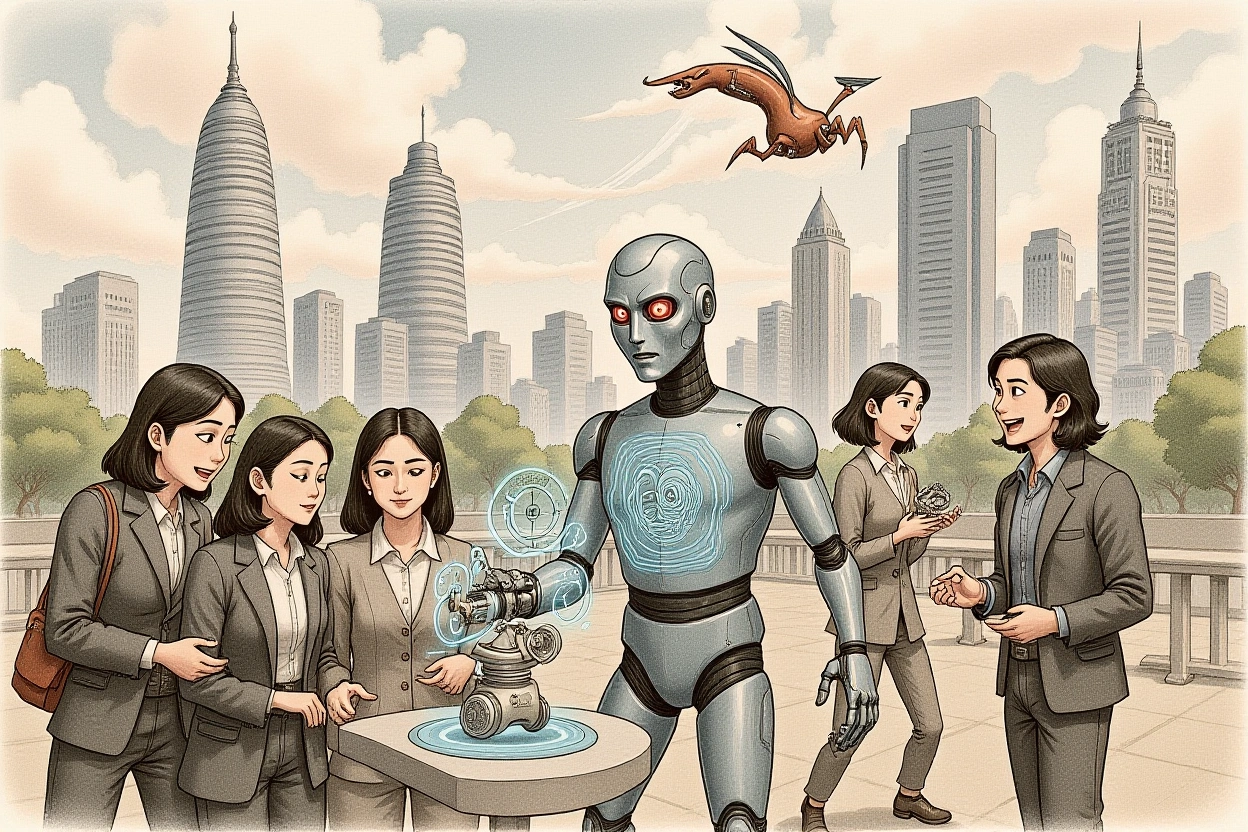
Summary of Key Developments
– Hangzhou released draft regulations explicitly supporting embodied intelligent robot development through technical standards and financial incentives
– The policy targets three core technical areas: AI “brains,” motion control “cerebellums,” and mechanical “bodies” of robots
– Six priority application sectors include industrial manufacturing, healthcare, agriculture, education, special operations, and public safety
– New requirements establish ethical guidelines and data security protocols for embodied intelligent systems
– Municipal departments will coordinate implementation with industry partnerships and infrastructure investments
The Regulatory Catalyst for Robotic Transformation
Hangzhou’s Municipal Bureau of Justice has unveiled revolutionary draft regulations that position the city at the forefront of embodied intelligent robotics innovation. These comprehensive guidelines, announced on August 11, 2025, create China’s first municipal-level framework specifically targeting the development of autonomous robots capable of interacting with physical environments. The timing coincides with global breakthroughs in multimodal AI systems, with cities like Tokyo and Berlin implementing similar technological initiatives. This regulatory package addresses critical bottlenecks through coordinated policy measures designed to accelerate commercialization. Industry analysts project these embodied intelligent robotics regulations could catalyze over ¥20 billion in regional investment by 2030.
Defining Embodied Intelligence
The regulations formally define embodied intelligent robots as systems integrating perception, cognition, and physical action within real-world environments. Unlike conventional industrial robots, these machines dynamically adapt to unstructured settings through continuous environmental feedback. This technological category represents the convergence of advanced AI with mechatronics – creating machines that learn through embodied experience much like humans. The draft legislation specifically prioritizes three interconnected technical pillars that form the foundation for these sophisticated systems.
Technical Framework: Brain, Cerebellum and Body
The Intelligent “Brain” Architecture
At the core of the framework is the embodied intelligence “brain” – referring to multimodal AI systems that process sensory inputs and make contextual decisions. The regulations mandate:
– Development of specialized large language models (LLMs) for robotic cognition
– Enhanced reliability testing protocols ensuring 99.8% decision-making accuracy
– Simulation training environments mirroring real-world complexity
– Transparent AI architectures allowing human oversight
These requirements address current limitations in robotic adaptability, pushing developers toward creating more resilient cognitive architectures for embodied intelligent platforms. Companies like CloudMinds and UBTECH already have prototype systems demonstrating these capabilities.
Motion Control “Cerebellum” Systems
The regulatory term “cerebellum” encompasses the motion coordination systems enabling physical dexterity. Technical priorities include:
– Advanced inertial navigation with sub-millimeter precision
– Whole-body dynamic control algorithms
– Environment-adaptive movement protocols
– Fail-safe collision avoidance mechanisms
These standards specifically target the challenge of operating in unpredictable environments – a critical hurdle for widespread adoption of embodied intelligent robots. Recent demonstrations by Boston Dynamics showcase the rapid advancements in this domain.
Mechanical “Body” Innovation
For the physical “body” component, the regulations incentivize:
– Lightweight durable actuator development
– Biomimetic materials mimicking human skin and muscle
– Modular component designs enabling rapid customization
– Energy-efficient power systems
Material science breakthroughs from institutions like Zhejiang University directly support these objectives, particularly in flexible sensor integration.
Cross-Cutting Technical Priorities
Specialized Chip Development
The regulations designate semiconductor innovation as a critical national priority, focusing on:
– Neuromorphic processors mimicking biological neural networks
– Low-power computation-in-memory architectures
– Application-specific integrated circuits (ASICs) for sensor fusion
– Fault-tolerant control chips for safety-critical systems
This aligns with China’s broader semiconductor self-sufficiency goals. Companies like Horizon Robotics and Cambricon are positioned to lead development in these specialized chips for embodied intelligent applications.
Shared Research Infrastructure
To prevent redundant investment, the framework establishes:
– Open-access testing facilities with industrial-grade equipment
– Shared computing resource pools offering 50% cost subsidies
– Standardized interoperability protocols across platforms
– Cloud-based development environments
These provisions specifically lower barriers for startups entering the embodied intelligent robotics field. The municipal government has allocated ¥800 million for initial infrastructure development.
Implementation and Industry Enablement
Financial Support Mechanisms
The regulatory package includes comprehensive economic incentives:
– Venture capital matching funds for early-stage robotics companies
– Tax credits covering 30% of R&D expenditures
– Specialized insurance products mitigating technical risk
– Low-interest loans for manufacturing scale-up
These mechanisms directly address the capital-intensive nature of embodied intelligent robotics development. Financial institutions like Industrial and Commercial Bank of China (ICBC) are developing dedicated financing products aligned with these policies.
Technology Transfer Acceleration
To bridge the lab-to-market gap, the regulations create:
– Mandatory industry-academic partnership requirements
– Rapid patent review channels (60-day guarantee)
– Demonstration zones for commercial validation
– International technology exchange programs
These provisions are modeled after successful programs at the Suzhou Industrial Park, which reduced technology transfer timelines by 40%.
Priority Application Sectors
Industrial and Agricultural Transformation
For manufacturing, the regulations target:
– Automotive assembly line cobots with AI decision-making
– Automated logistics systems for warehouse optimization
– Electronics manufacturing precision applications
In agriculture, development priorities include:
– Autonomous crop monitoring drones with disease detection
– Robotic harvesters with computer vision targeting
– AI-guided precision irrigation systems
These applications address labor shortages while increasing productivity – early trials show 35% efficiency gains in Hangzhou’s pilot smart factories.
Healthcare and Education Innovations
The healthcare provisions promote:
– Surgical assistance robots with haptic feedback
– Rehabilitation exoskeletons with adaptive support
– Elderly care companions with emotional intelligence
Educational applications focus on:
– Customizable teaching assistants for special needs students
– Programming education kits with tangible interfaces
– Virtual science lab companions
Notably, children’s hospitals in Hangzhou are already testing therapeutic embodied intelligent robots for autism spectrum therapy.
Specialized Operational Environments
For hazardous environments, the regulations mandate development of:
– Radiation-hardened inspection robots for nuclear facilities
– Explosive ordnance disposal platforms
– Deep-sea maintenance systems
Public safety applications include:
– Autonomous crowd monitoring during major events
– AI-powered forensic evidence collection
– Disaster response coordination systems
These specialized embodied intelligent robots reduce human risk in dangerous scenarios – a critical advancement following recent industrial accidents.
Governance and Ethical Framework
Operational Safety Requirements
The regulations establish China’s most comprehensive robotics safety protocols:
– Triple-redundant emergency shutdown systems
– Real-time behavior monitoring with human override
– Mandatory 10,000-hour reliability testing
– Cybersecurity certification for networked robots
These requirements exceed current international standards, positioning Hangzhou as a leader in responsible embodied intelligence deployment.
Data Privacy and Ethical Compliance
All embodied intelligent robotics systems must implement:
– End-to-end encrypted data handling
– Anonymous biometric processing
– Right-to-explanation interfaces for AI decisions
– Independent ethics review boards
The regulations explicitly reference the European Union’s AI Act while adding context-specific provisions for Chinese operational environments.
The Road to Commercialization
Implementation will occur through coordinated municipal action:
– Industry-specific task forces establishing technical standards
– Quarterly progress reviews with public accountability metrics
– International benchmarking against global robotics hubs
– Talent development programs at Zhejiang University
This systematic approach creates a replicable model for other Chinese cities. Companies developing embodied intelligent robotics should immediately:
1. Engage with relevant municipal departments for compliance guidance
2. Explore partnership opportunities with designated research institutions
3. Review funding eligibility for upcoming grant cycles
4. Participate in public commentary on the draft regulations
The window for shaping final implementation closes October 15, 2025 – stakeholders must act decisively to capitalize on this unprecedented policy framework. As these regulations take effect, Hangzhou is positioned to become the global capital for embodied intelligent robotics innovation within this decade.