



Executive Summary
– The first Spring Festival travel season following Hainan’s customs closure has exposed unprecedented demand, with all vehicle ferry tickets across the Qiongzhou Strait sold out days in advance. – Passenger and vehicle traffic hit historic highs, with a 74% year-on-year surge in new energy vehicle transport, underscoring shifting consumer mobility trends. – The Hainan customs closure has directly fueled a tourism and retail boom, with duty-free shopping soaring nearly 50% in the first month post-closure. – Transportation infrastructure is under severe strain, leading to opportunistic scalping and highlighting urgent need for capacity expansion. – For investors, this crisis signals robust growth in Hainan’s consumer economy but also reveals critical bottlenecks that could impact logistics, retail, and tourism sectors.
A Perfect Storm of Demand Grips Hainan
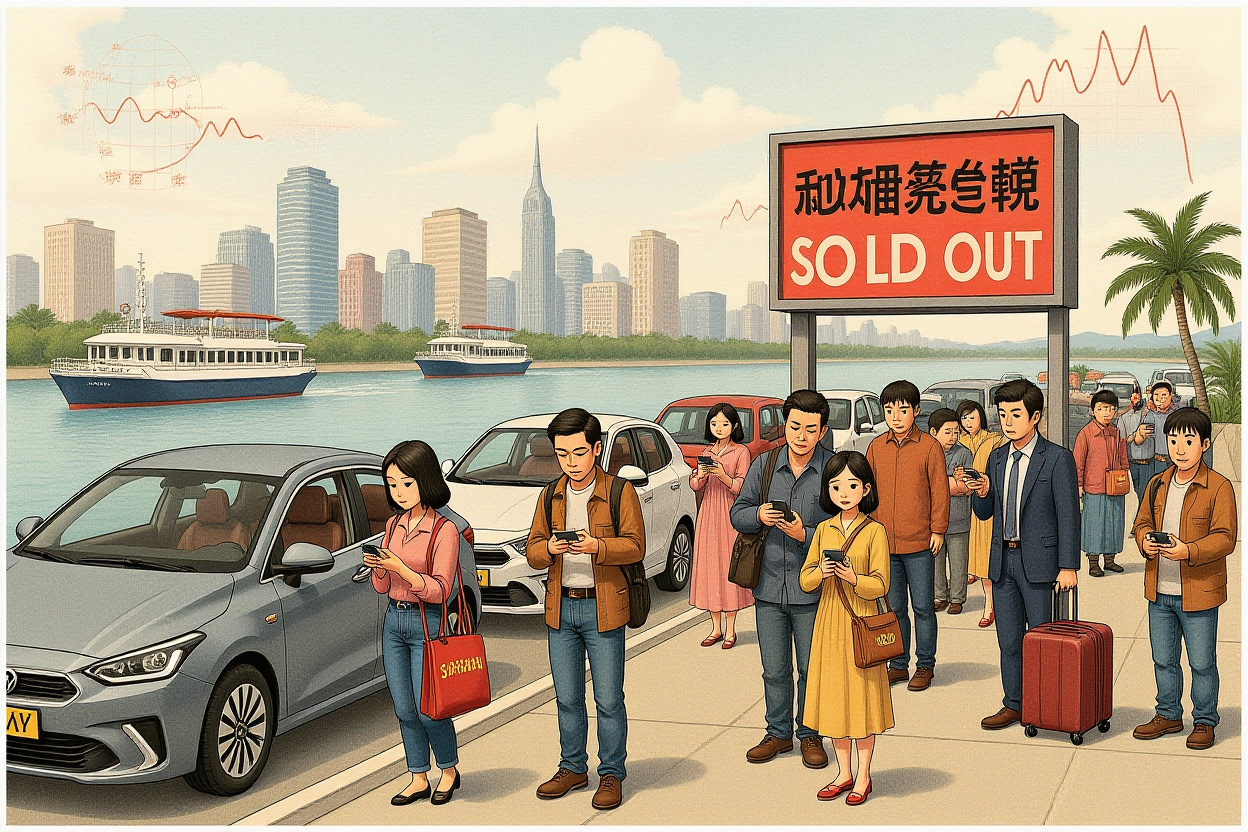
For Mr. Li (李先生), a longtime Guangdong worker, the annual drive home to Hainan for Lunar New Year reunions has always been a ritual. This year, that ritual shattered against the reality of a sold-out ferry system. His experience—abandoning his car in Zhanjiang’s Xuwen district, shepherding his family through back roads, and trudging a kilometer to port—epitomizes the transportation chaos engulfing Hainan during its first Spring Festival since the landmark customs closure. This isn’t mere holiday congestion; it’s a tangible manifestation of profound economic shift. The Hainan customs closure, a pivotal policy milestone, has unleashed a torrent of travelers and consumers, testing the very limits of regional connectivity and offering a clear window into the island’s accelerated integration into the global economy.
Record Demand Overwhelms Qiongzhou Strait Crossings
The official platform, Qiongzhou Strait Ferry Butler (琼州海峡轮渡管家), became the focal point of frustration as vehicle tickets vanished from February 9th through 12th. By February 11th, queues of waiting vehicles snaked for over ten kilometers. In response, operators pushed capacity to its absolute limit. On February 9th alone, 355 ferry sailings were conducted—a historical record—transporting 133,200 passengers and 32,100 vehicles. According to data released by Hainan Provincial authorities, the first nine days of the Spring Festival travel period (February 2-10) saw 486,390 passenger trips across all transport modes in Hainan, a 6.34% year-on-year increase. Crucially, Qiongzhou Strait crossings accounted for 101,200 passenger trips and 257,900 vehicles, with new energy vehicles reaching 42,000 units, up 74% from 2023. This surge is not accidental; it is directly linked to the policy-driven appeal of the Hainan customs closure.
Personal Anecdotes Highlight Systemic Strain
Social media platforms like Xiaohongshu are flooded with accounts of desperate travelers. One user lamented being scammed after paying a scalper for a non-existent ticket. This underground market, where “yellow bulls” charge up to 800 RMB (约 $110) per ticket on top of the standard 390 RMB fare, exploits the severe supply-demand imbalance. While the ferry platform has issued warnings against unauthorized purchases, the persistence of scalping indicates systemic pressure that mere advisories cannot alleviate.
Quantifying the Surge: Data Tells the Story of a Booming Island
The numbers paint a picture of explosive growth. Beyond the strait, air travel faced similar constraints. On China Southern Airlines (中国南方航空) routes from Guangzhou to Haikou, flights for February 13th-14th were nearly fully booked, with only scattered business class seats remaining at fares exceeding 5,000 RMB. This across-the-board capacity crunch points to a broad-based influx. The Hainan customs closure has acted as a powerful magnet. In the first month post-closure, Hainan’s air ports handled 311,000 inbound and outbound passengers, a 48.8% annual increase. More tellingly, offshore duty-free shopping hit 4.86 billion RMB in sales, up 46.8%, with 745,000 shoppers purchasing 3.494 million items. Consumers report significant savings, such as an Omega watch discounted by 13,400 RMB or an Apple iPhone by over 2,000 RMB at Haikou Meilan Airport’s duty-free store—though high demand has already led to stock-outs for popular models.
The Spike in New Energy Vehicle Transport
The 74% jump in new energy vehicle (NEV) ferry crossings is a critical data point for investors. It reflects both China’s broader NEV adoption curve and specific tailwinds from Hainan’s green vehicle policies within the free trade port framework. This trend suggests growing opportunities for NEV-related logistics, charging infrastructure, and ancillary services on the island, a sector closely watched by institutional investors.
The Hainan Customs Closure: Catalyst for Unprecedented Demand
Initiated on December 18, 2023, the full-island customs closure operation marks a cornerstone in the Hainan Free Trade Port (海南自由贸易港) build-out. By creating a distinct customs territory, the policy enhances the flow of goods, capital, and people while offering tax incentives. The immediate effect has been a powerful draw for domestic tourists and shoppers. Mr. Chen from Inner Mongolia represents this new wave: traveling to Hainan for winter, duty-free shopping, and to witness the changes firsthand. The Hainan customs closure has effectively rebranded the island as a premier consumption destination, altering travel patterns and concentrating demand during peak periods like Spring Festival.
Duty-Free Shopping Boom Post-Closure
The duty-free sales surge is perhaps the most direct financial indicator of the policy’s success. With annual duty-free shopping quotas increased to 100,000 RMB per person, Hainan is siphoning retail spending from mainland China and competing with traditional hubs like Hong Kong. For equity analysts, this boosts the outlook for listed operators like China Tourism Group Duty Free Corp (中国旅游集团中免股份有限公司) and Hainan-based retail entities. The sustained growth in shopping volume, even amidst travel chaos, indicates resilient consumer appetite driven by the Hainan customs closure.
Market Opportunities and Challenges for Investors
For the sophisticated investor, this transportation crisis is a signal, not just a setback. It underscores both the vibrant growth trajectory of Hainan’s economy and the acute infrastructure deficits that could hamper it. Key sectors warranting close scrutiny include: – Transportation & Logistics: Ferry operators, port authorities, and airlines are experiencing record volume but face capacity constraints. Publicly-listed entities in this space may see revenue boosts but also increased capex demands. – Retail & Tourism: Duty-free retailers, hotel chains, and experiential service providers are direct beneficiaries of the inbound surge. The Hainan customs closure creates a durable advantage for consumer-facing stocks. – Infrastructure Development: The current strain highlights multi-year investment opportunities in port expansion, road networks, and digital booking systems to improve connectivity.
Regulatory and Infrastructure Considerations
The Hainan Provincial Department of Transport has responded by extending ticket预售期 to 15 days for inbound and 30 days for outbound travel, while adding return trip packages. However, reactive measures may be insufficient. Long-term, the success of the Hainan customs closure hinges on parallel investments in hard and soft infrastructure. Investors should monitor government announcements for major infrastructure projects and public-private partnership opportunities aimed at easing these bottlenecks.
Navigating Challenges: From Scalpers to Strategic Responses
The proliferation of ticket scalping is more than a nuisance; it represents a market failure and a security risk. When travelers provide personal ID and license plate numbers to unverified third parties, data privacy and fraud risks escalate. The official ferry platform’s warnings are a necessary first step, but a more robust, transparent, and scalable ticketing system is required to support the Hainan customs closure’s long-term viability. Furthermore, the reliance on ferries underscores Hainan’s geographical constraint. While the long-proposed Qiongzhou Strait undersea tunnel remains a topic of discussion, its enormous cost and technical complexity mean ferry capacity will bear the brunt for the foreseeable future. This reality necessitates optimized scheduling, better demand forecasting, and integrated multi-modal transport plans.
Government and Platform Responses
Authorities have activated emergency transport plans, adding sailings where possible. Yet, with tickets sold out through February 22nd on most sailings, the system remains saturated. This scenario offers a case study in demand management for other high-growth special economic zones globally. For investors, the responsiveness and effectiveness of Hainan’s regulators in managing this crisis will be a key indicator of governance quality and operational maturity.
Forward Outlook: Strategic Positioning in Hainan’s Growth Story
The current travel crunch, while disruptive, is a growing pain associated with rapid economic transformation. The underlying demand catalyst—the Hainan customs closure—is a structural, multi-year policy shift. For fund managers and corporate executives, this presents a clear directive. Investment strategies should consider: – Short-term: Positioning in sectors with immediate revenue upside from the tourist influx, such as duty-free retail and select transportation services. – Medium-term: Identifying companies involved in infrastructure upgrades and capacity expansion projects approved or likely to be fast-tracked. – Long-term: Assessing Hainan’s integration into regional supply chains and its evolving role as a consumption and services hub, which will benefit from the sustained effects of the customs closure. The Hainan customs closure is not an isolated event; it is a re-engineering of the island’s economic DNA. The Spring Festival transportation crisis is its first major stress test, revealing both immense potential and critical vulnerabilities. For the global investment community, engaging with Hainan now requires a dual lens: capitalizing on the consumption boom while strategically accounting for the infrastructure and logistical investments needed to sustain it. As Hainan continues its journey toward becoming a globally influential free trade port, those who navigate these complexities with insight and agility will be best positioned to reap the rewards.