



A Traffic Snarl of Economic Significance
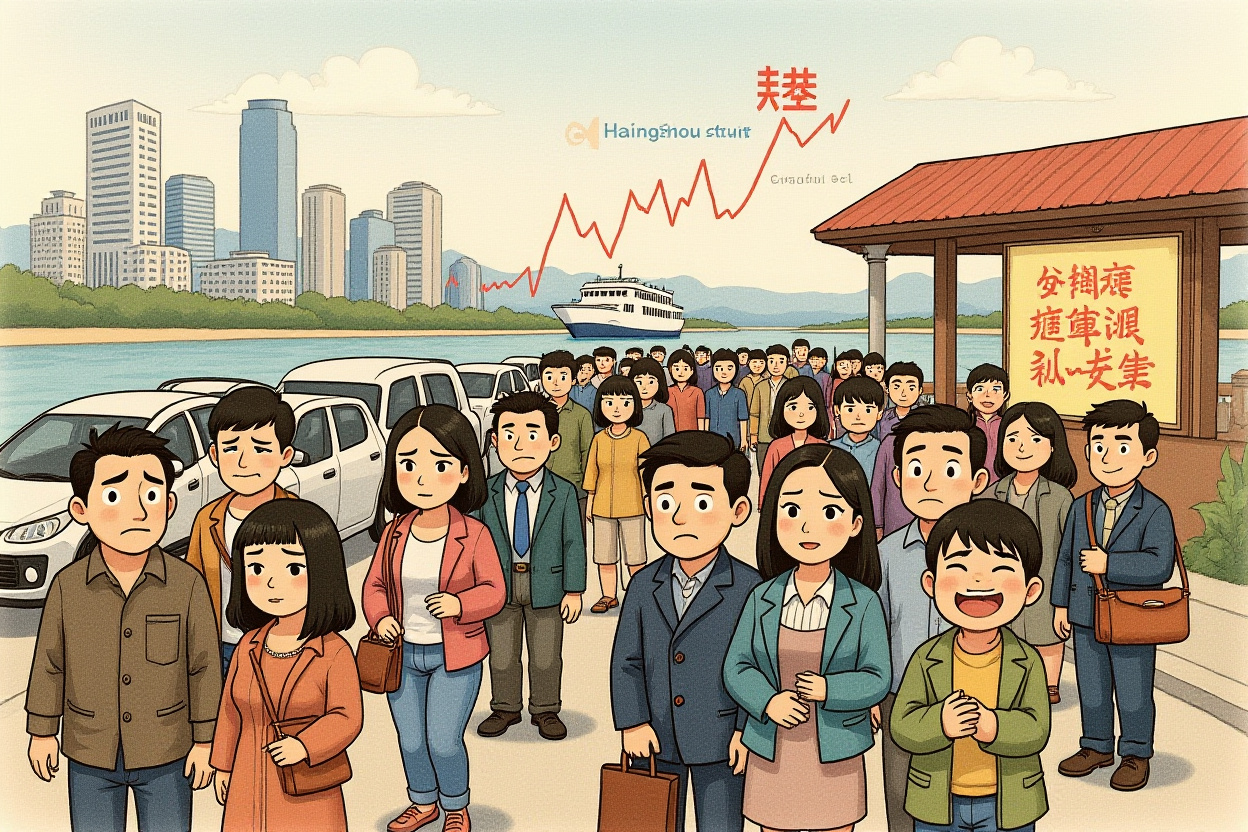
The scene at the port of Xuwen was one of gridlocked ambition. Mr. Li, a long-time Guangdong worker, faced a daunting sight upon reaching the gateway to Hainan: a staggering queue of vehicles stretching over ten kilometers, all waiting for a ferry that had no available tickets. His annual Lunar New Year pilgrimage home had hit an unprecedented wall. This year, for the first time, he could not secure passage for his car across the Qiongzhou Strait, forcing an improvised family journey on foot. ‘It’s so difficult just to get home for the Spring Festival,’ he lamented. This logistical bottleneck is not merely a travel headache; it is the first tangible, large-scale symptom of Hainan’s new economic reality following the official launch of its island-wide customs closure operation (封关运作). The surge in demand that has overwhelmed the Qiongzhou Strait ferry system offers critical, real-time data for investors gauging the early impacts of Hainan’s bold policy shift.
The post-closure travel frenzy provides a powerful lens through which to analyze consumer behavior, infrastructure capacity, and the investment thesis for China’s premier free-trade port. The sold-out ferries and packed flights are direct proxies for surging economic activity, driven by policy tailwinds. For institutional investors and market analysts, understanding the dynamics behind this transport crunch is essential for evaluating companies in tourism, retail, logistics, and related sectors exposed to the Hainan Free Trade Port (海南自由贸易港) story.
Key Market Takeaways from the Spring Festival Surge
– Policy-Driven Demand Shock: The official launch of Hainan’s customs closure operation (封关运作) in December 2023 has acted as a powerful catalyst, attracting a significant influx of visitors seeking to experience the new policy environment and its benefits firsthand, overwhelming existing transport capacity.
– Infrastructure Strain as an Investment Signal: The complete sell-out of vehicle ferry tickets weeks in advance and saturated flight schedules highlight a severe supply-demand imbalance. This underscores immediate investment needs and opportunities in transport logistics, port operations, and regional aviation.
– Duty-Free Retail Engine in Overdrive: Parallel data showing a near 50% year-on-year jump in offshore duty-free shopping in the month post-closure confirms that travel demand is directly translating into robust consumer spending, a strong positive indicator for listed retail operators.
– Emergence of Secondary Market & Regulatory Gaps: The proliferation of scalpers (‘黄牛’) charging exorbitant premiums for ferry tickets points to market inefficiencies and potential regulatory challenges in the new ecosystem, a factor for risk assessment.
The Catalyst: Decoding Hainan’s Customs Closure Operation
The unprecedented travel pressure during the 2024 Spring Festival travel rush (春运) is inextricably linked to a singular policy event. On December 18, 2023, the Hainan Free Trade Port (海南自由贸易港) officially initiated its island-wide customs closure operation (封关运作), a landmark move in its development. In practical terms, this transforms Hainan into a distinct customs territory. While goods and capital will flow more freely between Hainan and international markets, movement between Hainan and mainland China will be treated as import and export, albeit with specific, streamlined processes designed to facilitate trade.
For consumers, the immediate and most compelling benefit is the enhanced offshore duty-free shopping policy. The closure operation (封关运作) simplifies and potentially expands the quota and variety of duty-free goods available to travelers leaving the island for the mainland. This policy sweetener has proven to be a powerful magnet. As Mr. Chen, a visitor from Inner Mongolia, noted, his trip this year was motivated not just by warmer weather but by the desire to purchase duty-free goods and witness the changes post-closure firsthand.
Quantifying the ‘封关运作’ Pull Factor
The data released by Haikou Customs confirms the powerful draw of the new policy environment. In the first month following the closure operation launch:
– Inbound and outbound passenger traffic through Hainan’s air ports surged to 311,000人次, a remarkable 48.8% increase year-on-year.
– Offshore duty-free shopping sales skyrocketed to 4.86 billion yuan, up 46.8% from the same period last year.
– The number of shoppers reached 745,000, a 30.2% increase, purchasing a total of 3.494 million items.
These figures are not abstract statistics; they represent a direct influx of consumption power. One consumer interviewed reported saving over 10,000 yuan on a 100,000-yuan shopping spree compared to mainland prices. On-the-ground reports from Haikou Meilan Airport’s duty-free mall illustrate the frenzy: a specific model of Apple iPhone was sold out, and an Omega Constellation watch was offered at a discount of 13,400 yuan off the official retail price. This consumption surge is the fundamental driver behind the transport bottleneck, creating a clear line of sight for revenue growth for operators like China Tourism Group Duty Free Corporation (中国旅游集团中免股份有限公司).
The Bottleneck: A Stress Test for Qiongzhou Strait Logistics
The primary physical link between mainland China and Hainan Island is the Qiongzhou Strait, serviced by a fleet of roll-on/roll-off passenger ferries. The official booking platform, ‘Qiongzhou Strait Ferry Steward’ (琼州海峡轮渡管家), has become the frontline of the demand surge. An investigation by Yicai revealed that from February 9 to February 12, all vehicle ferry tickets from Xuwen to Haikou were sold out. Even with extended booking windows—15 days for entering the island and 30 days for leaving—scarcity persisted. By February 13, only 17 tickets remained for a single early-morning departure across a 10-day period, with all other sailings fully booked.
The operating entity has responded with record-breaking schedules. On February 9 alone, 355 voyages were dispatched, a historic high, transporting 133,200 passengers and 32,100 vehicles. Notably, the transport of new energy vehicles (NEVs) saw a staggering 74% year-on-year increase to 42,000 units in the first ten days of the travel period, reflecting both consumer trends and specific logistical planning for such vehicles. The Hainan Provincial Department of Transportation has stated it is closely monitoring ticket reservations and dynamically optimizing capacity.
Investment Implications of the Transport Crunch
The strain on the Qiongzhou Strait crossing presents a multi-faceted investment narrative:
– Immediate Capacity Constraints: The need for ’emergency transport plans’ and added voyages indicates that ferry operators are running at absolute maximum utilization. This suggests strong short-term revenue visibility for the entities managing this route, though margins may be pressured by operational intensity.
– Long-Term Infrastructure Demand: The chronic shortage, even with increased sailings, underscores the long-anticipated need for a fixed link, such as an undersea tunnel or bridge. While such a project remains complex, the current crisis adds political and economic weight to its necessity, putting companies in construction, engineering, and materials on watch lists for future tenders.
– Aviation as a Complementary Play: With ferry capacity saturated, air travel has absorbed spillover demand. Analysis of China Southern Airlines’ (中国南方航空) booking system for the Guangzhou-Haikou route showed most economy class seats sold out days in advance, with only premium cabins available at prices exceeding 5,000 yuan. This benefits airlines with strong regional networks to Hainan.
The Shadow Market: Scalpers and Systemic Friction
Where official supply fails to meet rampant demand, a secondary market inevitably emerges. Social media platforms like Xiaohongshu (小红书) and Xianyu (闲鱼) have become hubs for scalpers, or ‘黄牛’, offering to ‘secure’ coveted vehicle ferry tickets for a hefty premium. Investigative contacts revealed fees of around 800 yuan per ticket, on top of the official price of approximately 390 yuan, bringing the total cost to nearly 1,200 yuan. Some travelers reported being defrauded after payment, receiving no ticket and no further communication.
The ‘Qiongzhou Strait Ferry Steward’ platform has issued warnings against these practices, urging travelers to use only official channels and beware of scams. The persistence of this shadow market, however, is a critical indicator for investors and policymakers:
– Market Inefficiency: The premium commanded by scalpers quantifies the extent of the supply-demand gap and the friction in the official distribution system. It suggests potential value in platforms or technologies that can ensure fairer, more transparent allocation.
– Regulatory Risk: As Hainan refines its post-closure (封关运作) systems, cracking down on such gray-market activities will be necessary to ensure a smooth consumer experience. This represents an ongoing operational and regulatory challenge for the authorities managing the port’s flow.
– Consumer Sentiment Gauge: The willingness of some travelers to pay a 200% premium highlights the high value placed on the Hainan trip, reinforcing the strength of underlying demand driven by duty-free shopping and the novelty of the post-closure environment.
Forward Outlook: From Congestion to Sustainable Growth
The sold-out ferries of the 2024 Spring Festival are a powerful, if chaotic, validation of Hainan’s post-closure (封关运作) appeal. They confirm that the policy is successfully attracting its target audience: mobile, consumption-oriented travelers. The direct translation of this travel demand into a duty-free shopping bonanza provides a strong fundamental case for the tourism and retail sectors. For investors, companies with entrenched positions in Hainan’s duty-free market, hospitality, and travel services are clear beneficiaries of this demand shock.
However, the transport bottleneck also serves as a stark reminder of the infrastructure challenges that accompany rapid growth. Sustainable development of the Hainan Free Trade Port will require massive, coordinated investment not just in retail spaces, but in the arteries that connect it to the world. The current crisis amplifies the investment thesis for logistics, port expansion, regional aviation, and, ultimately, a fixed cross-strait link. The scramble for tickets today may well be the catalyst for billion-dollar infrastructure projects tomorrow.
For market participants, the key takeaway is to look beyond the headlines of traffic jams. See them instead as real-time metrics of policy efficacy and consumer confidence. Monitor the normalization of transport capacity in the coming months, the sustainability of duty-free sales growth beyond the holiday peak, and the government’s response in accelerating infrastructure upgrades. The success of Hainan’s grand experiment hinges on balancing explosive demand with seamless execution. The journey across the Qiongzhou Strait, now fraught with difficulty, is a microcosm of that larger challenge—and opportunity.