



Executive Summary
Key takeaways from Hainan’s property market transformation after the official closure of the Hainan Free Trade Port.
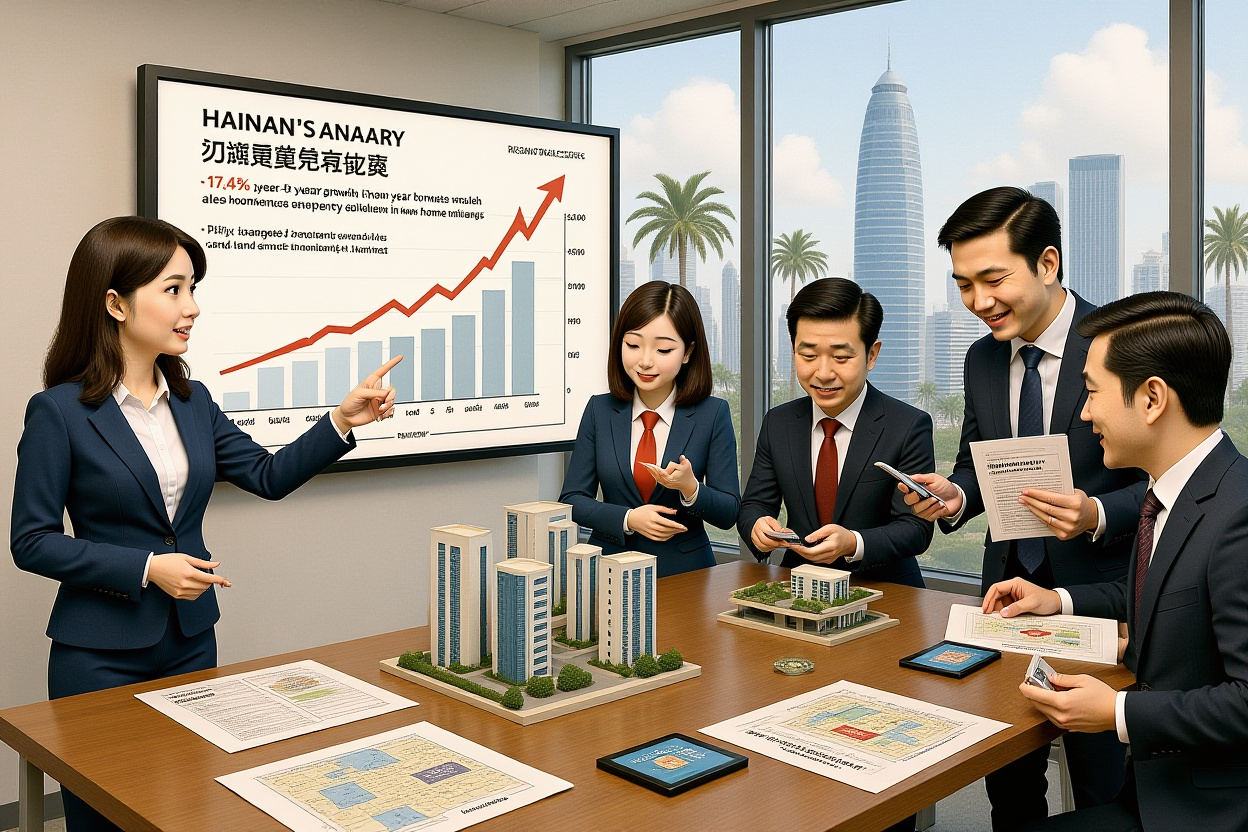
- Hainan’s property market is experiencing a significant rebound, with new home sales value up 17.4% year-over-year in the first ten months of 2025, defying national trends.
- Land auction activity has surged, attracting both established developers like China Green Development Group and cross-border capital from energy firms, with billions invested in prime Sanya plots.
- The closure policy, characterized by ‘first line opening, second line control, island freedom,’ is driving demand from high-net-worth individuals, corporations seeking tax advantages, and tourism growth.
- Major developers such as Poly Development, China Resources Land, and DaHua Group report robust sales, with instances of bulk purchases by investors anticipating long-term gains.
- Expert analysis suggests sustained growth fueled by inbound investment, talent migration, and regulatory tailwinds, positioning Hainan as a premium real estate destination.
The Dawn of a New Era: Hainan Free Trade Port Goes Live
The Hainan property market stands at a pivotal crossroads. On December 18, 2025, the Hainan Free Trade Port (海南自贸港) officially commenced its closed-off operation, marking the full implementation of the ‘first line opening, second line control, island freedom’ policy framework. This historic move transitions Hainan from a period of stringent real estate controls into a phase of comprehensive openness, directly influencing capital flows, investment patterns, and housing demand. For global investors monitoring Chinese equities, understanding the implications of this closure is critical, as early indicators suggest a robust and evolving Hainan property market poised for growth.
Decoding ‘Closure’: What It Really Means for Hainan
The term ‘closure’ or ‘封关运作’ does not imply isolation but rather a sophisticated customs and regulatory redesign. The ‘first line’ refers to the boundary between Hainan and overseas, which is now more open for trade and investment. The ‘second line’ is the boundary between Hainan and mainland China, where goods and capital flow is managed to prevent tax leakage. Internally, the island enjoys greater freedom for capital, talent, and logistics. This unique status, combined with preferential policies like the ‘dual 15%’ tax incentives for eligible enterprises and high-end talent, creates a compelling business environment. Consequently, the Hainan real estate market is becoming a magnet for corporate headquarters, high-net-worth individuals, and leisure buyers, fundamentally altering demand dynamics.
Immediate Market Sentiment and Initial Reactions
In the days leading up to and following the closure, market activity intensified. Developers and investors acted swiftly to position themselves within this new paradigm. The closure has been perceived not as a barrier but as a gateway, unlocking Hainan’s potential as a free trade hub. This sentiment is reflected in heated land auctions and rising transaction volumes, signaling strong confidence in the island’s long-term economic trajectory. The Hainan property market, once subdued by strict purchase restrictions, is now displaying remarkable vitality, attracting attention from sophisticated institutional players worldwide.
Land Auction Frenzy: Billions Flow into Prime Plots
The most visible sign of the Hainan property market’s resurgence is the explosive activity in its land sales sector. Core urban plots, especially in Sanya, have become battlegrounds for deep-pocketed investors, with total transaction values soaring.
Established Players Double Down on Strategic Holdings
A standout example is China Green Development Group (中国绿发), a veteran developer in Hainan formerly known as Luneng Group. In a dramatic two-day spree just before and on the closure date, the company invested nearly 5 billion yuan to acquire approximately 252 mu of land in Sanya’s city center. On December 17, it secured a 100-mu residential plot in Sanya Bay for about 2 billion yuan. The following day, it won another 152-mu plot with river and secondary sea views for 2.949 billion yuan. Notably, the latter sale required the buyer to commit to additional investments of at least 10 billion yuan in Sanya within five years. This aggressive expansion follows earlier land purchases in 2024 and 2025, underscoring a strategic, long-term commitment to the Hainan property market.
Cross-Border Capital and New Entrants Shake Up the Landscape
Beyond traditional real estate firms, the market has attracted significant cross-sector capital. Energy conglomerates like Liaoning Fangda Group (辽宁方大集团) and Shaanxi Hengyuan (陕西恒源系) have made high-profile entries, investing heavily in Sanya land auctions between June and September 2025. These transactions, totaling over 9.5 billion yuan, accounted for more than 60% of Sanya’s fiscal revenue in 2024. This trend indicates that industrial capital from sectors like coal is diversifying into Hainan real estate as a strategic asset allocation and business transformation move. Simultaneously, private enterprises from other regions, such as Shanghai-based DaHua Group (大华集团), have gained notable market share, ranking high in annual sales rankings.
The land sale mechanism itself has evolved. As noted by a real estate insider in Haikou, local governments increasingly use ‘targeted land solicitation’ or ‘定点勾地’ models. By setting specific qualifications and investment requirements for bidders, authorities aim to attract high-quality developers and ensure synergistic industrial-residential development, thereby de-risking the market from speculative buying.
Market Performance: Data Points to a Sustained Upswing
Official statistics paint a clear picture of a Hainan property market in recovery mode, with key metrics showing positive growth across the board.
Provincial Sales and Price Trends Defy Broader Slowdown
According to data from the Hainan Provincial Bureau of Statistics (海南省统计局), from January to October 2025, the province’s new commercial housing sales reached 127.951 billion yuan, a year-on-year increase of 17.4%. Sales area grew by 8.0% to 7.7518 million square meters. Crucially, the average transaction price rose to 16,506 yuan per square meter, up 8.7% or 1,323 yuan per square meter compared to the same period last year. This performance contrasts with the more tepid national property market, highlighting Hainan’s unique drivers. The growth is underpinned by the anticipation and reality of the closure, which enhances the island’s attractiveness for living, investment, and business operations.
Sanya Cements Its ‘Top-Tier’ Status with Explosive Growth
Within Hainan, Sanya continues to dominate. The Sanya economic circle, which includes surrounding areas, saw sales value skyrocket by 48.4% to 74.245 billion yuan in the first ten months of 2025. Sanya city alone recorded a 56.4% increase in new home sales value, with the average price soaring over 30% to 31,467 yuan per square meter. A report from CRIC (克而瑞) notes that Sanya’s residential transaction volume in the first half of 2025 grew by nearly 50% on top of a high base in 2024, and its real estate investment prospects ranking jumped 28 places to 30th nationally. This cements Sanya’s position as the crown jewel of the Hainan property market, driven by its premium tourism assets and the influx of high-end demand.
Developer Strategies and High-Profile Investment Cases
Leading developers are capitalizing on the bullish sentiment, tailoring projects to meet the sophisticated demands of the new Hainan buyer profile.
Insights from Market Leaders: Poly, CR Land, and DaHua
Poly Development (保利发展), the top seller in Hainan for the January-November 2025 period, reported strong performance from projects like Sanya Poly Tianjun and Poly Banshan Zhenyue. A representative from Poly’s Hainan region stated that with the closure in effect and the peak travel season underway, customer traffic in Sanya has increased sequentially. They anticipate a steady rise in transaction volumes by year-end as the market digests the policy’s conveniences and benefits.
China Resources Land (华润置地), another top performer, focuses on large-scale, integrated developments such as Haitang Yuefu, Sanya Guanlan, and China Resources Shimei Bay. These projects follow a ‘holistic area development’ model, combining tourism, commercial operations, and environmental upgrades to enhance overall livability and value. A CR Land Hainan representative explained this approach aligns perfectly with the ‘island freedom’ policy, attracting high-end talent, tourists, and capital seeking a composite ‘living + environment + tourism + investment’ package.
The Case of the Bulk Buyer: Leveraging Tax Policies for Gain
A particularly striking example of investor confidence comes from DaHua Group. A regional executive revealed that a client from Shandong purchased over a hundred small-sized commercial-office units in the DaHua Jinxiu Coast project. This move exemplifies a strategic calculation: by holding core assets, the investor seeks future appreciation while utilizing Hainan’s preferential tax policies to optimize corporate financial structures. The ‘dual 15%’ tax incentive—a 15% corporate income tax rate for qualifying encouraged industries and a 15% personal income tax cap for high-end talent—acts as a powerful draw. As the DaHua insider noted, such purchases are akin to ‘securing an all-access pass to the long-term development of the free trade port.’ This case underscores how the Hainan property market is not just about residential living but also about corporate strategy and wealth preservation.
Regulatory Evolution and Policy Tailwinds
The current buoyancy in the Hainan property market must be viewed against its recent regulatory history and the deliberate policy shifts designed to shape its future.
From Strict Controls to Targeted Opening
For years, Hainan was known as one of China’s strictest property markets, with province-wide purchase restrictions, five-year social security requirements, and resale bans. In early 2024, the government began optimizing these policies. For instance, Haikou maintained a five-year社保 requirement in restricted zones but reduced it to two years in non-restricted zones, while also shortening the resale holding period from five to two years and easing corporate purchase rules. These calibrated relaxations, preceding the full closure, were designed to stabilize the market and prepare it for the influx of new demand. The current land auction mechanisms further reflect this targeted approach, guiding development toward high-quality, industry-integrated projects.
Future Implications: Sustained Demand from Multiple Fronts
According to Song Hongwei (宋红卫), co-dean of Tongce Research Institute (同策研究院), the closure will continue to propel the Hainan property market and rental sector from the demand side. He forecasts three major sources of incremental demand: investment from manufacturing giants and foreign enterprises, trade and service professionals, and tourism and vacation crowds. This trend is already visible, with provincial housing prices per square meter rising by over 1,000 yuan year-on-year in the third quarter of 2025, and hotspots like Sanya, Haikou, and Lingshui showing even more pronounced increases. The policy framework ensures that the Hainan real estate market growth is structurally supported, not merely speculative.
Expert Outlook and Strategic Considerations for Investors
The consensus among analysts is that the Hainan property market has entered a new growth cycle, but savvy investors must navigate both opportunities and nuances.
Key Drivers and Risk Factors
The primary growth drivers are clear: the unique tax and trade policies of the Free Trade Port, the island’s unparalleled natural and climatic advantages, and the improving connectivity and infrastructure. However, risks include potential policy adjustments, market overheating in specific segments like Sanya’s luxury sector, and the broader macroeconomic environment. Investors should focus on projects with strong developer credentials, prime locations, and alignment with Hainan’s strategic industries. The residential market, particularly high-end and vacation homes, alongside commercial assets benefiting from corporate inflow, present compelling avenues.
Long-Term Vision: Hainan as a Global Investment Hub
The closure of the Hainan Free Trade Port is more than a real estate story; it’s a fundamental recalibration of Hainan’s role in the global economy. For institutional investors and fund managers, this represents a tangible opportunity to gain exposure to a specialized, policy-driven growth market within China. The Hainan property market is likely to see increased differentiation, with premium assets in key cities outperforming. Monitoring official data from bodies like the Hainan Provincial Bureau of Statistics and regulatory announcements will be essential for timely decision-making.
Synthesis and Forward-Looking Guidance
The evidence is compelling: the Hainan property market is undergoing a robust transformation fueled by the historic closure of its Free Trade Port. From frenzied land auctions and double-digit sales growth to strategic bulk investments and favorable policy winds, all indicators point to sustained momentum. The market has successfully transitioned from one of China’s most controlled to one of its most dynamically open, attracting a diverse pool of domestic and international capital. While Sanya remains the undisputed leader, opportunities are emerging across the island as development becomes more integrated and sophisticated.
For global business professionals and investors, the message is clear: Hainan warrants close attention. The closure has effectively repositioned the island’s real estate from a cyclical play to a structural one, intertwined with long-term economic upgrading. Conduct thorough due diligence, partner with established local operators, and consider the full spectrum of assets—from luxury residences to commercial properties—that stand to benefit from the influx of talent, corporations, and tourism. The Hainan property market is not just bouncing back; it’s building a new foundation for future value creation. Engage with expert advisors, stay abreast of regulatory updates, and consider allocating resources to capture this unique window of opportunity in one of Asia’s most promising investment frontiers.