



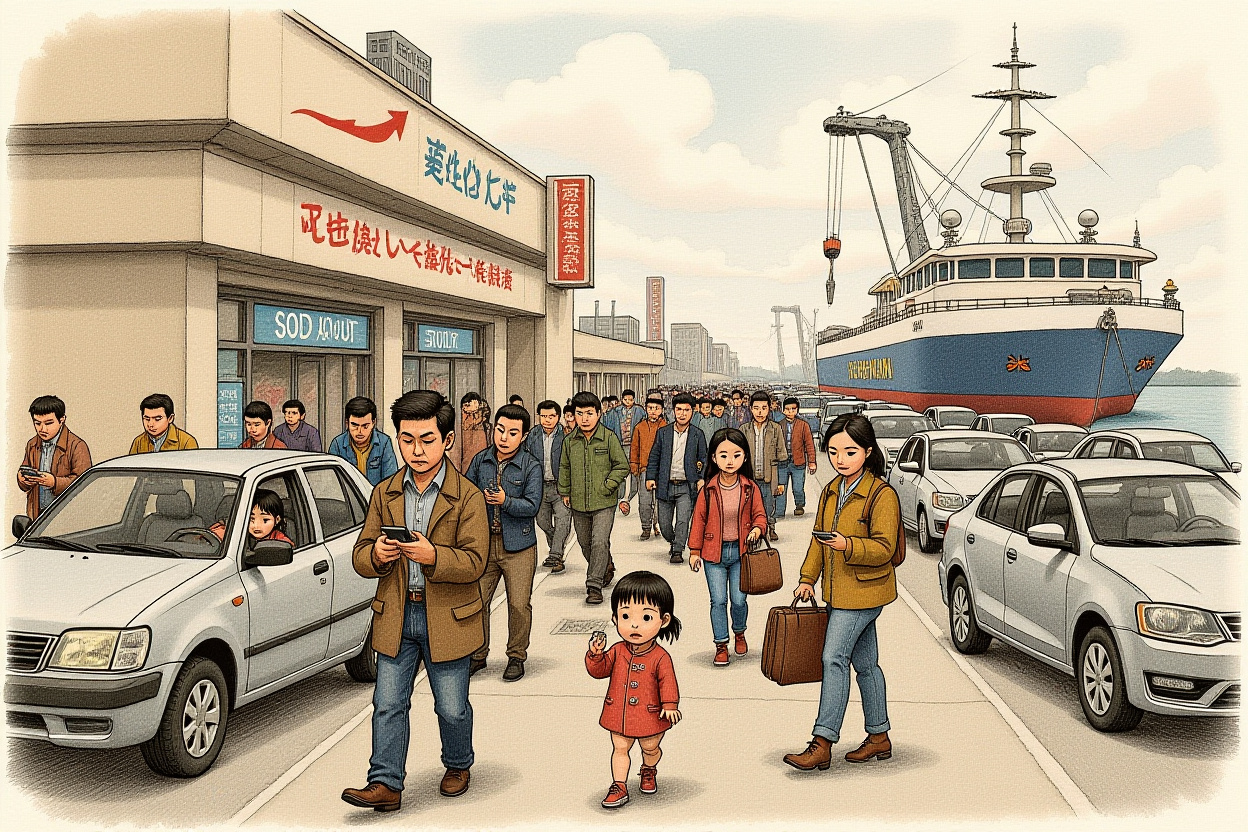
The Spring Festival travel rush, the world’s largest annual human migration, has collided with a new economic reality in China’s southernmost province. For the first time since the landmark initiation of its full island ‘sealing off’ (封关运作) operation in December, Hainan finds itself at the center of an unprecedented surge in traveler demand, straining its critical maritime lifeline—the Qiongzhou Strait. Vehicle ferry tickets for the crossing from Guangdong to Hainan have been completely sold out for consecutive days, creating miles-long queues of idling cars and exposing both the immediate allure and the infrastructural growing pains of China’s ambitious free-trade port experiment. This bottleneck is more than a logistical headache; it is a real-time stress test for Hainan’s integration into the global economy and a potent indicator of shifting consumption and investment patterns within the Greater Bay Area and beyond.
Executive Summary: Key Market Implications
- The post-closure operating environment has triggered a significant, measurable spike in passenger and vehicle traffic to Hainan, with Qiongzhou Strait vehicle crossings up 8.2% year-on-year and new energy vehicle transport surging 74%.
- Severe capacity constraints at the strait, despite record-breaking daily sailings, highlight a critical infrastructure bottleneck that must be addressed for Hainan to fully realize its economic potential as a free-trade port.
- Parallel surges in air travel demand and off-island duty-free shopping (up 46.8% in value) confirm that ‘sealing off’ is successfully functioning as a powerful magnet for tourism and high-value consumption.
- The emergence of a ‘scalper’ market for ferry tickets, with mark-ups exceeding 1000 yuan, points to market inefficiencies and potential security risks within the current ticketing system, necessitating regulatory scrutiny.
- For investors, this congestion underscores the tangible demand behind Hainan’s policy narrative, highlighting opportunities in related sectors such as logistics, port operations, duty-free retail, and tourism services, while also signaling near-term operational challenges for consumer-facing businesses.
A Logistical Snarl: The Human Story of the Congestion
The abstract concept of ‘sealing off’ (封关运作) translates, for many, into a very concrete travel ordeal. Mr. Li, who has worked in Guangdong for seven or eight years, represents countless individuals caught in this year’s extraordinary crunch. In previous years, his Spring Festival ritual involved a straightforward drive and ferry crossing back to his Hainan hometown. This year, that familiar routine shattered. "The car ferry tickets for the next few days are completely sold out," he told Yicai. His only recourse was to abandon his car in Xuwen, Zhanjiang, and purchase pedestrian tickets for his family of four to complete the journey home on foot after navigating local backroads.
Unprecedented Queues and System Strain
Arriving in Xuwen on February 11, Mr. Li witnessed the physical manifestation of the demand surge: a staggering queue of vehicles waiting to cross the strait, which he estimated stretched for over ten kilometers. The official booking platform, the "Qiongzhou Strait Ferry Butler" (琼州海峡轮渡管家) WeChat official account, confirmed the systemic strain. Queries from February 9 to 12 showed all vehicle tickets from Xuwen to Haikou were sold out. By February 13, the platform’s customer service acknowledged a "sharp spike" in traffic and stated that emergency transport plans had been activated, increasing the frequency of sailings.
Even with these emergency measures, scarcity persists. As of February 13, a check of the platform revealed that for the period spanning February 13 to 22, only one of eight available vehicle ferry slots from Xuwen Port to Haikou Port had any tickets remaining—a mere 17 spots for a 0:05 am departure. All other slots were fully booked, demonstrating that the congestion is a sustained issue, not a fleeting peak.
The Catalyst: Understanding Hainan’s ‘Sealing Off’ Operation
The primary driver of this travel frenzy is not merely traditional holiday migration. It is the powerful new economic gravity created by Hainan’s transition into a fully functional free-trade port. On December 18, 2023, the Hainan Free Trade Port (海南自由贸易港) officially launched its island-wide ‘sealing off’ operation, a milestone event that fundamentally alters the province’s relationship with the mainland and the world.
What ‘Sealing Off’ Really Means
In this context, ‘sealing off’ (封关运作) does not imply isolation. Instead, it refers to the establishment of a special customs territory. Effectively, the entire island of Hainan becomes a bonded zone, where goods can be imported, stored, processed, and re-exported with simplified procedures and favorable tax treatments. For travelers, the most immediate and palpable benefit is the enhanced off-island duty-free shopping policy, which allows visitors to purchase high-value goods at significantly reduced prices. This policy lever has been pulled with remarkable success, transforming Hainan into a premier shopping destination.
A customer service representative for the "Qiongzhou Strait Ferry Butler" directly linked this year’s transport tension to the new policy environment, stating it "may be related to the increase in tourists after Hainan implemented its sealing off operation this year." This sentiment is echoed by travelers like Mr. Chen from Inner Mongolia, who traveled to Hainan this winter not only for the warmer climate but specifically to purchase duty-free goods and witness the changes brought by the historic policy shift.
Quantifying the Surge: Data Points on Demand and Economic Activity
The anecdotal evidence of congestion is backed by hard data from official sources, painting a clear picture of explosive growth across transportation and retail metrics. According to a press conference held by the Hainan Provincial Information Office on February 11, the first nine days of the Spring Festival travel period (February 2-10) saw provincial passenger traffic reach 4.8639 million person-times, a 6.34% year-on-year increase.
Maritime and Retail Data Highlights
The figures for the Qiongzhou Strait crossing are even more striking:
- Passenger Transport: 1.012 million person-times, up 14.0% year-on-year.
- Vehicle Transport: 257,900 vehicle-times, up 8.2% year-on-year.
- New Energy Vehicle Transport: 42,000 vehicle-times, a massive 74.0% year-on-year increase, reflecting both broader automotive trends and potential policy incentives for green vehicle transit.
- Operational Peaks: On February 9 alone, the strait saw a record 355 sailings, transporting 133,200 passengers and 32,100 vehicles.
This transportation surge directly fuels a retail boom. Data from the first month post-closure reveals:
- Off-island duty-free shopping sales hit 4.86 billion yuan, a 46.8% year-on-year jump.
- Shoppers totaled 745,000 person-times, up 30.2%.
- Individual savings can be substantial. One consumer reported saving over 10,000 yuan on a 100,000-yuan shopping spree compared to mainland prices. For example, an Omega Constellation watch with an official price of 81,300 yuan was selling for 67,900 yuan at the Haikou Meilan Airport duty-free store, a discount of 13,400 yuan.
Market Distortions: The Rise of ‘Scalpers’ and Secondary Ticket Markets
Where official supply fails to meet rampant demand, gray markets inevitably emerge. The severe ticket shortage for the Qiongzhou Strait crossing has spawned a lucrative opportunity for ‘scalpers’ (黄牛), who exploit the desperation of travelers. On social media platforms like Xiaohongshu (小红书), users have reported tickets being resold at exorbitant markups.
The Mechanics and Risks of Ticket Reselling
Investigations reveal a shadowy marketplace. One scalper contacted by journalists offered to secure a vehicle ferry ticket for a flat fee of 800 yuan, on top of the official ticket price of approximately 390 yuan, bringing the total cost to nearly 1,200 yuan—a markup of over 200%. Similar offers were found on the second-hand marketplace Xianyu (闲鱼). The modus operandi typically involves the traveler providing their ID and license plate number to the scalper.
However, this market is rife with fraud. When pressed on their methods, scalpers become evasive. One traveler reported paying a scalper in advance, only to be ghosted afterward, stating plainly, "I was cheated." The official "Qiongzhou Strait Ferry Butler" platform has issued warnings, urging passengers to purchase tickets only through official channels and not to believe promises of "proxy purchasing" or "guaranteed boarding," cautioning them to be wary of falling into scalper traps. This situation underscores a vulnerability in the ticketing system and a consumer protection gap that regulators may need to address.
Beyond the Strait: Ripple Effects on Air Travel and Regional Dynamics
The transportation squeeze is not confined to the sea crossing. It has created parallel pressure on air routes into Hainan, further validating the scale of the inbound demand surge. A check of China Southern Airlines’ official website for flights from Guangzhou to Haikou on February 13-14 showed a similar picture of scarcity.
Sky-High Airfares and Full Flights
On February 13, only two business class seats remained on available flights, priced at a steep 5,180 yuan. For February 14, only a handful of early morning and late-night flights had full-price economy seats available; most flights were either sold out or only had expensive business class tickets remaining. This congestion in the skies confirms that the travel boom is multi-modal and reflects a broad-based influx of higher-spending visitors, consistent with the duty-free retail data.
The Hainan Provincial Department of Transportation has responded to the maritime crisis by announcing it will closely monitor ticket reservations and dynamically optimize transport capacity, adding extra flights as needed. It has also extended the ticket预售期 (advance booking period) to 15 days for entering the island and 30 days for leaving, and introduced round-trip ticket packages to improve planning and flow management.
Investment Implications and Forward Outlook
For institutional investors and market analysts, the scenes of congestion at the Qiongzhou Strait are a powerful, real-world validation of the Hainan Free Trade Port’s initial appeal. The ‘sealing off’ (封关运作) policy is demonstrably working as a demand driver. However, this first major stress test also reveals critical bottlenecks that could constrain growth if not resolved.
Sectoral Opportunities and Challenges
The immediate implications point to several key areas:
- Infrastructure & Logistics: The need for enhanced strait-crossing capacity is urgent and obvious. This presents long-term opportunities for companies involved in port expansion, ferry service operations, and potentially, future fixed-link projects (like a bridge or tunnel). Investment in smarter, more resilient ticketing and traffic management systems is also a clear necessity.
- Duty-Free Retail: The stellar sales figures directly benefit listed operators like China Tourism Group Duty Free Corp. (中国旅游集团中免股份有限公司), cementing Hainan’s status as a dominant luxury retail hub. Sustained traffic growth is fundamental to this sector’s earnings.
- Tourism & Services: Hotels, resorts, and experiential tourism providers stand to gain from the increased visitor volume, though they must also manage the operational challenges of peak-season overload.
- Risk Factors: Near-term, the logistical difficulties could slightly dampen the visitor experience. The scalper issue points to regulatory and systemic risks. Over the longer term, Hainan’s success depends on continuous policy refinement, world-class infrastructure development, and maintaining its competitive edge in duty-free retail.
The inaugural Spring Festival under Hainan’s new ‘sealing off’ (封关运作) regime has delivered a unambiguous message: the policy is a resounding success in attracting people and capital. The miles-long queues at Xuwen are not just traffic jams; they are queues of consumer demand, investment interest, and economic vitality waiting to cross into China’s most ambitious free-trade experiment. While the current logistical bottlenecks highlight pressing infrastructure challenges, they ultimately underscore the substantial and tangible economic potential that the Hainan Free Trade Port is beginning to unlock. For global investors monitoring China’s regional development strategies, Hainan has just provided a compelling, data-rich proof of concept. The focus now shifts to how swiftly and effectively the province can scale its physical and digital infrastructure to harness this roaring demand, transforming holiday congestion into sustained, year-round economic momentum. Stakeholders should closely monitor follow-on policy announcements from the Hainan provincial government and the Ministry of Transport regarding long-term capacity solutions for the Qiongzhou Strait, as these will be critical indicators of the port’s operational maturity and future growth trajectory.