



Executive Summary: Key Market Takeaways
The inaugural Spring Festival travel period following Hainan’s historic customs closure has unveiled significant stress points and opportunities within China’s southern economic hub. This event serves as a critical real-time stress test for the island’s logistics and tourism infrastructure, with direct implications for investors monitoring consumer behavior and regional development.
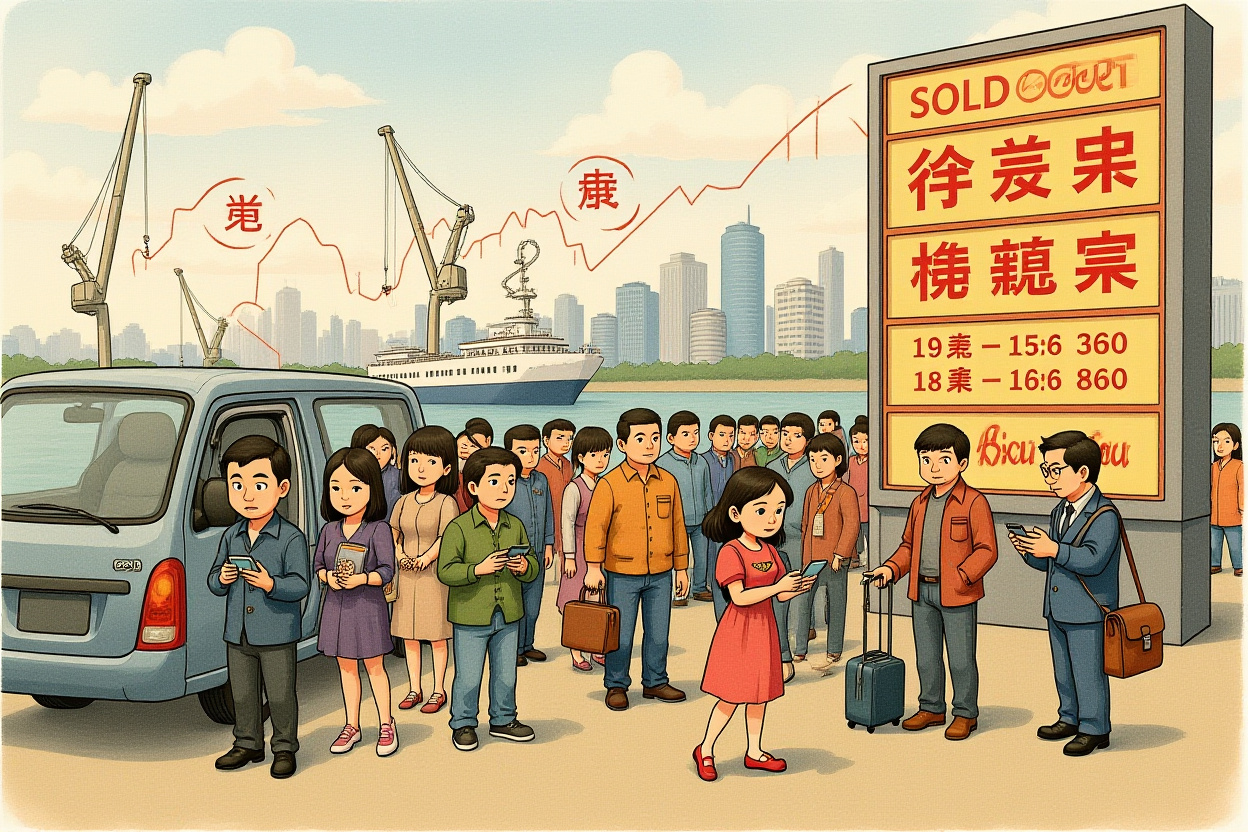
– Transportation Gridlock: All vehicle ferry tickets for the Qiongzhou Strait (琼州海峡) crossing were sold out days in advance, with wait times extending for kilometers, signaling severe capacity constraints during peak demand.
– Record-Breaking Demand: Passenger and vehicle volumes across the strait surged by 14.0% and 8.2% year-over-year respectively in early February, with a staggering 74% increase in new energy vehicle transport, underscoring a fundamental shift in travel patterns.
– Economic Catalyst: The Hainan customs closure has directly fueled a 46.8% year-on-year jump in duty-free shopping to 4.86 billion yuan in its first month, attracting tourists and signaling robust consumer spending potential.
– Market Distortions Emerge: A secondary black market for ferry tickets has sprung up, with scalpers charging premiums exceeding 800 yuan per vehicle ticket, highlighting system vulnerabilities and regulatory gaps.
– Investment Signal: The congestion crisis underscores an urgent need for infrastructure investment and logistical innovation in Hainan, presenting clear opportunities for sectors ranging from port operations to retail and hospitality.
A Journey Home Transformed by Policy
For Mr. Li, a Guangdong-based worker who has driven home to Hainan for the Lunar New Year for nearly a decade, the 2026 Spring Festival presented an unprecedented hurdle. For the first time, he could not secure a ferry ticket for his vehicle across the Qiongzhou Strait. ‘All the car ferry tickets for these past few days are completely sold out,’ he told Yicai. His solution was emblematic of the widespread disruption: abandoning his car in Xuwen, Zhanjiang and purchasing passenger-only tickets for his family’s crossing. Upon arrival, he witnessed a traffic snake stretching an estimated ten kilometers, a visceral testament to the new reality of post-closure travel. This personal ordeal mirrors a systemic challenge: the Hainan customs closure has irrevocably altered the mobility landscape during China’s most significant annual migration.
The Hainan customs closure, formally initiated on December 18, 2025, marks the operational launch of the Hainan Free Trade Port (海南自由贸易港). By creating a customs-separated zone, the policy aims to facilitate duty-free trade and investment, but its first major public test has been logistical. The official booking platform, ‘Qiongzhou Strait Ferry Butler’ (琼州海峡轮渡管家) WeChat public account, showed all vehicle slots from Xuwen to Haikou sold out from February 9th through 12th. This scarcity is not a temporary glitch but a symptom of profound demand surges intertwined with policy-driven appeal.
Quantifying the Post-Closure Surge
The data released by Hainan provincial authorities provides a clear, quantified picture of the intensified pressure. In the first nine days of the Spring Festival travel rush (February 2-10), comprehensive passenger traffic in Hainan reached 4.8639 million person-times, a 6.34% increase year-on-year. The Qiongzhou Strait corridor itself handled over 1.012 million passengers and 257,900 vehicles, with new energy vehicles accounting for 42,000 trips. The single day of February 9th set a historical record with 355 ferry sailings, moving 133,200 passengers and 32,100 vehicles.
Operational Responses and Limits
In response, operators have implemented emergency plans. The ferry service platform has maximized scheduling, extending the ticket预售期 (advance booking period) to 15 days for entry and 30 days for exit, and introducing round-trip package tickets. A customer service representative for the platform confirmed to Yicai that the surge is directly linked to increased traveler numbers following the Hainan customs closure. Despite these measures, capacity remains utterly insufficient for peak demand. As of February 13th, a check of the platform showed only one of eight scheduled vehicle ferry crossings from Xuwen Port to Haikou Port in the coming ten days had any tickets left—a mere 17 slots for a 0:05 AM departure on the 13th.
The Economic Engine Driving Demand
Beyond traditional homecoming travel, a powerful new economic magnet is pulling people to Hainan: duty-free shopping. The Hainan customs closure has institutionalized the island’s status as a duty-free shopping paradise, with policies allowing visitors significant savings on imported goods. Official statistics from the first month post-closure are staggering: duty-free shopping turnover hit 4.86 billion yuan, up 46.8%; shopping participants rose 30.2% to 745,000; and the number of items purchased increased 14.6% to 3.494 million.
From Watches to Phones: The Allure of Savings
The on-the-ground reality explains the numbers. A consumer from Inner Mongolia, Mr. Chen, stated his trip was dual-purpose: to escape the winter cold and to access discounted luxury goods. At the Haikou Meilan Airport Duty-Free Shop, an Omega Constellation watch retailing for 81,300 yuan domestically was priced at 67,900 yuan—a saving of 13,400 yuan. Similarly, a 1TB Apple iPhone 17 Air was available for 9,940 yuan, over 2,000 yuan less than the mainland price, though high demand had already cleared stocks. This tangible value proposition is a primary driver behind the travel rush, transforming Hainan from a mere holiday destination into a cost-saving procurement hub for middle and upper-income Chinese consumers.
Market Frictions and the Rise of Scalpers
Where official supply fails to meet demand, unofficial and often illicit markets flourish. Social media platforms like Xiaohongshu (小红书) have become hotbeds for complaints about ticket scarcity and advertisements from scalpers, known locally as ‘yellow bulls’ (黄牛). These operators offer to ‘secure’ vehicle ferry tickets for a service fee as high as 800 yuan, on top of the base fare of around 390 yuan, bringing the total cost to nearly 1,200 yuan. On second-hand marketplace Xianyu (闲鱼), similar offers abound.
Consumer Risks and Official Warnings
The risks are significant. One traveler recounted paying a scalper only to be ghosted afterward, a victim of straightforward fraud. When questioned about their methods, these ticket brokers remain evasive. The official ‘Qiongzhou Strait Ferry Butler’ platform has issued explicit warnings, urging travelers to purchase tickets only through authorized channels and to beware of scams promising ‘guaranteed passage’ or ‘proxy purchasing.’ This secondary market distortion not only imposes a financial tax on travelers but also points to potential inefficiencies in the official distribution system that could be exploited, eroding trust in the platform.
Broader Transportation Network Under Stress
The strain is not confined to sea routes. Air travel into Hainan has also reached capacity constraints during this period. Checking China Southern Airlines’ (中国南方航空) official website for flights from Guangzhou to Haikou on February 13th-14th revealed near-total sell-outs. On the 13th, only two business class seats remained at a fare of 5,180 yuan. On the 14th, only early morning and late-night flights had full-fare economy seats available, with other flights either sold out or offering only premium cabins. This across-the-board capacity crunch indicates that the Hainan customs closure is driving demand that exceeds the current absorption capacity of the island’s multi-modal transport infrastructure.
Strategic Implications for Investors and Policy
For the international financial community focused on Chinese equities, this Spring Festival traffic jam is far more than a travel story; it is a leading indicator. It validates the strong consumer appeal of Hainan’s new economic model but simultaneously exposes critical bottlenecks that could cap growth.
Infrastructure as an Investment Theme
The immediate need is for enhanced transport capacity. This presents opportunities for companies involved in port operations, ferry services, logistics, and related technology. The 74% surge in new energy vehicle transport also highlights specific niches, such as charging infrastructure at ports and preferential scheduling for eco-friendly transport. Investors should monitor listed entities like Hainan Strait (琼州海峡) service providers and parent groups for capital expenditure announcements and capacity expansion plans.
Regulatory and Planning Responses
The Hainan Provincial Department of Transport (海南省交通运输厅) has stated it is closely monitoring ticket reservations and waitlists to dynamically optimize capacity. The situation calls for accelerated investment in transport infrastructure, potentially including additional vessels, expanded port facilities, and better demand-management systems. For policymakers, the challenge is to balance the welcoming of increased traffic—a sign of policy success—with maintaining service quality and safety. The extension of booking windows is a short-term fix; long-term solutions may involve public-private partnerships for infrastructure development.
Navigating the New Normal in Hainan
The first Spring Festival under the Hainan customs closure regime has delivered a unambiguous message: policy-driven economic transformation can rapidly outpace physical infrastructure. The sold-out tickets and endless queues are symptoms of high demand—a positive economic signal—but also warnings of friction that can dampen consumer experience and limit scalable growth. The surge in duty-free spending confirms the island’s potent retail appeal, a key pillar for its free trade port ambitions.
For business professionals and investors, the takeaways are clear. First, the consumer story in Hainan is robust and likely to sustain, benefiting retail, tourism, and real estate sectors. Second, the infrastructure gap represents a tangible investment theme, with public and private capital likely to flow into logistics and transportation solutions. Third, regulatory vigilance will be required to ensure market fairness and prevent the growth of exploitative secondary markets. Moving forward, stakeholders should view this congestion not merely as a temporary holiday headache, but as a critical data point in assessing the pace and sustainability of Hainan’s economic rise. Monitoring official capacity enhancements and monthly duty-free sales figures will provide ongoing metrics for the island’s integration into global trade and finance networks.