



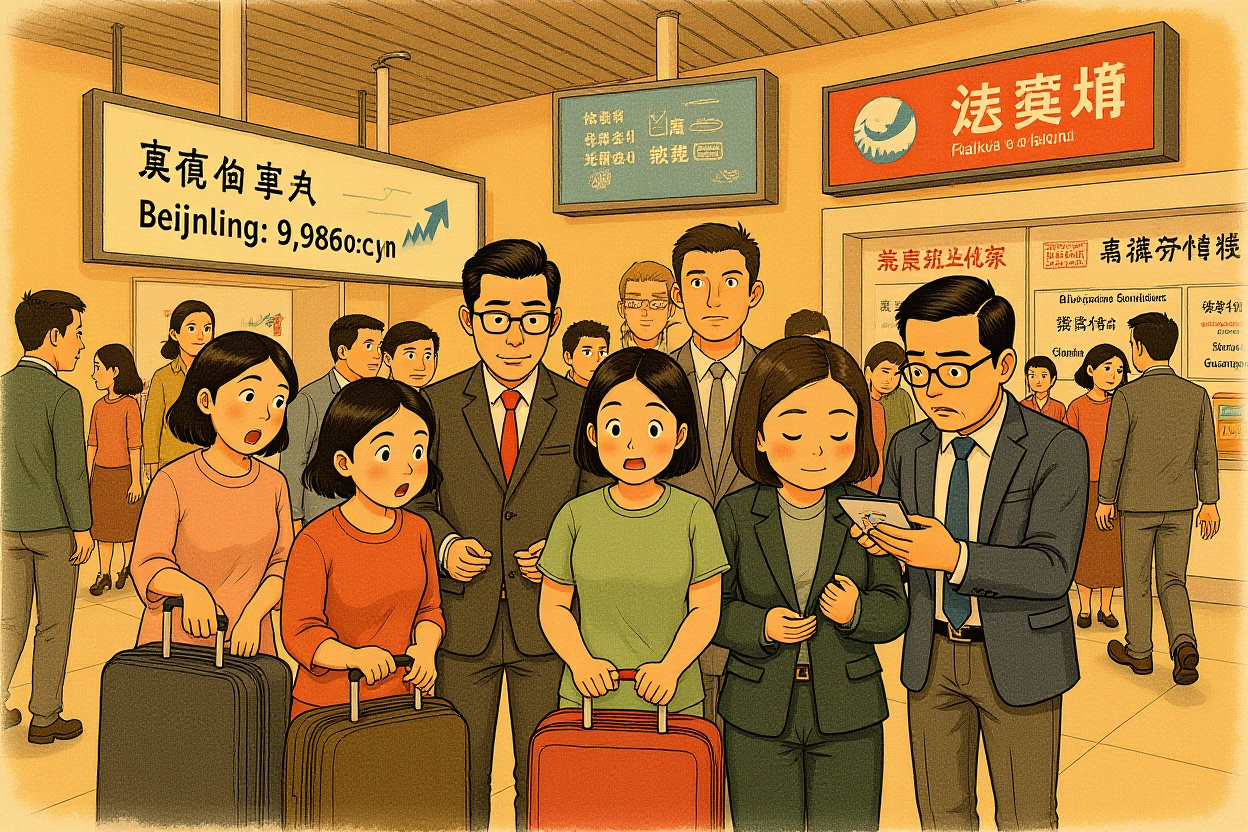
As the Lunar New Year holiday draws to a close, a concentrated wave of travelers is exiting China’s southern island province of Hainan, creating a supply-demand shock that has sent airfares on key routes soaring. The Hainan post-holiday travel surge has pushed prices for flights from Haikou to Beijing to nearly 10,000 yuan, highlighting critical bottlenecks in domestic aviation capacity and sparking a wave of consumer ingenuity. For investors and business professionals monitoring Chinese equities, this event offers a real-time case study in peak-season pricing power, consumer behavior, and the operational challenges facing the tourism and transportation sectors.
Executive Summary: Key Takeaways from the Hainan Travel Crunch
- The Hainan post-holiday travel surge has led to record passenger volumes at the island’s major airports, with over 215,000 travelers processed on a single day.
- Ticket prices on premium routes like Haikou to Beijing have spiked to approximately 10,000 yuan, with many flights selling out or only business class seats remaining.
- Consumers are actively sharing strategies online to bypass high costs, primarily by transiting through mainland Guangdong province before flying to final destinations.
- This demand spike presents a short-term revenue windfall for airlines but also exposes capacity constraints that could influence stock valuations and sector analysis.
- Industry forecasts suggest ticket prices will gradually decline after February 24, offering relief and potential opportunities for value-conscious travelers and investors.
The Unprecedented Scale of the Post-Holiday Exodus from Hainan
The conclusion of the Spring Festival holiday traditionally triggers one of China’s largest annual human migrations, and the 2025 return period from Hainan is proving exceptionally intense. Data from 海南机场集团 (Hainan Airport Group) reveals that the province’s three main airports—海口美兰国际机场 (Haikou Meilan International Airport), 三亚凤凰国际机场 (Sanya Phoenix International Airport), and 琼海博鳌机场 (Qionghai Boao Airport)—have been operating at elevated capacity since the holiday’s end.
Passenger Volume and Flight Data Insights
On February 19 alone, these airports managed 1,176 flights serving more than 215,000 passengers, a year-on-year increase of 6.3%. The group anticipates that the return peak, which began on February 20 (the fourth day of the Lunar New Year), will culminate on February 23, with an estimated 232,000 passengers expected to depart. This Hainan post-holiday travel surge is characterized by high concentration, a sharp peak, and a short duration, placing immense pressure on available airlift.
Historical Context and Capacity Challenges
Comparisons with previous years indicate that this year’s passenger volumes are on track to surpass historical records for the period. The sheer number of travelers, many of whom are returning from holiday visits or tourism trips, underscores Hainan’s popularity as a winter destination and the limited flexibility in air service expansion during ultra-peak times. For market observers, this data point is a vital indicator of resilient domestic consumption and the pent-up demand within China’s travel economy.
Decoding the Sky-High Ticket Prices and Consumer Response
The most visible symptom of the capacity crunch is the dramatic inflation in airfares. A spot check for travel on February 23 shows that on popular routes, options are severely limited. For instance, 厦门航空 (Xiamen Airlines) flight MF8330 from Haikou to Beijing has only business class seats left, priced at close to 10,000 yuan—a premium significantly above typical levels.
Analysis of Premium Route Pricing Dynamics
The pricing on routes like Haikou-Beijing and Sanya-Shanghai reflects classic peak-season economics: inelastic demand meets fixed supply. With many flights fully booked days in advance, airlines can command higher yields on remaining seats. This Hainan post-holiday travel surge effectively turns certain routes into seller’s markets. Data from online travel agency (OTA) platforms confirms that tickets from Sanya to hubs like Hangzhou, Shanghai, Guangzhou, and Shenzhen are in critically short supply, with limited availability also on flights to Beijing, Xi’an, Zhengzhou, and Chengdu.
Social Media Buzz and Consumer Sentiment
The price surge has ignited widespread discussion on Chinese social media platforms. Netizens have expressed frustration, with some stating they were “discouraged by the return ticket prices” from originally planning a Hainan holiday. Others noted that return tickets cost more than double their inbound flights, leading to searches for cheaper alternatives. This public discourse is not just anecdotal; it provides real-time sentiment analysis for companies in the travel sector and hints at potential consumer resistance to extreme pricing.
Strategic Workarounds: How Savvy Travelers Are Bypassing the Crunch
Faced with exorbitant direct flight costs, a cohort of travelers is deploying creative logistics strategies. These workarounds, widely shared online, offer a lesson in consumer adaptability and highlight alternative transportation nodes within China’s integrated travel network.
The Guangdong Transit Strategy: A Cost-Effective Alternative
A popular method involves leaving Hainan via the 琼州海峡 (Qiongzhou Strait) ferry service to Guangdong province, then catching flights from major airports like 广州白云国际机场 (Guangzhou Baiyun International Airport), 深圳宝安国际机场 (Shenzhen Bao’an International Airport), or 湛江机场 (Zhanjiang Airport). This multi-modal approach, while more time-consuming, can result in substantial savings. It effectively spreads demand across a broader transportation corridor, alleviating some pressure on Hainan’s direct air links.
Leveraging Airline Flexibility and Multi-Airport Options
Recognizing the disruption, 海南机场集团 (Hainan Airport Group) has coordinated with carriers like 海南航空 (Hainan Airlines) and 东方航空 (China Eastern Airlines) to offer change services. Eligible passengers can modify their departure or destination airport once. This policy encourages travelers to consider flying from or to less congested airports within Hainan or opting for connecting flights during off-peak hours. For the business-minded, this flexibility is a minor but notable example of industry adaptation to market disequilibrium.
Market Implications for Aviation, Tourism, and Related Sectors
Beyond the immediate travel headaches, the Hainan post-holiday travel surge carries significant financial implications. For investors tracking Chinese equities, especially in the consumer discretionary and transportation spaces, this event is a microcosm of larger trends.
Airline Revenue Surges and Equity Performance Considerations
The period of maximized yields provides a short-term earnings boost for airlines serving Hainan. Carriers like 中国国际航空 (Air China), 中国南方航空 (China Southern Airlines), and 海南航空 (Hainan Airlines) may see improved quarterly metrics from this route-specific premium pricing. However, the transient nature of the surge means it is unlikely to alter long-term valuations significantly unless it points to sustained pricing power or capacity shortages. Analysts will be watching load factors and yield reports closely in upcoming financial disclosures.
Broader Economic Ripple Effects on Hainan’s Tourism Economy
Hainan’s status as an international tourism consumption hub means travel flows directly impact retail, hospitality, and duty-free shopping revenues. The 海南离岛免税政策 (Hainan offshore duty-free policy) drives significant consumer spending. A smooth exit for high-spending tourists is crucial for positive overall holiday economic metrics. Any negative sentiment from difficult or expensive departures could potentially affect future travel plans, indirectly influencing stocks of companies like 中国中免 (China Duty Free Group) with substantial Hainan operations.
Industry Responses and Forward-Looking Price Trajectory
The aviation and airport authorities are not passive observers. Their coordinated response aims to manage the surge and mitigate passenger dissatisfaction, while market forces are already signaling the next phase.
Collaborative Measures to Manage Peak Demand
海南机场集团 (Hainan Airport Group) has publicly outlined its strategy, which includes close collaboration with airlines to optimize slot usage and provide passengers with transparent information on alternatives. The push for flexible itinerary changes is a direct attempt to smooth demand curves. These operational tactics are critical for maintaining service reliability and brand reputation, factors that equity analysts consider when assessing airport operators and airline management quality.
Price Normalization and Investment Takeaways
Industry forecasts, supported by OTA data, predict that airfares will begin a gradual descent after February 24 (the eighth day of the Lunar New Year). This expected normalization is typical after peak travel windows close. For investors, the key insight is the identification of predictable, seasonal volatility in travel-related revenues. The Hainan post-holiday travel surge exemplifies how geographic choke points and holiday calendars can create temporary investment themes. Monitoring capacity announcements from airlines and airport expansion plans in Hainan can provide early signals for future cycles.
Synthesizing the Travel Disruption for Strategic Decision-Making
The phenomenon of nearly 10,000-yuan flights from Hainan to Beijing is more than a travel news headline; it is a multifaceted event with layers of economic significance. It demonstrates the robust demand within China’s domestic consumption engine, the limits of current transportation infrastructure during extreme peaks, and the innovative capacity of consumers to find solutions. For the financial professional, it underscores the importance of granular, real-time data in understanding sector dynamics. The surge will subside, but the patterns it reveals—regarding pricing elasticity, consumer behavior, and operational logistics—remain valuable for modeling company performance and sector risks. As the market looks ahead, stakeholders should watch for increased airline capacity planning for Hainan routes and any regulatory nudges from bodies like the 中国民用航空局 (Civil Aviation Administration of China) aimed at smoothing such seasonal imbalances. Consider integrating analysis of peak travel periods into your broader assessment of Chinese consumer and transportation equities.