



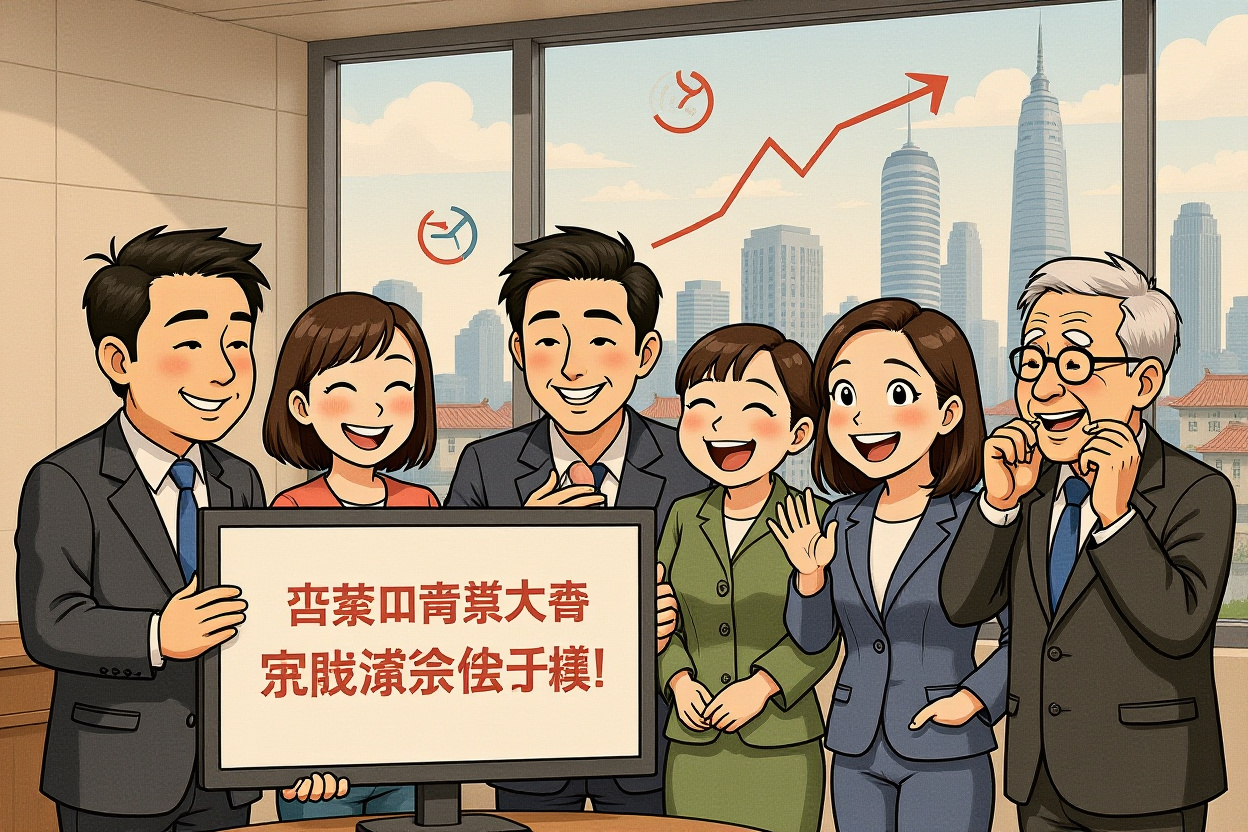
The Cafeteria Cheers That Echoed Across an Industry
In early 2026, the cafeteria at Great Wall Motors’ (长城汽车) headquarters in Baoding erupted into spontaneous cheers during a routine lunch hour. Veteran employees, scrolling through the company’s newly released work calendar, pointed at the clear, consistent markings for two-day weekends—a sight many had never seen in their careers. One long-time worker, visibly emotional, was overheard saying, “We finally have this day.”
This scene marked the official end of Great Wall Motors’ long-standing alternative-weekend system and the full implementation of a standard two-day weekend for its entire workforce. The move represents a profound cultural shift within one of China’s automotive giants and is being interpreted by market analysts as a potential inflection point for an industry historically defined by breakneck speed and relentless “internal competition,” or 内卷 (nèijuǎn). This analysis delves into the implications of Great Wall Motors’ dual-day weekend policy, exploring its roots in industry-wide pressures, its strategic trade-offs, and what it signals for the future of China’s competitive automotive landscape.
Summary: Key Takeaways for Investors and Executives
- Great Wall Motors has formally abolished its “alternating weekends” system, implementing a standard two-day weekend for all employees, effective 2026.
- The policy change comes amid intense profit pressure in the Chinese auto sector, where costly marketing wars and a race for market share have eroded margins despite rising sales volumes.
- Industry-wide, excessive overtime has become a systemic issue, with some firms averaging 70-100 hours of monthly overtime, leading to burnout and talent attrition.
- The move, alongside recent actions by peers like BYD’s salary increases, suggests a coordinated industry pivot away from purely volume- and cost-based competition towards sustainable practices focused on innovation and global competitiveness.
- For investors, this signals a potential bottoming of the most destructive phase of industry “internal competition,” with future winners likely to be determined by technology, quality, and operational efficiency rather than mere labor intensity.
The Policy in Detail: From Rumor to Reality
For months, whispers about the cancellation of the “big-small week” (大小周 dà xiǎo zhōu) system—where employees work one Saturday on, one Saturday off—had circulated within Great Wall Motors. When the official 2026 calendar was published, confirming the shift to a stable two-day weekend, the initial reaction among many was disbelief. “At first, when I heard the news, I thought it was a rumor and didn’t dare believe it,” said an 8-year veteran employee using the pseudonym Li Ming (李明 (pseudonym)). In an industry where grueling schedules are the norm, such a move seemed almost too good to be true.
The new Great Wall Motors’ dual-day weekend policy does involve a trade-off: the company’s traditional 10-day summer high-temperature break has been discontinued. However, employees like Li Ming have done the math. “Five of those high-temperature leave days were actually deducted from annual leave, so we only really lost five days,” he explained. “In exchange for a stable two-day weekend all year round, it’s a fantastic deal. Finally, I can spend proper weekends with my family.” This sentiment of regained personal time and work-life balance has been a common thread in employee feedback, highlighting a pent-up demand for respite after years of industry-wide pressure.
A Fourth Iteration in Employee Welfare
This change is not an isolated event but the latest step in an evolving approach to employee scheduling at Great Wall. Company veterans note this is the fourth major iteration:
- Monthly alternating single/double-day weekends.
- The “big-small week” system.
- The “big-small week” supplemented by a high-temperature leave period.
- The current, full implementation of the two-day weekend.
This progression mirrors the broader trajectory of China’s manufacturing and tech sectors, which are gradually confronting the human and operational costs of unsustainable work cultures. As one industry observer noted, “Regardless of the initial motivation, in the current environment where industry profits are generally declining, giving the right to rest back to employees is truly not easy.”
The Broader Context: An Industry Plagued by “Internal Competition”
The significance of Great Wall’s policy shift cannot be understood without acknowledging the extreme competitive pressures that have defined China’s auto market in recent years. The term 内卷 (nèijuǎn), often translated as “internal competition” or “involution,” perfectly captures the dynamic: companies engage in a self-defeating race where increasing input (time, money, marketing spend) yields diminishing returns, trapping all players in a cycle of exhaustion.
A Culture of Excessive Overtime
Employee burnout has become a stark indicator of this trend. Reports from across the sector paint a grim picture:
- An employee at a new energy vehicle (NEV) startup claimed to have accumulated nearly 500 hours of overtime in six months, leading to multiple emergency room visits.
- An AI algorithm lead at another firm stated work had become his entire life, gaining 20 kilograms under the stress of relentless overtime before resigning.
- Some manufacturers attempted to compress vehicle development cycles from a traditional 20+ months to just 12 months by implementing two-shift systems in R&D departments.
- There have even been reports of employees being dismissed for refusing weekend overtime.
Consultancy AlixPartners’ (艾睿铂) data for 2025 showed average monthly overtime at several automakers stubbornly lingering between 70 and 100 hours. The “996” culture (9 am to 9 pm, 6 days a week) was often surpassed by even more demanding schedules like “8-10-6.” This environment placed immense strain on talent retention and long-term innovation capacity.
Regulatory and Industry Pushback
The unsustainable nature of this competition finally prompted external intervention. In May 2025, both the China Association of Automobile Manufacturers (中国汽车工业协会, CAAM) and the Ministry of Industry and Information Technology (工业和信息化部, MIIT) publicly addressed the issue. They identified disorderly price wars and other forms of destructive internal competition as primary reasons for declining industry profitability, warning that such practices undermine sustainable R&D investment. You can read CAAM’s official statements on their website here.
This top-down guidance created an opening for a coordinated industry reset. In June 2025, major players like BYD (比亚迪) and Dongfeng (东风) committed to compressing payment terms to their suppliers to 60 days, easing liquidity pressure across the supply chain. Then, in a one-two punch at the end of the year, BYD announced widespread salary increases in December, followed immediately by Great Wall’s confirmation of the dual-weekend policy. Together, these actions mark a deliberate, peer-influenced move to step back from the brink of恶性竞争 (è xìng jìngzhēng –恶性竞争) or恶性竞争 (malicious competition).
Financial Pressures and Strategic Recalibration
Great Wall Motors’ decision is particularly notable because it comes at a time of financial strain, making it a strategic choice rather than a move born of pure abundance. The company’s 2025 performance highlights this tension.
Sales Growth Versus Profit Squeeze
Great Wall reported record annual sales for 2025, moving 1.3237 million vehicles, a 7.33% year-on-year increase. Its new energy vehicle (NEV) sales were particularly strong, reaching 403,700 units, a surge of 25.44%. These figures underscore the company’s success in maintaining and growing its market footprint in a ferociously competitive landscape.
However, this growth came at a significant cost. For the first three quarters of 2025, Great Wall’s net profit declined by 16.97% year-on-year. The primary culprit was the immense financial burden of marketing campaigns and extensive sales channel development necessary to fight for market share. This profit squeeze is a microcosm of the entire industry’s dilemma: winning the volume war was eroding the value war.
Implementing the Great Wall Motors’ dual-day weekend policy in this context is a bold statement. It suggests management is willing to absorb potential short-term productivity adjustments to achieve longer-term strategic goals: improving employee morale, reducing burnout-related turnover, and fostering a more sustainable and innovative work culture. The immediate market reaction was positive; on January 6, following the news, Great Wall’s A-share and H-share stock prices both rose, with its Hong Kong-listed stock gaining over 3%. This indicates investor approval of a strategy focused on long-term health over short-term grinding.
The Investor Perspective: Valuing Sustainable Operations
For institutional investors and fund managers, this policy shift is a critical non-financial metric. It provides a tangible data point suggesting that:
- Management is proactively addressing operational risks associated with talent burnout and high attrition.
- The company is confident enough in its operational processes and automation to maintain output with a standardized workweek.
- It aligns with broader Environmental, Social, and Governance (ESG) trends, where social responsibility (the “S”) is gaining weight in investment decisions globally.
A move away from a culture of perpetual overtime can lead to higher per-hour productivity, improved quality control, and more creative problem-solving—factors that directly impact a company’s innovative capacity and, ultimately, its valuation. Investors can track the long-term effects of this policy through Great Wall’s investor relations materials available here.
2026 and Beyond: A New Competitive Paradigm for China’s Auto Sector
The collective actions of Great Wall, BYD, and others point toward 2026 as a potential watershed year. As one industry insider analyzed, “The two-day weekend is not just an employee benefit; it is a sign of the industry returning to rationality.” The era of competing purely on the basis of who can extract more hours from their workforce may be drawing to a close.
The Emerging Core Competencies
In this new phase, the battleground is expected to shift. The key differentiators will become:
- Technological Innovation: Genuine breakthroughs in battery technology, autonomous driving, and smart cockpits.
- Product Quality and Brand Strength: Building lasting consumer loyalty based on reliability and experience, not just specs and price.
- Globalization Capability: Successfully navigating international markets, regulatory environments, and supply chains outside of China.
- Operational and Capital Efficiency: Doing more with optimal, rather than maximal, resource input.
The Great Wall Motors’ dual-day weekend policy can be seen as an early investment in this new paradigm. By prioritizing employee well-being, the company is betting that a rested, engaged, and stable workforce will be more capable of delivering on these complex, innovation-driven goals than an exhausted one.
Implications for the Broader Workforce and Corporate China
For automotive professionals across China, Great Wall’s move sets a powerful precedent. It creates a benchmark for work culture that other manufacturers, especially those struggling with talent retention, will be pressured to meet. The analyst’s prediction that “for ordinary industry practitioners, Great Wall’s adjustment may just be the beginning; more automakers’ ‘burden reduction’ measures may be on the way” seems increasingly plausible.
This trend also resonates with wider shifts in China’s white-collar labor market, where younger generations are increasingly vocal about rejecting the 996 culture, seeking better work-life integration. Companies that adapt to these expectations will likely win the war for top talent in the decades to come.
Navigating the Post-“Internal Competition” Landscape
The cheering in Great Wall’s cafeteria was more than just celebration; it was a sigh of relief from an entire industry. The formal adoption of the Great Wall Motors’ dual-day weekend policy is a concrete, high-profile signal that the most destructive phase of China’s automotive “internal competition” may be peaking. It reflects a maturing market where surviving players are compelled to find smarter, more sustainable ways to compete.
For global investors and corporate executives watching China’s equity markets, this development warrants close attention. It suggests that future alpha in the Chinese auto sector will be generated not by companies that simply out-work their rivals, but by those that out-think and out-innovate them. The metrics for evaluation are expanding beyond quarterly delivery numbers to include indicators of human capital management, operational sustainability, and long-term strategic vision.
The call to action is clear: scrutinize corporate culture and employee welfare policies as material factors in investment and partnership decisions. In the next chapter of China’s automotive revolution, the most valuable engines of growth may well be the rested, creative, and sustainably engaged minds of its workforce.