



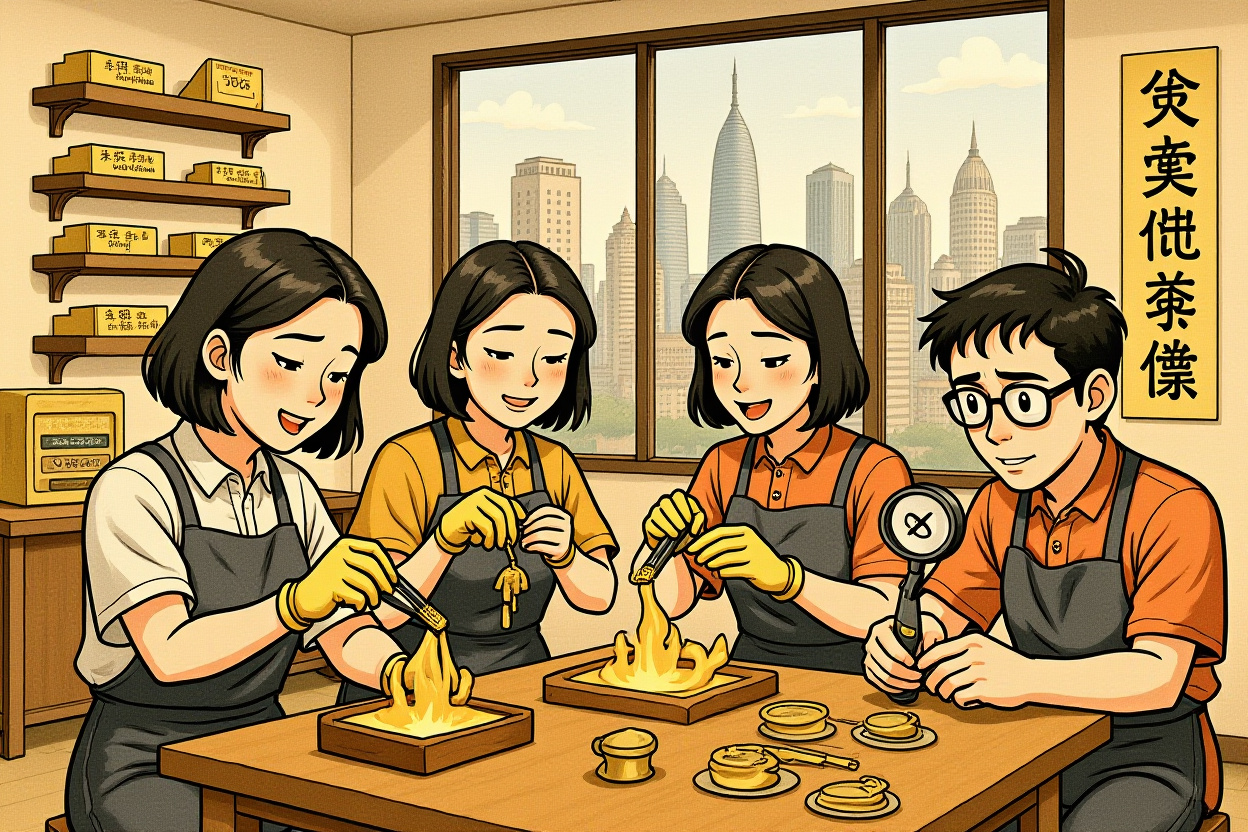
The recent explosive rally in gold prices has not only captivated global markets but has also spawned a surprising cultural and investment phenomenon: the rise of home gold crafting. As spot gold breached $4,555 per ounce and domestic jewelry prices neared 1,400 yuan per gram, a new generation is turning to DIY methods to reshape their gold holdings. This trend, while offering a sense of empowerment and customization, carries significant hidden risks that every market participant must understand.
Executive Summary: Key Market Takeaways
- Gold prices have experienced a sharp, multi-session rally, with domestic retail prices for major brands like Lao Feng Xiang and Chow Sang Sang approaching 1,400 yuan per gram, driven by global macroeconomic uncertainty.
- A resurgence in traditional gold crafting, or “da jin,” has become a viral trend among young Chinese consumers, blending investment, personalization, and cultural revival into a new form of “Guochao” or national trend.
- The professional gold crafting industry is seeing an influx of young, creative artisans, with skilled workers earning monthly wages ranging from 10,000 to 15,000 yuan, indicating a viable new career path.
- The dangerous parallel trend of home gold crafting is gaining traction via social media tutorials, posing serious safety hazards from high-temperature operations and potential financial losses due to operational errors and metal wastage.
- Industry experts and regulators uniformly advise against amateur home gold crafting, emphasizing the need for professional oversight, proper equipment, and awareness of the substantial risks involved.
The Anatomy of the Gold Price Surge: Global and Domestic Drivers
The lightning-fast ascent of gold has reset market expectations and consumer behavior. On March 27th (U.S. Eastern Time), spot gold and silver prices skyrocketed in late-night trading, with gold momentarily surpassing the $4,555 per ounce threshold. This international surge instantly reverberated through China’s retail gold market.
Domestic Gold Jewelry Prices Approach a Psychological Milestone
By March 28th, the quoted prices for pure gold jewelry from leading domestic brands had undergone significant daily adjustments, inching perilously close to the 1,400 yuan per gram mark. This represents a substantial premium over international prices when factoring in tariffs, distribution costs, and brand value. Key data points illustrate the rapid climb:
- Lao Feng Xiang: 1,396 yuan/gram, up 28 yuan from the previous day.
- Lao Miao Gold: 1,397 yuan/gram, up 32 yuan from the previous day.
- Chow Sang Sang: 1,391 yuan/gram, up 27 yuan from the previous day.
This price movement is not merely a retail phenomenon but a direct reflection of underlying market forces, including currency fluctuations, central bank purchasing patterns, and its status as a traditional safe-haven asset during periods of geopolitical and economic instability.
Beyond Safe-Haven Flows: The Structural Demand Shift
While macroeconomic factors are primary drivers, the demand profile within China is evolving. Gold is increasingly viewed not just as a store of value but as a malleable asset for personal expression. This shift is fueling the gold crafting revival and, concerningly, the risky experiment of home gold crafting. Investors are looking for ways to directly interact with and add value to their physical holdings, a sentiment amplified by soaring prices.
Da Jin Reborn: The Viral Resurgence of Gold Crafting
The ancient craft of goldsmithing, known as “da jin,” involves melting gold and manually shaping it through processes like molding, forging, and polishing to create rings, bracelets, and necklaces. Once a fading trade, it has found explosive new life on social media platforms, where related content has garnered over 1.3 billion views. This isn’t just nostalgia; it’s a calculated move by a savvy generation.
The Allure of Customization and Perceived Value
Professional gold craftsmen report that creating a basic piece takes one to three hours, with labor costs ranging from 10 to 40 yuan per gram. More intricate techniques like非遗花丝 (feiyi hua si, intangible cultural heritage filigree) or hand engraving can command fees from几十元至上百元 (several tens to over a hundred yuan). Compared to the steep brand premiums and standardized designs of major jewelry retailers, this offers a compelling mix of affordability, uniqueness, and sentimental value. Consumers are repurposing old family heirlooms into modern designs, effectively preserving the gold’s intrinsic worth and emotional significance while updating its aesthetic appeal.
A Confluence of Investment and Identity
For young buyers, this practice merges the financial logic of holding a tangible asset with the cultural resonance of参与感 (can yu gan, a sense of participation). It transforms gold from a passive investment into an active, creative endeavor. As Secretary-General of the Shanghai Gold Jewelry Association Wang Huiqun (王惠群) notes, “Gold crafting involves specific processing techniques and environmental requirements. Consumers should choose larger, reputable workshops, observe the craftsman’s skill, clarify all uncertainties beforehand, and reach a formal agreement.” This professional guidance stands in stark contrast to the informal, unregulated world of home gold crafting.
The New Generation of Goldsmiths: Injecting Youth into a Traditional Trade
The gold crafting boom is not limited to consumers; it is also creating fresh career opportunities. A new cohort of young artisans, often in their twenties, is entering the field, bringing contemporary design sensibilities and digital marketing savvy.
Demographic Shift and Economic Incentives
One workshop owner interviewed revealed that after noticing the trend’s growth three years ago, she now operates two stores with 20 employees, including 10 goldsmiths primarily born after 2000, with the oldest being 28. This young team’s strength lies in its innovation and acute understanding of client desires. The barrier to entry remains relatively low, with no strict age or学历 (xue li, educational background) limits, making it accessible to recent graduates and career changers alike.
Viable Earnings in a Craft Economy
The economic proposition is tangible. As store manager Zhou Baolin (周宝林) from a workshop in Shanghai’s Huangpu District explains, “In the gold crafting industry, the average monthly salary is around 10,000 yuan. Technically proficient masters, especially engravers, can earn about 15,000 yuan per month.” This income stability, coupled with creative fulfillment, makes professional gold crafting an attractive alternative to conventional employment paths and underscores why the dangerous shortcut of home gold crafting is an unnecessary gamble.
The Perilous Allure of Home Gold Crafting: A Deep Dive into the Risks
Spurred by a desire for ultimate cost-saving and hyper-personalization, a segment of enthusiasts has taken gold crafting into their own homes. Social media platforms are flooded with tutorials on home gold crafting, creating an illusion of simplicity and accessibility. This DIY approach represents a significant departure from professional practice and introduces a host of dangers.
The Tools and the Illusion of Simplicity
A basic home gold crafting kit—readily available on e-commerce platforms for 100 to 200 yuan—typically includes long-nose pliers, a torch, borax, carving tools, investment casting clay, and crucibles. Tutorials outline a deceptively straightforward process: preparing a mold with special clay, heating it with a torch, pouring molten gold, and cooling it rapidly. However, as many aspiring home smelters discover, even meticulously following these steps does not guarantee success. Beijing-based professional craftsmen report a growing number of clients seeking fixes for botched home gold crafting projects.
Expert Analysis: Why Home Gold Crafting is Fraught with Failure
Wang Chao (王超), Director of the Ningbo Quality Inspection Institute Gold Jewelry Testing Center, provides a sober technical assessment. “Theoretically, home gold crafting is not entirely impossible. Someone with strong hands-on skills might succeed after mastering the correct method,” he concedes. However, he immediately highlights the multitude of variables that lead to failure for most amateurs. “The uncertainty in the operation process and the quality factors of the molds themselves will cause corresponding problems,” Wang Chao (王超) states. This underscores that home gold crafting is far from the foolproof hobby portrayed online.
Confronting the Dual Threats: Safety Hazards and Financial Loss
The risks associated with home gold crafting are not merely about a failed craft project; they encompass personal safety and substantial financial detriment. Experts systematically break down these critical concerns.
Safety First: High Temperatures and Toxic Fumes
Gold melts at over 1,064 degrees Celsius, requiring a high-temperature torch. “Home operation certainly carries risks,” warns Wang Chao (王超). He recommends operating in a well-ventilated area with protective gear like thick gloves and long tongs. A more insidious danger lies in the composition of the gold being melted. “If the metal purity is not high, and it contains other volatile metals… For example, if there is mercury, it turns into mercury vapor. In a poorly ventilated environment, this can easily lead to poisoning.” These are hazards that professional workshops are equipped to mitigate but are often overlooked in a home setting.
The Inevitable “Pit”: Unanticipated Financial Loss
Beyond safety, financial loss is the most common pitfall for home gold crafting enthusiasts. Operational errors lead to gold wastage that far exceeds expectations. Common mistakes include improper preparation of石膏模具 (shi gao mu ju, plaster molds) causing castings to shatter, or metals breaking during welding. These errors result in黄金残留或损耗 (huang jin can liu huo sun hao, gold residue or loss) that is difficult to recover. The gold is often embedded in failed molds or scattered as dust, effectively lost. The subsequent cost of hiring a professional to repair or reclaim the material frequently surpasses the original savings, making the entire home gold crafting endeavor counterproductive. Wang Chao (王超) advises the public to “rationally view the possibilities and limitations of home gold crafting,” emphasizing it is not a simple matter of following an online tutorial.
Navigating the Gold Rush: Prudent Strategies for Investors and Enthusiasts
In light of these dynamics, market participants must adopt a measured approach. The convergence of soaring prices, cultural trends, and technological accessibility has created a unique moment that requires discernment.
For Investors: Separating Signal from Noise
The gold price rally itself demands attention to fundamentals rather than speculative frenzy. Investors should monitor announcements from the中国人民银行 (People’s Bank of China) regarding gold reserves, international美元指数 (U.S. Dollar Index) movements, and real interest rate trajectories. Physical gold ownership, whether in bars or jewelry, remains a valid strategy, but the added complexity and risk of home gold crafting do not enhance its investment merit.
For Consumers: Choosing the Right Path to Customization
Those captivated by the idea of personalized gold should heed the advice of industry bodies like the上海黄金饰品行业协会 (Shanghai Gold Jewelry Association). Engaging with established, licensed professionals ensures quality, safety, and ultimately, protects the value of the asset. The few hundred yuan saved in labor costs through home gold crafting are trivial compared to the potential loss of the entire gold value or, worse, personal injury.
The current gold market narrative is a powerful blend of finance and culture. While the empowerment of home gold crafting is understandably attractive, the realities of high-temperature metallurgy, toxic byproducts, and significant material loss present a clear verdict. The professional gold crafting industry offers a safe, creative, and economically sensible channel for personalizing gold assets. As prices continue their volatile climb, the wisest course for individuals is to appreciate gold’s dual role as a financial safeguard and a cultural material, but to entrust its transformation to skilled hands. Before embarking on any DIY project involving precious metals, consult with certified experts and prioritize the preservation of both your wealth and well-being.