



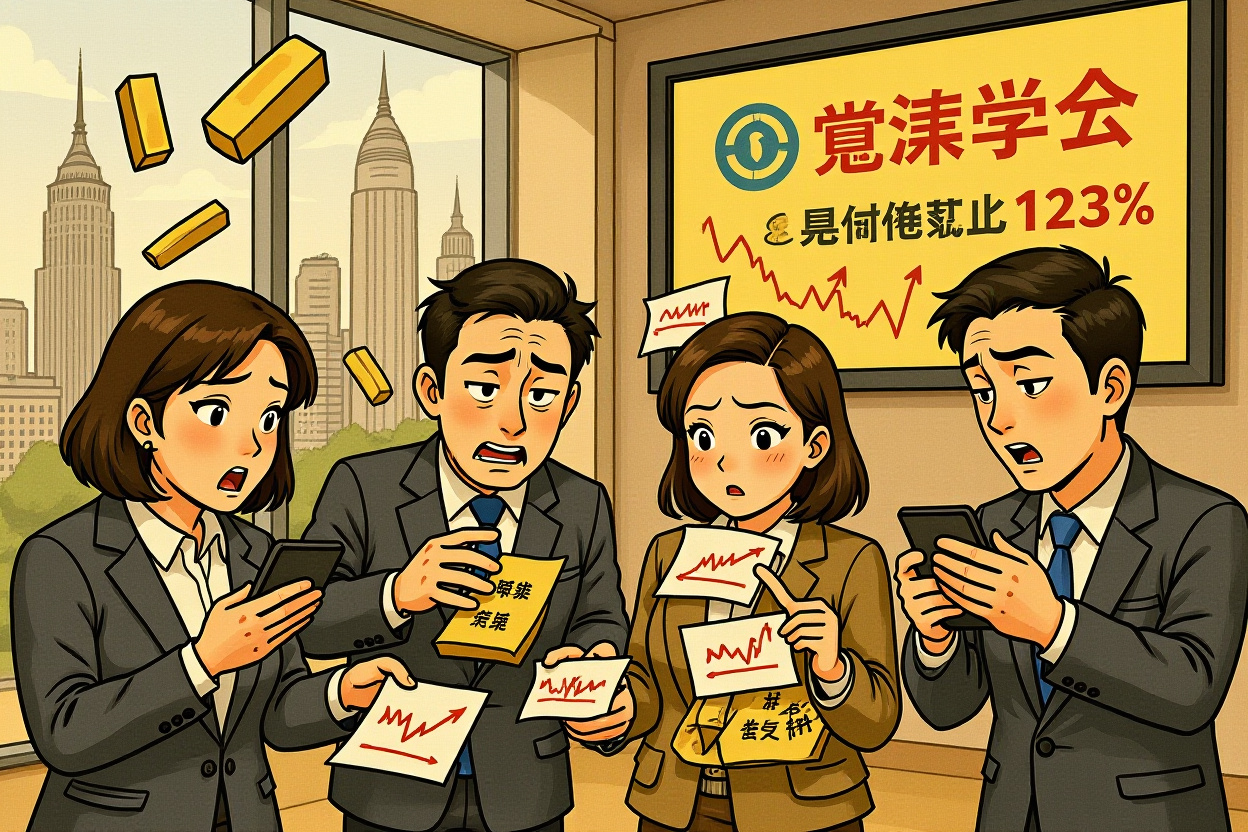
Executive Summary: Critical Takeaways for Market Participants
– Spot gold’s staggering 13%+ decline in March 2024 represents its largest monthly drop since the 2008 financial crisis, driven by a potent mix of macroeconomic forces and crowded positioning.
– The foundational long-term investment thesis for gold—central bank accumulation, de-dollarization trends, and portfolio diversification—remains structurally intact, but it is no longer a simple one-way bet.
– Determining the optimal moment to buy the bottom requires monitoring five interconnected signals: macroeconomic pressure relief, ETF flow stabilization, cessation of forced selling, technical support holds, and a reset in speculative positioning.
– For institutional and individual investors, the prudent approach shifts from attempting to time the absolute low to incorporating gold as a strategic, non-correlated asset within a broader portfolio framework, using disciplined entry strategies.
The Unprecedented Gold Sell-Off: Context and Immediate Drivers
Spot gold’s precipitous fall in March sent shockwaves through global commodity markets. Dubbed an ‘epic sell-off’ by traders, the over 13% cumulative decline marked the metal’s worst monthly performance in more than 17 years. This dramatic move has left investors worldwide grappling with a core question: amid the volatility, is now the time to buy the bottom, or is further pain ahead?
A Historic Decline in Context
The scale of the decline is critical to understanding market sentiment. A drop of this magnitude, unseen since the depths of the 2008 global financial crisis, indicates a violent repricing driven by factors beyond gold’s intrinsic demand drivers. It underscores a market that had become overly optimistic and leveraged, now undergoing a sharp correction. The plunge from record highs near $2,450 per ounce to briefly touch $2,100 levels on COMEX futures represents a significant technical and psychological breach.
Immediate Catalysts: Oil, Inflation, and the Dollar’s Resurgence
The sell-off was not triggered by a sudden failure of gold’s long-term narrative. Instead, it was a classic response to shifting short-term macro variables. A surge in oil prices reignited fears of persistent inflation, compelling markets to reprice expectations for ‘higher-for-longer’ interest rates from major central banks like the U.S. Federal Reserve. This, in turn, turbocharged the U.S. dollar (美元), which serves as a primary pricing currency and competitor safe-haven asset. As the dollar index (DXY) rallied, gold, which bears no yield, became less attractive relative to yielding assets and a strengthening currency. The environment for a simple buy the bottom strategy evaporated almost overnight.
Deconstructing Gold’s Long-Term Investment Thesis
Beyond the short-term noise, the fundamental case for holding gold has not been invalidated. However, investors must distinguish between enduring structural trends and transient price drivers. The key is to assess whether the conditions supporting a long-term buy the bottom mentality are still in place.
The Pillars of Sustained Demand: Central Banks and Geopolitics
Global central banks have been consistent net buyers for over a decade. This trend is rooted in strategic de-dollarization efforts and the desire to diversify foreign exchange reserves away from over-reliance on the U.S. dollar. Institutions like the People’s Bank of China (中国人民银行) have steadily increased their gold holdings. Furthermore, ongoing geopolitical tensions and fiscal concerns in developed markets sustain gold’s role as a proven hedge against systemic risk and currency debasement. These are slow-moving, powerful currents that continue to flow in gold’s favor.
When the Bull Case for Gold Could Crumble
The long-term logic for gold would only be decisively broken if three concurrent events transpired:
– A sustained, broad-based shift from net buying to net selling by the world’s central banks.
– A material reversal in the multi-decade trend toward reserve diversification and de-dollarization.
– The emergence of a prolonged cycle where high real interest rates and a dominant U.S. dollar structurally suppress gold’s price for years, not quarters.
Currently, none of these scenarios are unfolding. Therefore, while the opportunity to buy the bottom may present itself, it requires more nuance than in past cycles. The long-term direction remains supportive, but the path will be dictated by short-term macro and positioning.
The Five Signals That Will Signal a True Bottom
Identifying a sustainable low requires more than a price bounce. Astute investors monitor a confluence of factors to gauge whether selling pressure is truly exhausted. Here are the five critical signals to watch before committing capital to buy the bottom.
Signal 1: Macroeconomic Pressure Relief – Dollar, Oil, and Rate Expectations
The core of the recent gold weakness lies in the ‘trifecta’ of a strong dollar, elevated oil prices, and hawkish interest rate expectations. The first signal of a lasting bottom will be a synchronous easing of these pressures. Key indicators to monitor include:
– A sustained downturn in the U.S. Dollar Index (DXY) below key resistance levels.
– A moderation in Brent crude oil prices that alleviates embedded inflation fears.
– A shift in interest rate futures (e.g., CME FedWatch Tool) pricing toward a credible path for rate cuts, moving away from the ‘higher for longer’ narrative. Until these macro headwinds abate, rallies in gold may prove fleeting.
Signal 2: ETF Flows Stabilizing and Turning Positive
Exchange-Traded Fund (ETF) holdings represent institutional and longer-term investor sentiment. Since the escalation of conflict in the Middle East, global gold ETFs have witnessed massive outflows. Data from the World Gold Council (WGC) indicated a net outflow of $7.9 billion (54.8 tonnes) in just three weeks, predominantly from U.S.-listed funds. A confirmed bottom will likely coincide with a stabilization and eventual reversal of these flows, signaling that institutional capital is returning. Persistent outflows suggest the distribution phase is not complete.
Signal 3: Passive and Forced Selling Subsides
The market has been contending with ‘non-discretionary’ selling. A prime example was the Central Bank of the Republic of Türkiye’s (土耳其央行) reported sale of approximately $3 billion in gold reserves in late March to support its local currency. Such forced liquidations, driven by liquidity needs rather than a bearish view on gold, create intense, concentrated selling pressure that can distort prices. Monitoring central bank activity and margin-led selling in futures markets is crucial. The absence of such large, distressed sales is a prerequisite for a healthy base to form.
Signal 4: Technical Support Holds Firm on Re-Tests
Technical analysis provides key levels where buyer interest historically emerges. The World Gold Council identified a critical support zone between $2,090 and $2,066 per ounce (对应 4,090-4,066美元/盎司), aligning with the 200-day moving average and the 38.2% Fibonacci retracement of the 2022-2024 bull run. While gold briefly pierced the $2,100 level in March, it has since rebounded. The true test for a buy the bottom opportunity will be a subsequent re-test of this support area that holds without breaking to new lows. A successful hold would suggest long-term buyers are actively defending this level.
Signal 5: Market Positioning Resets from Extreme Levels
Commitments of Traders (COT) reports from the U.S. Commodity Futures Trading Commission (CFTC) offer a window into speculative sentiment. In the week following the worst of the sell-off, data showed that large speculators (非商业头寸) actually increased their net-long positions, adding nearly 4,900 contracts. This indicates that the most leveraged players were ‘buying the dip’ rather than capitulating. For a durable bottom, the market often needs to see a washout of overly bullish positions—a period of pessimism or neutrality where weak hands exit. Current data suggests positioning, while adjusted, may not yet be ‘clean’ enough to fuel a new sustained uptrend. A reduction in net speculative longs could be a contrarian positive signal.
A Strategic Framework for Investors: Beyond Timing the Bottom
For the professional investor, the question of whether to buy the bottom is less about pinpoint precision and more about strategic integration. Gold’s role is fundamentally that of a portfolio diversifier and insurance policy, not a high-conviction directional trade.
Gold in a Portfolio Context: Hedge, Not a Bet
The primary value of gold lies in its low-to-negative correlation with risk assets like equities during periods of market stress. Therefore, its allocation should be determined by overall portfolio objectives, risk tolerance, and the existing mix of assets. Trying to time the absolute bottom in gold is as difficult as timing the stock market and often leads to suboptimal outcomes. A strategic, constant-weight allocation (e.g., 5-10% for a balanced portfolio) that is rebalanced periodically can capture long-term appreciation without the need for market timing.
Practical Execution: DCA, Position Sizing, and Patience
If an investor is under-allocated to gold and seeks to increase exposure amid the downturn, a disciplined process is paramount:
– Use Dollar-Cost Averaging (DCA): Instead of a lump-sum investment attempting to buy the bottom, schedule smaller, regular purchases over weeks or months. This averages entry points and reduces the impact of short-term volatility.
– Scale In Gradually: Begin with a partial position and add to it only if the market moves in your favor or if further weakness aligns with the key signals discussed above.
– Prioritize Physical and Low-Cost Vehicles: Consider the form of exposure. For large allocations, allocated physical gold or vaulted products offer direct ownership. For most, low-cost ETFs like the SPDR Gold Shares (GLD) or iShares Gold Trust (IAU) provide efficient liquidity. Always be mindful of storage costs and management fees.
Synthesizing the Outlook: Patience, Precision, and Preparedness
The dramatic March sell-off has reset expectations and cleared extreme bullishness from the gold market. The long-term foundational drivers remain supportive, but the era of ‘buying without looking’ is conclusively over. The current environment demands a more analytical and patient approach.
Key Takeaways for the Informed Investor
First, acknowledge the regime change. Gold is now trading as a macro-driven asset highly sensitive to real yields and the dollar, not merely a reflexive safe haven. Second, the decision to buy the bottom should be data-dependent, contingent on the alignment of the five key signals rather than gut feeling or price alone. Third, for those with a long-term horizon, weakness can represent a strategic accumulation zone, but only if incorporated as part of a deliberate plan.
The Path Forward: Monitoring the Signals and Staying Disciplined
The most violent phase of the sell-off may have passed, but confirmation of a durable low is not yet in hand. Investors should maintain watchlists tracking the U.S. dollar index, gold ETF flow data from sources like the World Gold Council, CFTC positioning reports, and key technical levels. When a majority of these signals turn positive, the case for adding exposure strengthens significantly. Until then, discipline trumps enthusiasm. The ultimate goal is not to buy at the very bottom but to build a position that will protect and enhance your portfolio when the next cycle turns. Stay informed, stay strategic, and let the market data guide your decision to buy the bottom.