



Executive Summary
Before diving into the details, here are the key takeaways from this analysis of China’s burgeoning gold crafting phenomenon:
– Global and domestic gold prices have surged dramatically, with spot gold exceeding $2,200 per ounce and domestic retail prices nearing 1400 yuan per gram, fueling consumer interest in alternative gold consumption.
– The ancient craft of gold making, or “打金” (dǎ jīn), is experiencing a massive revival, particularly among young Chinese, driven by social media trends and a desire for personalized, cost-effective jewelry.
– A new generation of artisans, including many “00后” (post-2000s birth), is entering the field, offering innovation and capturing market demand, with skilled craftsmen earning monthly wages of 10,000 to 15,000 yuan.
– The trend of home gold making, or “居家打金” (jū jiā dǎ jīn), is gaining popularity but carries significant risks, including safety hazards from high-temperature operations and potential financial losses due to operational errors and material wastage.
– Experts from bodies like the Shanghai Gold Jewelry Industry Association and the Ningbo Quality Inspection Institute caution that while home gold making is theoretically possible, it requires skill, proper equipment, and awareness of risks to avoid pitfalls that could negate any cost savings.
The Meteoric Rise of Gold: Setting the Stage for a Crafting Revolution
In late March, global financial markets witnessed a startling surge in precious metals. On March 27th (Eastern U.S. time), gold and silver prices skyrocketed overnight, with spot gold briefly piercing the $2,200 per ounce barrier—a level that sent ripples across investment portfolios worldwide. By March 28th, this global frenzy had cemented itself in China’s domestic market, with major jewelry brands announcing sharp increases in their retail gold prices, bringing the per-gram cost of pure gold jewelry perilously close to the 1400 yuan psychological threshold.
This price explosion is not merely a statistic; it is the catalyst for a profound behavioral shift among Chinese consumers, particularly the younger generation. When the store price for a gram of gold approaches such heights, the search for value and personal expression takes on new forms. This environment has directly fueled the explosive growth of gold making, transforming it from a niche, traditional craft into a mainstream, social media-driven trend. The focus phrase, home gold making, emerges from this context as a double-edged sword: a potential avenue for savings and creativity, but one fraught with challenges that both consumers and investors must understand.
Decoding the Price Spike: Data from Leading Chinese Brands
The immediate impact on consumers is best illustrated by the pricing data from major Chinese jewelry retailers. On March 28th, comparative price checks revealed significant day-over-day increases:
– Lao Feng Xiang (老凤祥) quoted 1396 yuan per gram, up 28 yuan from 1368 yuan.
– Lao Miao Gold (老庙黄金) quoted 1397 yuan per gram, a sharp increase of 32 yuan from 1365 yuan.
– Chow Sang Sang (周生生) quoted 1391 yuan per gram, rising 27 yuan from 1364 yuan.
These hikes reflect a complex interplay of international market volatility, currency fluctuations, and domestic demand. For the average consumer, the rising cost of brand-new jewelry has made the prospect of repurposing old gold or creating custom pieces increasingly attractive, setting the stage for the gold making boom.
The Renaissance of Gold Making: From Antiquated Skill to Modern “Guochao”
Gold making, the process of transforming raw or old gold into new jewelry through melting, molding, shaping, and polishing, is an art form with millennia of history in China. Its sudden resurgence, however, is distinctly modern. On social media platforms like Xiaohongshu (小红书) and Douyin (抖音), the topic of “打金” has amassed over 1.3 billion views, indicating a cultural movement far beyond a fleeting hobby. This trend represents a fusion of financial prudence, emotional nostalgia, and contemporary aesthetic tastes, effectively becoming a new form of “国潮” (guócháo, or national trend).
Consumers are increasingly drawn to this option because it offers a compelling value proposition. As reported by craftsmen, the labor cost for a basic gold item ranges from 10 to 40 yuan per gram, with more intricate techniques like非遗花丝 (feiyí huāsī, intangible cultural heritage filigree) or手工錾刻 (shǒugōng zànkè, hand engraving) commanding higher fees. Compared to the substantial brand premiums and craftsmanship fees at established jewelry stores, gold making presents a personalized and often more economical alternative. Many young consumers see it as a way to preserve the intrinsic value and sentimental memory of inherited or older pieces while updating them to suit modern styles.
Industry Guidance for Safe Engagement
Wang Huiqun (王惠群), Secretary-General of the Shanghai Gold Jewelry Industry Association (上海黄金饰品行业协会), offers prudent advice for those venturing into this space. “Gold making involves specific processing techniques and environmental requirements,” she notes. “It is advisable to choose a relatively large-scale gold making shop, observe the craftsman’s skills firsthand, clarify any uncertainties in advance, and reach a formal agreement.” This guidance underscores that while the trend is accessible, professional oversight remains crucial for quality and security—a point that becomes even more critical when considering the DIY, or home gold making, variant.
The New Face of an Old Trade: Young Artisans Forging Careers
The popularity of gold making has done more than just create demand; it has sparked a supply-side revolution. A new cohort of young artisans, predominantly from the “00后” generation, is entering the profession, bringing fresh perspectives, digital savvy, and innovative designs. Shop owners report that their teams, sometimes with an average age under 28, excel at understanding client desires and translating them into unique pieces. This infusion of youth is vital for the industry’s sustainability and evolution.
From an economic standpoint, gold making offers viable career paths. Zhou Baolin (周宝林), store manager at a gold making shop in Shanghai’s Yuyuan area, provides insight into earning potential: “In the gold making industry, the basic monthly salary is around 10,000 yuan. For technicians with superior skills, such as engravers, wages can generally reach about 15,000 yuan per month.” This income level, competitive for many skilled trades in urban China, is attracting not only fine arts graduates but also career-changers seeking a tangible and creative profession.
The Allure and Peril of Home Gold Making: A Deep Dive into DIY Risks
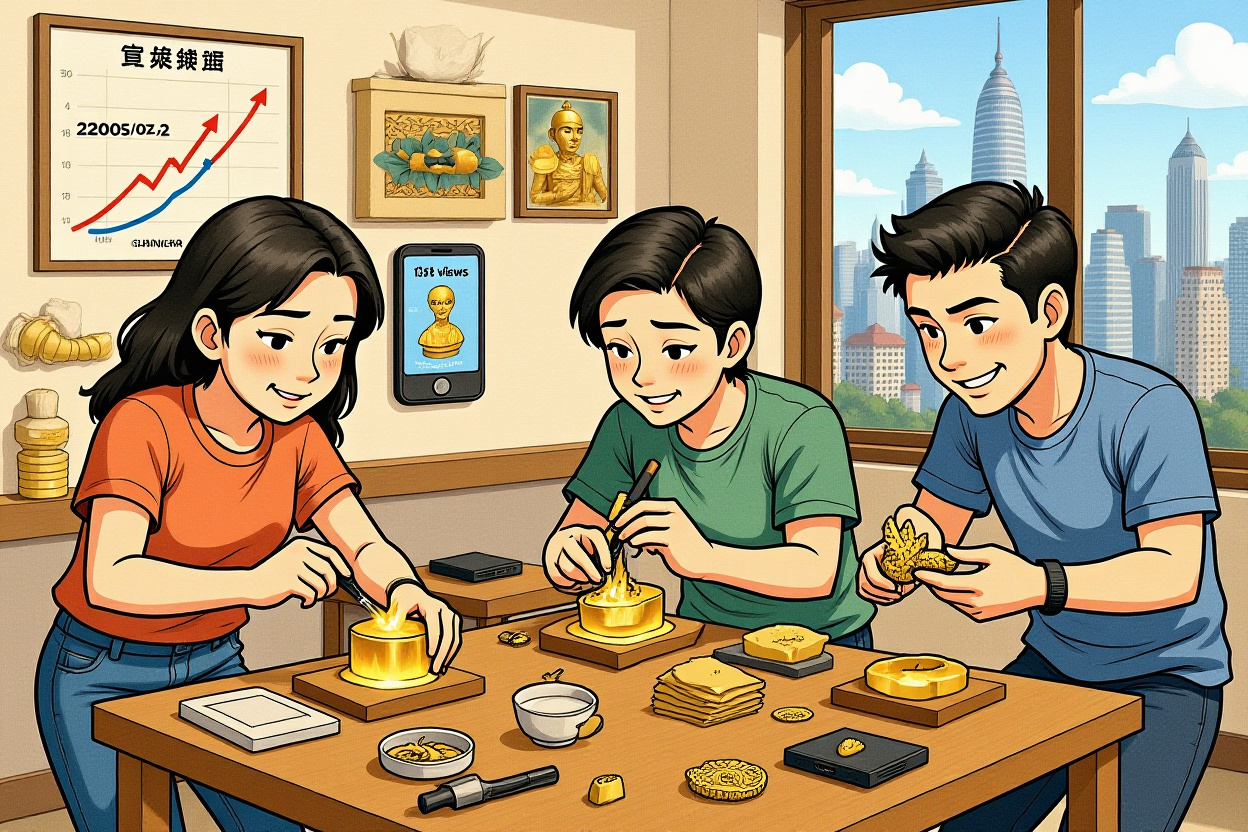
At the extreme end of this trend lies the practice of home gold making. Empowered by detailed video tutorials on social media and readily available toolkits from e-commerce platforms, a growing number of enthusiasts are attempting to bypass professional shops altogether. A basic “home gold making” kit, searchable under keywords like “打金套装” (dǎ jīn tào zhuāng), can be purchased online for as little as 100 to 200 yuan. These kits typically include long-nose pliers, brushes, files, agate burnishers, borax, torches, crucibles, electronic scales, and modeling clay or investment plaster for molds.
The process, as outlined in numerous tutorials, involves careful steps: setting up a heat-resistant workspace, assembling the torch, heating the mold, melting the gold with borax as a flux, and then pressing or pouring it into the mold before quenching in water. However, the gap between theory and practice is vast. Even with meticulous replication of online steps, failure is common. Professionals report a surge in customers seeking rescue for botched home gold making projects, where the anticipated savings evaporate into additional repair costs.
Technical and Safety Analysis from an Expert
Wang Chao (王超), Director of the Gold and Jewelry Testing Center at the Ningbo Quality Inspection Institute (宁波市质检院黄金珠宝检测中心), provides a balanced yet cautious perspective. “From a theoretical standpoint, home gold making is not entirely infeasible,” he acknowledges. “People with certain hands-on abilities, after mastering the correct methods, may indeed complete the production.” However, he immediately highlights the uncertainties. “The melting point of gold is over 1000 degrees Celsius. It involves high temperatures, and operating at home certainly carries risks. It is recommended to operate in a ventilated environment with protective measures like thick gloves and long tongs, and to stay away from high temperatures to minimize risk.”
Wang Chao (王超) further elaborates on specific dangers that extend beyond burns. “You need to consider the purity of the metal. If it is mixed with other, more volatile metals—for example, if there is mercury—when heated, these inferior metals with lower melting points may already have vaporized by the time the gold melts. In a poorly ventilated environment, this can easily lead to poisoning.” This underscores that home gold making is not a benign craft; it involves genuine chemical hazards.
The Financial Pitfalls: When Savings Become Losses
Beyond safety, the most common pitfall for home gold making enthusiasts is financial loss. Operational errors can lead to gold wastage that far exceeds expectations. Common mistakes include improper preparation of plaster molds causing castings to shatter, or metal melting and breaking during soldering. These errors result in gold residue or loss that is difficult to recover. Often, the damaged piece must be turned over to a professional for repair, incurring additional costs that nullify the initial goal of saving money. As the focus phrase, home gold making, suggests, the domestic setting amplifies these risks due to lack of professional equipment and expertise. Wang Chao (王超) advises a rational view: “Home gold making is not something that can be achieved simply by following tutorial operations. One should realistically assess its possibilities and limitations.”
Market Implications and Strategic Considerations for Investors
For institutional investors and financial professionals monitoring Chinese consumer trends and equity markets, this gold making phenomenon offers several layers of insight. Firstly, it signals a shift in consumer behavior within the luxury and jewelry sector. Brands that fail to adapt to the demand for personalization and value may face headwinds, while companies involved in gold refining, tool manufacturing, or providing professional crafting services could see growth. Secondly, the volatility in gold prices themselves remains a primary driver, influenced by global macroeconomic factors, monetary policy from the中国人民银行 (People’s Bank of China), and international geopolitical tensions.
Investors should scrutinize listed companies in the gold supply chain, from miners like Zhongjin Gold (中金黄金) to retailers such as Chow Tai Fook (周大福). The rise of home gold making could also indirectly benefit e-commerce platforms that facilitate the sale of tools and materials, though regulatory scrutiny on safety standards for such products may increase. Furthermore, this trend reflects broader themes of Chinese youth embracing domestic culture and hands-on creation, which could inform investment theses in other consumer discretionary sectors.
Regulatory and Quality Assurance Landscape
The growing DIY trend may prompt regulatory bodies to examine the sale of gold making kits and the purity of gold materials sold directly to consumers. Organizations like the国家市场监督管理总局 (State Administration for Market Regulation) could introduce guidelines to ensure consumer protection. For investors, this implies a need to monitor regulatory announcements that might affect companies in this niche. Quality assurance, as emphasized by experts like Wang Chao (王超), is paramount; any incidents related to home gold making could lead to stricter controls, impacting market sentiment.
Synthesizing the Golden Trend: Key Takeaways for the Discerning Professional
The intersection of soaring gold prices, cultural nostalgia, and digital community has given birth to a significant trend in China’s consumer economy. Gold making, in its professional and home-based forms, is more than a fad; it is a reflection of adaptive consumerism in the face of economic pressures. However, the enthusiasm for home gold making must be tempered with a clear understanding of its associated risks—from toxic fumes and fire hazards to substantial financial losses from failed projects.
For market participants, this trend underscores the importance of looking beyond traditional metrics to gauge consumer sentiment and identify emerging growth niches. It also highlights the critical role of expertise and quality control in industries experiencing rapid democratization. As gold prices continue to exhibit volatility, driven by global and domestic factors, the demand for alternative gold consumption methods is likely to persist.
Moving forward, stakeholders—from individual consumers to institutional investors—are advised to prioritize safety, verify sources, and seek professional guidance when engaging with gold making. For those looking to capitalize on this trend within their portfolios, consider a balanced approach: monitor companies leveraging this shift, stay informed on regulatory developments, and always factor in the expert warnings that accompany any booming, yet technically demanding, consumer movement. The key lesson is clear: in the glittering world of gold, whether for investment or adornment, knowledge and caution are the most valuable assets of all.