



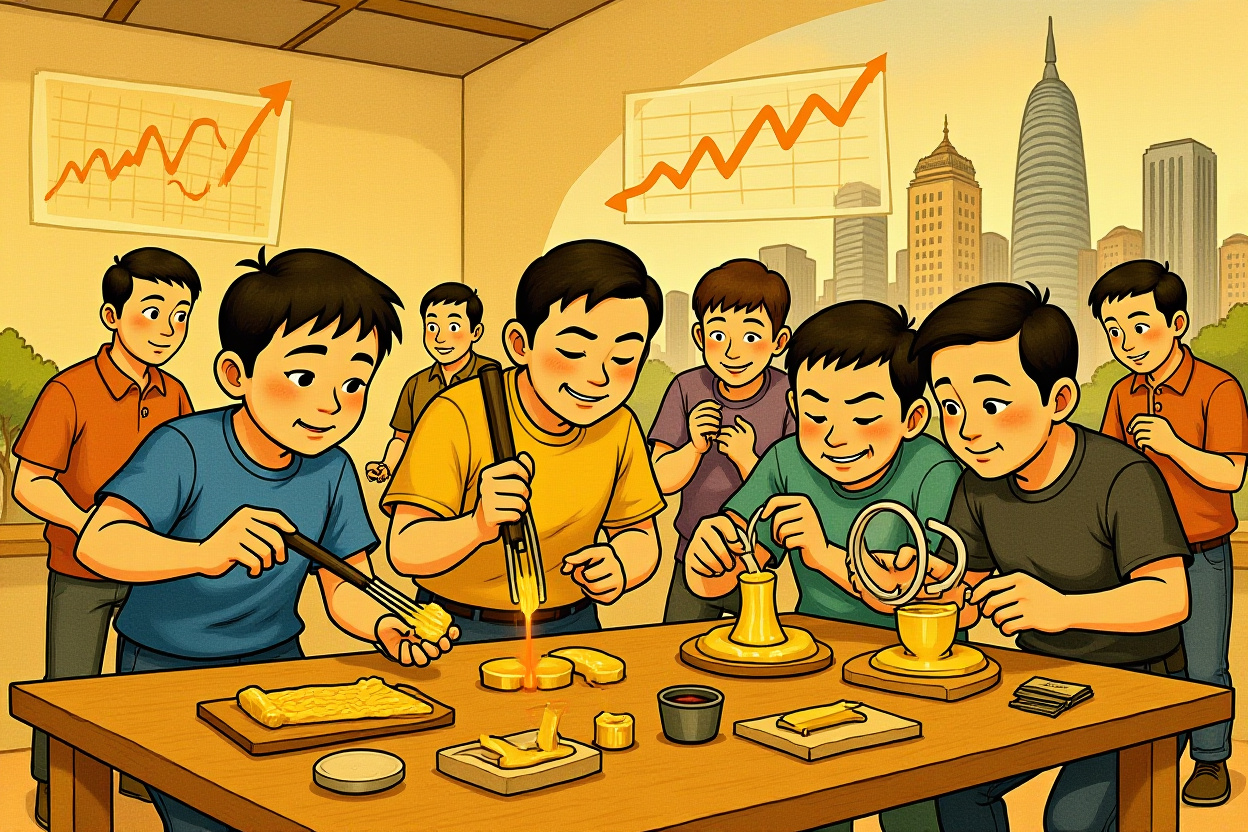
The Precious Metals Frenzy: A Global Surge Hits Home
Overnight Rally in International Markets
In the early hours of March 27, Eastern Time, global precious metals markets witnessed a dramatic vertical ascent. Spot gold prices pierced through the $4555 per ounce barrier, a level not seen in recent history, while silver followed suit with significant gains. This rally, driven by a complex mix of geopolitical tensions, inflationary pressures, and shifting central bank policies, sent immediate shockwaves through Asian markets upon opening. For international investors focused on Chinese equities, such commodity volatility often signals broader economic currents, influencing sectors from luxury retail to industrial manufacturing.
Domestic Gold Jewelry Prices Approach Historic Highs
By March 28, the reverberations were felt acutely in China’s consumer markets. Major domestic gold jewelry brands swiftly adjusted their retail prices upward, bringing per-gram costs perilously close to the symbolic 1400 yuan threshold. This rapid repricing underscores the direct pass-through effect of international benchmark prices on local consumption. The price adjustments from leading brands were stark:
– Lao Feng Xiang (老凤祥) quoted 1396 yuan per gram, a 28 yuan increase from the previous day.
– Lao Miao Gold (老庙黄金) listed 1397 yuan per gram, up by 32 yuan.
– Chow Sang Sang (周生生) priced at 1391 yuan per gram, marking a 27 yuan rise.
This consistent uptick across major retailers highlights the intense margin pressure and consumer sensitivity in the world’s largest gold market. The soaring prices have not dampened demand but have, paradoxically, fueled an innovative consumer counter-movement: the rise of home gold crafting.
The Renaissance of Gold Crafting: A New Consumer Paradigm
What is Gold Crafting and Why is it Exploding in Popularity?
Gold crafting, or “打金” (dǎ jīn), is the traditional process of transforming raw gold or old jewelry into new pieces through melting, molding, shaping, and polishing. Once a niche artisanal trade, it has stormed back into mainstream consciousness, particularly among younger, financially savvy demographics. On Chinese social media platforms, topics related to gold crafting have amassed over 1.3 billion views, signaling a profound shift in how value and sentiment are perceived in tangible assets. This trend represents more than a hobby; it is a calculated response to high retail markups and a desire for personalized asset expression.
The appeal is multifaceted. For consumers, it offers a direct way to circumvent the substantial brand premiums and craftsmanship fees charged by established jewelry stores. A basic gold crafting service typically costs between 10 to 40 yuan per gram in labor, compared to the significantly higher implicit costs in retail pieces. For complex designs involving非遗花丝 (intangible cultural heritage filigree) or手工錾刻 (hand engraving), fees can range from几十元至上百元 (several tens to over a hundred yuan). This cost-effectiveness, coupled with the emotional resonance of repurposing heirloom pieces into modern designs, has created a powerful consumer narrative. As one industry observer noted, it merges aesthetic appeal, emotional attachment, and financial utility into a potent form of “新国潮” (new national trend).
The Economic Mechanics Behind the Trend
The viability of home gold crafting is underpinned by accessibility. A full suite of tools—including crucible tongs, torches, carving clay, and molds—can be purchased online for as little as 100 to 200 yuan. This low barrier to entry has democratized a process once confined to specialized workshops. However, the economic calculation is not straightforward. While saving on labor costs is attractive, the risk of material loss due to operational error is high. Experts caution that the actual gold损耗 (loss) during amateur attempts can far exceed expectations, negating any perceived savings and potentially leading to greater financial outlay for professional remediation.
Young Artisans and a Revitalized Industry
A New Generation of Gold Craftsmen
The demand surge has catalyzed a parallel boom in gold crafting as a profession, attracting a cohort of young, creative individuals. Unlike traditional apprenticeships, this new wave is characterized by digital nativity and a strong design sensibility. Shop owners report hiring teams where the majority of craftsmen are from the “00后” generation (post-2000), with the oldest being only 28. This infusion of youth brings enhanced innovation and a sharper understanding of contemporary client desires, from minimalist aesthetics to custom engravings.
Career Opportunities and Earning Potential
The industry presents a viable and increasingly lucrative career path. Zhou Baolin (周宝林), store manager at a gold crafting shop in Shanghai’s Yuyuan area, notes that entry-level craftsmen can expect monthly salaries around 10,000 yuan, with skilled engravers or masters commanding 15,000 yuan or more. The sector has minimal formal barriers regarding age or academic background, making it accessible to recent graduates and career-changers alike. This labor market evolution is a microcosm of broader shifts in China’s gig and artisan economy, where traditional skills are being repackaged for the digital age. The home gold crafting trend, therefore, is not just a consumer phenomenon but a driver of small-business growth and employment.
The Perils of DIY: Unpacking the Risks of Home Gold Crafting
Safety Hazards: More Than Just a Burn Risk
The allure of home gold crafting belies significant dangers. Wang Chao (王超), Director of the Gold and Jewelry Testing Center at the Ningbo Product Quality Inspection Institute, emphasizes the primary concern: temperature. Gold melts at over 1000 degrees Celsius, requiring torches that pose serious fire and burn risks. He advises, “建议在通风的环境下做好防范措施,比如戴上厚手套,用长夹子,远离高温进行操作,风险会小一点。” (It is recommended to take precautions in a well-ventilated environment, such as wearing thick gloves, using long tongs, and operating away from high temperatures, to reduce risks.)
Furthermore, hidden dangers exist in the materials themselves. Impure gold or old pieces containing volatile metals like mercury can release toxic fumes when heated. In poorly ventilated spaces, this can lead to acute poisoning, a risk most amateur enthusiasts are ill-equipped to manage. The home gold crafting trend thus introduces household safety issues that extend beyond simple property damage.
The Financial Quagmire: When Savings Become Losses
Beyond physical safety, the most common pitfall for home gold crafting enthusiasts is financial loss. The process is deceptively complex. Common errors include improper preparation of石膏模具 (plaster molds) leading to cracked castings, or faulty welding causing metal fracture. Each mistake results in gold residue or loss that is often irrecoverable without professional intervention. As Wang Chao (王超)坦言 (candidly stated), “居家打金不是简单跟着教程操作就能实现的” (Home gold crafting is not something that can be achieved simply by following tutorial steps). The initial cost-saving motivation can quickly reverse, as individuals end up paying professionals to fix botched jobs, incurring costs far higher than if they had sought expert services from the outset.
Expert Perspectives and Strategic Guidance for Market Participants
Regulatory and Industry Body Warnings
Industry authorities are vocal in their caution. Wang Huiqun (王惠群), Secretary-General of the Shanghai Gold Jewelry Industry Association (上海黄金饰品行业协会), stresses the importance of due diligence. She advises consumers to “选择规模比较大的打金店,参观一下打金师傅的手艺,不了解的问题事先问清楚,达成协议。” (Choose larger gold crafting shops, observe the craftsman’s skills, clarify any unclear issues in advance, and reach an agreement.) This guidance is crucial for both consumers and investors to understand the legitimate side of the industry, which operates within regulatory frameworks concerning precious metals trading and consumer protection.
Investment Implications and Market Sentiment Indicators
For institutional investors and financial professionals, the home gold crafting trend is a valuable sentiment indicator. It reflects retail investor behavior in the face of asset price inflation and a search for tangible value preservation. The surge in DIY activity may signal underlying concerns about currency stability or traditional investment vehicles, prompting flows into physical gold in a more active, engaged manner. Monitoring social media trends and consumer spending patterns in this niche can provide early warnings about broader shifts in precious metals demand or disposable income allocation. The home gold crafting phenomenon, therefore, transcends craft; it is a lens into macroeconomic anxieties and adaptive financial strategies.
Navigating the Golden Crossroads: Synthesis and Forward Outlook
The concurrent surge in gold prices and the viral spread of home gold crafting create a unique market moment. On one hand, record highs validate gold’s enduring role as a safe-haven asset, particularly in uncertain economic climates. On the other, the consumer-driven push toward DIY crafting highlights a disruptive, cost-conscious approach to accessing this asset class. For sophisticated investors, this presents both opportunity and risk. The trend may bolster demand for physical gold, supporting price floors, but also introduces new variables in consumer markets that could affect retailers and traditional supply chains.
Key takeaways are clear. First, the allure of home gold crafting is rooted in rational economic behavior—seeking value and personalization—but is fraught with operational hazards that can undermine its benefits. Second, this trend is empowering a new generation of artisans and small businesses, contributing to economic diversification. Third, from an investment standpoint, it underscores the importance of physical asset literacy and the need to differentiate between savvy asset management and risky speculation.
As the market evolves, stakeholders should prioritize education and caution. Consumers intrigued by home gold crafting must rigorously assess their skills and the true costs involved. Investors should watch this space for signals on retail sentiment and commodity demand. Ultimately, in a world of digital assets and complex derivatives, the ancient allure of gold, now channeled through modern trends like home gold crafting, reminds us that tangible value and human craftsmanship remain powerfully relevant. The call to action is for prudence: whether you are an individual considering melting down an old ring or a fund manager evaluating commodity exposures, seek expert advice, understand the full risk spectrum, and recognize that in gold’s glittering rise, not all that glitters is a guaranteed gain.