



Executive Summary
This article delves into the simultaneous surge in gold prices and the resurgence of gold crafting, particularly among young consumers in China. Key takeaways include:
– Global gold prices reached unprecedented levels in late March, with spot gold exceeding $4,555 per ounce, driving domestic Chinese gold jewelry prices toward 1,400 yuan per gram for major brands.
– The ancient practice of gold crafting, or \”打金\” (dǎ jīn), is experiencing a modern revival, fueled by social media and a desire for personalized, cost-effective jewelry, with related topics garnering over 1.3 billion views online.
– A new generation of young artisans, including \”00后\” (post-2000s birth), is entering the professional gold crafting industry, offering innovation and catering to contemporary tastes.
– A risky DIY offshoot, known as \”home gold crafting\” or \”居家打金\” (jū jiā dǎ jīn), has emerged, where individuals attempt to melt and shape gold at home using kits purchased online, posing significant safety and financial dangers.
– Experts from industry associations and quality inspection centers emphasize the perils of amateur gold smithing, including fire hazards, toxic fume exposure, and substantial gold loss due to operational errors, urging consumers to seek professional services or exercise extreme caution.
The Unprecedented Surge in Gold Prices
The global gold market witnessed a dramatic upswing in late March, with spot gold prices on international markets soaring past $4,550 per ounce. This rally has had an immediate and profound impact on domestic Chinese prices, setting the stage for a parallel consumer trend.
Record-Breaking Domestic Gold Jewelry Prices
On March 28, major Chinese gold jewelry brands adjusted their retail prices upward, reflecting the global bullion surge. Key brand quotations included:
– Lao Feng Xiang (老凤祥): 1,396 yuan per gram, a 28-yuan increase from the previous day.
– Lao Miao Gold (老庙黄金): 1,397 yuan per gram, up by 32 yuan.
– Chow Sang Sang (周生生): 1,391 yuan per gram, a rise of 27 yuan.
These prices, nearing the psychological threshold of 1,400 yuan per gram, represent a significant cost for consumers and have inadvertently fueled interest in alternative, more economical ways to acquire and remodel gold jewelry.
Market Drivers and Investor Sentiment
The price surge is attributed to a confluence of factors, including geopolitical tensions, inflationary pressures, and a weakening U.S. dollar, which have bolstered gold’s safe-haven appeal. For Chinese consumers, particularly the younger demographic facing high retail markups, this has sparked a search for value retention methods, directly contributing to the \”home gold crafting\” phenomenon. The high prices make the potential savings from DIY approaches seem increasingly attractive, albeit risky.
The Modern Revival of Gold Crafting
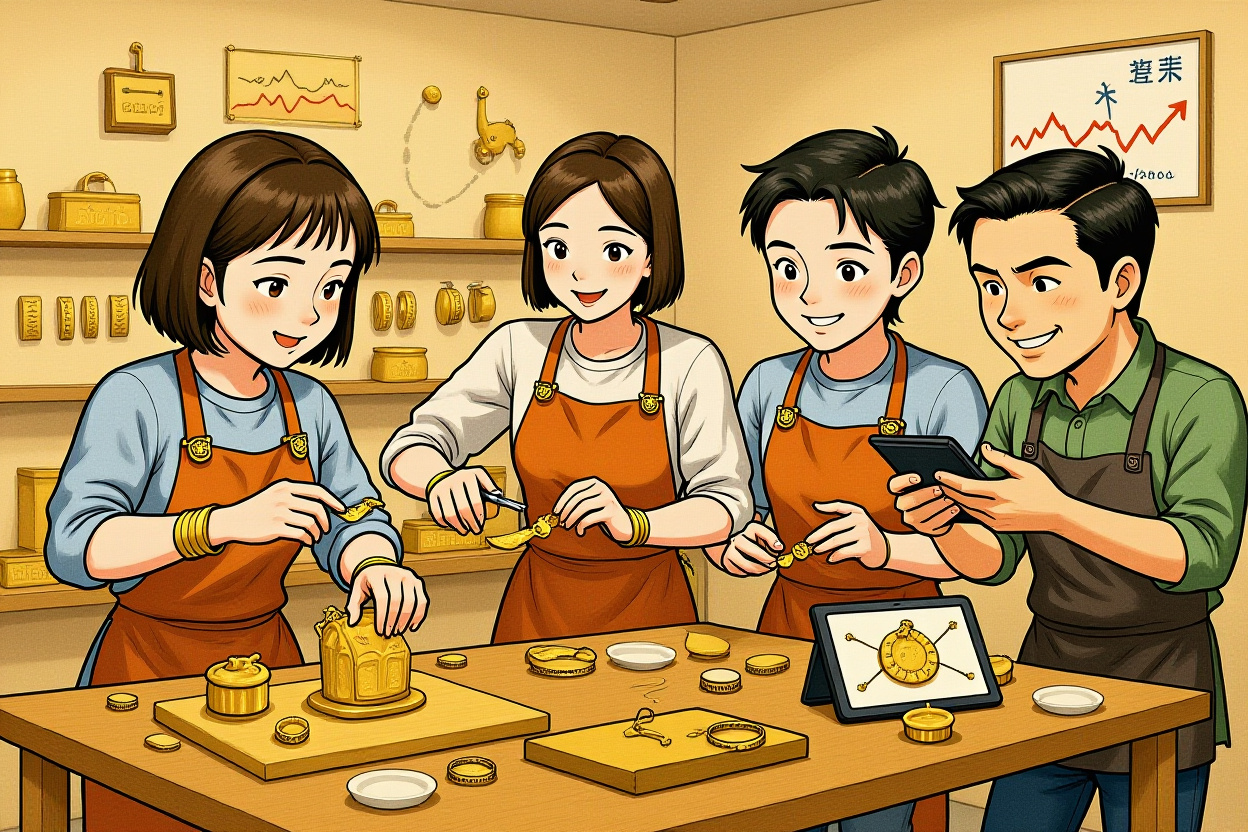
Gold crafting, the traditional process of transforming raw gold into jewelry through melting, molding, shaping, and polishing, is no longer confined to veteran artisans. It has evolved into a popular hobby and cost-saving strategy, especially among tech-savvy youth.
Understanding the Gold Crafting Process
Professional gold crafting involves several meticulous steps. A goldsmith typically takes one to three hours to create a basic piece, such as a ring or bracelet. The process includes:
– Melting the gold using high-temperature torches.
– Pouring the molten gold into molds or using techniques like forging.
– Shaping and detailing the piece with tools.
– Final polishing to achieve a finish.
Labor costs for basic items range from 10 to 40 yuan per gram, while intricate techniques like filigree or hand-chasing can cost hundreds of yuan. Compared to the substantial brand premiums and craftsmanship fees at retail stores, this offers a compelling, personalized alternative.
Why Young Consumers Are Embracing Gold Crafting
This trend resonates with younger generations for multiple reasons. Firstly, it allows for the customization of jewelry, aligning with individual aesthetic preferences. Secondly, it enables the refurbishment of inherited or outdated gold pieces, preserving both the metal’s intrinsic value and sentimental significance. As noted by industry observers, this transforms old gold into a \”new national trend\” (新国潮) that blends emotion, fashion, and finance. The rise of \”home gold crafting\” is a natural extension, driven by tutorials on platforms like Douyin and Xiaohongshu, which make the process appear accessible and fun.
The Professional Gold Crafting Industry’s New Wave
As demand grows, the gold crafting trade itself is undergoing a transformation, attracting young talent and creating new economic opportunities.
Young Artisans Fueling Innovation
Gold crafting workshops are increasingly staffed by young artisans, often from the \”00后\” generation. For instance, one shop owner in Shanghai reported that after opening her business three years ago, she now employs a team of 10 goldsmiths, with the oldest being just 28. These young craftsmen bring fresh creativity, a better understanding of modern design trends, and an ability to engage with client requests through digital channels. The barrier to entry is relatively low, with no strict age or学历 (xué lì, academic background) requirements, making it an attractive career pivot or first job.
Economic Prospects and Industry Growth
The economic incentives are tangible. According to Zhou Baolin (周宝林), a shop manager in Shanghai’s Huangpu District, entry-level goldsmiths can earn around 10,000 yuan per month, while skilled specialists, such as engravers, can make 15,000 yuan monthly. This income potential, coupled with the craft’s artistic appeal, is drawing more young people into the field, ensuring the trade’s vitality. However, this professional sphere stands in stark contrast to the amateur \”home gold crafting\” movement, where lack of training leads to different outcomes.
The Allure and Mechanics of Home Gold Crafting
The \”home gold crafting\” trend represents a bold, if risky, foray into DIY jewelry making. Propelled by social media tutorials, individuals are attempting to bypass professional fees by setting up miniature workshops in their homes.
Tools and Processes for DIY Enthusiasts
A basic \”home gold crafting\” kit, readily available on e-commerce platforms like Taobao for 100 to 200 yuan, typically includes:
– A long-nozzle torch and gas canister for melting.
– Crucibles, molds (often made of oil-based clay or plaster), and borax for flux.
– Tools like pliers, files, brushes, and a precision scale.
– A fire-resistant board for safety.
The process, as detailed in popular videos, involves steps such as preparing the mold, heating the gold to over 1,000 degrees Celsius, pouring it carefully, and cooling it rapidly. The perceived simplicity of these steps fuels the \”home gold crafting\” craze, promising savings and a hands-on creative experience.
The Perceived Savings and Social Media Influence
For many, the primary draw is economic: avoiding the 10-40 yuan per gram labor charge of a professional, which on a 20-gram piece could mean saving several hundred yuan. Social media amplifies this by showcasing successful projects, creating an illusion of easy mastery. However, as experts caution, this overlooks the steep learning curve and hidden costs. The \”home gold crafting\” trend is a testament to consumer ingenuity but also to the pitfalls of underestimating a complex craft.
Critical Risks and Expert Warnings on Home Gold Crafting
While the DIY approach may seem appealing, industry professionals and safety experts uniformly highlight severe risks associated with \”home gold crafting.\” These dangers extend beyond mere inconvenience to pose genuine threats to health and wealth.
Significant Safety Hazards
The most immediate risks are physical. Wang Chao (王超), Director of the Gold and Jewelry Testing Center at the Ningbo Product Quality Inspection Institute, explicitly warns that melting gold requires temperatures exceeding 1,000 degrees Celsius, posing serious fire and burn risks in domestic settings. Inadequate ventilation can lead to the inhalation of toxic fumes. \”If the gold contains impurities like mercury, which vaporizes at a lower temperature, it can produce toxic mercury vapor,\” Wang Chao (王超) explained. \”In a poorly ventilated space, this could lead to poisoning.\” Even with precautions like thick gloves and long tongs, the margin for error is slim for amateurs.
Financial Pitfalls and Gold Loss
Beyond safety, financial loss is a predominant \”pitfall\” for home gold crafters. Operational errors frequently result in gold wastage that far exceeds expectations. Common mistakes include:
– Improper preparation of plaster molds, causing the cast piece to crack or shatter.
– Incorrect pouring techniques leading to spillage or incomplete fills.
– Overheating during soldering or shaping, causing the gold to become brittle or melt uncontrollably.
This lost gold, often trapped in molds or reduced to unrecoverable scraps, represents a direct financial hit. Many individuals end up taking their botched projects to professional shops for repair, incurring additional costs that negate any initial savings. Wang Chao (王超)坦言 (tǎn yán,坦言 frankly stated), \”Home gold crafting is not something you can simply achieve by following a tutorial. You should rationally assess its possibilities and limitations.\”
Navigating the Trend: Professional Guidance and Consumer Advice
In light of these risks, how should interested consumers engage with the gold crafting trend safely and wisely? Insights from industry bodies provide a roadmap.
Recommendations from Industry Authorities
Wang Huiqun (王惠群), Secretary-General of the Shanghai Gold and Jewelry Trade Association (上海黄金饰品行业协会), advises consumers to opt for established, professional workshops if they choose to have gold crafted. \”Gold crafting involves specific processing techniques and environmental requirements,\” she said. \”Select a larger-scale gold crafting shop, observe the craftsman’s skills, clarify any uncertainties beforehand, and reach an agreement.\” This professional oversight ensures quality control and minimizes risks. For those still tempted by DIY, thorough research and starting with small, low-value projects is crucial.
The Role of Education and Regulation
There is a growing need for public awareness campaigns about the dangers of amateur gold smithing. Regulatory bodies like the China Gold Association (中国黄金协会) could issue guidelines, while social media platforms might consider adding disclaimers to popular \”home gold crafting\” videos. Furthermore, professional training programs for aspiring goldsmiths can help channel interest into safe, skilled practice. For market participants, monitoring gold price trends through official sources like the Shanghai Gold Exchange (上海黄金交易所) is essential for informed decision-making.
Synthesizing the Gold Rush: Key Takeaways and Forward Outlook
The convergence of soaring gold prices and the \”home gold crafting\” trend underscores a dynamic shift in consumer behavior within China’s retail gold market. While the desire for personalized, value-retentive jewelry is understandable and has positively revitalized a traditional craft, the DIY approach carries disproportionate risks. The financial allure of avoiding professional fees is often eclipsed by the high probability of gold loss and the serious safety hazards involved.
For investors and consumers alike, the key takeaway is to balance enthusiasm with prudence. Those interested in gold crafting should strongly consider utilizing professional services, which support a growing sector of young artisans and guarantee a safer, more reliable outcome. For the daring few who pursue DIY, extensive preparation, proper safety equipment, and starting with minimal amounts of gold are non-negotiable. As gold prices remain volatile, staying informed through reputable financial news and heeding expert warnings will be crucial. Ultimately, whether for investment or adornment, respecting the complexities of gold processing ensures that its gleam is not tarnished by preventable loss or harm.