



Executive Summary: Key Takeaways for Market Participants
In recent weeks, the global gold market has witnessed a dramatic surge, with prices breaching key psychological levels. Concurrently, a cultural and consumer trend centered on do-it-yourself (DIY) gold crafting, known as “打金” (gold crafting), has exploded in popularity across China, particularly among younger demographics. This article delves into the intersection of these developments, analyzing their drivers, implications, and inherent risks. Below are the critical insights for financial professionals and investors monitoring Chinese consumer markets and precious metal dynamics.
- Global gold prices, driven by macroeconomic uncertainty and safe-haven demand, have propelled domestic Chinese gold jewelry prices to near-record highs, with major brands like Lao Feng Xiang (老凤祥) and Chow Sang Sang (周生生) adjusting retail rates daily.
- The “gold crafting trend” is a multifaceted phenomenon fueled by social media, a desire for personalized jewelry, and economic considerations, representing a shift in how younger consumers engage with precious metals as both adornment and asset.
- Significant safety hazards and potential for substantial financial loss accompany amateur “home goldsmithing” attempts, with experts like Wang Chao (王超) of the Ningbo Product Quality Inspection Institute highlighting risks from toxic fumes to metal wastage.
- This trend is creating new economic niches, including opportunities for young artisans and pressures on traditional jewelry retailers to adapt their value propositions.
- For investors, understanding this behavioral shift is crucial for assessing companies in the jewelry retail, luxury goods, and gold mining sectors within Chinese equity markets.
The Unprecedented Surge in Precious Metal Values
The rally in gold prices is not occurring in a vacuum. On March 27, Eastern U.S. time, spot gold vaulted past $4555 per ounce, a level that reverberated instantly through Asian markets. By March 28, the domestic Chinese gold market responded with sharp upward adjustments, bringing retail jewelry prices perilously close to the 1400 yuan per gram threshold. This price movement reflects a complex interplay of global and local factors that every market watcher must comprehend.
Global Macroeconomic Drivers Fueling the Rally
Internationally, gold’s ascent is underpinned by persistent inflation concerns, geopolitical tensions, and shifting expectations around central bank policies, particularly from the U.S. Federal Reserve. As a traditional safe-haven asset, gold attracts capital during periods of market volatility and currency debasement fears. The metal’s performance often inversely correlates with real interest rates and the strength of the U.S. dollar, making it a key barometer for global risk sentiment. This environment has prompted not only institutional investors to increase allocations but also retail buyers worldwide to seek tangible assets, a trend acutely visible in China’s savings-oriented culture.
Domestic Price Dynamics and Brand-Specific Adjustments
Within China, the price transmission from international benchmarks to local retail is swift. The Shanghai Gold Exchange (上海黄金交易所) serves as the primary domestic pricing mechanism, and its fluctuations directly impact consumer-facing brands. On March 28, leading jewelry houses announced notable price hikes:
- Lao Feng Xiang (老凤祥) quoted 1396 yuan per gram, up 28 yuan from the previous day.
- Lao Miao Gold (老庙黄金) reached 1397 yuan per gram, a 32 yuan increase.
- Chow Sang Sang (周生生) set its price at 1391 yuan per gram, rising 27 yuan.
These adjustments, occurring in a high-inflation environment for other goods, make the intrinsic value of gold even more salient to cost-conscious consumers, setting the stage for alternative consumption models like the gold crafting trend.
The “打金” (Gold Crafting) Revolution: A New Consumer Paradigm
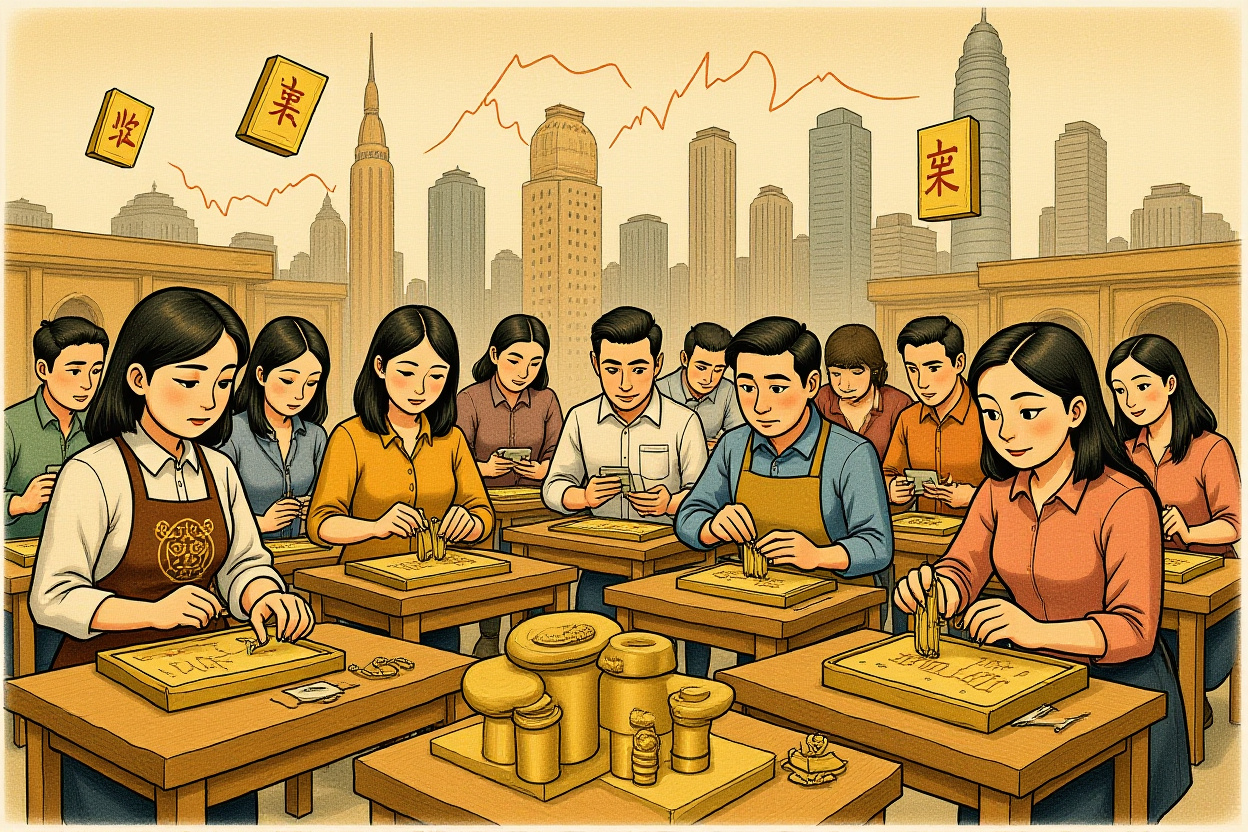
As prices climb, a counterintuitive trend has taken hold: instead of shunning gold purchases, a segment of consumers, predominantly young adults, are embracing hands-on creation. The gold crafting trend involves transforming raw gold or old jewelry into new pieces through processes like melting, molding, shaping, and polishing. This movement transcends mere transaction; it is an experiential and value-driven approach to owning precious metals.
From Social Media Virality to Mainstream Adoption
The ignition point for this trend has been social media platforms like Xiaohongshu (小红书) and Douyin (抖音). Topics and tutorials related to “打金” have amassed over 1.3 billion views, creating a vast digital community of enthusiasts. Automated video players on news platforms, such as those from CCTV Finance’s 正点财经 program, have further amplified awareness. This visibility demystifies the craft, presenting it as an accessible and creative hobby. The core appeal lies in customization—consumers can design unique pieces that reflect personal style, a stark contrast to mass-produced jewelry from large brands.
Economic and Cultural Drivers Behind the Craze
The gold crafting trend is driven by a potent mix of financial pragmatism and cultural resonance. On the economic front, it offers perceived savings. Professional goldsmiths charge a crafting fee ranging from 10 to 40 yuan per gram for basic items, and up to hundreds of yuan for intricate techniques like filigree or hand-chasing. This is often lower than the brand premium and high craftsmanship fees at established retailers. Culturally, it taps into “新国潮” (New National Tide), a movement valuing heritage reinvention. Consumers report that refurbishing old family jewelry preserves sentimental value and financial worth while aligning with modern aesthetics, making gold a vehicle for both emotional and economic utility.
The New Artisans: Youth Infusion into a Traditional Trade
The demand surge has catalyzed a supply response, attracting a new generation of craftsmen. This facet of the gold crafting trend is revitalizing an age-old profession, offering career alternatives in a competitive job market.
Profile of the Modern Gold Crafter
Workshop owners note that many new entrants are “00后” (post-2000 generation), with teams often having an average age under 30. These young artisans bring digital native skills, aesthetic sensitivity, and an intuitive understanding of peer consumer desires. Their presence challenges the stereotype of goldsmithing as an antiquated trade. As one shop owner from Shanghai’s Huangpu District noted, the industry has low barriers to entry regarding formal education, welcoming career-changers and graduates alike.
Economic Viability and Earning Potential
For these artisans, the trade can be financially rewarding. According to Zhou Baolin (周宝林), a store manager in Shanghai’s Yuyuan area, a typical goldsmith’s monthly salary starts around 10,000 yuan, with skilled specialists in techniques like chiseling earning upwards of 15,000 yuan. This income level, combined with entrepreneurial opportunities to open small studios, makes the profession attractive. The gold crafting trend is thus not only changing consumption but also creating micro-enterprises and employment, a subtle positive for local economies and a point for investors to consider in consumer discretionary analyses.
The Perils of DIY: Why Home Goldsmithing Carries High Stakes
Parallel to the professionalization of the craft, a riskier subset has emerged: “居家打金” (home gold crafting). Lured by online tutorials and the promise of greater savings, individuals are attempting to melt and shape gold in their own homes. This dimension of the gold crafting trend warrants extreme caution, as outlined by industry experts.
Safety Hazards: From Burns to Toxic Exposure
Gold melts at over 1064 degrees Celsius, requiring torches and equipment that pose severe fire and burn risks in domestic settings. Wang Chao (王超), Director of the Gold and Jewelry Inspection Center at the Ningbo Product Quality Inspection Institute, emphasizes the danger of toxic fumes. If impure gold alloys contain volatile metals like mercury, heating can release poisonous vapors. Inadequate ventilation leads to health hazards, turning a DIY project into a medical emergency. Experts universally advise against home operations without professional-grade safety measures, including fire-resistant surfaces, protective gloves, and long-handled tools.
The Financial Quagmire: When Savings Become Losses
Beyond safety, the most common pitfall is economic. The gold crafting trend, when pursued amateurishly, often results in significant material loss. Common errors include improper preparation of plaster molds leading to cracked castings, or faulty welding causing metal fracture. These mistakes scatter or waste gold, which is difficult to recover. Wang Chao (王超) notes that operational losses frequently exceed expectations, and the cost of hiring a professional to rectify botched jobs can surpass the original crafting fee. A basic home goldsmithing kit, purchasable on e-commerce platforms for 100-200 yuan, becomes a false economy when precious metal is irreversibly damaged.
Market Implications for Investors and Industry Stakeholders
This cultural shift is more than a fleeting social media fad; it has tangible implications for financial markets and corporate strategies. For institutional investors focused on Chinese equities, understanding the gold crafting trend is essential for sectoral analysis.
Pressure on Traditional Jewelry Retailers
Established brands like Chow Tai Fook (周大福) and the aforementioned Lao Feng Xiang (老凤祥) may face margin pressures if consumers increasingly bypass retail channels for customized crafting. Their value proposition of brand trust and design must now compete with hyper-personalization and perceived better value from independent artisans. Companies that adapt by offering in-house customization services or collaborating with trendy craftsmen could capture this market segment. Monitoring quarterly sales data and customer footfall in physical stores will be key metrics.
Broader Investment Themes in Precious Metals
The sustained retail demand for gold, whether for crafting or investment, supports prices and benefits upstream players. Listed gold miners such as Zijin Mining Group (紫金矿业集团) and Shandong Gold Mining (山东黄金矿业) could see reinforced fundamentals. Additionally, this trend highlights gold’s dual role in China as a financial asset and a cultural commodity, suggesting resilience in demand despite price volatility. Investors should watch for regulatory comments from bodies like the People’s Bank of China (中国人民银行) on gold import policies and consumer credit trends that might affect discretionary spending on luxuries.
Navigating the Trend: Expert Guidance and Forward Outlook
As with any market frenzy, a measured approach is prudent. Insights from industry veterans provide a roadmap for both consumers and investors engaging with the gold crafting trend.
Insights from Industry Regulators and Associations
Wang Huiqun (王惠群), Secretary-General of the Shanghai Gold Jewelry Industry Association (上海黄金饰品行业协会), advises consumers to vet craftsmen carefully. She recommends choosing established workshops, observing the artisan’s skill firsthand, and clarifying all terms before proceeding. For those considering DIY, the consensus is clear: the risks far outweigh the rewards. Professional environments have controlled settings, proper equipment, and insurance, none of which are available at home.
Strategic Recommendations for Market Participants
For consumers, the message is to appreciate the gold crafting trend but engage wisely—opt for reputable professionals for significant projects. For investors, this trend underscores the importance of granular consumer behavior analysis in equity valuation. It may signal a long-term shift towards experience-driven consumption and value-conscious luxury in China. Keeping abreast of social media analytics, consumer sentiment surveys, and retail innovation will be crucial.
Synthesizing the Gold Rush: Prudence in a Sparkling Market
The confluence of soaring gold prices and the DIY crafting movement presents a unique snapshot of modern Chinese consumerism. The gold crafting trend encapsulates a search for value, individuality, and connection to tradition, all while navigating a high-stakes asset class. However, the allure of personalization must be balanced against stark realities: home goldsmithing is fraught with danger and potential loss, and even the professional trend carries market disruption risks. For the global financial community, this phenomenon is a reminder that cultural currents can drive material economic outcomes. As you assess opportunities in Chinese consumer markets, factor in this behavioral evolution, but always prioritize due diligence and risk management. Stay informed through trusted financial news sources and regulatory updates to make astute decisions in this glittering yet volatile landscape.