



Executive Summary: Key Market Takeaways
The recent volatility in global gold markets has triggered significant behavioral shifts among Chinese consumers and investors. Here are the critical insights from our analysis:
- International gold benchmarks, such as spot gold, breached $4,555 per ounce, driving domestic retail gold jewelry prices toward 1,400 yuan per gram, with brands like Lao Fengxiang (老凤祥) and Lao Miao Gold (老庙黄金) implementing sharp daily increases.
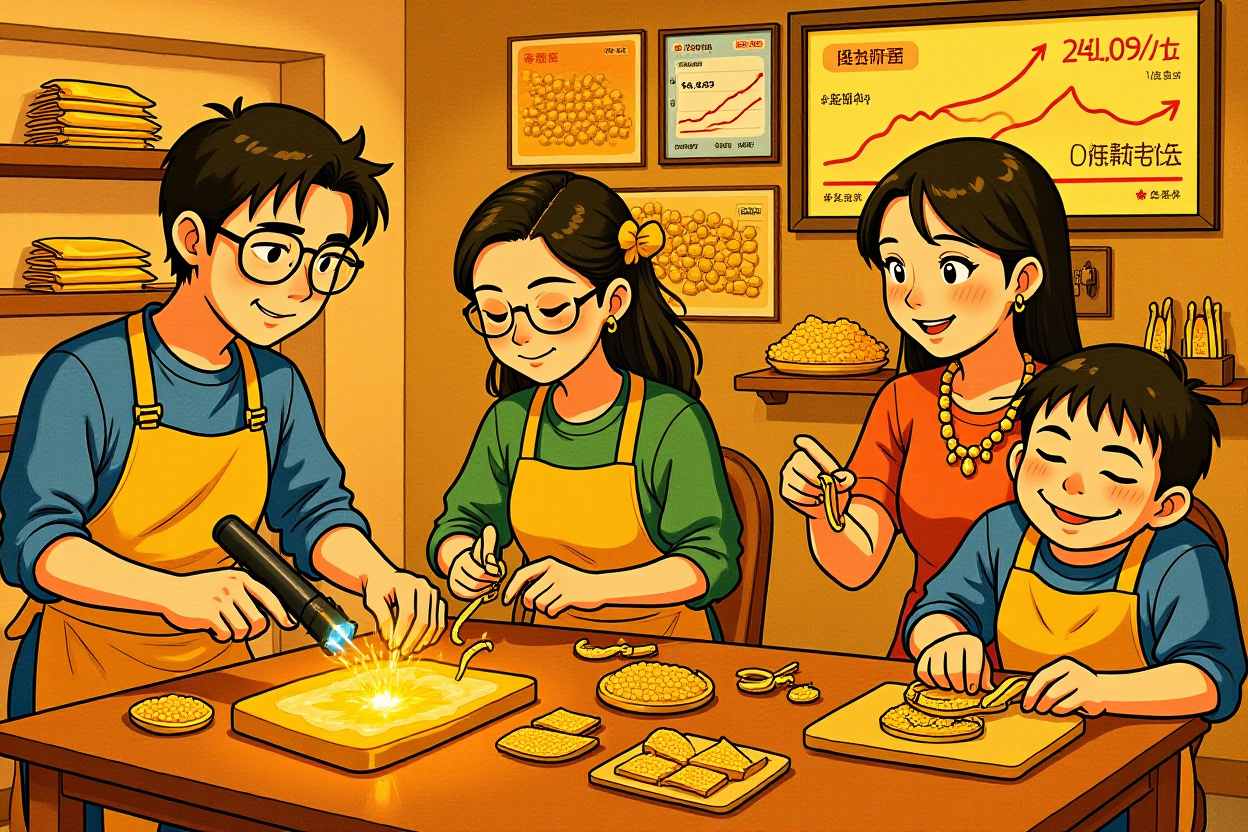
- A burgeoning home gold smithing trend, colloquially known as ‘打金’ or DIY gold crafting, is gaining massive traction among young consumers seeking cost-effective and personalized alternatives to branded jewelry.
- This trend is creating new economic opportunities, with a wave of young, often ’00s-born artisans entering the trade, commanding monthly salaries ranging from 10,000 to 15,000 yuan for skilled work.
- Experts, including Wang Chao (王超), Director of the Ningbo Quality Inspection Institute Gold and Jewelry Testing Center, warn of severe safety risks and financial pitfalls associated with amateur home gold smithing, such as toxic fume inhalation and significant metal loss due to operational errors.
- The movement reflects a broader ‘New National Tide’ (新国潮) phenomenon, blending traditional craftsmanship with modern consumer demand for assets that offer aesthetic, emotional, and financial value—a dynamic with implications for luxury retail, small-business growth, and precious metals investing within China.
The Precious Metals Frenzy: Understanding the Gold Price Surge
As Eastern Time markets closed on March 27, 2026, a sharp overnight rally in precious metals sent shockwaves through global financial circles. Spot gold prices momentarily soared past the $4,555 per ounce threshold, a level not seen in recent years, while silver followed suit with substantial gains. This movement was not an isolated event but part of a complex interplay of macroeconomic factors influencing investor sentiment worldwide.
Global Catalysts and Market Sentiment
The surge can be attributed to a confluence of factors typical of risk-off environments. Persistent geopolitical tensions, evolving monetary policy expectations from major central banks like the U.S. Federal Reserve, and currency fluctuations have bolstered gold’s traditional role as a safe-haven asset. For international investors with exposure to Chinese equities, this gold price movement serves as a critical barometer for inflation expectations and currency stability. A strong gold price often signals concerns about fiat currency devaluation or economic uncertainty, which can influence capital flows into and out of emerging markets like China. Monitoring the Shanghai Gold Exchange (上海黄金交易所) benchmarks alongside international prices is therefore essential for a holistic view.
Immediate Impact on Chinese Retail and Consumer Prices
The international rally translated directly to Mainland China’s retail landscape with remarkable speed. By March 28, major domestic jewelry brands had adjusted their listed prices upward, bringing per-gram costs for pure gold jewelry alarmingly close to the 1,400 yuan psychological barrier. Data from brand announcements revealed consistent jumps:
- Lao Fengxiang (老凤祥): 1396 yuan/gram, up 28 yuan from the previous day.
- Lao Miao Gold (老庙黄金): 1397 yuan/gram, up 32 yuan.
- Chow Sang Sang (周生生): 1391 yuan/gram, up 27 yuan.
This rapid price escalation has fundamentally altered the cost-benefit analysis for consumers, making the upfront cost of brand-new, finished jewelry pieces significantly heavier. It is within this context of soaring retail premiums that the home gold smithing trend has found fertile ground, emerging as a pragmatic response to market conditions.
The DIY Revolution: Deconstructing the Home Gold Smithing Trend
Across social media platforms like Xiaohongshu (小红书) and Douyin (抖音), the hashtag #打金 has amassed over 1.3 billion views, signaling a cultural and consumer shift. This home gold smithing trend involves individuals purchasing raw gold—often in the form of old jewelry, bars, or granules—and using specialized tools to melt, cast, and fashion it into new pieces at home. The process, which includes steps like melting, molding, shaping, and polishing, transforms gold from a mere financial asset into a hands-on, creative project.
Economic Drivers: Cost Savings and Hyper-Personalization
The primary engine behind this home gold smithing trend is economic. At professional shops, crafting fees range from 10 to 40 yuan per gram for basic designs, climbing to hundreds of yuan for intricate techniques like filigree or hand-chasing. By contrast, a basic DIY toolkit purchased from e-commerce platforms like Taobao or JD.com can cost as little as 100 to 200 yuan. For consumers holding older, unworn gold items, repurposing them through DIY methods avoids the substantial brand premium and craftsmanship fees charged by established retailers like Chow Tai Fook (周大福) or Luk Fook (六福珠宝). Moreover, it offers unparalleled personalization—consumers can create unique designs that reflect individual style, a value proposition highly prized by younger generations.
The New Artisan Economy: Youth Infusion into Traditional Crafts
Paradoxically, the same trend fostering amateur experimentation is also professionalizing a new cohort of artisans. Workshops are reporting an influx of young talent, with ’00s-born (born after 2000) goldsmiths now common. As one shop owner in Shanghai’s Huangpu District noted, her team of ten goldsmiths has an average age under 28. These young artisans are not just executing traditional designs; they are leveraging contemporary aesthetics and digital marketing to attract clients, effectively creating a new vocational pathway. Monthly salaries for competent goldsmiths start around 10,000 yuan, with skilled specialists in techniques like engraving (錾刻) earning upwards of 15,000 yuan—a competitive income that challenges perceptions of manual trades. This revitalization of a classic craft underscores a broader movement where tradition intersects with modern entrepreneurship.
Weighing the Glitter: Risks and Realities of Amateur Goldsmithing
While the home gold smithing trend presents an appealing narrative of empowerment and savings, industry experts and regulatory bodies urge extreme caution. The process is fraught with technical challenges that amateurs often underestimate, leading to potential harm and financial loss.
Tangible Safety Hazards in the DIY Environment
The most immediate dangers are physical. Gold melting requires temperatures exceeding 1,000 degrees Celsius, typically achieved with handheld butane or propane torches. In a home setting, improper ventilation can lead to the accumulation of harmful fumes. Wang Chao (王超) of the Ningbo Quality Inspection Institute highlights a particularly insidious risk: ‘If the metal purity is not high, and it contains volatile elements like mercury, heating can vaporize these metals. In a poorly ventilated space, this can lead to poisoning.’ Additionally, the use of open flames and molten metal poses significant burn and fire risks. Experts recommend that if individuals proceed, they must operate in well-ventilated areas, wear protective gear like heat-resistant gloves, and use long-handled tools—precautions rarely emphasized in abbreviated online tutorials.
The Silent Cost: Financial Pitfalls and Material Loss
Beyond safety, the financial promise of home gold smithing is frequently illusory. The property loss cited by experts is a major pitfall. Common operational errors include improper preparation of plaster or clay molds, leading to cracked castings, and unsuccessful welding or soldering attempts that cause gold to fragment or become irrecoverably embedded in tools. ‘The loss of gold due to operational errors far exceeds expectations,’ notes Wang Chao (王超). A miscalculation in the amount of metal needed, or a failed pour, can result in several grams of gold—worth thousands of yuan at current prices—being reduced to unrecoverable scrap. Many aspiring home goldsmiths ultimately bring their botched projects to professional shops for repair, incurring costs that negate any intended savings and sometimes exceeding the price of a new, store-bought item. This reality check is crucial for consumers viewing DIY as a simple, guaranteed way to ‘save money and gain more gold.’
Market Implications and Strategic Considerations for Stakeholders
The rise of the home gold smithing trend is not merely a consumer fad; it carries meaningful implications for various market participants, from investors and retailers to policymakers.
Opportunities and Disruption for the Traditional Jewelry Sector
Established gold jewelry retailers face a dual-edged sword. On one hand, high gold prices boost the nominal value of their inventory and can drive demand for gold as an investment product. On the other, the DIY trend represents a form of disintermediation, where consumers bypass retail channels for customization. Savvy brands may respond by enhancing in-house customization services, offering more transparent pricing for craftsmanship, or launching educational campaigns about the value of professional workmanship and quality assurance. The advice from Wang Huiqun (王惠群), Secretary-General of the Shanghai Gold and Jewellery Trade Association (上海黄金饰品行业协会), is pertinent: consumers should choose reputable workshops, observe the goldsmith’s skill, and clarify all terms beforehand. This guidance underscores the enduring value of professional expertise in an era of DIY experimentation.
Investment Angles: Gold as a Consumer and Asset Class
For financial professionals and institutional investors monitoring Chinese markets, this trend highlights the multifaceted role of gold in the domestic economy. Beyond ETF holdings and central bank reserves, gold’s penetration into everyday life through crafts reinforces its status as a sought-after physical asset. This sustained retail demand can provide underlying support for gold prices. However, investors should also consider the potential for increased volatility in small-scale gold supply chains and the knock-on effects for companies in the jewelry manufacturing and retail sector listed on exchanges like the Shenzhen Stock Exchange (深圳证券交易所). The popularity of repurposing old gold also suggests a vibrant secondary market for physical metal, which could influence premiums and liquidity in localized markets.
Navigating the New Landscape: Prudent Steps Forward
The convergence of record gold prices and the DIY crafting wave presents a complex scenario. For consumers enchanted by the home gold smithing trend, the path forward requires balanced judgment. The allure of creating a personalized, cost-effective piece is undeniable, but it must be tempered with a realistic assessment of one’s skills, proper investment in safety equipment, and an understanding that material loss is a probable cost of the learning curve. Consulting with professional organizations, such as local chapters of the China Gold Association (中国黄金协会), or seeking workshops that offer supervised DIY experiences can provide a safer middle ground.
For market observers and investors, this phenomenon is a vivid case study in how macro price movements trigger micro-behavioral shifts with economic ripple effects. Monitoring social media trends, consumer sentiment surveys, and retail sales data from both traditional jewelers and e-commerce platforms selling DIY kits will offer valuable leading indicators. The home gold smithing trend, in essence, blurs the line between consumption and investment, between tradition and innovation. Its evolution will depend on gold price trajectories, regulatory attention to consumer safety, and the continuous innovation of both amateur enthusiasts and the professional trade. In a market as dynamic as China’s, understanding these grassroots movements is key to anticipating broader shifts in consumer finance and retail investment landscapes.