



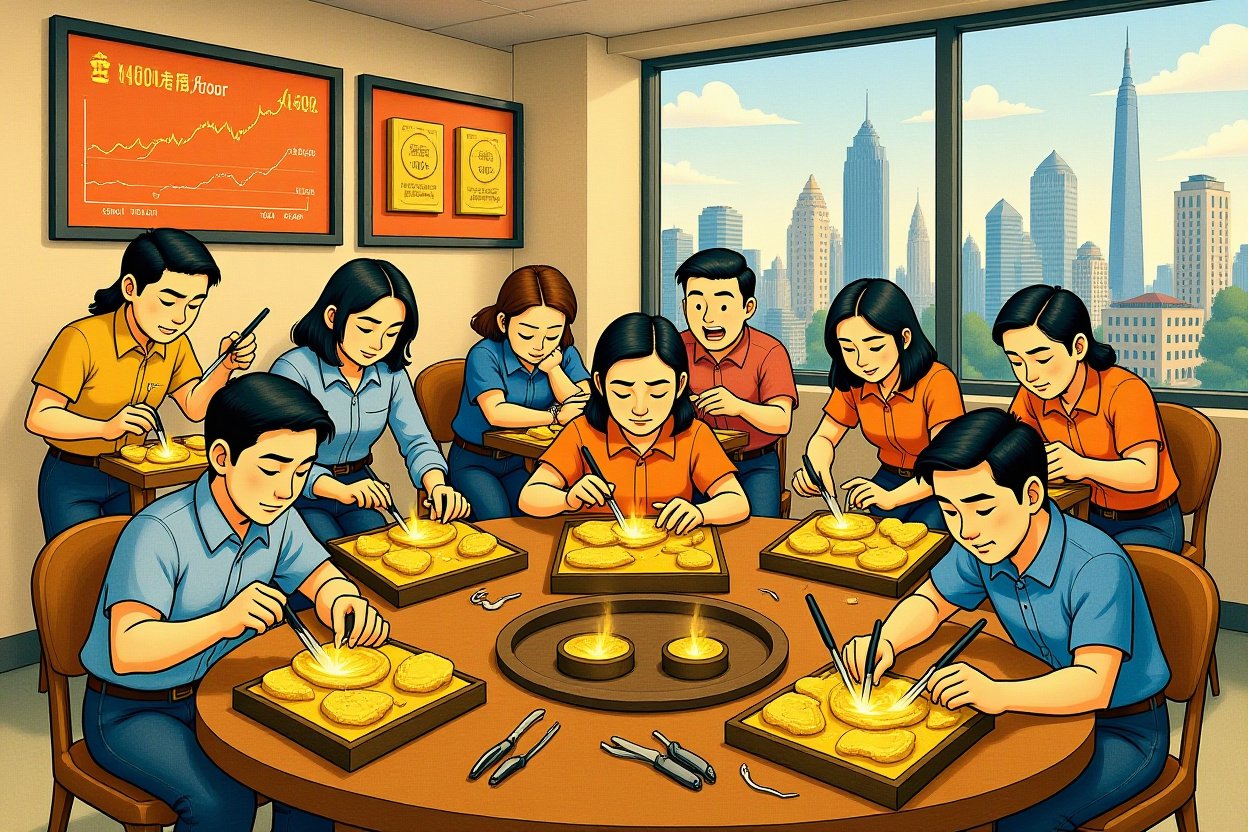
Executive Summary: Key Takeaways from the Gold Crafting Phenomenon
– Gold prices have experienced a sharp rally, with domestic brand gold jewelry prices in China nearing 1400 yuan per gram, driven by global market movements and local demand. – A resurgence in gold crafting, or 打金 (dǎ jīn), is captivating young consumers seeking personalized, cost-effective alternatives to traditional retail jewelry. – The DIY gold crafting trend at home is gaining traction but carries significant risks, including safety hazards and unexpected property loss due to operational errors. – The professional gold crafting industry is being revitalized by young artisans, offering new career paths and blending traditional techniques with modern aesthetics. – Investors should monitor this consumer behavior shift for implications on gold-related equities, luxury retail, and broader market sentiment in China’s capital markets.
The Meteoric Rise of Gold Prices: A Global and Domestic Snapshot
In late March, global gold markets witnessed a dramatic surge, with spot gold prices briefly exceeding $4555 per ounce in U.S. trading hours. This upward momentum quickly reverberated across China’s domestic market, where retail gold jewelry prices approached historic highs. The rapid appreciation has not only bolstered gold’s appeal as a safe-haven asset but also catalyzed unique consumer trends, including the burgeoning interest in DIY gold crafting. This convergence of financial and cultural factors underscores gold’s dual role as both an investment vehicle and a medium for personal expression in today’s economy.
Recent Price Movements and Brand Adjustments
On March 28, major Chinese gold jewelry brands adjusted their prices upward, reflecting the international rally. Key data points highlight the intensity of the move: – 老凤祥 (Lao Feng Xiang) quoted 1396 yuan per gram, a 28 yuan increase from the previous day’s 1368 yuan. – 老庙黄金 (Lao Miao Gold) listed 1397 yuan per gram, up 32 yuan from 1365 yuan. – 周生生 (Chow Sang Sang) reported 1391 yuan per gram, rising 27 yuan from 1364 yuan. These adjustments bring domestic prices perilously close to the 1400 yuan per gram psychological threshold, a level not seen in recent years. The spike is attributed to a combination of geopolitical tensions, currency fluctuations, and sustained demand from Chinese consumers who view gold as a stable store of value. For investors, this price action reinforces gold’s sensitivity to macroeconomic indicators and its potential impact on related sectors within the 沪深300 (Shanghai-Shenzhen 300 Index).
Drivers Behind the Gold Rally
Several factors are fueling this gold price boom. Primarily, expectations of looser monetary policy from major central banks, including the 美联储 (Federal Reserve), have diminished the opportunity cost of holding non-yielding assets like gold. Additionally, ongoing geopolitical uncertainties and inflationary pressures are driving safe-haven flows. In China, robust consumer demand during traditional buying seasons and a cultural affinity for physical gold further amplify the trend. This environment sets the stage for innovative consumption patterns, such as DIY gold crafting, which offer perceived value amidst high retail prices.
The Cultural Resurgence of Gold Crafting Among China’s Youth
Gold crafting, an ancient art involving melting, molding, shaping, and polishing gold into jewelry, is experiencing a remarkable revival. On social media platforms, topics related to 打金 (dǎ jīn) have garnered over 1.3 billion views, signaling a massive shift in how younger generations engage with precious metals. This trend is not merely about cost-saving; it represents a fusion of nostalgia, creativity, and financial pragmatism, often dubbed a “new national trend” that merges aesthetic, emotional, and investment functions.
What is Gold Crafting and Why It’s Gaining Popularity
Professional gold crafting typically involves a multi-step process completed within one to three hours by skilled artisans. Labor costs range from 10 to 40 yuan per gram for basic pieces, with intricate techniques like非遗花丝 (intangible cultural heritage filigree) or手工錾刻 (hand engraving) commanding higher fees. Compared to the substantial brand premiums and工艺费 (craftsmanship fees) at established retailers, this approach offers significant savings. For many young consumers, repurposing old family heirlooms into modern designs preserves sentimental value while aligning with contemporary fashion, making DIY gold crafting an attractive proposition.
Economic and Cultural Drivers
The appeal of gold crafting is multifaceted. Economically, it provides a hedge against the high costs of brand-new jewelry, especially as gold prices soar. Culturally, it taps into a desire for customization and authenticity, resonating with the 国潮 (Guochao or China-chic) movement that celebrates domestic heritage. According to the 上海黄金饰品行业协会 (Shanghai Gold Jewelry Trade Association) Secretary-General王惠群 (Wang Huiqun), consumers should seek reputable workshops and clarify all terms beforehand. This guidance is crucial as the DIY gold crafting trend expands, blending traditional craftsmanship with modern consumerism.
Evolution of the Professional Gold Crafting Industry
The gold crafting boom is not limited to hobbyists; it is also transforming the professional landscape. Young artisans, particularly from the “00后” generation (those born after 2000), are entering the field, infusing it with fresh creativity and technical innovation. This influx is addressing a skills gap and creating new entrepreneurial opportunities, indicative of broader shifts in China’s labor market towards niche, craft-oriented professions.
New Faces in an Old Trade: Young Goldsmiths
Industry reports indicate that gold crafting shops are increasingly staffed by young professionals. For instance, one shop owner noted that after opening three years ago, her two locations now employ 20 staff, including 10 goldsmiths mostly in their twenties, with the oldest being 28. These young teams excel in innovation and customer-centric design, accurately capturing market demands. There are no strict age or educational barriers to entry, making the field accessible to graduates and career-changers alike.
Business Models and Economic Impact
Financially, gold crafting offers viable career paths. As cited by上海黄浦区豫园街道某打金店店长 (a shop manager in Shanghai’s Huangpu District Yuyuan Street)周宝林 (Zhou Baolin), monthly salaries for goldsmiths average around 10,000 yuan, with skilled engravers earning up to 15,000 yuan. This income level is competitive in urban centers and supports the growth of small businesses catering to the DIY gold crafting trend. The sector’s expansion also stimulates demand for raw materials and tools, potentially benefiting suppliers in the gold supply chain and related equities on the 上海证券交易所 (Shanghai Stock Exchange).
The DIY Gold Crafting Trend at Home: Opportunities and Perils
As gold prices climb, an increasing number of enthusiasts are attempting DIY gold crafting at home, driven by tutorials on social media and the availability of affordable toolkits. This trend, while seemingly economical and engaging, harbors significant risks that experts urgently warn against. The allure of saving on labor costs and achieving personalized results must be balanced with a clear understanding of the technical challenges and dangers involved.
How Home Gold Crafting Works
A basic DIY gold crafting setup, easily purchased on e-commerce platforms for 100 to 200 yuan, typically includes tools like long-nose pliers, brushes, files, agate knives, borax, torches, short-nose pliers, electronic scales,旧料 (old gold materials),油泥王 (oil-based clay),石膏模具 (plaster molds), gas canisters, and耐火板 (fireproof boards). The process involves: – Preparing a safe workspace with fireproofing to prevent gold splatter and loss. – Assembling and heating the torch to melt gold in molds. – Pressing the clay mold uniformly, cooling briefly, and quenching in cold water. Despite detailed online tutorials, success is not guaranteed. Many aspirants find that replicating steps precisely still leads to failure, often due to模具缺陷 (mold defects) or improper technique.
Risks and Pitfalls of DIY Gold Crafting
宁波市质检院黄金珠宝检测中心主任 (Ningbo Product Quality Inspection Institute Gold and Jewelry Testing Center Director)王超 (Wang Chao) emphasizes that while theoretically feasible, home gold crafting is fraught with uncertainties. Key risks include: – Safety hazards: Gold melts at over 1000°C, posing fire and burn risks. Proper ventilation, protective gloves, and long tools are essential, but home environments often lack industrial safeguards. – Toxic exposure: Impure gold may contain volatile metals like mercury, which can vaporize during heating, leading to poisoning in poorly ventilated spaces. – Property loss: Operational errors, such as faulty mold preparation or焊接失误 (welding mistakes), can cause黄金损耗 (gold loss) beyond expectations. Residual gold trapped in molds or broken pieces is difficult to recover, often necessitating costly professional repairs. 王超 (Wang Chao) advises that DIY gold crafting is not a simple follow-along activity; it requires strong hands-on skills and a realistic assessment of limitations.
Expert Insights and Regulatory Considerations for Market Participants
The DIY gold crafting trend intersects with broader market dynamics, prompting experts to offer guidance for consumers and investors alike. Understanding these insights is crucial for navigating the risks and opportunities presented by gold’s volatile price action and shifting consumer behaviors.
Technical Challenges and Financial Implications
Professionals note that home crafters frequently underestimate the complexity of gold working. Common pitfalls like石膏模具制备不当 (improper plaster mold preparation) can result in碎裂铸件 (shattered castings), leading to irreversible gold loss. This not only negates any intended savings but may increase costs if pieces require professional restoration. For investors, this consumer trend could influence demand patterns for gold bullion and jewelry stocks, as seen in companies like周大福 (Chow Tai Fook) or六福珠宝 (Luk Fook Holdings), which may adapt to compete with crafting services.
Safety and Regulatory Guidelines
Authorities like the 国家市场监督管理总局 (State Administration for Market Regulation) stress the importance of consumer protection in niche markets. While no specific regulations target home gold crafting, general product safety and fair trade laws apply. Experts recommend: – Sourcing黄金原料 (gold raw materials) from reputable dealers to ensure purity and avoid contaminants. – Consulting professionals before attempting complex projects, especially involving熔金 (gold melting). – Being aware of insurance gaps; standard homeowner policies may not cover DIY crafting accidents or losses. These precautions align with the warnings from王超 (Wang Chao) and others, highlighting that the DIY gold crafting trend demands caution to prevent both personal harm and financial setbacks.
Investment Implications and Future Outlook for Gold Markets
The convergence of soaring gold prices and the DIY gold crafting craze offers valuable insights for institutional investors and fund managers focused on Chinese equities. This phenomenon reflects deeper trends in consumer sentiment, retail innovation, and asset allocation strategies that could shape market performance in the coming quarters.
Gold as an Asset in Volatile Economic Times
Gold’s recent surge reinforces its role as a避险资产 (hedge asset) amid global uncertainty. For portfolios exposed to Chinese markets, increased gold holdings can provide diversification benefits. However, the DIY gold crafting trend may subtly affect physical gold demand; while it boosts consumption of small quantities, it could also reduce sales of finished jewelry from major brands. Monitoring companies within the黄金ETF (gold ETF) sector or mining stocks like紫金矿业 (Zijin Mining) is essential to gauge broader impacts.
Market Trends and Forward-Looking Analysis
Looking ahead, several factors will influence this space: – If gold prices stabilize or correct, the urgency for cost-saving methods like DIY gold crafting may wane, but the cultural shift towards customization could persist. – Technological advancements, such as improved home crafting tools or online platforms for design sharing, might further popularize the trend, creating investment opportunities in ancillary industries. – Regulatory developments from bodies like the中国人民银行 (People’s Bank of China) regarding gold imports or the中国证监会 (China Securities Regulatory Commission) on commodity-linked financial products could alter market dynamics. Investors should stay attuned to consumer behavior reports and earnings calls from jewelry retailers for signals on how the DIY gold crafting trend is reshaping the competitive landscape.
Synthesizing the Gold Crafting Narrative: Key Takeaways and Strategic Guidance
The rapid rise in gold prices has undeniably sparked a cultural and economic phenomenon centered on gold crafting. This trend, encompassing both professional revival and risky home experiments, underscores gold’s enduring allure in Chinese society. For market participants, the key lessons are clear: gold remains a critical asset class sensitive to global macro forces, while consumer innovations like DIY gold crafting highlight evolving preferences for value and personalization. However, the expert warnings cannot be overstated. The DIY gold crafting trend, while enticing, carries substantial risks that often outweigh its perceived benefits. Property loss from operational errors, safety hazards from high-temperature processes, and potential toxic exposures make it a precarious endeavor for amateurs. As王超 (Wang Chao) cautions, a realistic appraisal of one’s skills and the inherent limitations is paramount. For investors and professionals, this scenario presents both challenges and opportunities. Monitoring gold price trends, consumer sentiment indices, and regulatory updates will be crucial for informed decision-making. Consider diversifying into sectors that may benefit from this trend, such as tool manufacturers or online education platforms offering crafting courses, while remaining cautious of overexposure to traditional jewelry retailers facing disruptive competition. As a final call to action, we urge readers to approach gold-related investments with diligence and to seek expert advice before engaging in any form of gold crafting. Whether you are a fund manager evaluating gold equities or a consumer intrigued by DIY projects, staying informed through reliable sources and prioritizing safety can help navigate this golden yet complex landscape. The interplay between market forces and cultural shifts will continue to define opportunities in China’s dynamic economy.