



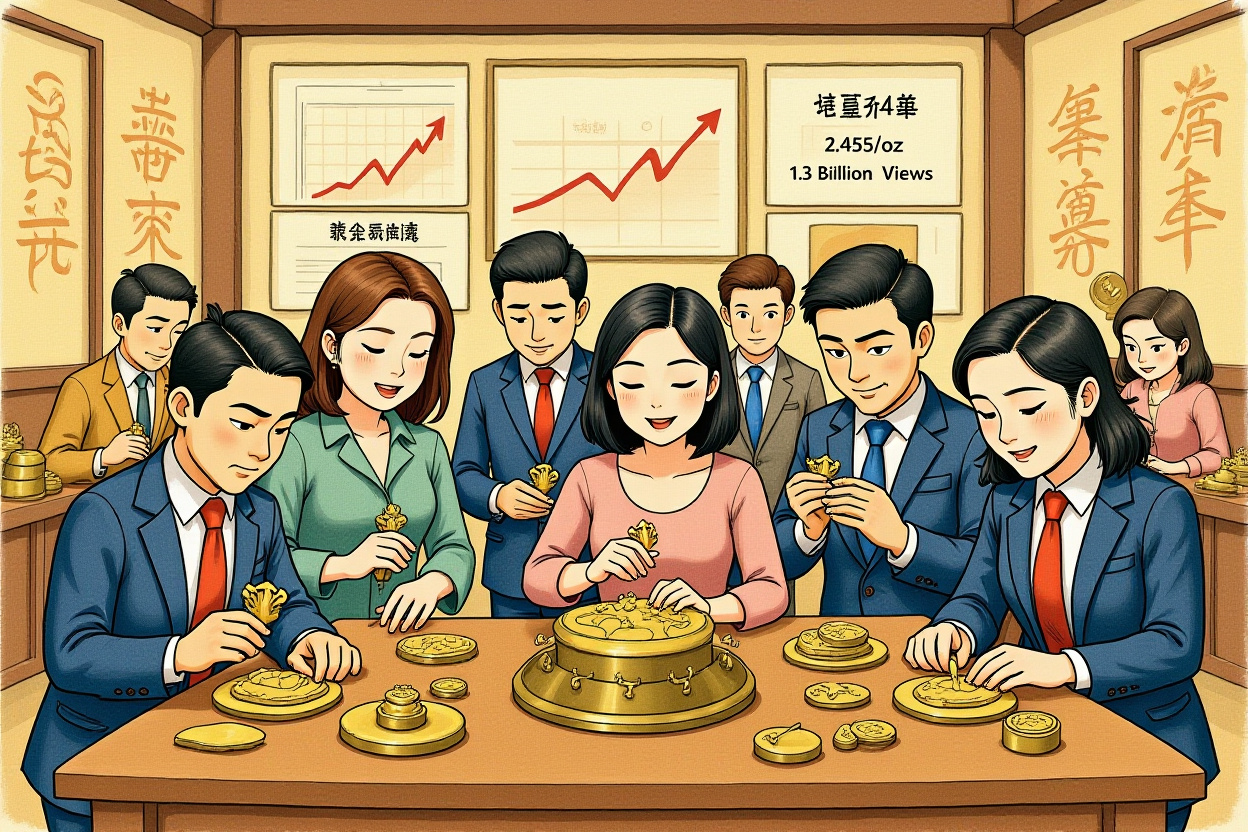
As gold prices skyrocket to unprecedented levels, a fascinating consumer trend has emerged from China’s bustling markets: the rise of DIY gold crafting. This movement, blending ancient craftsmanship with modern social media virality, is reshaping how a generation interacts with the precious metal, but it carries significant risks that every investor and enthusiast must understand. The convergence of soaring gold valuations and a quest for personalized, cost-effective jewelry has created a perfect storm, making DIY gold crafting a focal point for market watchers and financial professionals alike. In this deep dive, we analyze the drivers, the dangers, and the broader implications for Chinese equities and global commodity markets.
Critical takeaways from this trend include:
– Spot gold breached $4555/oz, driving domestic Chinese gold jewelry prices to near 1400 yuan per gram, a key psychological level for consumers.
– DIY gold crafting, or ‘home gold smithing,’ has surged in popularity, with social media话题 (topics) amassing over 1.3 billion views, indicating massive youth engagement.
– This trend is creating new economic niches, with young goldsmiths entering the trade and earning competitive salaries, potentially impacting retail and artisan sectors.
– However, experts uniformly caution that home gold crafting poses severe safety hazards and high risks of financial loss due to operational errors, often outweighing perceived savings.
– For investors, this behavioral shift could influence gold demand patterns, recycling rates, and related equities, requiring close monitoring for portfolio adjustments.
The Anatomy of the Gold Price Surge: Global Catalysts and Domestic Response
The dramatic rise in gold prices is not an isolated event but a response to complex global macroeconomic forces. On March 27, Eastern Time, gold and silver experienced a sharp nocturnal rally, with spot gold momentarily surpassing $4555 per ounce. This surge echoes through China’s domestic market, where gold holds profound cultural and financial significance. The price movement reflects a flight to safety amid persistent inflation concerns, geopolitical tensions, and shifting central bank policies, notably from the Federal Reserve. For Chinese markets, this external volatility interacts with robust local demand, particularly during periods of economic uncertainty, making gold a dual-purpose asset for both adornment and wealth preservation.
Domestic Gold Jewelry Prices: Nearing the 1400 Yuan per Gram Threshold
By March 28, the ripple effects were crystal clear in China’s retail gold landscape. Major domestic jewelry brands swiftly adjusted their prices upward, bringing them perilously close to the 1400 yuan per gram mark—a symbolic barrier that often influences consumer psychology and purchasing decisions. Comparative data from that day reveals:
– Lao Fengxiang (老凤祥) quoted 1396 yuan per gram, a 28 yuan increase from the previous day’s 1368 yuan.
– Lao Miao Gold (老庙黄金) listed 1397 yuan per gram, up 32 yuan from 1365 yuan.
– Chow Sang Sang (周生生) priced at 1391 yuan per gram, rising 27 yuan from 1364 yuan.
This coordinated price hike underscores the sensitivity of the Chinese gold market to international benchmarks and highlights the tight margins and competitive dynamics among major retailers. The Shanghai Gold Exchange (上海黄金交易所) serves as the primary domestic pricing mechanism, and its fluctuations directly feed into these retail quotes. For investors, this price resilience in the face of global headwinds signals sustained demand, potentially buoying shares of listed jewelry firms and gold mining companies with exposure to the Chinese consumer.
The DIY Gold Crafting Phenomenon: Why Youth Are Embracing the Hammer and Crucible
Parallel to the price surge, a cultural shift is underway. DIY gold crafting, known colloquially as ‘打金’ (da jin), involves traditional processes like熔金 (melting gold), 倒模 (pouring molds),塑型 (shaping), and抛光 (polishing) to transform raw or old gold into custom rings, bracelets, and necklaces. This age-old technique has been resurrected as a modern hobby and cost-saving measure, particularly among tech-savvy young adults. The trend’s virality is undeniable: on platforms like Xiaohongshu (小红书) and Douyin (抖音), related content has garnered billions of views, fueling a community of aspirational goldsmiths. This DIY gold crafting wave represents more than a fad; it’s a response to the high brand溢价 (premiums) and工艺费 (craft fees) charged by established jewelry stores, offering a path to个性化 (personalization) and perceived value retention.
Economics of DIY Gold Crafting: Cost Savings Versus Branded Alternatives
The financial appeal of DIY gold crafting is compelling. A professional goldsmith typically charges between 10 to 40 yuan per gram for basic pieces, with complex techniques like非遗花丝 (intangible cultural heritage filigree) or手工錾刻 (hand engraving) commanding fees from几十元 to上百元 (tens to hundreds of yuan). In contrast, branded jewelry often includes markups of 20-30% or more for design and brand value. For consumers, especially those repurposing heirloom pieces, DIY gold crafting can significantly reduce outlays. However, the true cost extends beyond labor. As Wang Huiqun (王惠群), Secretary-General of the Shanghai Gold and Jewellery Trade Association (上海黄金饰品行业协会), advises, ‘Gold crafting involves specific processing techniques and environmental requirements. Choose larger, reputable shops, observe the craftsman’s skills, clarify all questions beforehand, and formalize agreements.’ This professional guidance underscores that while DIY approaches seem cheaper, they lack the safeguards of established venues.
The Emotional and Financial Fusion: Gold as ‘New National Trend’
New Faces in an Ancient Trade: The Rise of Young GoldsmithsThe DIY gold crafting craze isn’t just about consumers; it’s spawning a new generation of artisans. Across China, young people, including many ’00后’ (post-2000 births), are entering the goldsmithing trade, bringing fresh creativity and digital savvy. These new entrants are transforming a once-staid industry, with workshops reporting teams where the oldest member might be only 28. Their innovation lies in understanding client desires for unique, social-media-worthy pieces, effectively bridging tradition and modernity. This demographic shift injects活力 (vitality) into the sector and creates viable career paths outside conventional corporate roles.
Career Prospects and Income in the Gold Crafting Sector
The Perils of Home Gold Crafting: A Minefield of Risks and Hidden CostsSafety Hazards: From Burns to Toxic FumesThe primary concern is safety. Gold’s熔点 (melting point) exceeds 1000 degrees Celsius, requiring intense heat that can cause severe burns or fire if mishandled in a home setting. Wang Chao (王超), Director of the Gold and Jewelry Testing Center at the Ningbo Product Quality Inspection Institute (宁波市质检院黄金珠宝检测中心), warns, ‘Home operation certainly carries risks. It’s advisable to work in a well-ventilated area with protective measures like thick gloves and long tongs.’ He further cautions about impurity risks: ‘If the gold contains other metals, like volatile ones, heating can release toxic vapors. For example, mercury could turn into vapor, leading to poisoning in poorly ventilated spaces.’ These hazards underscore why professional environments with proper equipment are essential, a key point for regulators and insurance providers to consider.
Financial Loss: The Inevitable ‘Pitfall’ for Amateurs
Market Implications and Strategic Insights for InvestorsImpact on Gold Demand and Supply ChainsThe trend could subtly influence gold demand. Increased DIY activity may boost sales of raw gold bars or granules, as well as recycling services for old jewelry, potentially benefiting refiners and recyclers listed on exchanges. Conversely, it might pressure traditional jewelry retailers if consumers pivot to crafting, though high-end brands may remain insulated due to their luxury appeal. Monitoring companies like Chow Tai Fook (周大福) or Luk Fook (六福珠宝) for adaptability to this trend is crucial. Additionally, the demand for crafting tools—from torches to molds—could spur growth in niche industrial suppliers, a segment worthy of investor attention.