



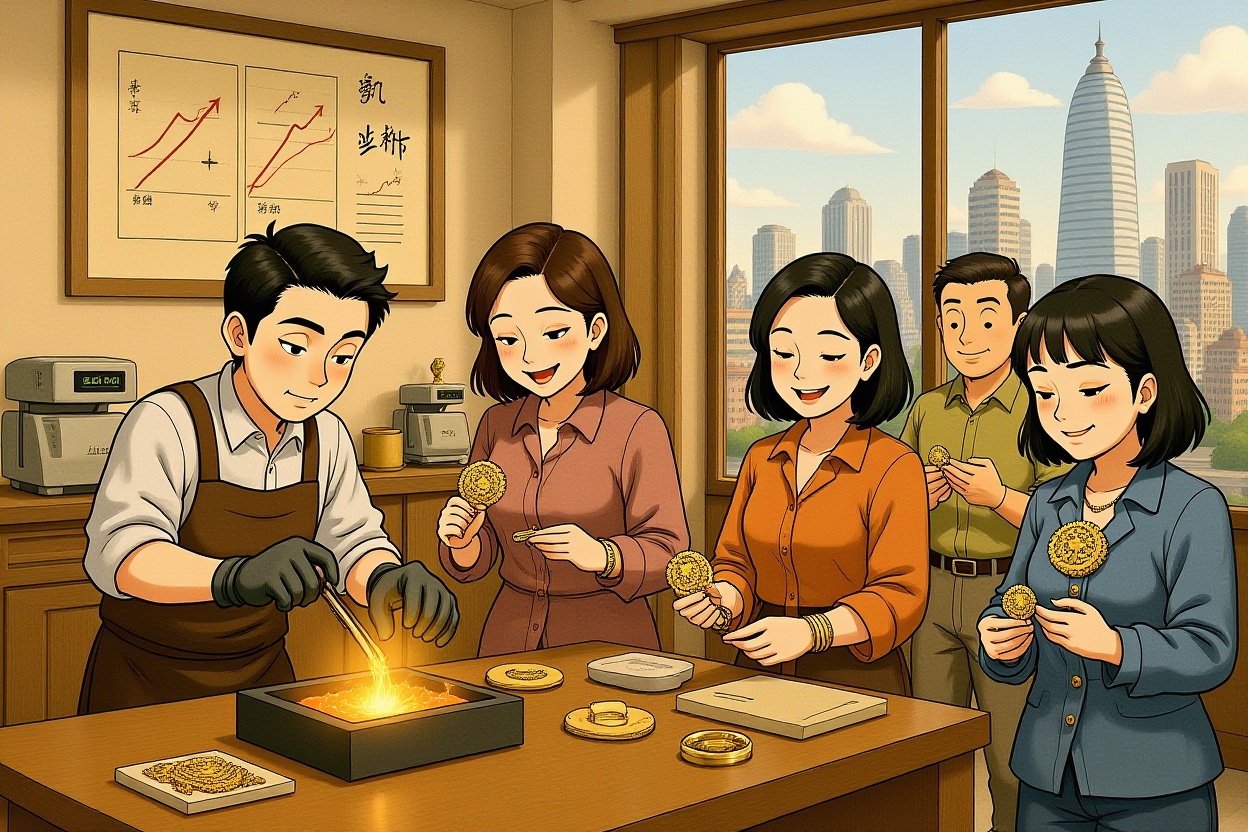
Executive Summary: Key Takeaways on the Gold Crafting Phenomenon
– Surging international gold prices, with spot gold exceeding $4555 per ounce, have driven domestic Chinese jewelry prices to near 1400 yuan per gram, highlighting renewed investor and consumer interest in the precious metal.
– A DIY gold crafting trend, known as “打金” (dǎ jīn), is gaining rapid popularity among younger generations, fueled by social media and desires for cost savings, personalization, and emotional connection to heirlooms.
– Professional artisans, including a new wave of “post-00s” craftsmen, are entering the industry, offering services with fees ranging from 10 to over 100 yuan per gram, compared to higher brand premiums at traditional jewelry stores.
– Experts like Wang Chao (王超) from the Ningbo Product Quality Inspection Institute warn that home gold crafting poses serious risks, including toxic fume exposure, fire hazards, and unexpected gold loss due to operational errors, often leading to greater financial cost than intended savings.
– For investors and consumers, this trend reflects broader themes in Chinese markets: the blend of cultural nostalgia with financial utility, the impact of commodity volatility on consumer behavior, and the need for informed risk assessment in alternative investment channels.
The Precious Metal Surge: Understanding the Gold Price Rally
The global gold market witnessed a sharp upward movement in late March, with spot gold prices briefly piercing the $4555 per ounce level during U.S. trading hours. This rally, driven by a combination of geopolitical tensions, currency fluctuations, and central bank buying, has had immediate reverberations in China, the world’s largest gold consumer.
International Drivers and Domestic Price Adjustments
Analysts point to expectations of monetary policy shifts, safe-haven demand, and physical accumulation by institutions like the People’s Bank of China (中国人民银行) as key factors propelling gold’s value. Domestically, this translated into swift price adjustments by major jewelry retailers. By March 28, benchmark domestic足金 (pure gold) jewelry prices from leading brands had climbed sharply, approaching the 1400 yuan per gram psychological threshold.
– Lao Feng Xiang (老凤祥): Quoted 1396 yuan/gram, up 28 yuan from the previous day.
– Lao Miao Gold (老庙黄金): Quoted 1397 yuan/gram, up 32 yuan.
– Chow Sang Sang (周生生): Quoted 1391 yuan/gram, up 27 yuan.
This price environment has made consumers, particularly cost-conscious younger demographics, seek alternatives to traditional retail purchases, setting the stage for the DIY gold crafting trend to gain traction.
The DIY Gold Crafting Revolution: From Ancient Skill to Modern Hobby
DIY gold crafting, or “home gold crafting,” involves individuals using tools like crucibles, torches, and molds to melt and reshape gold—often from old jewelry—into new pieces. This practice has exploded on social media platforms in China, with related topic views surpassing 1.3 billion. The appeal lies in its perceived affordability and the deep personalization it allows.
Process, Cost, and Cultural Resonance
A typical DIY gold crafting session for a basic ring or bracelet takes one to three hours, encompassing melting, casting, shaping, and polishing. Professional service fees range from 10 to 40 yuan per gram for simple designs, climbing to over 100 yuan for intricate techniques like filigree or hand-chasing. Compared to the high brand markups in stores, this DIY gold crafting approach offers significant savings. Moreover, it taps into a cultural narrative where consumers, especially the young, are revitalizing family heirlooms, merging sentimental value with contemporary aesthetics. As Shanghai Gold Jewelry Trade Association Secretary-General Wang Huiqun (王惠群) advises, “Choosing a reputable workshop and clarifying all terms beforehand is crucial for consumers.”
Economic and Social Drivers Fueling the DIY Gold Crafting Craze
Several interconnected factors explain why DIY gold crafting has resonated so powerfully at this moment. Beyond direct cost comparison, it intersects with broader economic behaviors and social trends shaping Chinese consumer markets.
Financial Prudence and Emotional Investment
In a high-price environment, the DIY gold crafting method is seen as a way to hedge against retail premiums. Consumers are not just buying a product; they are investing labor to enhance the intrinsic value of their gold holdings. This aligns with a growing preference for experiences and customization over passive consumption. The trend is part of the “新国潮” (New National Trend) movement, where traditional elements are reimagined with modern relevance, adding layers of emotional and financial utility to gold ownership.
The New Generation of Artisans
The demand has also spawned a new cohort of young professionals. Workshop owners report hiring predominantly “post-00s” artisans, with the oldest in their late twenties. These young craftsmen, like those managed by shop owner Zhou Baolin (周宝林) in Shanghai’s Yuyuan area, bring fresh creativity and a keen understanding of client desires. Salaries in the field can reach 10,000 to 15,000 yuan monthly for skilled artisans, making it a viable career path. This influx is revitalizing a traditional trade and demonstrating how commodity booms can create micro-entrepreneurial opportunities.
Navigating the Pitfalls: Expert Warnings on Home Gold Crafting Risks
While the allure of DIY gold crafting is strong, industry and regulatory experts are raising red flags about the significant dangers associated with amateur attempts at home. The narrative of easy, cheap transformation promoted online often glosses over complex technical and safety requirements.
Safety Hazards: From Toxic Fumes to Fire Risks
Gold melts at over 1000 degrees Celsius, requiring high-temperature tools like gas torches. Wang Chao (王超), Director of the Gold and Jewelry Testing Center at the Ningbo Product Quality Inspection Institute, emphasizes the inherent dangers. “Operating in a well-ventilated space with protective gear like thick gloves is essential,” he notes. A critical, less-discussed risk involves impurities in the gold. If the metal contains volatile elements like mercury, heating can release toxic vapors, posing a serious poisoning hazard in confined spaces. This makes the DIY gold crafting process far riskier than typical home crafts.
The High Cost of Failure: Unseen Financial Losses
Perhaps the most immediate “pitfall” for enthusiasts is financial loss. The initial investment in a DIY gold crafting toolkit—available on e-commerce platforms for 100 to 200 yuan—seems minimal. However, operational errors lead to gold wastage that can far exceed any anticipated savings. Common failures include improper preparation of plaster molds causing castings to shatter, or incorrect welding leading to metal breakage. This results in gold being trapped in molds or lost as unrecoverable residue. As Wang Chao (王超)坦言 (tǎn yán, frankly states), “DIY gold crafting is not as simple as following an online tutorial. The success rate for those without strong hands-on skills is low.” Many who attempt DIY gold crafting end up seeking professional help to fix botched projects, incurring additional costs and negating the intended economic benefit.
Market Implications and Strategic Guidance for Stakeholders
This surge in DIY gold crafting activity is more than a passing fad; it offers insights into consumer sentiment, gold market dynamics, and investment behavior in China. For international investors and financial professionals monitoring Chinese equities, understanding these grassroots trends can inform broader market analysis.
Impact on Gold Demand and Related Sectors
The trend likely supports underlying physical gold demand, as it encourages the recycling and active use of existing holdings rather than dishoarding. However, it may also pressure margins for traditional jewelry retailers if consumers increasingly bypass them for crafting services. Companies in the precious metals supply chain, from tool manufacturers to assay services, could see new demand vectors. For a comprehensive view of gold market regulations, investors can refer to announcements from the Shanghai Gold Exchange (上海黄金交易所).
Actionable Advice for Consumers and Investors
For consumers tempted by DIY gold crafting, the advice is clear: weigh the risks carefully. Start by consulting with established professionals, understand the full process, and consider the true cost of potential failures. For investors, this trend underscores gold’s dual role as a financial asset and a cultural store of value in China. Monitoring consumer engagement with gold can provide leading indicators of retail investment flows and sentiment toward inflation-hedge assets.
Synthesizing the Golden Trend: Caution Amidst Opportunity
The convergence of record gold prices and a booming DIY crafting culture presents a unique market snapshot. While DIY gold crafting empowers consumers with creativity and potential cost savings, the warnings from experts like Wang Chao (王超) are unequivocal: the risks of property loss and personal injury are substantial and often underestimated. This trend highlights the innovative ways Chinese consumers, particularly the youth, are interacting with traditional asset classes, blending financial acumen with cultural expression. For market participants, the key takeaway is to recognize both the entrepreneurial energy driving this niche and the paramount importance of risk management. Before embarking on any home gold crafting project or adjusting investment theses based on such consumer trends, conducting thorough due diligence and prioritizing safety over short-term savings is the prudent path forward.