



Executive Summary
This analysis delves into the critical issue of abandoned high-speed rail infrastructure and the ghost town phenomenon plaguing many high-speed rail new towns across China. Key takeaways include:
– Several high-speed rail stations have been shuttered shortly after opening due to poor location choices and insufficient passenger流量, representing significant financial waste.
– The nationwide trend of developing high-speed rail new towns has often backfired, leading to vacant urban zones, increased municipal debt, and failed economic uplift.
– Regulatory bodies like the National Development and Reform Commission (NDRC) have tightened planning and construction criteria to curb irrational development.
– While major cities continue to expand their high-speed rail networks with new mega-stations, smaller cities grapple with the legacy of past speculative projects.
– Future infrastructure planning must prioritize practicality, economic viability, and genuine demand to avoid repeating these costly mistakes.
The Allure and Aftermath of High-Speed Rail Development
China’s high-speed rail network, the world’s largest, stands as a testament to modern engineering and economic ambition. Yet, beneath the gleaming tracks and stations lies a growing narrative of misallocation and unfulfilled promise. The dream of high-speed rail new towns—urban developments centered around rail hubs intended to drive regional growth—has for many locales turned into a nightmare of empty plazas and silent streets. This phenomenon not only questions the efficiency of capital deployment but also serves as a cautionary tale for investors and policymakers navigating China’s evolving urban landscape. The focus on high-speed rail new towns reveals deeper systemic issues in infrastructure-led development strategies.
The Phenomenon of Abandoned High-Speed Rail Stations
The most visible symptom of flawed planning is the growing list of underused or entirely abandoned high-speed rail stations. These white elephants dot the countryside, symbols of ambition outpacing reality.
Case Studies in Waste and Inefficiency
Recent media reports have highlighted several glaring examples. In Zhuzhou, Hunan, the Jiulangshan Station on the Changsha-Zhuzhou-Xiangtan intercity railway, with an investment exceeding 1.25 billion yuan, operated for just over five years before closing in April 2022. Local transportation authorities confirmed that daily passenger流量 had fallen to fewer than 10 people, making continued operation economically unfeasible. Similarly, in Hainan, the Haitou Station in Danzhou, built at a cost of over 40 million yuan, remained unopened for years until public pressure led to its belated commissioning in late 2023. These cases are not isolated. A survey by Sohu City indicates that more than 20 high-speed rail stations across the country remain闲置, locked in a state of expensive dormancy.
Root Causes: Poor Location and Absent Demand
The reasons for these failures are consistently cited by analysts and officials:
– Remote选址: Stations were often built far from existing urban cores, sometimes in areas with minimal existing population or economic activity.
– Inadequate Connectivity: Poor linking to local public transport networks made access inconvenient for potential users.
– Overestimation of Demand: Planners dramatically overestimated the passenger流量 these stations would generate, especially in regions with multiple nearby stations or lower population density.
– Economic Miscalculation: The operating costs of maintaining a station, including staffing, security, and utilities, vastly outweighed the minimal ticket revenue from sparse ridership.
These factors combined to render the stations financially unsustainable, forcing authorities to cut their losses. The situation is a direct outcome of the earlier frenzy to build high-speed rail new towns, where station location was frequently dictated by land availability for future urban expansion rather than current passenger convenience.
The Rise and Fall of High-Speed Rail New Towns
The concept was seductively simple: use a high-speed rail station as an anchor to attract investment, spur commercial development, and create a new urban growth pole. This led to a nationwide “high-speed rail new town” development潮, with nearly 70 such projects reportedly in planning or construction phases at its peak. However, the reality has starkly diverged from the vision.
The Dream of Instant Economic Growth
Local governments envisioned these zones as catalysts for transformation. The高铁站 was seen not just as a transit point but as a powerful流量 engine that would draw businesses, residents, and capital. By positioning stations on cheaper, undeveloped land at city peripheries, officials aimed to kill two birds with one stone: minimize upfront land acquisition costs and create a blank canvas for a modern urban district. The underlying hope was to replicate the success stories of stations that had genuinely integrated with and stimulated their surroundings.
The Reality: Ghost Towns and Mounting Liabilities
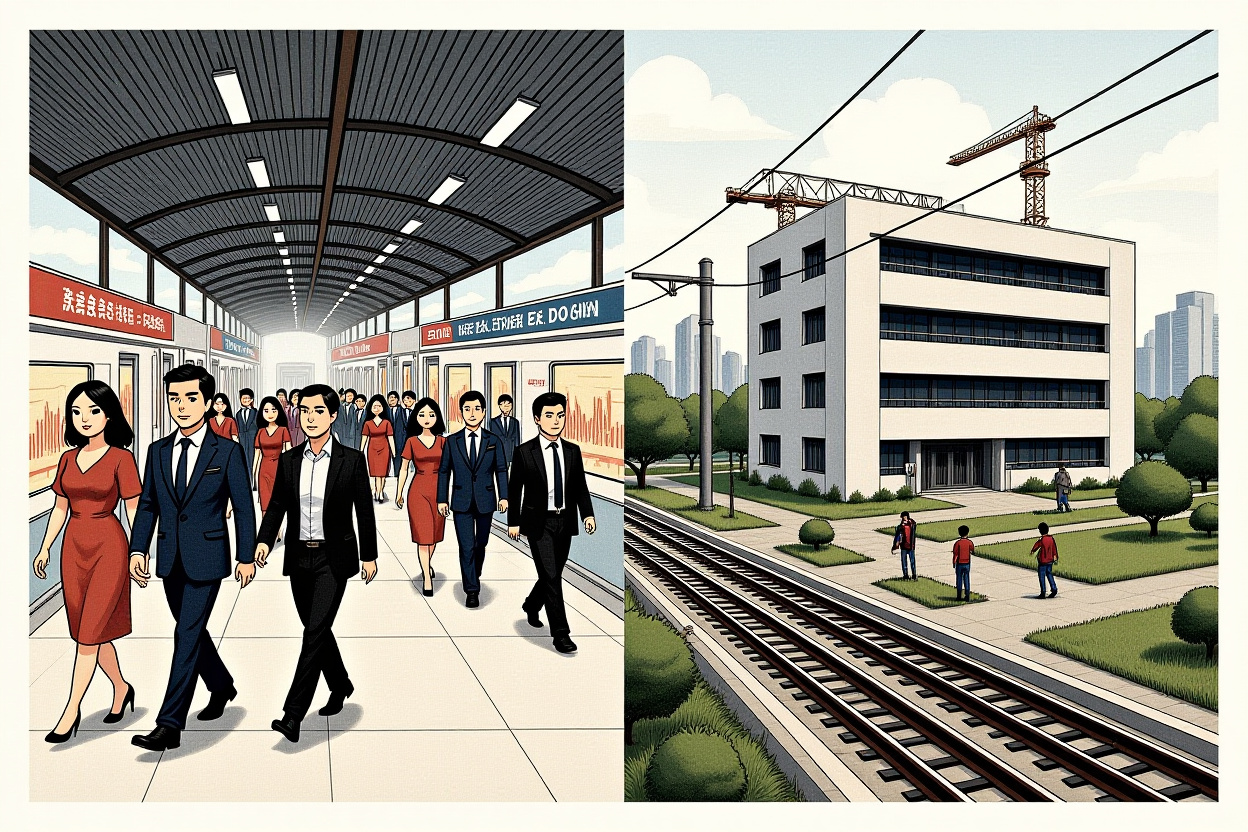
For the majority, the outcome has been bleak. Without a solid industrial base or compelling employment opportunities, these high-speed rail new towns failed to attract sustained population inflow. Vast investments in supporting infrastructure—roads, utilities, commercial centers—now serve mostly empty streets. The term “鬼城” (ghost town) has become a common descriptor. Furthermore, the peripheral locations intended to save money ended up undermining the core utility of high-speed rail: convenient travel. Stations like Tianmen South, Boluo North, and Fengtai South are reportedly over two hours by public transport from their respective city centers, negating the speed advantage of the trains themselves.
The financial consequences are severe. Municipalities are left with heavy debt burdens from the upfront construction costs, with little to no return on investment. Property buyers who purchased homes in these promised boom zones now hold assets of questionable value. This misadventure represents a classic case of “赔了夫人又折兵” (suffering a double loss), wasting public funds while failing to deliver the intended public good. The high-speed rail new towns experiment has become a textbook example of infrastructure-led development gone awry.
Regulatory Response and Policy Tightening
Recognizing the growing risks, central authorities have moved to impose discipline on the planning and construction of rail-linked urban projects. The shift reflects a broader re-evaluation of investment efficiency under China’s “new normal” of moderated economic growth.
National Guidelines to Curb Excess
In 2018, a joint指导意见 was issued by the National Development and Reform Commission (NDRC), the Ministry of Natural Resources, the Ministry of Housing and Urban-Rural Development, and China State Railway Group Co., Ltd. It laid out four core principles for high-speed rail station area development: planning coordination and rational layout; building according to capacity and in an orderly manner; integrated station-city development with comprehensive配套设施; and market-driven operation with risk prevention. This was a direct admonition against the speculative, debt-fueled model of the past.
Stricter Criteria for Future Rail Construction
A more impactful document followed in 2021. The NDRC, Ministry of Transport, National Railway Administration, and China State Railway Group jointly released the “Opinions on Further Improving Railway Planning and Construction.” It introduced concrete thresholds:
– Utilization Rate Hurdle: New parallel lines should not be built if existing high-speed rail capacity utilization is below 80%.
– Tiered Speed Standards: Construction standards are now explicitly tied to city tiers and projected客流 density. Lines connecting major metropolises can use 350 km/h standards; those linking larger prefecture-level cities can预留 350 km/h; regional connectors use 250 km/h; and intercity lines are capped at 200 km/h or below.
These rules aim to ensure that future investments are justified by demonstrable demand and economic logic, directly addressing the core problems that created the high-speed rail new town ghost towns. On the ground, adjustments are already visible. For instance, Changsha’s High-Speed Rail New Town Management Committee was dissolved in 2022, and Xinghua City in Jiangsu canceled its eastern new district高铁新城 plan in 2023.
Contrasting Fortunes: Expansion in Major Metropolitan Hubs
While many high-speed rail new towns languish, a different story is unfolding in China’s largest and most economically dynamic cities. Here, existing major stations are operating at or near capacity, driving a new wave of mega-project construction.
The New Generation of Super-Hubs
Major urban centers are investing heavily in expanding their rail枢纽 capabilities. Nanjing is building the Nanjing North Station, projected to surpass the massive Nanjing South Station with 16 platforms and 30 tracks. Shenzhen is developing the Xili High-Speed Rail Station, set to become the city’s largest. Shanghai’s under-construction Shanghai East Station will be its second-largest after Hongqiao. Zhengzhou, already a national rail crossroads, plans to add three new stations—Eastern New Town Station, Daguanzhuang Station, and Gangli Station—to its “five main, multiple auxiliary” passenger hub system. These projects are underpinned by robust and growing passenger流量, clear economic rationale, and their role in enhancing regional connectivity.
Lessons from the Dichotomy
The contrast is instructive. Successful expansion in core cities is demand-driven, often involving the upgrade or replacement of outdated infrastructure in saturated markets. The failed high-speed rail new towns, conversely, were largely supply-driven, attempting to create demand where little existed. This dichotomy underscores a critical lesson: infrastructure must follow and serve genuine economic activity, not attempt to conjure it from thin air. As China pushes toward a national high-speed rail network exceeding 50,000 kilometers and targeting 60,000 km by 2030, the allocation of new stations must be guided by this reality. Upcoming stations on lines like the Xi’an-Shiyan high-speed rail or the Xiong’an-Shangqiu high-speed rail will be watched closely for signs of learned wisdom.
Investment Implications and Forward-Looking Guidance
The saga of China’s high-speed rail new towns offers crucial insights for institutional investors, fund managers, and corporate executives with exposure to Chinese urban development and related sectors.
The era of blanket bullishness on infrastructure-led real estate plays is over. Due diligence must now extend beyond municipal blueprints to critically assess fundamental demand drivers, population trends, and existing economic vitality. Projects in lower-tier cities that rely primarily on the “high-speed rail new town” label without substantive industrial plans carry elevated risk. Conversely, infrastructure investments tied to genuine capacity expansion in major city clusters, or to logistics and connectivity within established economic zones, present more resilient opportunities.
Policymakers are clearly shifting focus from quantity to quality, from speed of construction to sustainability of operation. This aligns with broader national goals of financial de-risking and high-quality development. For market participants, this means recalibrating valuation models for municipal debt, real estate assets, and companies in the construction and materials sectors. The regulatory tightening around高铁新城 development is a positive long-term signal for market rationality, but it also necessitates a more nuanced, selective investment approach.
The ultimate takeaway is that the high-speed rail new towns phenomenon serves as a powerful reminder: in real estate and infrastructure, fundamentals cannot be ignored. Sustainable value is built on便民 (convenience for the people) and tangible economic效益, not on speculative hype or administrative fiat. As China continues its infrastructure modernization, the lessons from these ghost towns must guide future planning to ensure that the nation’s vast investments yield productive, not vacant, returns.