



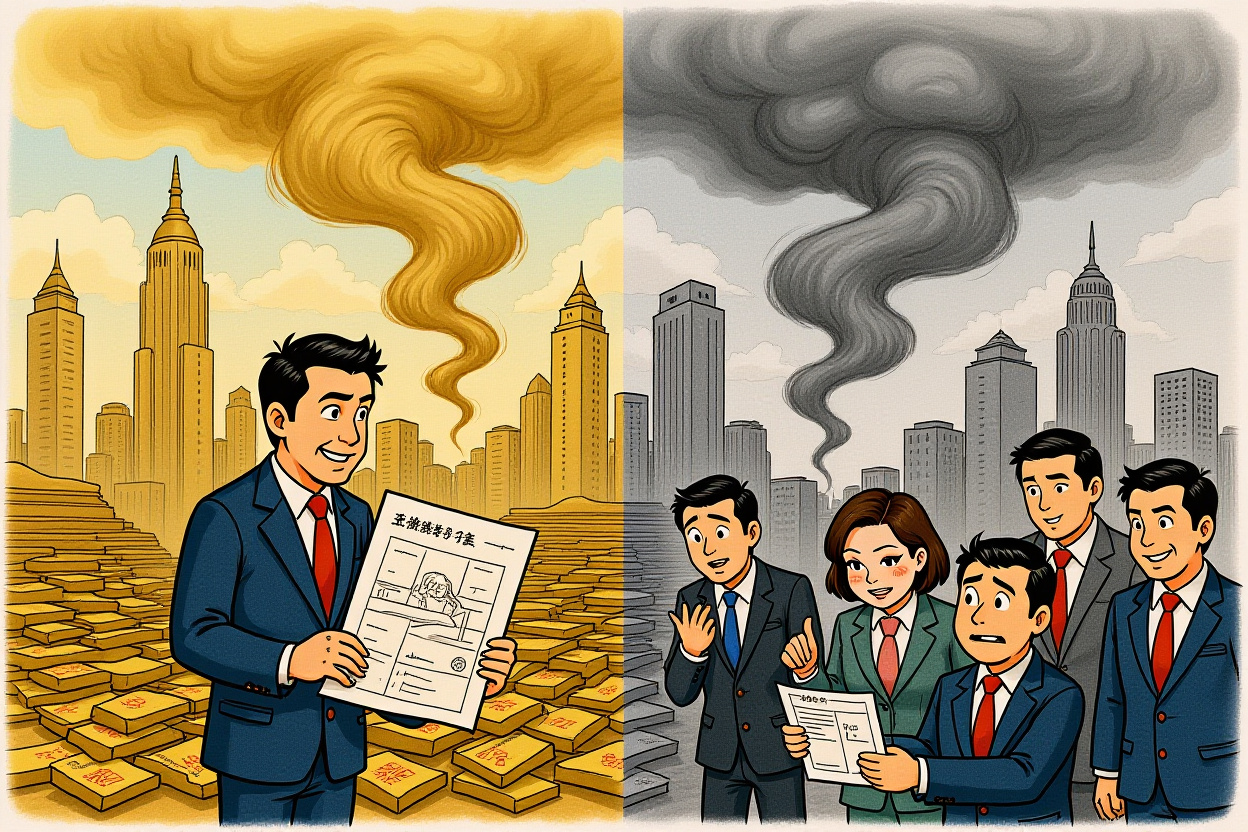
From billion-dollar sales and the title of Fujian’s richest real estate magnate to insolvency and a delisting, the journey of Tahoe Group and its founder Huang Qisen (黄其森) encapsulates an era of frenzy and decline in China’s property sector. Recently, Huang Qisen was placed under留置措施 (lien measures) by the Liaoning Xinmin Supervisory Commission, adding another layer of crisis to the already beleaguered company. This article delves into the spectacular rise and catastrophic fall of Fujian’s real estate tycoon.
Early Success and Meteoric Rise
Huang Qisen’s career is nothing short of legendary. Born in 1965 into an ordinary family in Minqing, Fujian, where his father was a teacher, Huang was a prodigy, enrolling at Fuzhou University at just 15 years old. After graduating in 1984, he joined the Construction Bank of China’s Fujian Branch, securing a coveted ‘iron rice bowl’ job. However, in 1992, at the young age of 27, Huang abandoned this security to establish Fujian Tahoe Real Estate Development Co., Ltd., marking his formal entry into the real estate industry. His business acumen quickly became apparent. In 1996, he founded Tahoe (Hong Kong) Group Limited, serving as its chairman and president. By early 2002, Huang led the Tahoe team northward, acquiring land in Tongzhou District’s Lucheng Town, with ambitions to create ‘China’s premier luxury villa.’ During the market adjustment period around 2005, he aggressively acquired land in Fuzhou, demonstrating foresight that few possessed at the time. A pivotal moment came in 2007 when Fujian SanNong’s stock was suspended from the Shenzhen Stock Exchange due to three consecutive years of losses. Huang seized the opportunity to介入重组事宜 (intervene in restructuring matters). After three years of effort, on September 30, 2010, Tahoe Group successfully back-door listed by acquiring Fujian SanNong, becoming the only real estate stock to list in China that year.
Awards and Accolades
Under Huang’s leadership, Tahoe Group experienced rapid growth. He garnered numerous accolades, including ‘2015 China Real Estate Brand Contribution Figure,’ ‘2015 Most Respected Chairman of a Listed Company in China,’ and ‘Reform and Opening Up 40-Year Era Figure.’ At its peak in 2017, Tahoe Group’s sales exceeded 100 billion yuan, propelling Huang Qisen to the top as Fujian’s real estate tycoon and earning him a spot on the Hurun Rich List nine times.
Mounting Troubles and Regulatory Scrutiny
The news of Huang Qisen’s detainment came abruptly. Tahoe Group’s announcement did not specify the exact nature of the alleged violations, only stating that the company would monitor the situation and disclose updates promptly. This incident is not an isolated one but part of a broader pattern of regulatory issues plaguing the company. Simultaneously, Tahoe Group and several related individuals received a行政处罚决定书 (administrative penalty decision) from the China Securities Regulatory Commission (CSRC) Fujian Bureau. The investigation revealed two primary violations: failure to disclose major litigation as required and significant omissions in annual reports from 2020 to 2022. Between July 6, 2020, and December 13, 2022, Tahoe Group, as a Shenzhen Stock Exchange-listed company and issuer of six bonds including ’16 Tahoe 02′ and ’17 Tahoe 01,’ was involved in multiple诉讼 (lawsuits) with cumulative values reaching billions of yuan, representing substantial portions of its audited net assets. For instance, from July 6, 2020, to May 8, 2021, 13 lawsuits occurred with a total value of 96.736995 billion yuan, accounting for 48.21% of the company’s 2020 audited net assets. Similarly, from December 14, 2021, to December 13, 2022, 10 lawsuits arose with a total value of 61.906073 billion yuan, or 41.84% of the 2021 audited net assets. Tahoe Group was obligated to disclose these litigations promptly but delayed until May 26, 2023, for just one case, with the remaining 22 not fully disclosed until February 6, 2025. This failure violated several provisions of the Securities Law and related regulations.
Financial Penalties Imposed
The CSRC Fujian Bureau imposed significant fines: – Tahoe Group Co., Ltd.: Warning and a fine of 6 million yuan. – Huang Qisen: Warning and a fine of 3 million yuan. – Other executives, including葛勇 (Ge Yong) and王景岗 (Wang Jinggang), received warnings and fines ranging from 800,000 to 2.5 million yuan, totaling 11.4 million yuan in penalties. These sanctions highlight the severe regulatory oversight and the company’s disregard for transparency, further eroding investor confidence.
The Unraveling: From Glory to Insolvency
Two years ago, Tahoe Group was delisted from the A-share market, and today, it is deeply mired in insolvency. The company’s strategy relied heavily on high leverage to fuel sales growth, which sowed the seeds for the impending crisis. In 2018, warning signs emerged as Tahoe’s cash flow dwindled, with cash and cash equivalents decreasing by 1.685 billion yuan. By 2019, the company was scrambling to collect payments and issued bonds with interest rates as high as 15%, a desperate move to repay debts and temporarily alleviate financial strain. The true test arrived in 2020. In April alone, Tahoe faced multiple court enforcements: on April 1, the Beijing Fourth Intermediate Court pursued a 134 million yuan execution case, followed by a 5.5535 million yuan demand from the Shanghai Baoshan District Court just two days later. By July, the situation escalated publicly when Tahoe defaulted on public bonds, bringing the debt crisis into the open.
Leadership Void and Operational Chaos
On March 16, 2022, another blow struck: the company announced that Chairman Huang Qisen was assisting relevant authorities in an investigation. The board activated emergency measures, with two co-presidents temporarily overseeing operations. Huang’s absence lasted eight months, during which Tahoe’s performance forecasts drastically worsened, leading to an ST designation (special treatment for financial abnormalities). Overdue debts ballooned, reaching 58.451 billion yuan in overdue unpaid loan principal by October 28, 2022. The combination of debt pressure and operational instability caused Tahoe’s stock price to plummet continuously. In 2023, after its stock price remained below 1 yuan per share for 20 consecutive trading days, it triggered delisting criteria, officially exiting the market on August 4. Post-delisting, Tahoe accelerated asset disposals. Former symbols of glory became auction targets. On July 23, 2024, Shanghai舜晟建设集团 (Shanghai Shunsheng Construction Group) acquired Tahoe Mansion for approximately 660 million yuan. This building in Shanghai’s Jing’an District, once Tahoe Group’s East China headquarters and a testament to its ‘100-billion-yuan developer’ heyday, was sold by a Tahoe subsidiary to settle debts.
Current Financial Quagmire and Future Prospects
Even in 2024, Tahoe’s operational data showed no signs of recovery. The company reported营业收入 (operating revenue) of 8.044 billion yuan, a 25.78% year-on-year increase, but net profit attributable to shareholders of delisted companies was -21.308 billion yuan, a staggering 250.94% decline. Tahoe attributed the increased losses to several factors: some operating entities undergoing court-mandated bankruptcy reorganization or liquidation, leading to significant investment losses from auctioned or debt-settled equity and key assets. Additionally, the overall downturn in the real estate sector resulted in impairments of investment properties and inventory, causing substantial fair value changes and asset减值损失 (impairment losses). By the end of 2024, Tahoe’s total assets stood at approximately 164.707 billion yuan, while liabilities soared to 187.138 billion yuan, resulting in negative shareholder equity of -23.814 billion yuan—a clear state of insolvency. More critically, as of December 31, 2024, assets totaling 107.179 billion yuan were seized, frozen, or mortgaged, representing 65.07% of total assets, indicating that over three-fifths of assets are immobilized. Despite receiving 947 million yuan in government relief funds during the reporting period, Tahoe admitted that remaining assets still face risks of auction or debt settlement. Litigation pressures continue to mount. As of August 15, the cumulative litigation amount for all pending cases exceeded 10% of net assets. Between May 1 and June 30, 2025, aside from major lawsuits, the company encountered 338 new non-major plaintiff and defendant cases related to engineering construction contracts and commercial housing sales disputes, involving a total of 1.324 billion yuan. Huang Qisen’s recent detainment adds another layer of uncertainty, but the debt crisis that has engulfed Tahoe for years shows no signs of abating. The story of Fujian’s real estate tycoon serves as a cautionary tale about the perils of over-leverage and opacity in business practices.
Lessons from the Downfall
The collapse of Tahoe Group underscores several critical lessons for businesses and investors: – High leverage, while potentially fueling rapid growth, can lead to unsustainable debt levels. – Regulatory compliance and transparent disclosure are non-negotiable for publicly listed companies. – Leadership stability is crucial; prolonged absence can exacerbate operational and financial crises. – Economic downturns and sector-specific challenges can quickly expose underlying weaknesses. For more insights into corporate governance failures, visit CSRC Enforcement Actions. Investors and industry observers must heed these warnings to avoid similar pitfalls in the future. The saga of Huang Qisen and Tahoe Group is a stark reminder that even the most towering empires can fall if built on shaky foundations.