



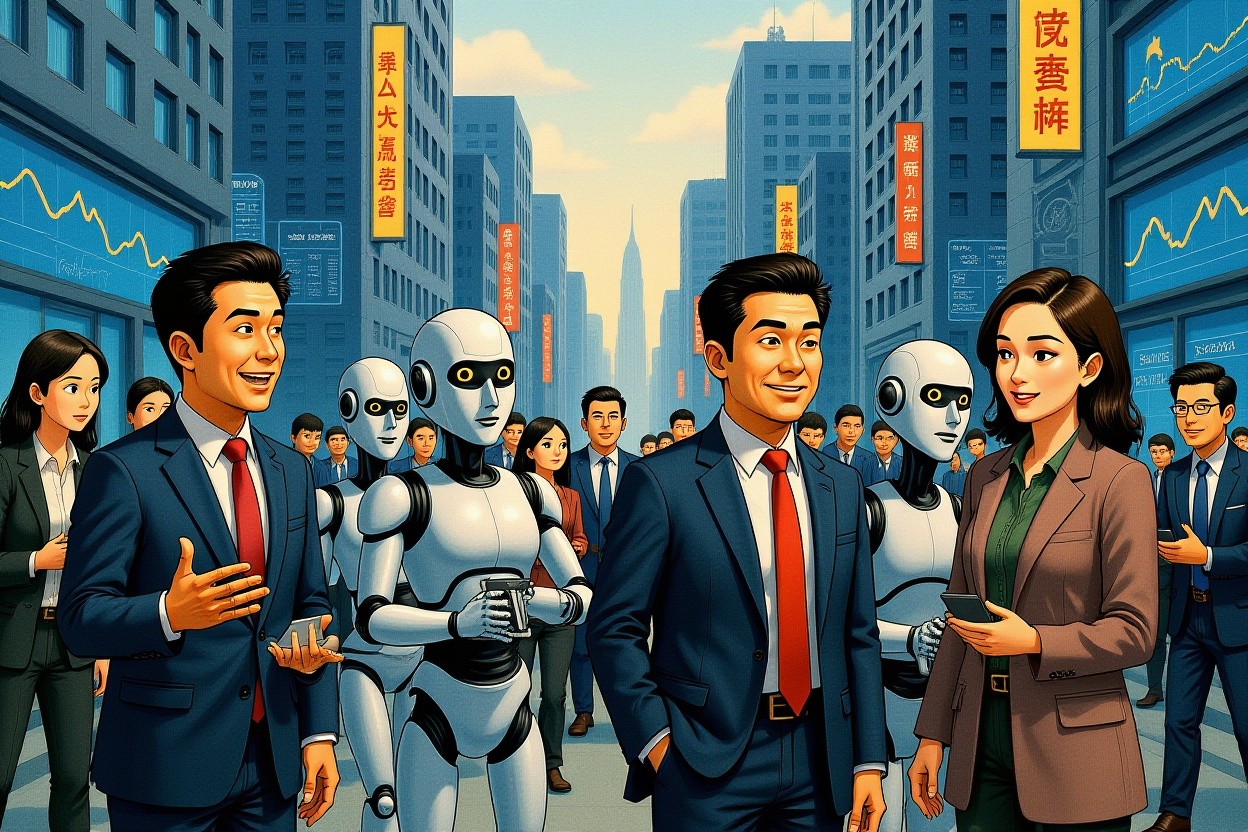
– The 2026 CCTV Spring Festival Gala featured 魔法原子 (Magic Atom), 银河通用 (Galaxy General), 宇树科技 (Unitree Robotics), and 松延动力 (Songyan Power), highlighting China’s embodied AI advancements. – This national platform serves as a critical showcase for technology validation, but the industry must now transition from performance to practical application in factories, commercial spaces, and homes. – IDC projects China’s embodied AI robot market to reach $770 billion by 2030, with a 94% CAGR, signaling immense growth potential but also intense competition. – Investors should focus on companies demonstrating real-world deployment, recurring revenue, and scalability beyond promotional events. – The sector is at an inflection point, moving from capital-driven hype to metrics-driven sustainability, with the Spring Festival Gala acting as the embodied AI ultimate test for market readiness.
The Spring Festival Gala as Embodied AI’s Ultimate Proving Ground
The CCTV Spring Festival Gala, a cultural institution watched by billions, has evolved into a barometer for technological innovation in China. In 2026, it transformed into embodied AI’s ultimate test, where four domestic companies demonstrated their prowess on a national stage. This moment marks a pivotal shift from laboratory experiments to real-world scrutiny, setting the stage for a brutal commercial showdown. The embodied AI ultimate test is not just about technical flair but about proving viability to investors, regulators, and future customers in a highly competitive landscape.
Showcasing China’s Embodied AI Prowess on a National Stage
The 2026 Gala saw 魔法原子 (Magic Atom), 银河通用 (Galaxy General), 宇树科技 (Unitree Robotics), and 松延动力 (Songyan Power) perform alongside human stars, from martial arts displays to comedic sketches. Each company’s participation was strategically labeled—宇树科技 as “Spring Festival Gala Robot Partner,” 松延动力 as “Spring Festival Gala Humanoid Robot Partner,” 魔法原子 as “Spring Festival Gala Intelligent Robot Strategic Partner,” and 银河通用 as “Spring Festival Gala Designated Embodied Large Model Robot.” These distinctions reflect divergent technical pathways and market positioning, underscoring the embodied AI ultimate test of differentiation in a crowded field. For instance, 宇树科技 (Unitree Robotics) leveraged its 2025 Gala success to become a household name, but the real embodied AI ultimate test lies beyond viral moments.
From Viral Moments to Viable Business Models
宇树科技 (Unitree Robotics), after its 2025 Gala debut, became a sensation, featuring in over 12 major events and 7 dedicated robot competitions. However, as industry insiders note, “robots can’t dance on stage forever.” The embodied AI ultimate test lies not in entertainment value but in economic utility. The Gala serves as a springboard for public acceptance and investor confidence, but sustainable growth requires crossing the chasm to profitable applications. This embodied AI ultimate test will determine which companies survive the coming shakeout, moving from showmanship to substance.
The Commercial Imperative: Three Gates to Market Success
After the applause fades, embodied AI firms must navigate a harsh reality: the market demands tangible returns. The embodied AI ultimate test unfolds across three critical arenas, each with its own challenges and opportunities. Success here is non-negotiable for long-term survival and investor returns.
Gate One: Conquering the Factory Floor
Industrial automation represents the most immediate and lucrative opportunity. Robots must perform tasks like sorting, assembly, and logistics with near-perfect reliability in harsh environments. The embodied AI ultimate test here is stability—a minute of downtime can cost thousands in lost production. Companies that falter in factory trials risk being sidelined. Key considerations include: – Uptime requirements exceeding 99.9% for continuous operations. – Integration with existing systems like MES and ERP. – Cost-effectiveness compared to human labor, with target payback periods under two years. For example, in automotive plants, robots from 松延动力 (Songyan Power) are being tested, but the embodied AI ultimate test is achieving flawless performance over millions of cycles without failure.
Gate Two: Navigating Complex Commercial Environments
From retail stores to hospitals, robots face dynamic, unstructured settings. They must integrate perception, decision-making, and interaction capabilities. The embodied AI ultimate test extends beyond pre-programmed routines to adaptive intelligence, such as avoiding obstacles or handling customer queries. Success demands robust AI systems and continuous learning. Scenarios include: – In warehouses, robots like those from 银河通用 (Galaxy General) must navigate aisles with moving people and equipment. – In hotels, they need to deliver items while interacting politely with guests. The embodied AI ultimate test here is versatility and reliability, often requiring advancements in computer vision and natural language processing.
Gate Three: The Holy Grail of Home Integration
The household is the final frontier—chaotic, unpredictable, and demanding. Robots must be safe, intelligent, user-friendly, and affordable. This long-term goal requires breakthroughs in cost reduction and AI sophistication, making it the ultimate embodied AI test for mass adoption. Challenges include: – Safety standards to prevent injuries, especially around children and pets. – Affordability, with target prices below $10,000 for widespread consumer adoption. – Ease of use, with intuitive interfaces for non-technical users. Companies like 魔法原子 (Magic Atom) are exploring home assistant robots, but the embodied AI ultimate test is creating products that consumers actually buy and use daily, not just showcase on stage.
Financial Landscape and Investment Implications
The embodied AI sector is attracting massive capital, but investors must discern hype from reality. The embodied AI ultimate test is translating stage presence into sustainable revenue streams and profitability. This requires a deep dive into financial metrics and market dynamics.
Valuation vs. Reality: A Sector at a Crossroads
With IDC forecasting China’s embodied AI robot user expenditure to hit $770 billion by 2030, capital is flooding in. However, the embodied AI ultimate test is translating hype into hard revenue. Investors must scrutinize order books, customer retention, and operational margins. As one venture capitalist put it, “Stage presence doesn’t pay the bills; recurring contracts do.” Key financial indicators for investors include: – Revenue growth from product sales versus service contracts. – Gross margins and path to profitability, with benchmarks of 30% or higher for hardware. – Burn rate and runway before next funding round, ensuring companies don’t run out of cash. The embodied AI ultimate test for startups is achieving positive cash flow before venture capital runs dry.
The Shift from Spectacle to Substance
2026 heralds a transition from funding-driven growth to execution-driven scalability. Companies like 宇树科技 (Unitree Robotics) are leveraging Gala exposure to secure industrial partnerships, but the real battle is in securing long-term clients. The embodied AI ultimate test will separate winners from losers based on deployment speed and cost efficiency. For instance, in logistics, robots that reduce operational costs by 30% or more will gain traction, while those that remain expensive novelties will fade. Investors should look for: – Pilot projects with Fortune 500 companies. – Recurring revenue models, such as robotics-as-a-service (RaaS). – Scalability in manufacturing to drive down unit costs. This embodied AI ultimate test is critical for justifying current valuations and attracting further investment.
Regulatory and Policy Backdrop
China’s regulatory environment plays a pivotal role in shaping the embodied AI landscape. The embodied AI ultimate test includes not only technological prowess but also compliance with evolving standards and policies. Understanding this framework is essential for investors and companies alike.
Government Support and Strategic Direction
China’s “Made in China 2025” and subsequent policies emphasize AI and robotics, with subsidies and R&D incentives. Regulatory bodies like 工业和信息化部 (Ministry of Industry and Information Technology) set standards that shape the embodied AI ultimate test for compliance and safety, influencing market access. Policies include: – Tax breaks for R&D expenditures, encouraging innovation. – Grants for pilot projects in smart manufacturing and smart cities. – Standards for robot safety and data security, such as those from 国家标准委 (Standardization Administration of China). These measures help companies pass the embodied AI ultimate test of regulatory approval, but they also add compliance costs that must be managed.
Global Standards and Export Challenges
As Chinese firms eye international markets, they must navigate foreign regulations, from EU’s AI Act to U.S. trade policies. The embodied AI ultimate test includes adapting to diverse legal frameworks while maintaining competitive edges. For example, exports to Europe require CE marking for safety, while the U.S. may impose tariffs or restrictions. Companies that successfully globalize will have passed a critical embodied AI ultimate test of adaptability. Key steps include: – Obtaining international certifications like ISO for quality management. – Building partnerships with local distributors to navigate regulatory hurdles. – Investing in R&D to meet region-specific requirements, such as data privacy laws.
Global Competitiveness and Future Outlook
The embodied AI race is global, and Chinese companies must benchmark against international peers. The Spring Festival Gala showcase is just the beginning; the embodied AI ultimate test is achieving sustained competitiveness on the world stage.
Benchmarking Against International Peers
Companies like Boston Dynamics and Tesla’s Optimus represent formidable competition. Chinese embodied AI firms must prove their mettle through innovation and cost advantages. The embodied AI ultimate test is global market penetration. Comparative strengths include: – Chinese firms often lead in cost efficiency due to integrated supply chains and manufacturing scale. – International players may have an edge in advanced AI algorithms and brand recognition. – Collaboration opportunities, such as joint ventures or technology licensing, can bridge gaps. The embodied AI ultimate test will be who can scale globally while maintaining quality and innovation.
Call to Action for Stakeholders
For investors, due diligence should focus on technological moats and scalable business models. Look for companies with: – Patented核心技术 (core technologies) that are difficult to replicate. – Pilot deployments with blue-chip clients yielding real-world data. – Clear roadmaps to profitability, with timelines under five years. For corporates, pilot projects in real scenarios are key to evaluating embodied AI solutions. Engage with industry reports, attend tech conferences, and consider strategic investments in promising startups. The embodied AI ultimate test is now—those who pass will define the next decade of automation, driving efficiencies across industries worldwide.
The 2026 Spring Festival Gala illuminated China’s embodied AI ambitions, but the journey has just begun. As the lights dim, companies face the embodied AI ultimate test of commercial viability. Success will hinge on overcoming practical hurdles, driving down costs, and delivering tangible value. For the financial community, this sector offers high-reward opportunities tempered by high-risk realities—vigilance and strategic patience are paramount. The embodied AI ultimate test is not just a moment on stage; it’s a continuous process of innovation and execution that will reshape industries and investment portfolios globally. Stay informed through trusted sources and be prepared to act as this dynamic market evolves.