



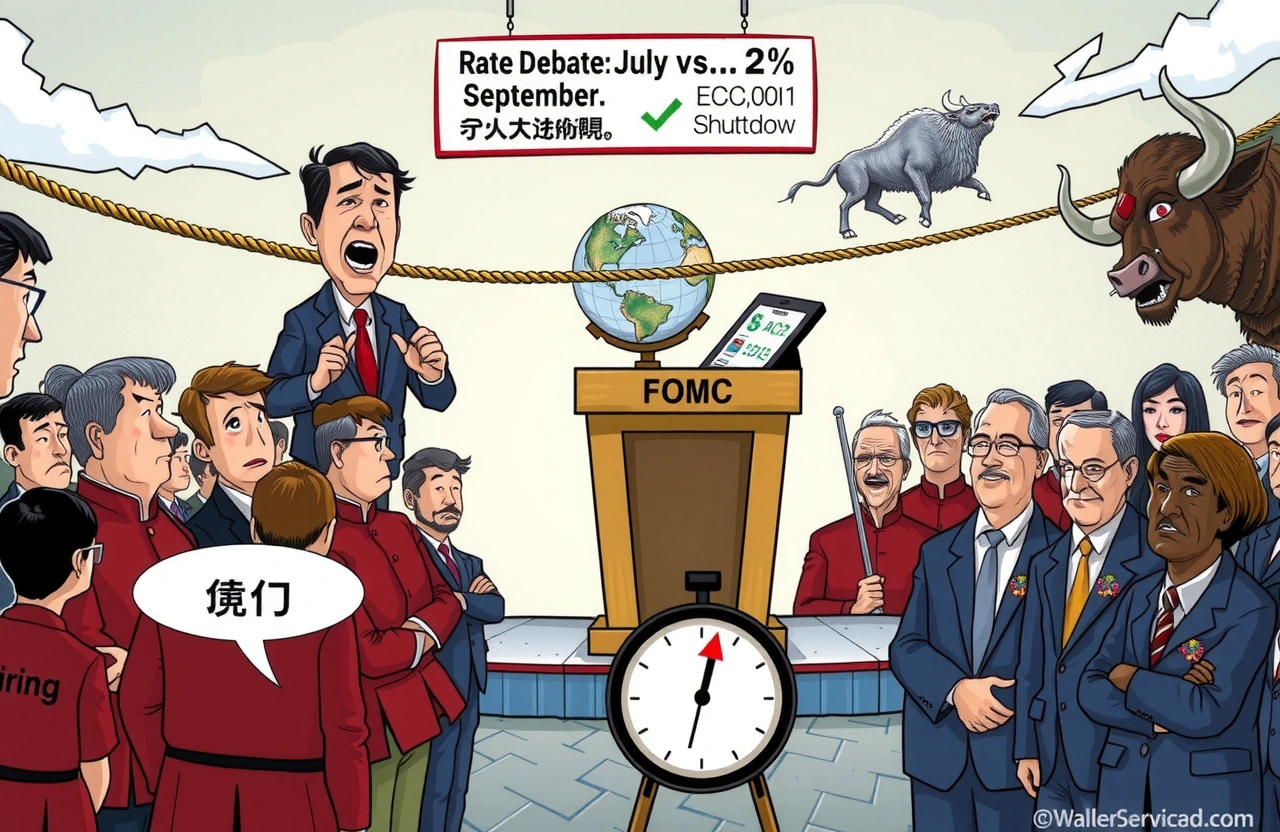
— Federal Reserve Governor Christopher Waller publicly advocates for 25-basis-point July rate cut
— Departs from consensus view amid labor market deterioration concerns
— Challenges market expectations pricing near-zero chance of July rate change
— Argues tariffs’ inflationary impact is temporary; core inflation near targets
— Highlights emerging policy divisions within Federal Open Market Committee
In a significant policy shift challenging Federal Reserve consensus, Governor Christopher Waller (沃勒) made the case for immediate monetary easing during Thursday’s address in New York. Waller broke ranks with colleagues by directly advocating for a 25-basis-point July rate cut to address emerging labor market vulnerabilities, positioning himself as only the second voting FOMC member to endorse near-term easing. This intervention introduces fresh debate ahead of July’s policy meeting amid conflicting economic signals and foregrounds Waller’s July rate cut proposal as a pivotal policy inflection point requiring urgent consideration.
Waller’s Case for July Rate Cut
Federal Reserve Governor Christopher Waller (沃勒) argued forcefully that delaying monetary support risks exacerbating economic softness already visible across indicators. His advocacy for the July rate cut represents a profound departure from prevailing FOMC restraint.
Labor Market Concerns Driving Decision
Waller characterized labor conditions as ‘on the edge,’ citing softening payroll growth, declining job openings, and weakening small business hiring plans. Key supporting evidence includes:
— Unemployment rate creeping upward despite nominal stability
— Declining quits rate suggesting reduced worker confidence
— Recent JOLTS data showing cooling demand for workers
— Leading indicators signaling potential acceleration in job losses
Waller emphasized FOMC’s mandate requires ‘preemptive action’ before deterioration becomes entrenched. With growth projected to remain below 1% through 2025, he framed the July rate cut as necessary insurance against mounting downside risks.
Inflation Outlook Enables Accommodation
Despite tariffs elevating some prices, Waller stressed core inflation fundamentals remain favorable:
— Recent CPI readings confirm disinflation momentum holding
— Five consecutive months of core inflation undershooting expectations
— Well-anchored inflation expectations from NY Fed surveys
— Wage growth stable without acceleration pressure
He contended tariff impacts should be viewed as transitory supply shocks, arguing ‘policy should see through temporary disturbances’ while focusing on underlying inflation trending toward the Fed’s 2% target.
Fed Policy Divide Intensifies
Waller’s stance exposes deepening fractures within the Federal Reserve leadership ahead of the July 30-31 meeting, crystallizing arguments around the proposed July rate cut.
The Pro-Easing Camp
Waller joins Vice Chair for Supervision Michelle Bowman (鲍曼) in supporting near-term cuts:
— Both emphasize asymmetric risks of delayed action
— Prioritize labor market stability over inflation concerns
— Argue policy remains restrictive despite recent improvements
Their position challenges the ‘higher for longer’ paradigm, citing business surveys showing tightening credit conditions despite benchmark rates holding steady.
The Cautious Opposition
New York Fed President John Williams (威廉姆斯) leads resistance:
— Concerns about tariff-driven inflation persistence
— Indicates need for ‘more evidence’ before reversing course
— Advocates maintaining restrictive stance against upside risks
Board members favoring patience reference strengthening service sector inflation and volatile energy prices as grounds for hesitation, creating a complex landscape where the July rate cut proposal faces substantial internal skepticism.
Market Reactions and Pricing Implications
Waller’s intervention dramatically reshaped short-term interest rate expectations despite gaps between potential policy actions and trader positioning.
Rebalanced Expectations
CME FedWatch data revealed:
— Pre-speech July rate hold probability exceeded 95%
— Post-announcement July cut odds jumped to 42%
— September easing likelihood surged past 70% constituency
The swift repricing demonstrates markets acknowledging heightened uncertainty after Waller elevated debate about July rate cut necessity. Treasury yields dropped steeply across the curve, with 2-year notes falling 15 basis points immediately following remarks.
Sector Responses
Immediate market movements included:
— Rate-sensitive tech stocks rallying
— Regional bank shares gaining on margin relief prospects
— Dollar weakness against major currencies
Energy and materials sectors lagged on growth concerns underscoring mixed valuations as rotation patterns suggest investors remain skeptical about coordinated Fed action before autumn.
Broader Economic Context
Waller emphasized slowing macroeconomic momentum justifying the July rate cut initiative:
Growth Deceleration
Recent GDP tracking shows:
— Atlanta Fed Nowcast projecting Q2 growth at 1.5%
— Persistent weakness in manufacturing PMIs
— Consumer spending losing momentum on credit constraints
Waller warned subdued hiring intentions and contracting CEO confidence foreshadow softer activity ahead.
Comparative Global Policy
The Fed’s potential shift occurs amid:
— ECB initiating cutting cycle in June
— Swiss National Bank easing despite marginal inflation
— Emerging market central banks facing Fed divergence burdens
Unlike peers stressing policy independence, Waller acknowledged global financial spillovers influencing domestic conditions.
Leadership Context and Political Dimensions
Though denying discussions with Trump administration officials, Waller acknowledged Federal Reserve chair succession speculation during Q&A:
— Role increasingly politicized amid election pressures
— Steering committee reviewing Fed governance structures
— Financial stability concerns extending to cryptocurrency regulation
Relevant Federal Reserve reforms include proposals extending bank liquidity backstops to 2026.
Waller’s prominence foregrounds institutional tensions balancing Congressional oversight demands against operational independence required for contested July rate cut decisions.
Economic policymakers face unprecedented scrutiny amid mounting evidence that delayed accommodation risks avoidable contraction. While exact timing remains contested between July and September implementations, Waller compellingly demonstrates circumstances warrant urgent policy recalibration responding to emerging downside risks.
Investors should monitor next week’s retail sales data and unemployment claims for confirmation of labor market trajectory ahead of crucial July deliberation where Waller’s July rate cut contention forces urgent reassessment of conventional policy frameworks.