



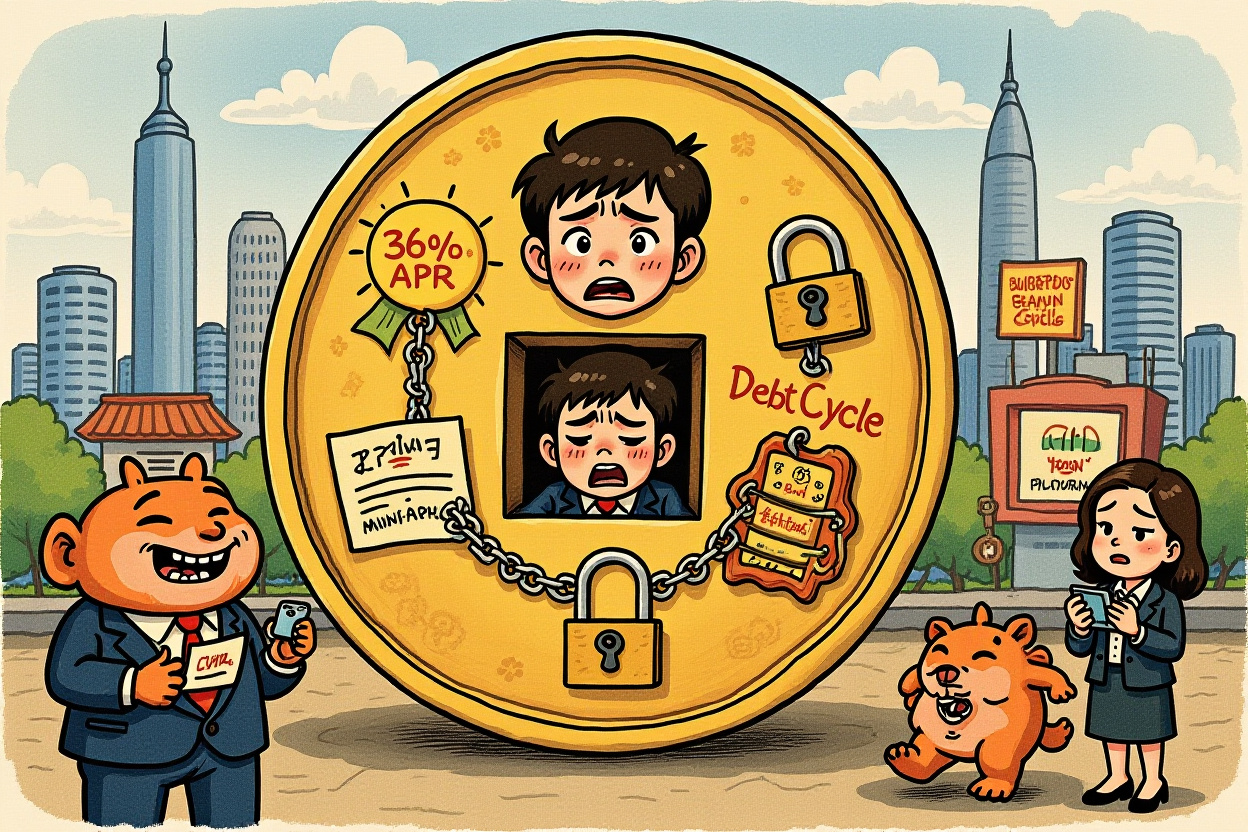
– Mini-loan platforms such as Fenqile (分期乐) lure borrowers with low upfront payments but impose effective annual percentage rates (APRs) nearing 36%, far exceeding regulatory caps of 24%.
– Despite new guidelines from the People’s Bank of China (中国人民银行) and the National Financial Regulatory Administration (国家金融监督管理总局), enforcement gaps allow opaque fee structures and hidden costs to persist, trapping consumers in debt cycles.
– Fenqile’s legacy as a campus lender continues, with numerous complaints about targeting students and employing aggressive, privacy-invading debt collection methods that impact mental health.
– Investors in China’s fintech sector must scrutinize lending practices and regulatory compliance to mitigate risks associated with predatory mini-loans, which could face heightened scrutiny and legal challenges.
– Consumers are advised to exercise caution, read fine print, and seek legal recourse if faced with unfair terms, as regulatory bodies ramp up efforts to clean up the industry.
The Hidden Crisis in China’s Consumer Credit Market
As the Lunar New Year approaches, young professionals and students across China face heightened financial pressures—from gifting red envelopes to funding family trips. In this climate, mini-loan platforms like Fenqile (分期乐) dangle enticing offers: “credit limits up to 50,000 yuan” and “annual interest rates as low as 8%.” Yet, beneath this veneer of accessibility lies a perilous reality. Borrowers like Chen, who took out 13,674 yuan in loans, now owe 26,859 yuan, nearly double the principal, due to exorbitant interest and hidden fees. This investigation uncovers how mini-loans, often marketed as convenient solutions, are systematically draining young people through predatory practices, while regulators scramble to keep pace. For international investors monitoring Chinese equities, understanding these dynamics is crucial, as they signal broader risks in the fintech sector and potential regulatory shifts that could impact market valuations.
The Allure and Trap of Mini-Loans
Mini-loans, characterized by small amounts and extended repayment periods, appear benign on the surface. Platforms like Fenqile promote them as tools for managing cash flow, with slogans emphasizing low monthly payments. However, this model masks a dangerous calculus: by stretching repayments over 24 to 36 months and layering on fees, the total cost balloons, ensnaring borrowers in debt spirals. The focus on mini-loans reveals a industry-wide pattern where accessibility comes at a steep price.
Opaque Fee Structures and Skyrocketing Debt
Consumers often encounter unclear terms that obscure the true cost of borrowing. For instance, Fenqile’s interface highlights “1 yuan borrowed per day costs as little as 2.2 yuan,” but buried in electronic agreements are additional charges like membership fees,担保费 (guarantee fees), and credit assessment costs. Data from the Black Cat Complaint Platform (黑猫投诉平台) shows over 160,000 grievances against Fenqile, many citing APRs逼近36% (approaching 36%). A typical case involves a borrower who took a 10,300 yuan loan at a stated 6% annual rate but ended up repaying 12,425.4 yuan due to hidden fees, as reported by China Consumer. This lack of transparency violates guidelines from the People’s Bank of China (中国人民银行), which mandate clear disclosure of all costs.
- Example: Chen’s loans totaled 13,674 yuan across five transactions, with APRs ranging from 32.08% to 35.90%, leading to a repayment sum of 26,859 yuan after defaults and penalties.
- Statistic: On the Black Cat Platform, a user complained on February 12, 2025, that Fenqile’s综合年化利率 (comprehensive annualized rate) hit 36%, urging regulators to intervene.
- Regulatory Context: The 2025 guidance from the People’s Bank of China and the National Financial Regulatory Administration caps new loan APRs at 24%, with plans to reduce them to within four times the one-year Loan Prime Rate (LPR) by 2027.
Case Study: The Human Cost of Debt Cycles
Chen’s story, highlighted in Southern Daily, illustrates the personal toll. As a university student, she borrowed for daily expenses, including a 400 yuan purchase split over 36 installments. After ceasing payments in 2022 due to financial strain, she faced over 1,000 days of逾期 (delinquency), accompanied by aggressive collection tactics that notified her family and friends, exacerbating depression. This underscores how mini-loans can transition from financial tools to sources of profound psychological distress, affecting not just credit scores but overall well-being.
Regulatory Landscape and Compliance Issues
China’s regulatory framework for consumer lending has tightened in recent years, but gaps remain that allow mini-loan platforms to operate in gray areas. The focus on mini-loans is intensifying as authorities seek to balance innovation with consumer protection, yet implementation challenges persist.
New Guidelines from the People’s Bank of China and NFRA
In December 2025, the People’s Bank of China (中国人民银行) and the National Financial Regulatory Administration (国家金融监督管理总局) issued the “小额贷款公司综合融资成本管理工作指引” (Guidelines for Comprehensive Financing Cost Management of Small Loan Companies), prohibiting new loans with APRs above 24% and mandating reductions to LPR-based benchmarks by 2027. These rules aim to curb predatory lending, but they apply primarily to new disbursements, leaving existing loans like Chen’s in a regulatory limbo. Additionally, local financial bureaus are tasked with enforcement, but resource constraints can lead to uneven oversight.
- Key Point: The guidelines emphasize动态管理 (dynamic management) of credit systems for non-compliant loans, yet platforms may exploit delays in enforcement to maintain high-profit models.
- Expert Insight: Financial analysts note that while regulations are stringent on paper, the proliferation of online lending apps complicates monitoring, requiring enhanced technological solutions for real-time compliance checks.
Gap Between Regulation and Practice
Despite these measures, platforms like Fenqile adapt by restructuring fees or partnering with持牌机构 (licensed institutions) to obscure true costs. For example, Fenqile collaborates with Shanghai Bank (上海银行) for fund disbursement, but the opaque allocation of service fees can still push effective rates beyond caps. A complaint from January 20, 2025, detailed how Fenqile charged extra信用评估费用 (credit assessment fees) atop interest, raising the total cost. This highlights a systemic issue: without robust auditing and consumer education, regulatory intentions may be undermined, keeping the mini-loan trap active.
The Legacy of Campus Lending and Ongoing Risks
Fenqile’s roots trace back to campus lending, a segment notorious for exploiting students. Founded in 2013 by Xiao Wenjie (肖文杰), Lexin Fintech Holdings (乐信集团) grew rapidly by targeting undergraduates with easy credit for electronics and lifestyle purchases. Although regulatory crackdowns in 2016 forced a rebranding, evidence suggests that mini-loans still permeate student circles, raising ethical and legal concerns.
Fenqile’s Origins and Controversies
Xiao Wenjie (肖文杰), Lexin’s CEO, built the company on the分期乐 (Fenqile) platform, initially marketing directly to universities. After going public on Nasdaq in 2017, Lexin shifted its image to a broader fintech player, but historical baggage lingers. The吉安市分期乐网络小额贷款有限公司 (Ji’an Fenqile Network Small Loan Co., Ltd.), the operational entity, continues to face scrutiny for practices reminiscent of its early days. Data from the Black Cat Platform shows 922 complaints specifically linking Fenqile to校园贷 (campus loans), with reports of promoters setting up booths on campuses to entice students.
- Example: A user reported that while still a student, they were approached by Fenqile agents offering loans without adequate income verification, leading to debt accumulation.
- Statistic: Over 20,000 complaints cite暴力催收 (violent debt collection), including harassment of family members and employers, violating privacy norms and exacerbating the mini-loan crisis.
Ongoing Issues with Student Targeting
The persistence of student-focused lending underscores vulnerabilities in China’s credit ecosystem. Young borrowers, often financially inexperienced, may not fully grasp terms like年化利率 (annualized rate) or the implications of default. Fenqile’s privacy policy, as investigated by Economic Reference News (经济参考报), reveals extensive data collection—from ID photos to location info—shared with third parties like增信机构 (credit enhancement agencies). This data can be leveraged in coercive collection, creating a cycle where borrowers feel trapped. For investors, this signals reputational risks that could affect Lexin’s stock performance and invite stricter regulatory actions.
Data Privacy and Aggressive Collection Practices
Beyond financial costs, mini-loan platforms impose significant privacy invasions. The integration of data harvesting with aggressive tactics forms a key pillar of their business model, raising alarms about consumer rights and corporate accountability in China’s digital economy.
Information Sharing and Privacy Concerns
Upon agreeing to Fenqile’s terms, users consent to sharing personal data with entities such as payment partners and清算银行 (clearing banks), often without clear opt-outs. This practice, detailed in the “经参调查” (Economic Reference Investigation), facilitates targeted collection efforts. For instance, if a borrower defaults, collectors might contact acquaintances using harvested contact lists, amplifying social pressure. Such methods not only breach ethical standards but may contravene China’s Personal Information Protection Law, highlighting a need for tighter data governance in the mini-loan sector.
- Case: A borrower from Sichuan reported unauthorized担保费 (guarantee fees) deducted after loans, with terms hidden in lengthy digital contracts, as per China Consumer reports.
- Regulatory Note: The Cyberspace Administration of China (国家互联网信息办公室) has guidelines on data usage, but enforcement in fintech remains patchy, necessitating cross-agency collaboration.
Impact on Borrowers’ Mental Health
The psychological toll of relentless collection is profound. Chen’s experience of depression due to public shaming is not isolated; many users describe anxiety and social isolation. This human dimension adds urgency to regulatory reforms, as healthy credit markets should foster financial inclusion without compromising mental well-being. For institutional investors, these social risks translate into potential ESG (Environmental, Social, and Governance) liabilities, urging deeper due diligence on companies like Lexin.
Market Implications for Investors and the Fintech Sector
The mini-loan phenomenon carries broad implications for China’s equity markets, particularly in fintech and consumer finance segments. As regulatory scrutiny intensifies, investors must reassess risk exposures and growth projections tied to lending platforms.
Risks in Fintech Lending Models
Companies reliant on high-interest mini-loans face dual threats: regulatory crackdowns and consumer backlash. Lexin’s stock, for example, could volatility if new fines or restrictions emerge from cases like Fenqile’s. Moreover, as awareness grows, borrower defaults might rise, impacting profitability. Historical parallels exist in peer-to-peer lending crackdowns, where similar practices led to sector-wide consolidation. Investors should monitor indicators like complaint volumes and regulatory announcements to gauge stability.
- Data Point: Lexin’s revenue streams from Fenqile contribute significantly to its overall earnings, making it vulnerable to shifts in lending policies.
- Expert Quote: A fund manager specializing in Asian equities notes, “The sustainability of mini-loan models hinges on transparency; without it, regulatory risks could trigger sell-offs.”
Due Diligence for Institutional Investors
To navigate this landscape, investors should prioritize companies with robust compliance frameworks and clear fee disclosures. Key steps include reviewing audit reports, engaging with management on ethical practices, and diversifying away from overexposed mini-loan providers. Additionally, tracking regulatory trends, such as updates from the National Financial Regulatory Administration (国家金融监督管理总局), can inform strategic adjustments. The focus on mini-loans here is critical, as it represents a litmus test for China’s broader fintech regulation and its appeal to global capital.
Pathways to Consumer Protection and Industry Reform
Addressing the mini-loan crisis requires concerted efforts from regulators, companies, and consumers. Proactive measures can mitigate harms while preserving innovation in China’s financial markets.
Legal Recourse and Advice for Borrowers
Affected individuals should document all communications and fee structures, then file complaints with local金融管理机构 (financial management agencies) or consumer protection bodies like the China Consumers Association (中国消费者协会). Legal avenues exist under China’s Contract Law and consumer rights statutes to challenge unfair terms. Resources such as the Southern Daily article on Chen’s case offer templates for seeking redress. Practically, borrowers are advised to:
- Always calculate the effective APR using online tools before committing to loans.
- Avoid platforms that do not provide clear breakdowns of all costs in prominent displays.
- Seek credit counseling if debt becomes unmanageable, leveraging non-profit services available in major cities.
Call for Tighter Oversight and Ethical Standards
Regulators must enhance monitoring through technology, such as AI-driven audits of lending platforms, to ensure compliance with APR caps. Simultaneously, industry associations should promulgate best practices for transparency and collection ethics. For companies like Lexin, investing in consumer education programs can rebuild trust and align with long-term growth. As China’s economy evolves, balancing fintech advancement with consumer safeguards will be pivotal for sustaining investor confidence and market integrity.
Synthesizing the Mini-Loan Challenge for Global Stakeholders
The exploration of mini-loans reveals a complex interplay of financial innovation, regulatory gaps, and human cost. Key takeaways include the urgent need for enforced interest rate caps, improved transparency in fee structures, and stronger data privacy protections. For international investors, this signals both risks and opportunities: companies that adapt to stricter norms may emerge stronger, while those resisting change could face downturns. As China refines its consumer credit framework, stakeholders should advocate for policies that prioritize consumer welfare without stifling economic dynamism. Moving forward, vigilant oversight and informed decision-making will be essential to navigate the evolving landscape of mini-loans and their impact on China’s equity markets.