



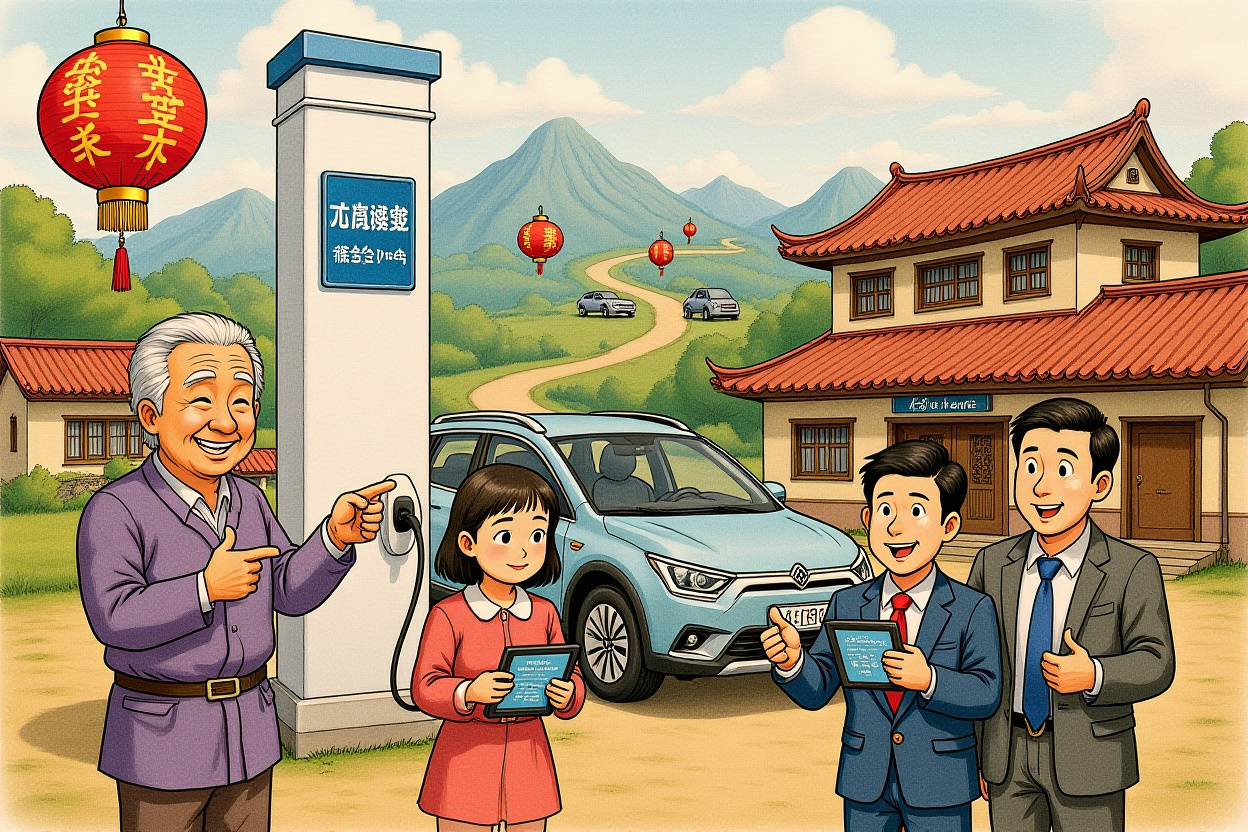
– The pervasive ‘charging anxiety’ that once plagued new energy vehicle (NEV) owners traveling to rural areas for the Spring Festival is rapidly dissipating due to infrastructure expansion. – Government-led initiatives have achieved near-universal charging coverage in highway service areas and are expanding into townships and villages, with 19 provinces now boasting ‘乡乡全覆盖’ (township-wide coverage). – Private investment is accelerating, with entrepreneurs like Lin Bowei (林伯伟) scaling up rural charging station deployments at an unprecedented pace, targeting a tenfold increase in 2026. – Technological advancements, including photovoltaic supercharging stations, are reducing charging times from hours to minutes, enhancing convenience for returning migrants. – This infrastructure boom supports China’s dominant 68.4% share of the global new energy passenger vehicle market and is poised to further fuel rural EV adoption.
For years, the thought of driving a new energy vehicle (NEV) back to one’s ancestral village for the Spring Festival holiday was met with palpable charging anxiety—the fear of being stranded with a depleted battery far from reliable charging points. This psychological barrier has been a significant hurdle for electric vehicle (EV) adoption in China’s vast hinterlands. However, the 2026 Lunar New Year travel season is telling a different story. From the mountains of Sichuan to the plains of Gansu, returning migrants are discovering that a quiet revolution in charging infrastructure has unfolded in their absence. The once-daunting journey home in an electric car is now not only feasible but often more convenient and cost-effective than relying on traditional fuel, marking a critical inflection point in China’s electric vehicle narrative as it moves beyond urban centers to empower rural mobility.
The Rural Charging Revolution: From Anxiety to Assurance
The term charging anxiety is losing its sting for a growing number of Chinese NEV owners, as evidenced by personal anecdotes and national data from this year’s Spring Festival travel peak. This shift reflects broader trends in infrastructure development and policy support.
Personal Stories: EV Owners’ Journey Home
Ms. Ai (艾女士), who works in Beijing, traditionally drove a gasoline-powered car on her long journey back to her mountainous hometown in Sichuan’s Dazhou region. This year, she opted for her pure electric vehicle (EV) with a 560-km official range, citing the new fast-charging station built just a ten-minute drive from her village. ‘I used to have to drive 40-50 kilometers to the nearest town to charge. Time was the biggest issue,’ she explained. Now, with two charging sessions during her stay, each taking less than an hour, she feels a sense of ‘charging freedom’ even in remote areas. Similarly, Mr. Liu (刘先生) from Shenzhen has driven his EV back to his village in Gansu’s Tianshui for three consecutive years. His early experiences involved relying on a slow, portable charging cable that required an overnight charge. ‘This year, a photovoltaic supercharging station opened in our town. It takes just 15 minutes to get a substantial charge, which is incredibly convenient,’ he noted. Their stories, echoed by many on social media with IP addresses from southern China, highlight a rapid deployment of charging points in townships and even village entrances.
Data-Driven Growth: Charging Infrastructure Expansion
This grassroots experience is backed by robust national data. In a January 21 announcement, the National Energy Administration (NEA 国家能源局) reported that as of December 2025, China’s highway service areas had cumulatively built 71,500 charging piles, covering over 98% of all service areas. Perhaps more significantly, 19 provinces have achieved charging facility ‘乡乡全覆盖’ (township-wide coverage). Tong Zongqi (仝宗旗), General Manager of the China Charging Alliance Open Service Platform, noted that this coverage is concentrated in eastern and southern regions but is accelerating nationwide due to policy support. ‘With the ‘新能源汽车下乡’ (New Energy Vehicle Going to the Countryside) campaign and continuous fiscal support from ministries like the Ministry of Finance and Ministry of Industry and Information Technology (MIIT 工业和信息化部), all provinces are speeding up charging facility construction,’ he stated. This data underscores a systematic effort to eliminate charging anxiety at its source.
Government Policies and Market Forces Driving Change
The eradication of rural charging anxiety is no accident; it results from a concerted, multi-year push by Chinese authorities and entrepreneurial investment to build a comprehensive NEV ecosystem.
National Initiatives and Local Implementation
Key policies have provided the framework for this transformation. The ‘新能源汽车下乡’ initiative, coupled with support from the Ministry of Finance, MIIT, and Ministry of Transport, has funded and incentivized charging infrastructure to address ‘短板’ (shortcomings) in county-level and rural areas. For instance, the State Council’s directives on NEV development have prioritized rural accessibility, leading local governments to implement projects that now yield tangible results during peak travel seasons. This top-down approach ensures coordination, while bottom-up execution allows for adaptation to local needs, such as the installation of fast chargers in villages like Ms. Ai’s in Sichuan.
Private Sector Investment and Business Models
Policy tailwinds have unleashed entrepreneurial energy. Lin Bowei (林伯伟), founder of Hefei Luchong New Energy Technology Co., Ltd., transitioned from used car sales to building public fast-charging stations in towns around Hefei, Anhui, in late 2025. ‘This area was still a blue ocean in the second half of 2025,’ he said. By opting for low-voltage stations that don’t require expensive transformers, he has kept single-gun costs around 15,000 yuan, compared to 60,000 yuan for a transformer-equipped station. His return on investment period is estimated at two to three years. From 10 stations in 2025, his target for 2026 is 100 stations—a tenfold increase in deployment speed. ‘As Spring Festival approached, electricity consumption at my earliest stations increased by 30%, driven by returning vehicle owners,’ Lin observed, highlighting the immediate economic viability. This model demonstrates how private capital can complement public efforts to tackle charging anxiety effectively.
Technological Advancements: Fast Charging and Beyond
Infrastructure quantity is being matched by leaps in quality and technology, further alleviating charging anxiety through faster and more sustainable solutions.
The Rise of Photovoltaic Supercharging Stations
The station used by Mr. Liu in Gansu represents a cutting-edge trend: the integration of solar power with ultra-fast charging. These photovoltaic supercharging stations can deliver a significant charge in 15 minutes, rivaling the refueling time for conventional cars. This technology is particularly promising for sun-rich regions and aligns with China’s dual carbon goals, reducing reliance on the grid and enhancing energy independence. For rural areas with abundant sunlight, such innovations make charging not only convenient but also environmentally friendly, addressing both range and sustainability concerns.
Cost-Effective Solutions for Rural Areas
Entrepreneurs like Lin Bowei are proving that deploying rural charging doesn’t have to be capital-intensive. His strategy involves first securing locations in villages with minimal infrastructure (‘buying a roughcast house’), then upgrading as demand stabilizes. This agile, phased approach reduces financial risk and allows for rapid market penetration in areas previously considered unprofitable. Key cost components include:
– Charging piles: Varying by technology and power output.
– Cables and auxiliary materials: Essential for connection and safety.
– Construction fees and land租金 (rent): Often negotiated locally to keep costs low.
– Operation and maintenance: Streamlined through remote monitoring systems.
By minimizing upfront investment, such models accelerate the rollout of charging stations, directly combating charging anxiety in underserved regions.
Market Implications and Future Outlook
The quiet conquest of rural charging anxiety has profound implications for China’s automotive and energy sectors, influencing global investment trends and domestic policy.
Impact on EV Adoption and Sales
Challenges and Opportunities AheadWhile progress is remarkable, challenges remain. Coverage is still denser in the east and south, and regions in central and western China may require more targeted investment. The next phase, as Tong Zongqi suggests, will involve ‘适度超前投建’ (appropriately超前 investment) tailored to local conditions and vehicle use patterns. This means further integration of different charging technologies, such as battery swapping and smart grid solutions, to address varying needs. For investors and policymakers, key opportunities include:
– Expanding into underserved provinces with incentives for public-private partnerships.
– Leveraging data analytics to optimize station placement and usage rates.
– Developing ancillary services like energy storage and maintenance hubs.
– Monitoring regulatory updates from bodies like the National Development and Reform Commission (NDRC 国家发展和改革委员会) for guidance.
The success stories from this Spring Festival should bolster confidence in the scalability of China’s NEV infrastructure ambitions, but sustained effort is needed to fully eradicate charging anxiety nationwide.
The narrative around new energy vehicles in China is decisively shifting. The charging anxiety that once defined long-distance travel to rural hometowns is being systematically dismantled by a powerful combination of government policy, private entrepreneurship, and technological innovation. This Spring Festival has served as a national stress test, proving that the infrastructure can handle mass migration events and deliver a reliable experience for EV owners. For global investors, automakers, and corporate executives, the message is clear: China’s EV revolution is entering its next, deeply pervasive phase, reaching into the heart of its countryside. The path forward involves sustained investment in charging networks, technological adaptation to local needs, and learning from rapid deployment models pioneered in provinces like Anhui. As charging anxiety fades, the era of worry-free electric travel across all of China is within sight, promising broader economic and environmental benefits. Stakeholders should monitor this trend closely and consider strategic investments in rural charging infrastructure to capitalize on this transformative shift.