



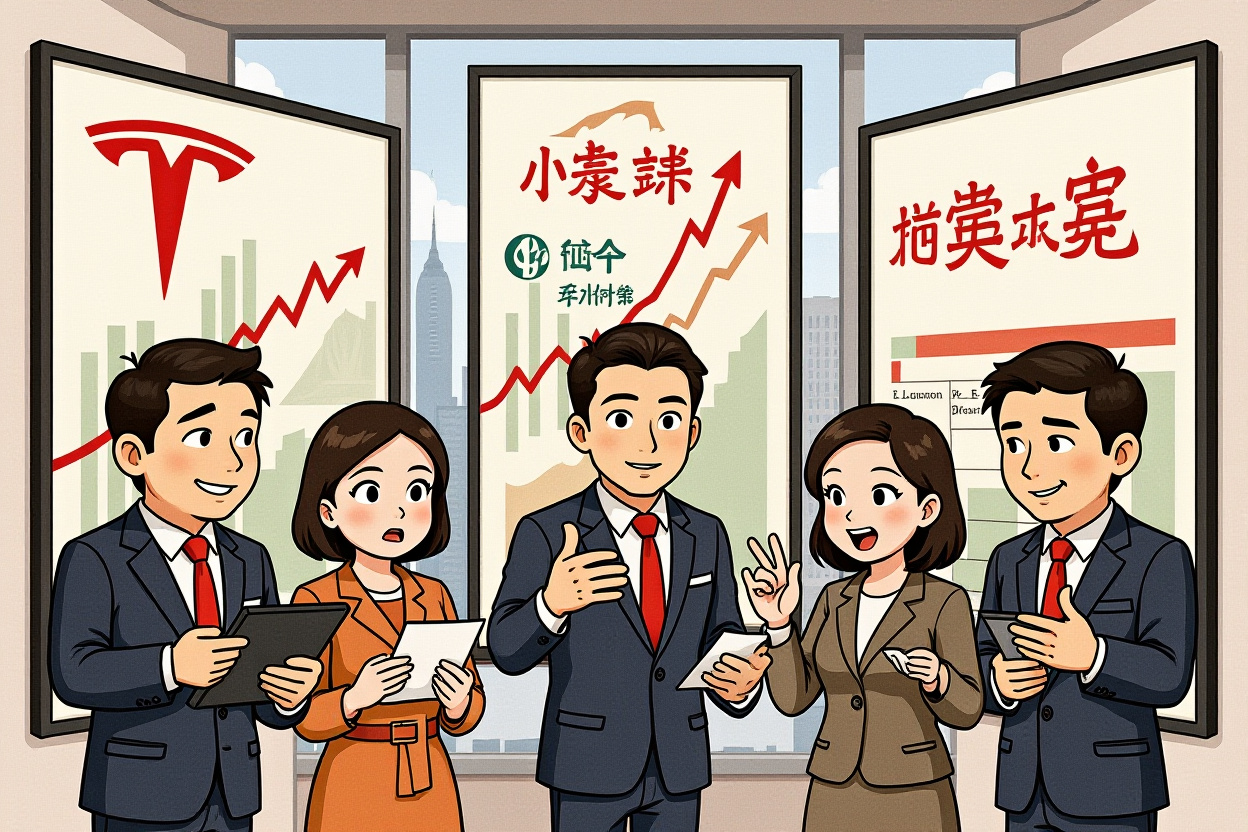
The cryptic, value-driven investment philosophy of Duan Yongping (段永平) has long served as a lodestar for a generation of Chinese market participants. His recent, pointed commentary on Tesla, however, has sent a distinctive ripple through professional investment circles. Duan suggests that analyzing the electric vehicle (EV) pioneer today requires looking beyond conventional metrics like the price-to-earnings (P/E) ratio. Instead, he posits, the dominant framework is a “市梦率” (shì mèng lǜ)—a term loosely translatable as the “P/E Dream Ratio” or “Dream Valuation.” This concept, far more than a witty pun, cuts to the heart of modern growth investing. It questions how investors price not just current operations, but an all-encompassing narrative of technological dominance, market transformation, and a future that remains largely unwritten. For institutional investors navigating the high-stakes terrain of Chinese and global equities, Duan’s perspective offers a crucial lens through which to evaluate not only Tesla but the entire ecosystem of narrative-driven, high-growth companies.
- The ‘P/E Dream Ratio’ Defined: An exploration of Duan Yongping’s (段永平) concept, differentiating it from traditional valuation models and highlighting its focus on future potential and market narrative over present fundamentals.
- Tesla Under the Microscope: A detailed analysis of how Tesla’s current market valuation aligns (or diverges) from its financial performance, justifying Duan’s characterization of its investment case.
- Implications for Growth Investing: How the prevalence of the “P/E Dream Ratio” reshapes risk assessment, due diligence, and portfolio strategy for funds targeting disruptive innovation.
- The Chinese Investor Perspective: Contextualizing Duan’s view within broader trends in China’s capital markets, where investor appetite for technology and growth stories has often embraced similar valuation philosophies.
- Actionable Insights for Professionals: Key questions and frameworks investors can use to discern sustainable “dreams” from speculative bubbles when evaluating high-flying stocks.
The Oracle Speaks: Decoding Duan Yongping’s Investment Philosophy
To fully grasp the weight of his comments on Tesla, one must first understand the stature and methodology of Duan Yongping (段永平). Often called “China’s Warren Buffett,” Duan built his reputation and fortune on a foundation of deep value investing, patient capital allocation, and an almost obsessive focus on business moats and understandable models. His legendary early investment in NetEase (网易) during its crisis is a masterclass in contrarian value spotting. Therefore, when such an investor describes a company’s valuation as being predicated on a P/E Dream Ratio, it is not a dismissal but a profound observation on market mechanics. He is signaling a shift from a numbers-based assessment to a faith-based one, where the price reflects collective belief in a visionary outcome.
From P/E to P/E Dream: A Conceptual Evolution
The traditional P/E ratio is a backward- or present-looking metric, dividing a company’s share price by its earnings per share. It answers the question: “How much am I paying for $1 of today’s profit?” The P/E Dream Ratio, as conceptualized by Duan, is inherently forward-looking and qualitative. It asks: “How much am I paying for the dream of what this company could become?” This dream encompasses total addressable market capture, technological monopoly, ecosystem lock-in, and even the charisma of its leadership. For companies like Tesla, under CEO Elon Musk, the dream includes not just EV dominance, but autonomy, robotics, energy storage, and a sustainable future. Duan’s point is that at Tesla’s current scale and valuation, this dream component vastly outweighs the contribution of its present automotive earnings, making standard valuation tools less instructive.
特斯拉 (Tesla) and the Anatomy of a Market Dream
Tesla stands as the quintessential case study for the P/E Dream Ratio. Its financials tell one story: it is a profitable, high-growth automaker with industry-leading margins. Yet, its market capitalization has frequently implied a value greater than many of the world’s largest legacy automakers combined, despite a fraction of their unit volume, revenue, and asset base. This disconnect is the “dream” in action. Investors are not valuing Tesla merely as a car company; they are pricing it as a vertically integrated technology and energy platform.
Quantifying the Dream: Narrative vs. Numbers
Analysts attempting to bridge this gap focus on potential future earnings streams that are highly speculative:
- Full Self-Driving (FSD): The potential for high-margin, recurring software revenue from an autonomous driving subscription service represents a paradigm shift from manufacturing economics.
- Energy Business: Growth in solar and storage (e.g., the Megapack) could position Tesla as a major utility-scale player.
- Robotics & AI: Projects like the Optimus humanoid robot are pure “dream” components with no near-term financial contribution but significant imagination capture.
Duan Yongping’s (段永平) insight is that the premium in Tesla’s stock price is a direct bet on the successful realization of several of these dreams. The core automotive business, while strong, alone cannot justify the valuation under traditional models. Thus, the investment thesis is fragile—it thrives as long as the narrative of inevitable technological domination remains intact and progresses. Any significant setback in FSD timelines, market share erosion in core EV markets, or execution missteps can sharply recalibrate the market’s estimated P/E Dream Ratio.
The Broader Implications for Disruptive Growth Investing
Duan’s commentary extends far beyond a single stock. It highlights a fundamental challenge in 21st-century capital markets: how to rationally invest in irrational-seeming growth. The P/E Dream Ratio is not unique to Tesla; it has applied to companies from Amazon in its early loss-making days to various high-flying Chinese tech and biotech firms. For fund managers and institutional investors, this environment demands a new skill set.
Navigating a Dream-Driven Market
Investing based on a P/E Dream Ratio requires different guardrails than value investing:
- Assess the Dream’s Credibility: Is the envisioned future technologically plausible? Does the company have a proven track record of execution (e.g., Tesla’s mastery of battery tech and manufacturing)?
- Evaluate the TAM (Total Addressable Market): The dream must point toward a market large enough to eventually justify the current valuation. Investors must critically assess if the projected TAM is realistic or fantastical.
- Monitor Narrative Momentum: The “dream” is sustained by milestones—product launches, technological breakthroughs, and partnership announcements. Stagnation in the story can be as damaging as a quarterly earnings miss.
- Price the Probability: Instead of a discounted cash flow model, investors must implicitly assign probabilities to various future scenarios (e.g., 30% chance FSD achieves Level 4 autonomy by 2030, generating $X in revenue). The stock price reflects the market’s consensus on these probabilities.
As Duan implies, this shifts investing from a purely analytical exercise toward a blend of analysis, psychology, and trend forecasting. The risk of a “dream deflation”—where the narrative cracks and the P/E Dream Ratio compresses rapidly—is a constant threat.
The Chinese Market Context: A Fertile Ground for Dream Valuations
Duan Yongping’s (段永平) perspective is deeply informed by his experience in China’s dynamic, often speculative, equity markets. The Chinese investment landscape has a history of embracing high-concept, future-oriented stories, particularly in technology, consumer internet, and, more recently, semiconductors and renewables. Concepts like “生态化反” (ecosystem synergy) from the now-defunct LeEco were pure expressions of a P/E Dream Ratio.
Learning from Parallels and Pitfalls
Seasoned Chinese investors have witnessed both the spectacular successes and dramatic collapses fueled by dream valuations. The success of companies like Tencent (腾讯) and Alibaba (阿里巴巴) in their growth phases rewarded those who believed in the dream of China’s digital transformation. Conversely, the meltdowns in sectors like online education and property-tech serve as stark reminders of what happens when dreams detach from regulatory reality and cash flow. For global investors looking at China, understanding this local context is vital. It explains the volatility and the high valuations often assigned to companies with minimal earnings but compelling stories about China’s tech self-sufficiency or consumption upgrade. Duan’s warning on Tesla is, in part, a reflection of lessons learned from observing these cycles in his home market.
Synthesizing Duan’s Wisdom for a Global Portfolio
Duan Yongping (段永平) has not outright condemned investing based on a P/E Dream Ratio. Instead, he has accurately diagnosed its primacy in certain cases. For the sophisticated institutional investor, the takeaway is not to avoid such investments but to approach them with clear-eyed discipline.
A Framework for Prudent Dream Investing
First, acknowledge when you are paying for a dream. Differentiate the “dream” portion of a company’s valuation from its core business value. Second, size positions appropriately. The inherent uncertainty of dream-realization warrants smaller, more strategic allocations than bedrock value investments. Third, establish clear narrative catalysts and red flags. What events must occur for the dream to stay on track? What developments would fundamentally break the thesis? Finally, maintain a relentless focus on optionality and margin of safety. Does the company have the financial strength (cash, balance sheet) and managerial talent to weather setbacks and keep pursuing its long-term vision?
In the final analysis, Duan Yongping’s (段永平) comments on Tesla and the P/E Dream Ratio serve as a masterclass in market metacognition. They force investors to question not what a company is worth, but what framework the market is using to determine that worth at a given moment. In an era defined by technological disruption and paradigm shifts, the ability to discern between a durable vision worthy of a premium and a speculative fever dream is perhaps the most critical skill an investor can cultivate. The most successful portfolios of the next decade will likely be built by those who, like Duan, can understand the mathematics of dreams without succumbing to their illusions.
For fund managers and corporate executives worldwide, the imperative is clear: incorporate a “dream assessment” into your standard due diligence. When evaluating high-growth disruptors, go beyond the spreadsheet. Rigorously pressure-test the underlying narrative, assess the credibility of its architects, and constantly re-evaluate the probability-adjusted payoff. In markets increasingly driven by stories of the future, the wisdom to know when you are investing in a business—and when you are investing in a dream—will separate the strategic winners from the speculative casualties.