



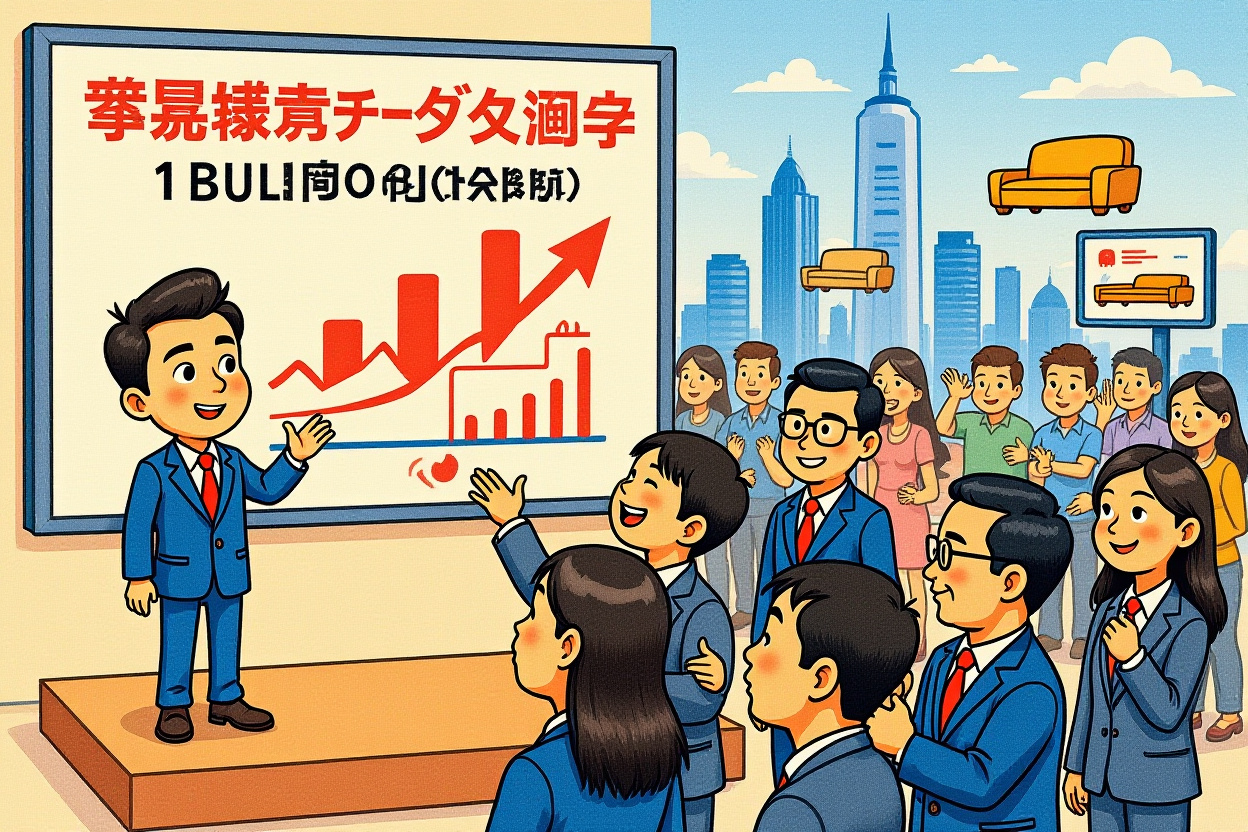
In the high-stakes arena of Chinese live-stream commerce, where sales records are shattered overnight, a new kind of stress test is emerging—one that unfolds not on screen, but deep within the nation’s sprawling manufacturing supply chains. The latest flashpoint: over 300 million yuan worth of sofas sold in a single evening by top influencer Dong Yuhui (董宇辉). While the sales figure itself is a testament to the staggering power of China’s digital sales channels, the subsequent whispers reverberating through industry circles tell a more complex story. Rumors swirled that the order’s sheer scale and aggressive pricing left factories unwilling or unable to fulfill it, casting a spotlight on the immense pressure such “泼天流量” (overwhelming traffic) events place on traditional manufacturing models. This incident involving Kuka Home (顾家家居) serves as a critical case study for investors assessing the resilience, operational prowess, and long-term viability of consumer brands thriving in the volatile world of live-stream mega-sales.
Executive Summary: Core Insights for Investors
- Stress Test for Supply Chains: A single live-stream session generated sofa orders equivalent to eight days of normal sales for Kuka Home, highlighting the severe capacity and logistical challenges such events create.
- Dispelling the “Unfulfillable Order” Myth: Kuka Home has officially denied outsourcing rumors, emphasizing its predominantly in-house production model. The debate underscores market skepticism about the sustainability of deep-discount, high-volume live commerce.
- Profitability Under the Microscope: The ultra-competitive pricing (around 3,471 RMB per sofa) has sparked intense industry discussion about cost structures, profit margins, and who ultimately bears the risk in these promotional blitzes.
- A Sector-Wide Inflection Point: This event signals a new phase for China’s home furnishing industry, where marketing innovation must be seamlessly matched by robust, flexible, and scalable production and delivery systems.
The Record-Breaking Sale and the Rumor Mill
The stage was set on the evening of December 10th. In a dedicated home furnishing live-stream hosted by the phenomenally popular Dong Yuhui, sales reached a staggering 356 million RMB within just 5.5 hours. The undisputed star product was a leather sofa from leading brand Kuka Home, with a single item transaction volume smashing through the 1-billion-yuan mark. The most affordable 2.8-meter three-seater version was offered at a promotional price of 3,471.4 RMB, a point heavily emphasized during the broadcast to drive conversion.
Anatomy of a Mega-Deal
Dong Yuhui’s approach was notably transparent and educational. Rather than avoiding comparisons, he organized products by price to simplify decision-making for viewers, repeatedly advising them to “consume according to their needs.” He physically deconstructed sofas and beds on camera, explaining materials and construction layer by layer. This trust-building pedagogy, combined with his immense credibility, is a key driver behind his conversion rates. However, the sheer volume of orders—reportedly representing approximately 30,000 sofa sets—immediately raised practical questions within manufacturing networks.
The Supply Chain Whisper Network Activates
Within days, discussions on professional and social media platforms questioned whether any factory could or would produce such an order. The core argument of the rumors was a simple cost breakdown: after subtracting platform fees, influencer commissions, logistics, and brand profit from the already-low retail price, the residual amount left for manufacturing would be unsustainably thin. Commentators claimed that major OEMs were reluctant to take on the order due to razor-thin margins, the use of costlier environmentally-friendly materials, long payment cycles, and the liability for potential returns. “The order has arrived in Guangdong,” one typical post speculated, “but no one dares to take it.” This narrative of an “unfulfillable order” tapped into deeper anxieties about the disruptive power of live commerce on traditional industry economics.
Kuka Home’s Response: In-House Production and Capacity Ramp-Up
Faced with growing speculation, Kuka Home moved to address the rumors directly. On December 29th, a company representative responded to the National Business Daily (每日经济新闻), providing crucial clarity. The spokesperson stated unequivocally that all sofas sold in Dong Yuhui’s直播间 (live-stream room) were produced by Kuka Home itself and affirmed that the company was accelerating production to meet the demand.
Decoding Kuka’s Production Strategy
This response aligns with the production model Kuka Home outlined in its 2025 interim report. The company follows a strategy of “self-production为主 (main), supplemented by outsourced production.” Its core products—sofas, bedroom furniture, and custom items—are primarily manufactured in-house. Outsourcing is utilized selectively to alleviate temporary capacity shortages or for integrated product categories. This vertically integrated model provides greater control over quality, cost, and production scheduling, which is vital when responding to unpredictable demand spikes like the Dong Yuhui event. The “overwhelming traffic” from the live-stream is thus being channeled into the company’s own factories, not farmed out to a potentially unwilling external network.
Contextualizing the Sales Surge
The scale of the challenge becomes clear when comparing the live-stream sales to Kuka’s regular business. In the first half of 2025, Kuka’s sofa segment revenue was 5.667 billion RMB, accounting for 57.82% of total revenue. This translates to an average daily sofa sales figure of approximately 15.53 million RMB. Consequently, the over 1-billion-yuan order intake from a single live-stream event is equivalent to roughly eight days of typical sales volume. For any manufacturing operation, absorbing such a concentrated surge represents a significant logistical and operational hurdle, testing everything from raw material procurement to workshop scheduling and final delivery.
The Deeper Challenge: Live Commerce vs. Manufacturing Reality
The Dong Yuhui-Kuka Home incident is not an isolated occurrence but a symptom of a broader clash between the digital and physical economies in China. Live-stream selling excels at generating explosive, concentrated demand, but traditional manufacturing is engineered for stability, forecasting, and gradual scaling.
Beyond the Sticker Price: Visible and Hidden Costs
Industry experts point out that the focus on the visible cost of materials like leather and lumber misses a significant part of the picture. The real pressure point lies in the hidden costs of manufacturing: production流程 (processes) and工艺 (craftsmanship), equipment depreciation, quality control, labor, and inventory management. When a product is sold at a deep discount in a live-stream, it squeezes the margin available to cover these comprehensive costs. Wang Jianguo (王建国), co-founder of New Set Hui Xue Gu and an expert on the家居 (home furnishing) industry, framed it as a new market challenge: “Home furnishing is still a rigid demand. Leading brands have the opportunity to obtain traffic and conversion rates higher than average brands through innovative marketing methods. The next thing to be tested is delivery.” He added that the delivery following this marketing event is undoubtedly difficult, “but this is the new challenge and new opportunity in the new market cycle.”
The New Metrics of Brand Strength
In this environment, a brand’s strength is no longer measured solely by marketing spend or retail footprint. For investors, critical metrics now include:
- Supply Chain Flexibility: Ability to rapidly scale production up and down.
- Vertical Integration: Control over core manufacturing processes to protect margins and ensure quality.
- Demand Forecasting Synergy: How well live-stream teams coordinate with production planners to mitigate volatility.
- Logistics & Fulfillment Prowess: Capacity to handle massive, geographically dispersed single-day order volumes.
The brands that will thrive are those that can not only attract the “overwhelming traffic” but also build a operational moat capable of managing its consequences.
Implications for the Home Furnishing Sector and Broader Market
This event serves as a bellwether for the entire consumer goods sector in China, particularly for big-ticket, bulky items like furniture. It highlights a necessary evolution from purely sales-driven growth to operationally-integrated growth.
Investor Takeaways: Scrutinizing the Integrated Model
For institutional investors and analysts, the key lesson is to look beyond top-line sales spikes from live-stream events. The sustainable value is created by companies that have invested in a resilient backend. Kuka Home’s emphasis on in-house production for core products is a strategic advantage in this context. However, the market will now watch closely for execution: Can they deliver these 30,000 sofas on time and to the expected quality without incurring excessive costs that erode the campaign’s profitability? The answer will significantly influence investor perception of the brand’s operational maturity and the long-term value of such high-profile collaborations.
Regulatory and Market Evolution
As live commerce continues to dominate retail, regulatory attention on consumer rights is intensifying. Promises made in the energetic atmosphere of a live-stream must be honored in the quiet of the delivery room. The State Administration for Market Regulation (国家市场监督管理总局) has been progressively tightening rules around live-stream commerce, focusing on false advertising, product quality, and after-sales service. Brands that fail to deliver on the promises implicit in a live-stream sale—whether due to supply chain failures or quality compromises—face not only consumer backlash but also increased regulatory risk. Therefore, managing the “overwhelming traffic” responsibly is becoming a compliance imperative as much as a business one.
Navigating the Flood: The Path Forward for Brands and Investors
The narrative surrounding Dong Yuhui’s billion-yuan sofa order has evolved from simple gossip about outsourced production to a profound discussion on modern industrial resilience. Kuka Home’s firm denial of the rumors and assertion of in-house control is a strong statement of its operational philosophy. The real story is not about an unfulfillable order, but about the immense pressure such concentrated demand places on even the most established manufacturers.
For the home furnishing sector, the era of competing solely on design, brand, and retail channels is over. The new battleground is the end-to-end efficiency of the entire value chain, from the直播 (live-stream) shout-out to the final delivery in a customer’s home. Successfully navigating the “泼天流量” (overwhelming traffic) requires a symphony of agile marketing, flexible manufacturing, and robust logistics. For investors, this underscores the need to conduct deep operational due diligence. The most attractive companies are those that demonstrate not just an ability to generate explosive sales, but a proven capacity to digest them efficiently, turning viral moments into sustainable, profitable growth without compromising brand equity or customer trust. As live-stream commerce matures, the winners will be those who master the complex art of turning digital traffic into physical delivery, consistently and at scale.