



Executive Summary
- Soaring Prices Fuel a Niche Craze: As domestic gold jewelry prices near 1,400 yuan per gram, cost-conscious consumers, particularly the youth, are turning to personalized, lower-cost DIY gold crafting, known as “居家打金 (jū jiā dǎ jīn – home gold crafting)”.
- A New Generation of Artisans Emerges: The trend is revitalizing a traditional trade, creating a new career path for young “post-00s” artisans who blend modern aesthetics with old-world techniques, with skilled craftsmen earning upwards of 15,000 yuan monthly.
- Significant Financial and Safety Risks Lurk: Industry experts, including Wang Chao (王超) from the Ningbo Product Quality Inspection Institute, warn that DIY gold crafting carries high risks of precious metal loss and potential safety hazards like toxic fumes from impure metals.
- Market Implications Beyond Retail: This behavioral shift highlights deeper currents in Chinese consumer sentiment—a search for value, emotional connection to assets, and a DIY investment mentality that could influence broader retail and precious metals markets.
- Due Diligence is Paramount: For consumers, choosing reputable artisans is crucial. For investors, this trend signals evolving demand dynamics in the world’s largest gold market, warranting close observation.
Metals on Fire: Record Prices Ignite a Consumer Revolution
The global gold market is ablaze. In late March, spot prices skyrocketed, briefly piercing $2,200 per ounce—a historic high that sent shockwaves through financial markets worldwide. This international frenzy found an immediate and potent echo in China, the world’s largest consumer of physical gold. Overnight, the retail landscape transformed, with domestic brand-name jewelry prices surging to stratospheric levels, inching perilously close to the symbolic 1,400 yuan per gram benchmark.
This isn’t merely a price spike; it’s a fundamental shift in the consumer psyche. When assets become prohibitively expensive, innovation follows. The ancient practice of goldsmithing, once the domain of specialized artisans in market alleyways, has been resurrected and democratized for the digital age. This phenomenon, driven by a potent mix of soaring costs, a desire for personalization, and the pervasive influence of social media, is reshaping how a generation interacts with this timeless store of value. At the heart of this movement lies the burgeoning trend of 居家打金 (home gold crafting), a DIY approach that promises savings and creativity but is fraught with hidden perils.
A Snapshot of the Domestic Price Surge
The data from March 28th paints a clear picture of a market in overdrive. Major Chinese jewelry houses enacted significant daily price adjustments, reflecting the intense pressure from international benchmarks and domestic demand.
- 老凤祥 (Lao Feng Xiang): Quoted 1,396 yuan/gram, a sharp increase of 28 yuan from the previous day’s 1,368 yuan.
- 老庙黄金 (Lao Miao Gold): Priced at 1,397 yuan/gram, up 32 yuan from 1,365 yuan.
- 周生生 (Chow Sang Sang): Listed at 1,391 yuan/gram, rising 27 yuan from 1,364 yuan.
This rapid appreciation has effectively widened the gap between the intrinsic value of the raw metal and the final retail price, which includes substantial brand premiums, design markups, and craftsmanship fees. It is within this gap that the new trend of 居家打金 (home gold crafting) has found fertile ground to grow.
Forging a New Identity: Why China’s Youth Are Embracing “打金” (Gold Crafting)
Gone are the days when gold was solely the preserve of older generations, purchased in standardized, ornate designs for weddings and wealth preservation. Today’s young Chinese consumers are redefining gold ownership. For them, 打金 (dǎ jīn – gold crafting) is not just a cost-saving measure; it is an act of creative expression, emotional recycling, and savvy financial behavior rolled into one. Social media platforms have been the primary accelerant, with topic views for “打金” exceeding 1.3 billion, showcasing a vibrant community of enthusiasts and artisans.
The appeal is multifaceted. Firstly, it offers remarkable cost efficiency. A basic custom piece carries a crafting fee of just 10 to 40 yuan per gram, compared to the hundreds of yuan in premium often embedded in brand-store jewelry. Secondly, it promises unique personalization—transforming an inherited, outdated family heirloom into a contemporary piece that reflects the wearer’s individual style. This process of “焕新 (huàn xīn – renewal)” preserves the gold’s intrinsic value and sentimental history while aligning with modern aesthetics, creating what industry observers call a “新国潮 (xīn guó cháo – new national trend)” that fuses culture, emotion, and finance.
The Economics of Custom Crafting
The business model for professional gold crafting shops is thriving. As reported by CCTV Finance, the process for a basic item typically takes one to three hours, encompassing melting, molding, shaping, and polishing. The labor cost structure is transparent and attractive:
- Basic Items: 10 – 40 yuan per gram in labor fees.
- Complex & Artisanal Items (e.g.,非遗花丝 fēi yí huā sī – intangible cultural heritage filigree): Labor fees range from several dozen to over a hundred yuan per gram.
Wang Huiqun (王惠群), Secretary-General of the Shanghai Gold & Jewelry Trade Association, advises consumers to exercise due diligence: “Gold crafting involves specific processing techniques and environmental requirements. Choose a larger-scale shop, observe the craftsman’s skills, clarify any uncertainties beforehand, and reach an agreement.” This guidance underscores the importance of professionalism in a field now flooded with new entrants.
The New Face of an Old Trade: Young Artisans Drive Industry Innovation
The demand surge has catalyzed a parallel revolution on the supply side. The image of the grizzled, veteran goldsmith is being replaced by a new cohort of young, often “post-00s” (born after 2000) artisans. These individuals are not just executing orders; they are injecting the centuries-old craft with fresh creativity, digital marketing savvy, and a keen understanding of their peer consumers’ desires.
One shop owner interviewed by CCTV Finance noted that after identifying the trend’s growth three years ago, she now operates two locations with a team of 20, half of whom are craftsmen. Significantly, most are “00后,” with the oldest being just 28. This youth-driven model prioritizes innovation and client-centric design. The barrier to entry in terms of age or formal education is low, making it an attractive career pivot for graduates and professionals from other fields seeking a creative and tangible profession.
Career Prospects in the Craft
The financial incentive for skilled labor in this niche is substantial. According to Zhou Baolin (周宝林), manager of a gold crafting shop in Shanghai’s Yuyuan area, average monthly salaries for craftsmen hover around 10,000 yuan. For masters of specialized techniques like手工錾刻 (shǒu gōng zàn kè – hand engraving), monthly earnings can reach 15,000 yuan or more. This economic viability is crucial for sustaining the talent pipeline and ensuring the craft’s evolution, moving it beyond a fleeting social media trend into a legitimate and rejuvenated sector of the jewelry industry.
The Allure and Peril of 居家打金 (Home Gold Crafting)
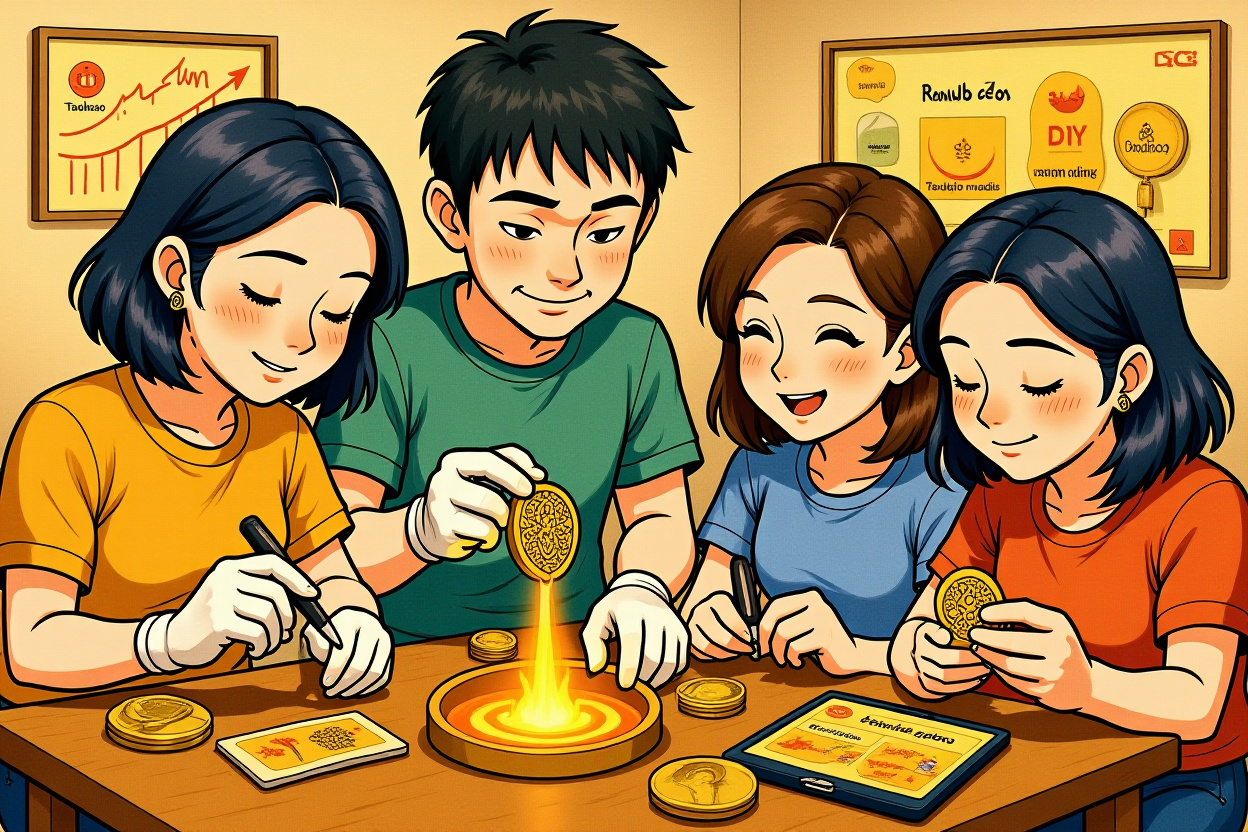
At the extreme end of the consumer spectrum lies the most disruptive and risky manifestation of this trend: the full-fledged DIY approach of 居家打金 (home gold crafting). Empowered by detailed video tutorials on social platforms and the easy availability of toolkits on e-commerce sites like Taobao, hundreds of amateurs are attempting to become their own goldsmiths. A basic “打金套装 (dǎ jīn tào zhuāng – gold crafting kit),” complete with torch, crucible, tweezers, molds, and polishing tools, can be purchased for a mere 100 to 200 yuan, presenting a seemingly low barrier to entry.
The promise is seductive: bypass all labor costs, achieve ultimate customization, and engage in a hands-on, rewarding hobby. Tutorials often showcase successful, polished final products, creating an illusion of simplicity. However, the reality is far more complex and hazardous. As one Beijing-based professional noted, while attempts are increasing, successes are rare, and his shop frequently sees DIYers seeking help to fix botched projects.
A Minefield of Technical and Safety Hazards
Wang Chao (王超), Director of the Gold and Jewelry Inspection Center at the Ningbo Product Quality Inspection Institute, provides a sober, expert analysis of the risks. While theoretically possible for a highly skilled and careful individual, 居家打金 (home gold crafting) is fraught with danger for the average person.
- Extreme Heat Danger: “Gold’s melting point is over 1000 degrees Celsius. Operating at such high temperatures at home certainly carries risks,” Wang states. He recommends strict safety measures like working in a ventilated area with protective gloves and long tongs.
- Toxic Fume Risk: This is a critical, often overlooked danger. “You need to consider the purity of the metal. If it’s mixed with other, volatile metals… for example, if there is mercury, it turns into mercury vapor. In a poorly ventilated environment, this can easily lead to poisoning.” This risk is particularly acute when melting down older, alloyed jewelry of unknown composition.
- High Probability of Failure: Wang cautions that success is not guaranteed even with careful replication of steps. Factors like imperfect mold quality or inherent skill limitations lead to a high failure rate. “If one’s hands-on and learning abilities are strong, they might succeed on the first try. But if not, the chance of failure is quite high.”
The Hidden Financial Pitfall: When DIY Leads to Irretrievable Loss
Beyond the immediate safety concerns lies the most common and painful consequence for the 居家打金 (home gold crafting) enthusiast: significant and unexpected financial loss. The core assumption—that DIY saves money—often proves catastrophically false. The process is inherently lossy, and amateur errors amplify this loss exponentially.
Professional refiners and crafters account for a standard, minimal percentage of metal loss during melting and working. Amateurs, however, face severe, unanticipated损耗 (sǔn hào – loss/wastage). Common catastrophic errors include:
- Improper Mold Preparation: If a plaster mold is not correctly prepared or cured, it can crack during casting, trapping and ruining the molten gold.
- Failed Welding or Melting: Applying too much heat can cause thin sections to melt away entirely or become irreparably deformed.
- Physical Loss: Tiny gold sprues, filings, and dust can be scattered during filing and polishing, especially without proper professional equipment and containment setups.
This lost gold, often scattered as fine dust or trapped in faulty molds, is frequently impossible for an amateur to recover. The final insult comes when the failed project must be taken to a professional for repair or complete re-melting, incurring additional costs on top of the material already lost. Wang Chao (王超) summarizes this economic reality succinctly, advising the public to “rationally view the possibility and limitations” of 居家打金 (home gold crafting).
Navigating the Golden Crossroads: Insights for Consumers and Market Watchers
The explosive growth of gold crafting, from professional shops to risky DIY endeavors, is more than a consumer fad; it is a revealing symptom of broader market forces. For international investors and analysts monitoring Chinese consumer behavior and the precious metals complex, this trend offers several key takeaways.
First, it underscores the profound sensitivity of Chinese retail demand to price. As premiums rise, consumers actively seek alternative channels, demonstrating market elasticity and ingenuity. This could pressure traditional jewelry retailers to adapt their value propositions. Second, the emotional and “craft” value attached to gold is becoming a powerful demand driver alongside its investment merit, potentially supporting consumption even during periods of price volatility. Finally, the rise of 居家打金 (home gold crafting) highlights the powerful role of social commerce and digital communities in shaping real-world economic activity in China.
For the individual consumer, the path forward requires informed caution. The desire for affordable, personalized gold is understandable. However, the pursuit should be tempered with a clear-eyed assessment of risk. Engaging a reputable, professional young artisan offers a compelling middle ground—delivering customization and value while mitigating the severe financial and safety hazards of the DIY approach. As with any investment, especially one as tactile and volatile as gold, due diligence is the most valuable tool in one’s kit.
The ultimate call to action is for prudence. Before embarking on a 居家打金 (home gold crafting) project, seriously weigh the expert warnings on safety and potential loss. For those investing in the broader gold market, watch this consumer trend as an indicator of retail sentiment and adaptability in the face of record prices. The gold market’s fundamentals are written not just on global charts, but also in the workshops and, increasingly, on the kitchen tables of China.