



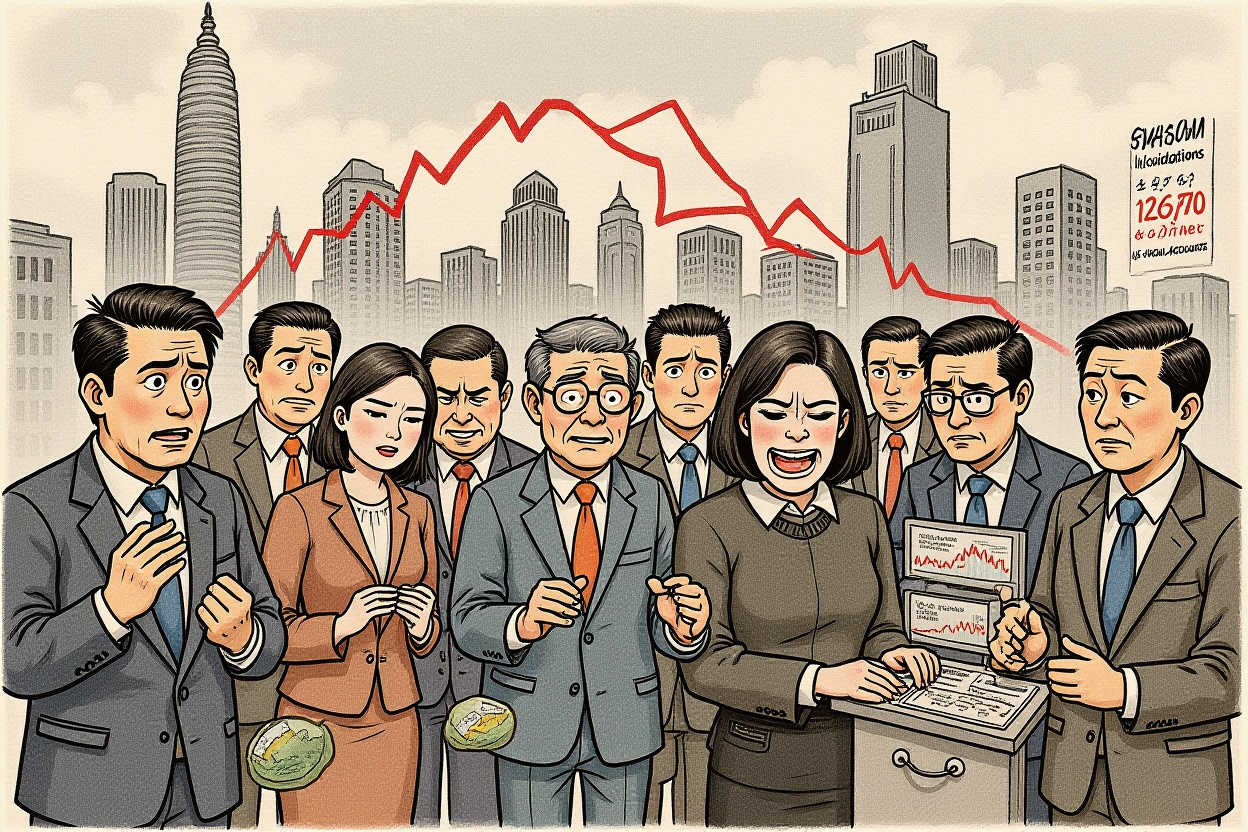
– Cryptocurrencies including Bitcoin (比特币) and Ethereum (以太坊) plunged over 5%, triggering $465 million in liquidations across 136,700 accounts in 24 hours.
– Geopolitical risks from potential US military strikes on Iran and renewed trade tariffs under the Trump administration fuel global market anxiety and risk aversion.
– US index futures fell, indicating broader financial stress that could spill over into Chinese A-shares and impact investor sentiment.
– Analysts warn of key support levels for Bitcoin and prolonged volatility, highlighting the interconnectedness of digital assets with traditional markets.
– The事件 underscores the need for Chinese equity investors to monitor global macro developments and adjust strategies accordingly.
Market Turmoil Erupts: A Cryptocurrency Bloodbath Unfolds
The global financial landscape was jolted today as a severe cryptocurrency market crash sent shockwaves through digital asset portfolios, culminating in a mass liquidation event that wiped out 136,700 trader accounts. This dramatic plunge, spearheaded by Bitcoin (比特币) falling below $65,000 and Ethereum (以太坊) breaching the $1,900 support, erased over $100 billion in market value within hours. For sophisticated investors focused on Chinese equity markets, this episode serves as a stark reminder of how external volatility can rapidly transmit to domestic assets, influencing sentiment and capital flows. The cryptocurrency market crash is not an isolated incident; it is intricately linked to escalating geopolitical tensions and trade policy uncertainties that threaten to destabilize broader financial ecosystems, including those in China.
Bitcoin and Altcoins: The Anatomy of a Decline
Data from tracking platforms paints a grim picture of the day’s trading. According to CoinGecko, the total cryptocurrency market capitalization plummeted by more than $100 billion in 24 hours, with Bitcoin (比特币) dropping 4.78% to $64,700 and Ethereum (以太坊) falling 5.86% to $1,858. Other major tokens like Binance Coin (BNB), Dogecoin (狗狗币), and Cardano (艾达币) saw losses exceeding 5%, while Solana (SOL) collapsed by over 9%. This synchronized decline underscores the high correlation within the crypto sphere during risk-off events, a dynamic that often precedes similar moves in risk-sensitive equity sectors, including Chinese technology stocks listed on the Nasdaq-style ChiNext (创业板) board.
Liquidation Carnage: By the Numbers
The force of the sell-off triggered a cascade of leveraged position closures. Coinglass data reveals that $465 million in cryptocurrency futures contracts were liquidated over the past 24 hours, affecting 136,700 individuals. Of this, long positions accounted for $434 million in losses, while short positions lost over $30 million. The single largest liquidation order occurred on the HTX exchange for a BTC-USDT pair, valued at a staggering $61.5 million. This mass liquidation event highlights the extreme leverage prevalent in crypto markets and its potential to amplify downturns, a risk factor that Chinese regulators at the China Securities Regulatory Commission (CSRC, 中国证券监督管理委员会) closely monitor for systemic implications.
Geopolitical Powder Keg: US-Iran Tensions and Trade Wars
The cryptocurrency market crash did not occur in a vacuum. It was catalyzed by a dual threat of geopolitical strife and protectionist trade policies emanating from the United States, creating a perfect storm for risk assets. These developments are of paramount concern to international investors with exposure to Chinese equities, as similar macro shocks have historically triggered capital flight from emerging markets.
Trump’s Gambit: Military Strikes on Iran Considered
Reports from international media have significantly raised the geopolitical risk premium. Citing a former CIA officer John Kiriaku (约翰·基里亚库), German newspaper Bild reported that the United States could launch military strikes on Iran as early as February 23 or 24. Further, according to CCTV News, former President Donald Trump (特朗普) has informed advisors that he is “inclined” to conduct a preliminary strike on Iran in the coming days, followed by a larger-scale military operation in subsequent months to force Iranian capitulation. Trump allegedly discussed targets including the Islamic Revolutionary Guard Corps headquarters, nuclear facilities, and ballistic missile sites. The deployment of carrier strike groups like the USS Abraham Lincoln and USS Gerald R. Ford to the region underscores the severity of the situation. For markets, this injects immense uncertainty, often driving investors towards safe havens and away from volatile assets like cryptocurrencies and growth-oriented Chinese stocks.
Trade Policy Whiplash: Tariffs and Global Response
Concurrently, trade policy uncertainty has resurfaced with a vengeance. After the US Supreme Court struck down the Trump administration’s previous tariff authority, Trump announced new global tariffs of 15% under Section 122 of the Trade Act of 1974, effective for 150 days. This move has triggered international backlash and reassessments. The European Union has called an emergency meeting to reevaluate its trade pact with the US, while India postponed a trade delegation visit to Washington. Mizuho Securities analyst Vishnu Varathan noted that this response “amplifies trade uncertainty” and that the threat of US unilateral action remains, advising against complacency. For China, a major trading nation, such volatility directly impacts export prospects and can pressure the yuan (人民币), affecting the valuation of A-share companies reliant on global trade.Spillover Effects: From Crypto to Global Equity Markets
The contagion from the cryptocurrency market crash was evident in traditional finance. US equity index futures traded lower, with Nasdaq futures down nearly 1%, S&P 500 futures falling 0.76%, and Dow Jones futures declining 0.66% at the time of reporting. This risk-off sentiment is a critical transmission channel to Chinese equities, as negative momentum in US markets often weighs on Asian sessions and influences the Hong Kong Stock Exchange (香港交易所) and the Shanghai Stock Exchange (上海证券交易所).US Futures and the Risk-Aversion Playbook
The drop in US futures reflects a broader market recalibration in the face of heightened geopolitical and trade risks. Institutional investors frequently reduce exposure to high-beta assets, including technology stocks and emerging market equities, during such periods. Given the significant weight of US-listed Chinese companies like Alibaba Group (阿里巴巴集团) and Tencent Holdings (腾讯控股) in major indices, their performance can be doubly impacted by both sectoral sentiment and China-specific factors. This interconnectedness means that a cryptocurrency market crash can precede or accompany volatility in Chinese equity benchmarks.
Correlation Dynamics with Chinese A-Shares
While direct correlation between cryptocurrencies and Chinese A-shares is not always strong, indirect effects are potent. Sharp crypto declines can erode risk appetite among retail and institutional investors globally, leading to broader deleveraging. In China, where authorities have cracked down on cryptocurrency trading, the fallout may manifest through reduced liquidity in peripheral risk assets or increased caution among margin traders. Furthermore, Chinese tech sectors, which often move in tandem with global growth narratives, could face selling pressure if the cryptocurrency market crash is perceived as a bellwether for speculative excess unwinding.
Analyst Insights: Diagnosing Vulnerability and Forecasting Paths
Market professionals have swiftly dissected the cryptocurrency market crash, offering perspectives on key levels and future trajectories. Their analyses provide valuable context for equity investors gauging the durability of the sell-off and its secondary effects.
Support Levels and Market Psychology
Caroline Mauron, co-founder of Orbit Markets, stated, “The cryptocurrency market remains fragile, with participants pinning hopes on the $60,000 support level. From Iran geopolitical tensions to flip-flopping US tariff policy, macro uncertainty is weighing on markets and could see Bitcoin prices test that support again.” Rachael Lucas, an analyst at BTC Markets, identified $65,000 as a critical juncture for Bitcoin, warning that a clear break below could open the path to $60,000, while a move above $70,000 is needed to restore bullish narratives. These technical levels are watched by equity traders as indicators of overall risk sentiment.
Long-term Implications for Digital Assets
The current plunge has entirely erased gains Bitcoin made following Trump’s re-election in November 2024, when expectations of crypto-friendly policies drove prices to an all-time high above $126,000. The subsequent sell-off has wiped over $2 trillion from the total crypto market cap, with smaller altcoins hit hardest. This underscores the asset class’s sensitivity to macro winds and regulatory shifts. For Chinese policymakers at the People’s Bank of China (PBOC, 中国人民银行), such volatility reinforces the rationale behind restrictive measures on crypto, while also highlighting the need for robust digital yuan (数字人民币) frameworks to hedge against external financial instability.
Implications for Chinese Markets and Strategic Responses
For professionals dedicated to Chinese equity markets, this cryptocurrency market crash and its drivers necessitate a calibrated response. Understanding the channels of influence and preparing for potential contagion is essential for portfolio management and strategic allocation.
Regulatory Posture and Domestic Market Stability
Actionable Strategies for Equity InvestorsIn light of these events, investors in Chinese equities should consider several steps:
– Enhance monitoring of global geopolitical and trade headlines, as these are primary drivers of risk sentiment affecting all asset classes.
– Reassess exposure to high-volatility sectors like technology and consumer discretionary, which may be more susceptible to spillovers from events like a cryptocurrency market crash.
– Diversify into defensive sectors or assets with lower correlation to global risk cycles, such as certain state-owned enterprises or sectors supported by domestic policy.
– Maintain liquidity to capitalize on potential dislocations or oversold conditions in quality Chinese stocks if the sell-off broadens.
Synthesizing the Storm: Key Takeaways and Forward Guidance
The dramatic cryptocurrency market crash, resulting in the liquidation of 136,700 accounts, is a multifaceted event rooted in geopolitical tensions and trade policy uncertainty. Its immediate impact on digital assets is severe, but the broader implications for Chinese equities are nuanced, operating through sentiment channels and global risk repricing. The potential for US-Iran conflict and escalating trade wars presents ongoing headwinds that require constant vigilance from investors and policymakers alike.
Moving forward, market participants should anticipate continued volatility and factor heightened macro risks into their decision-making frameworks. The cryptocurrency market crash serves as a timely reminder of the interconnectedness of modern finance. For those engaged in Chinese markets, the call to action is clear: stay informed, stress-test portfolios against external shocks, and align strategies with both domestic regulatory directives and global macroeconomic trends. By doing so, investors can navigate the turbulence and identify opportunities amidst the uncertainty, ensuring resilience in an increasingly complex financial world.