



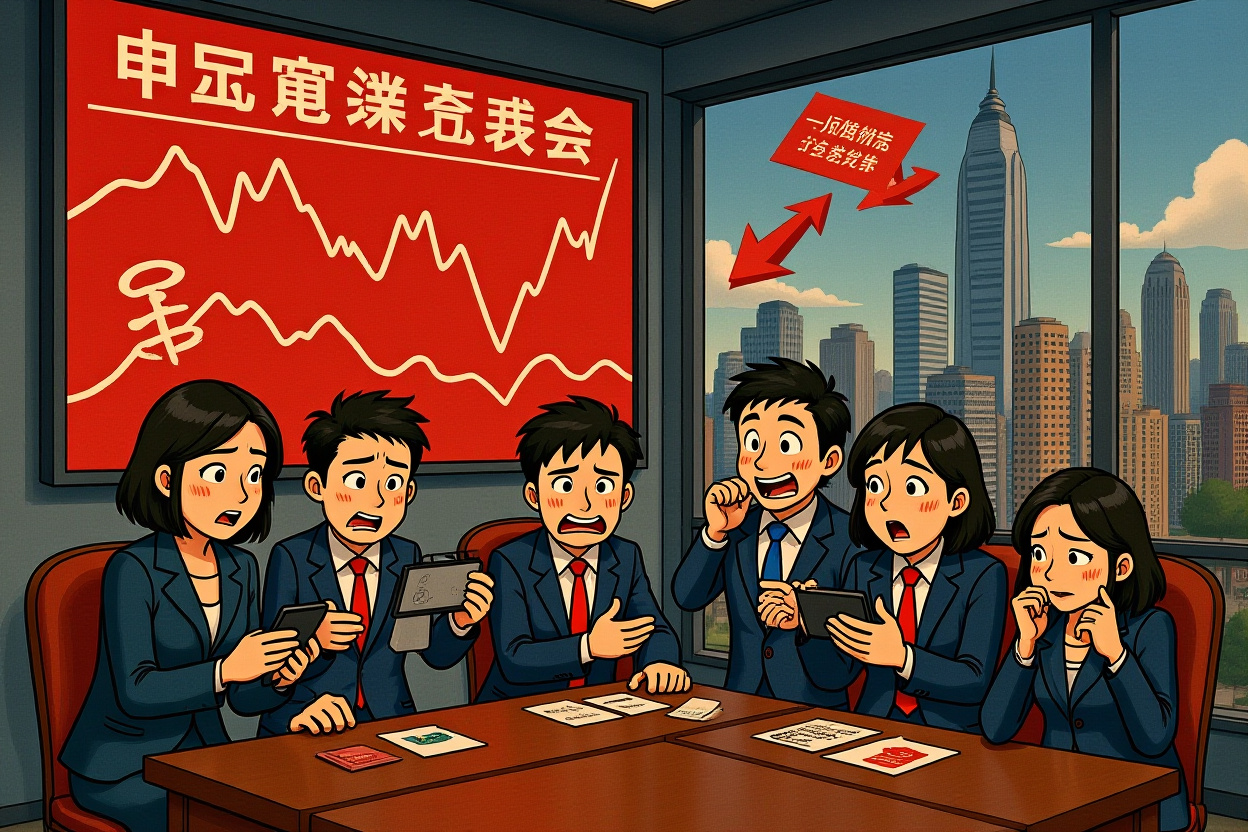
– An unexplained, rapid sell-off wiped over 70 billion yuan ($9.7 billion USD) from the market value of a major Chinese company, colloquially known as ‘Cold King’ in trading circles.
– The incident highlights critical vulnerabilities in China’s equity markets, including information asymmetry, regulatory scrutiny, and the impact of opaque corporate communications on investor confidence.
– This analysis delves into the potential catalysts behind the crash, from sector-wide pressures and macroeconomic headwinds to speculative trading and governance concerns.
– For global investors, the event serves as a stark reminder of the need for enhanced due diligence, robust risk management frameworks, and a nuanced understanding of China’s unique market dynamics.
In a dramatic display of the inherent volatility within China’s equity markets, shares of a leading industrial conglomerate—referred to by market traders as ‘Cold King’—experienced a precipitous and largely unexplained collapse this week. The swift descent erased a staggering sum exceeding 70 billion yuan from its market capitalization, sending shockwaves through domestic and international investment circles. The company’s official response, stating it was ‘unclear about the specific reasons’ for the plunge, has done little to quell market anxiety, instead amplifying concerns over transparency and information flow. This sudden sell-off of ‘Cold King’ underscores a recurring challenge for investors in Chinese equities: navigating periods of intense price dislocation where official narratives are absent or delayed, leaving rumor and speculation to fill the void. For institutional allocators and fund managers with exposure to Chinese assets, understanding the anatomy of such crashes is paramount to managing portfolio risk and identifying potential opportunities amid the chaos.
Anatomy of a Market Plunge: Deconstructing the ‘Cold King’ Event
The trading session began like any other, but within hours, the sudden sell-off of ‘Cold King’ was underway. A cascade of sell orders, far exceeding typical daily volumes, drove the share price down by a double-digit percentage, triggering automatic circuit-breaker mechanisms on the relevant exchange. By the close, the damage was quantified: a market value destruction measured in the tens of billions.
The Trading Data and Immediate Aftermath
A review of the ticker tape reveals a textbook panic sell-off. Volume spiked to over 300% of its 30-day average, with the majority of trades executed at the bid price, indicating overwhelming selling pressure. Large block trades, often indicative of institutional exits, were recorded in the final hour of the decline. The immediate aftermath saw a flurry of analyst notes downgrading price targets and questioning the stock’s previous valuation metrics. Social media platforms and financial chat rooms were inundated with unverified theories, ranging from impending regulatory action to a major contract cancellation, showcasing the speed at which narratives form in the absence of official information.
Corporate Response and Market Perception</h3
The company's disclosure to the Shenzhen Stock Exchange was notably brief. It confirmed no undisclosed material information that should have been publicly released, stated operations were normal, and professed ignorance regarding the specific cause of the sell-off. This type of response, while technically compliant with disclosure rules, is often perceived as inadequate by the market. It fails to address investor concerns proactively and can be interpreted as a lack of engagement or an unwillingness to stabilize shareholder confidence. The gap between the scale of the event and the minimalism of the corporate communication became a focal point for criticism, eroding trust and likely prolonging the period of price discovery and volatility.
Unpacking the Potential Catalysts: Why Did ‘Cold King’ Fall?
While the company claims ignorance, market participants and analysts have postulated several plausible, and often interconnected, drivers behind the crash. In China’s complex market ecosystem, a single trigger is rare; more common is a confluence of factors that collectively breach investor confidence.
Macroeconomic and Sector-Specific Pressures</h3
China's post-pandemic economic recovery has been uneven, with specific industrial and manufacturing sectors facing significant headwinds. If 'Cold King' is exposed to sectors like property construction, traditional heavy industry, or consumer durables, it would be susceptible to broader macro fears.
– Slowing Fixed Asset Investment (FAI): A key driver for industrial firms, FAI growth has been muted, potentially impacting order books.
– Deflationary Pressures in Producer Prices: The Producer Price Index (PPI) has seen periods of contraction, squeezing margins for manufacturers.
– Geopolitical Tensions Affecting Exports: Trade frictions and shifting global supply chains can disrupt overseas revenue streams, a critical component for many Chinese champions.
These macro factors create a fragile backdrop where any company-specific negative news, or even rumor, can precipitate a major re-rating.
Governance, Liquidity, and Speculative Forces</h3
Beyond macro concerns, micro factors are always in play. Governance remains a paramount concern for international investors, and any hint of trouble can lead to swift divestment.
– Margin Call Liquidation: A significant portion of China's retail and even some institutional trading is done on margin. An initial, modest decline can trigger forced selling from leveraged positions, creating a self-reinforcing downward spiral.
– Block Trade by a Major Shareholder: An undisclosed pre-planned sell order by a founding shareholder, private equity firm, or state-owned entity could flood the market with supply.
– Anticipated Regulatory Scrutiny: Sectors from technology to education have faced abrupt regulatory shifts. Fears of upcoming oversight in 'Cold King'
's industry could cause preemptive flight.
– Short-Seller Activity or Negative Research: While less common than in Western markets, the influence of short-selling reports or critical analyst research can be potent, especially when confidence is already shaky.
The Regulatory and Information Environment: Navigating Opacity
Beyond macro concerns, micro factors are always in play. Governance remains a paramount concern for international investors, and any hint of trouble can lead to swift divestment.
– Margin Call Liquidation: A significant portion of China's retail and even some institutional trading is done on margin. An initial, modest decline can trigger forced selling from leveraged positions, creating a self-reinforcing downward spiral.
– Block Trade by a Major Shareholder: An undisclosed pre-planned sell order by a founding shareholder, private equity firm, or state-owned entity could flood the market with supply.
– Anticipated Regulatory Scrutiny: Sectors from technology to education have faced abrupt regulatory shifts. Fears of upcoming oversight in 'Cold King'
's industry could cause preemptive flight.
– Short-Seller Activity or Negative Research: While less common than in Western markets, the influence of short-selling reports or critical analyst research can be potent, especially when confidence is already shaky.
The Regulatory and Information Environment: Navigating Opacity
The sudden sell-off of ‘Cold King’ throws into sharp relief the ongoing challenges within China’s financial information ecosystem. The China Securities Regulatory Commission (CSRC) has made strides in improving transparency and cracking down on market manipulation, but gaps persist.
Disclosure Rules and Enforcement Realities</h3
Chinese listing rules require timely disclosure of material information. However, the definition of 'material' can be subjective, and the enforcement of these rules, while strengthening, may not always preempt market-moving rumors. Companies may err on the side of minimal disclosure to avoid making definitive statements that could later be deemed inaccurate. Furthermore, the chain of information—from internal company developments to public disclosure—can be slow, allowing insider knowledge to potentially leak into the market through unofficial channels. This creates an environment where privileged actors may trade ahead of public announcements, contributing to violent pre-announcement price movements.
The Role of Social Media and Unofficial Channels</h3
In the digital age, information—and misinformation—travels at light speed. Platforms like Weibo, Xueqiu, and various trading forums often serve as the first source of 'news' for many investors. Unverified posts from anonymous accounts claiming to have insider information about a company's financials, legal troubles, or management disputes can gain tremendous traction. These narratives can trigger significant retail-driven selling before any official word is released, forcing institutional players to react to the price action itself, further fueling the decline. The sudden sell-off of ‘Cold King’ is a prime example of how markets can be moved by shadows long before the spotlight of official communication is turned on.
Implications and Strategies for Global Investors</h2
For international fund managers and institutional investors, episodes like this are not mere curiosities but critical stress tests for their China investment frameworks. The key is to move from reaction to proactive strategy.
Enhancing Due Diligence and Risk Management</h3
Standard financial analysis must be supplemented with deeper, qualitative checks in the Chinese context.
– Governance Deep Dive: Scrutinize shareholder structures, related-party transactions, and the history of controlling shareholders. Look for red flags like excessive pledging of shares for loans.
– Supply Chain and Customer Analysis: Understand concentration risk. Is the company overly reliant on a single sector (e.g., real estate) or a handful of customers that are themselves under stress?
– Sentiment and Technical Monitoring: Incorporate social media sentiment analysis and unusual options or short-interest activity into the risk dashboard. A divergence between strong fundamentals and deteriorating market sentiment can be an early warning sign.
– Position Sizing and Stop-Loss Discipline: Given the potential for gap-down risk, position sizes in single-name Chinese equities should be calibrated to account for higher volatility. Clear, pre-defined exit strategies are essential.
Portfolio Construction in an Asymmetric Information Landscape</h3
Smart portfolio construction can mitigate, though not eliminate, the risks highlighted by the sudden sell-off of ‘Cold King’.
– Diversification Across Drivers: Avoid over-concentration in stocks with similar macro exposures (e.g., all domestic consumption or all industrial). Blend companies with different economic drivers.
– Embrace ETFs for Broader Exposure: For core China exposure, broad-based or sector ETFs can dilute single-stock event risk. The impact of one holding’s collapse is minimized within a large basket.
– Consider the ‘State-Owned Enterprise (SOE) Premium’: While not without their own governance issues, major SOEs often have implicit state backing and may be less prone to certain types of speculative attacks or catastrophic, opaque failures.
– Maintain a Liquidity Buffer: Ensuring portfolio liquidity allows for tactical moves, whether to exit a deteriorating position or to capitalize on potential oversold opportunities that such sell-offs can create.
In the digital age, information—and misinformation—travels at light speed. Platforms like Weibo, Xueqiu, and various trading forums often serve as the first source of 'news' for many investors. Unverified posts from anonymous accounts claiming to have insider information about a company's financials, legal troubles, or management disputes can gain tremendous traction. These narratives can trigger significant retail-driven selling before any official word is released, forcing institutional players to react to the price action itself, further fueling the decline. The sudden sell-off of ‘Cold King’ is a prime example of how markets can be moved by shadows long before the spotlight of official communication is turned on.
Implications and Strategies for Global Investors</h2
For international fund managers and institutional investors, episodes like this are not mere curiosities but critical stress tests for their China investment frameworks. The key is to move from reaction to proactive strategy.
Enhancing Due Diligence and Risk Management</h3
Standard financial analysis must be supplemented with deeper, qualitative checks in the Chinese context.
– Governance Deep Dive: Scrutinize shareholder structures, related-party transactions, and the history of controlling shareholders. Look for red flags like excessive pledging of shares for loans.
– Supply Chain and Customer Analysis: Understand concentration risk. Is the company overly reliant on a single sector (e.g., real estate) or a handful of customers that are themselves under stress?
– Sentiment and Technical Monitoring: Incorporate social media sentiment analysis and unusual options or short-interest activity into the risk dashboard. A divergence between strong fundamentals and deteriorating market sentiment can be an early warning sign.
– Position Sizing and Stop-Loss Discipline: Given the potential for gap-down risk, position sizes in single-name Chinese equities should be calibrated to account for higher volatility. Clear, pre-defined exit strategies are essential.
Portfolio Construction in an Asymmetric Information Landscape</h3
Smart portfolio construction can mitigate, though not eliminate, the risks highlighted by the sudden sell-off of ‘Cold King’.
– Diversification Across Drivers: Avoid over-concentration in stocks with similar macro exposures (e.g., all domestic consumption or all industrial). Blend companies with different economic drivers.
– Embrace ETFs for Broader Exposure: For core China exposure, broad-based or sector ETFs can dilute single-stock event risk. The impact of one holding’s collapse is minimized within a large basket.
– Consider the ‘State-Owned Enterprise (SOE) Premium’: While not without their own governance issues, major SOEs often have implicit state backing and may be less prone to certain types of speculative attacks or catastrophic, opaque failures.
– Maintain a Liquidity Buffer: Ensuring portfolio liquidity allows for tactical moves, whether to exit a deteriorating position or to capitalize on potential oversold opportunities that such sell-offs can create.
Standard financial analysis must be supplemented with deeper, qualitative checks in the Chinese context.
– Governance Deep Dive: Scrutinize shareholder structures, related-party transactions, and the history of controlling shareholders. Look for red flags like excessive pledging of shares for loans.
– Supply Chain and Customer Analysis: Understand concentration risk. Is the company overly reliant on a single sector (e.g., real estate) or a handful of customers that are themselves under stress?
– Sentiment and Technical Monitoring: Incorporate social media sentiment analysis and unusual options or short-interest activity into the risk dashboard. A divergence between strong fundamentals and deteriorating market sentiment can be an early warning sign.
– Position Sizing and Stop-Loss Discipline: Given the potential for gap-down risk, position sizes in single-name Chinese equities should be calibrated to account for higher volatility. Clear, pre-defined exit strategies are essential.
Portfolio Construction in an Asymmetric Information Landscape</h3
Smart portfolio construction can mitigate, though not eliminate, the risks highlighted by the sudden sell-off of ‘Cold King’.
– Diversification Across Drivers: Avoid over-concentration in stocks with similar macro exposures (e.g., all domestic consumption or all industrial). Blend companies with different economic drivers.
– Embrace ETFs for Broader Exposure: For core China exposure, broad-based or sector ETFs can dilute single-stock event risk. The impact of one holding’s collapse is minimized within a large basket.
– Consider the ‘State-Owned Enterprise (SOE) Premium’: While not without their own governance issues, major SOEs often have implicit state backing and may be less prone to certain types of speculative attacks or catastrophic, opaque failures.
– Maintain a Liquidity Buffer: Ensuring portfolio liquidity allows for tactical moves, whether to exit a deteriorating position or to capitalize on potential oversold opportunities that such sell-offs can create.
The dramatic and unexplained plummet of ‘Cold King’ is a potent case study in the modern Chinese equity market. It encapsulates the tension between the market’s massive scale and sophistication and its lingering vulnerabilities: opacity, sentiment-driven retail flows, and the ever-present shadow of regulatory change. While the specific cause may remain elusive, the lessons are clear. For the global investment community, success in this market requires more than just analyzing financial statements; it demands a holistic approach that weighs governance, macro-sectoral shifts, and the powerful, often irrational, force of market narrative. Investors must build resilient portfolios capable of weathering such storms, using tools from rigorous due diligence to strategic diversification. Ultimately, navigating these waters means accepting that sometimes, even the companies themselves may be ‘unclear about the specific reasons’—and preparing accordingly.
Review your current exposure to single-name Chinese equities, particularly in sectors facing macroeconomic headwinds. Revisit the governance profiles and liquidity of these holdings. Stay abreast of regulatory announcements from bodies like the CSRC and macroeconomic data releases from the National Bureau of Statistics (NBS). Consider consulting with specialist China market advisors to stress-test your portfolio against scenarios of sudden, opaque sell-offs. In a market where information is a precious and sometimes scarce commodity, proactive vigilance is the most valuable asset an investor can hold.