



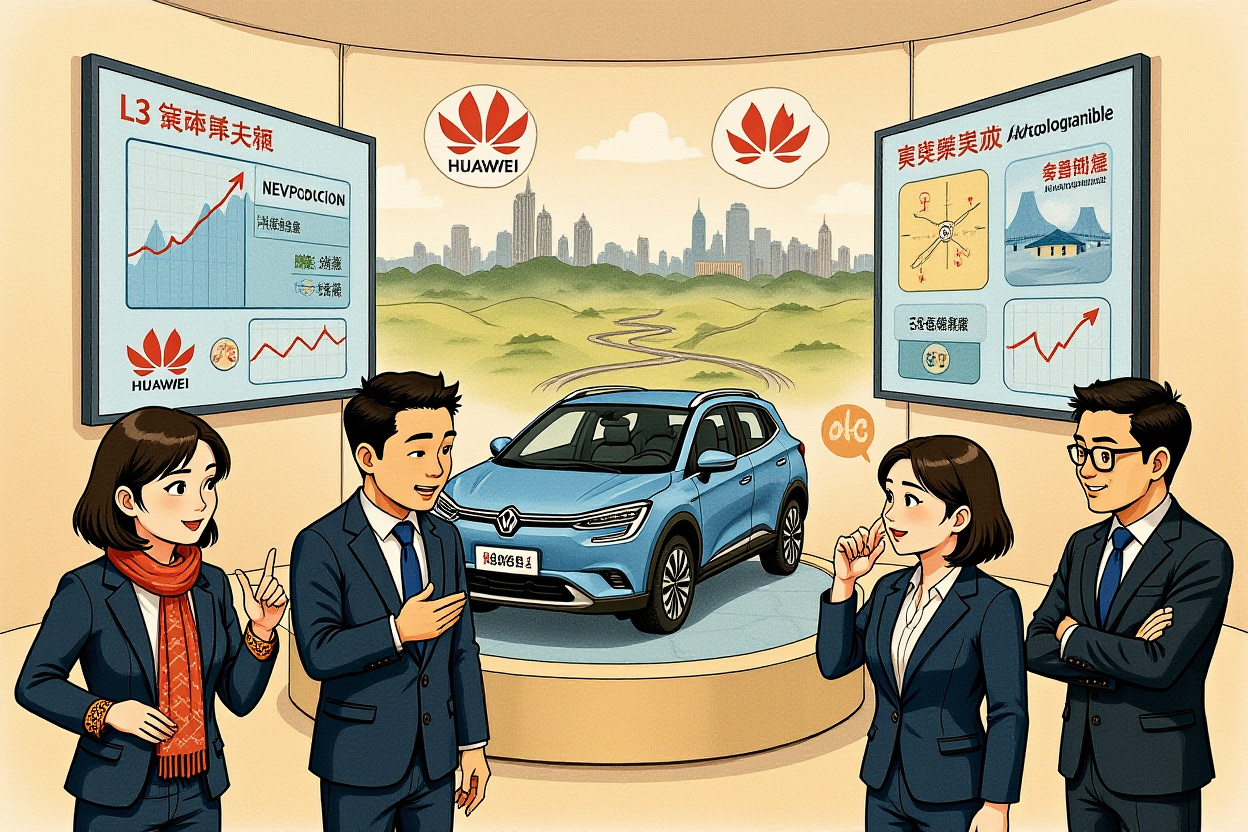
– Chongqing produced 2.788 million vehicles in 2025, reclaiming its position as China’s top automobile production city after a decade-long hiatus.
– The resurgence is fueled by a 36% surge in new energy vehicle (NEV) output to 1.296 million units, highlighting a strategic pivot towards electrification.
– Key drivers include transformative partnerships with tech giant Huawei, enabling brands like Changan Automobile and Seres to compete in the premium NEV and autonomous driving segments.
– Chongqing’s issuance of China’s first L3 autonomous driving license plate signals its ambition to lead in the next phase of smart, connected vehicles.
– Despite this success, challenges remain in AI infrastructure and talent retention, requiring sustained investment to maintain its competitive edge in the intensifying race among Chinese auto hubs.
A Dramatic Turn in the Race for Supremacy
The battle for China’s ‘top auto city’ title has taken a dramatic turn, with Chongqing staging a remarkable comeback to reclaim the crown. After being overtaken by rivals like Shenzhen and Guangzhou, the western metropolis has not only regained its production leadership but is now positioning itself at the forefront of the intelligent driving revolution. This Chongqing’s automotive resurgence is a testament to strategic reinvention, driven by explosive growth in new energy vehicles (NEVs) and pivotal technological alliances. As the automotive industry undergoes its most profound transformation in a century, Chongqing’s journey from decline to dominance offers critical insights for investors and policymakers alike. The city’s ability to leverage partnerships and navigate market shifts will define its role in shaping the future of mobility in China and beyond.
The Fall and Rise: Chongqing’s Automotive Journey
Chongqing’s path to reclaiming the automotive throne is a story of dramatic peaks and valleys. In 2016, the city celebrated a historic milestone, producing 3.156 million vehicles and standing as the nation’s sole city to breach the 3-million mark. This era positioned Chongqing as a formidable ‘Chinese Detroit,’ with a manufacturing base built on volume and scale. However, the reliance on mid-to-low-end internal combustion engine vehicles proved precarious, leading to a steep decline that tested the city’s industrial resilience.
Peak and Decline: The 2016 High and Subsequent Slump
By 2019, Chongqing’s annual automobile output had plummeted to 1.383 million units—less than half its peak. Analysts pointed to a dual challenge: a nationwide automotive slowdown compounded by Chongqing’s product mix failing to align with market upgrades towards premium and electric models. Changan Automobile (长安汽车), the local champion with sales exceeding 3 million units in 2016, mirrored this decline, experiencing falling profits and market share. This period underscored the vulnerabilities of an over-reliance on traditional manufacturing strengths without adapting to consumer trends.
The Turning Point: Embracing New Energy Vehicles
The蛰伏期 (hibernation period) for Chongqing coincided with the meteoric rise of NEVs across China. While national NEV sales exploded from over 100,000 in 2015 to more than 1 million by 2018, Chongqing’s own NEV production crawled from 40,400 in 2020 to just 51,100, highlighting a significant gap. The turning point came with a strategic pivot. Changan Automobile’s 2017 ‘Shangri-La’ plan to electrify its lineup by 2025 gained real traction only after forging critical alliances. Similarly, Seres (赛力斯), from humble beginnings as a spring factory, embraced electrification in 2016 and found its stride through collaboration, setting the stage for a broader transformation.
The Huawei Factor: Catalyzing Transformation
Data unequivocally points to Huawei as a cornerstone of Chongqing’s automotive resurgence. In 2021, while other automakers grappled with the ‘灵魂论 (soul theory)’—debating whether to cede control of their technological destiny—Chongqing’s carmakers embraced partnership as a pathway to revival. This pragmatic approach allowed them to leapfrog competitors and integrate advanced software and smart driving capabilities directly into their vehicles, redefining their market positioning.
Strategic Partnerships: Changan and Seres Collaboration
Changan Automobile joined forces with Huawei and CATL (宁德时代) to launch the premium NEV brand Avatr (阿维塔). Seres became the first automaker under Huawei’s智选 (Smart Selection) model, co-creating the Aito (问界) brand. These moves were not mere catch-up plays. As Seres Group Chairman Zhang Xinghai (张兴海) emphasized, ‘cooperating with Huawei was a necessary endeavor.’ The partnerships provided access to advanced software, battery technology, and channel distribution, catapulting both companies into the NEV mainstream. By 2024, Seres entered its盈利周期 (profitability cycle), becoming the world’s fourth profitable NEV maker, with NEV sales reaching 472,300 units, a 10.63% year-on-year increase.
Beyond Production: Gaining a Foothold in Intelligent Driving
The collaboration extended beyond electrification into the core of next-generation competition: autonomous driving. The Seres Huawei智选SF5, launched in 2021, was among the first mass-produced cars sold through Huawei’s retail network, featuring L2+ assisted driving. For Changan, the partnership yielded the Deepal (深蓝) brand, which, alongside Avatr, secured a place in China’s first batch of L3 conditional autonomous driving permits. This milestone, marked by the issuance of license plate ‘渝AD0001Z’ to a Changan vehicle, signifies Chongqing’s entry into the high-stakes arena of commercialized smart driving and underscores its broader automotive resurgence.
Navigating the Cycle: From NEVs to Autonomous Driving
The automotive industry’s evolution is accelerating, with the NEV ‘bloodbath’ competition giving way to an even fiercer淘汰赛 (elimination round) focused on intelligence. Chongqing’s automotive resurgence has strategically positioned it at this inflection point, allowing it to transition from volume producer to innovation hub. The city’s early bets on smart technology partnerships are now paying dividends as regulatory barriers lower and consumer acceptance grows.
L3 Breakthrough: Setting the Stage for Future Competition
The Ministry of Industry and Information Technology (MIIT) (工业和信息化部) granting L3 pilot permits to Changan’s Deepal and BAIC’s Arcfox models is a watershed moment. It allows testing in designated areas of Beijing and Chongqing, with the latter’s complex terrain of mountains, bridges, and tunnels serving as an ideal proving ground. As Che Baihui Chairman Zhang Yongwei (张永伟) projects, L3 and above autonomous passenger vehicles could reach 10% penetration by 2030, creating a new frontier for competitive advantage. This progress is detailed in official MIIT announcements, which stakeholders can monitor for updates on regulatory shifts.
Industry Insights: The Accelerating Elimination Round
Experts like Lu Wenliang (鹿文亮), a special researcher at the CAS Strategic Consulting Institute’s Automotive Industry Innovation Center, note that traditional OEMs’ desire to control their supply chain is being challenged by the software-defined vehicle trend. Chongqing’s pragmatic approach to collaboration, born from necessity during its downturn, may now be its greatest asset. The city’s early moves in L3 deployment provide a crucial head start as the industry consolidates around smart, connected capabilities. Key data points to watch include:
– NEV penetration rates in major Chinese cities, expected to exceed 50% by 2025.
– Investment in autonomous driving R&D, which surged by over 30% in 2024 across China.
– The performance of Chongqing-based brands in consumer satisfaction surveys for smart features.
The New Arena: Intelligent Connected Vehicle Ecosystem
Chongqing is no longer competing on production volume alone. Its ambition, crystallized in the 2024 goal to build a ‘智能网联新能源汽车之都 (Intelligent Connected New Energy Vehicle Capital),’ involves creating an entire ecosystem. This vision integrates vehicle manufacturing with cloud computing, big data, and urban infrastructure, positioning Chongqing as a holistic player in the future of mobility.
Chongqing’s Strategic Initiatives: Building a Testing Ground
Government policies have been pivotal. Following the 2018 ‘关于加快汽车产业转型升级的指导意见 (Guiding Opinions on Accelerating the Transformation and Upgrading of the Automobile Industry),’ Chongqing has actively fostered innovation. In 2024, it was approved as a首批试点 (first batch pilot) for the ‘车路云一体化 (Vehicle-Road-Cloud Integration)’ application, a national smart infrastructure initiative. This, combined with its challenging natural driving environment, makes Chongqing a living laboratory for autonomous systems. The city’s产业集群规模 (industrial cluster scale) now exceeds 800 billion yuan, supporting over 1,000 auto parts and tech firms.
Competitive Landscape: Rivals Like Guangzhou and Shenzhen
The race is intensifying. Guangzhou (广州), which held the top production spot for seven years after overtaking Chongqing in 2016, now aims to become a ‘智车之城 (Smart Car City)’ with a trillion-yuan industry scale by 2035. Its recent upgraded partnership with Huawei for the ‘华望汽车 (Huawei-Auto)’ project signals a direct countermove. Meanwhile, Shenzhen (深圳) and Suzhou (苏州) boast stronger AI industries. According to the ‘中国人工智能区域竞争力研究(2024) (China Artificial Intelligence Regional Competitiveness Study 2024)’ by CCID Consulting, Chongqing ranks only 14th nationally in AI competitiveness, trailing peers like Anhui and Sichuan. This highlights the intense pressure Chongqing faces to innovate beyond hardware.
Challenges and Opportunities: Sustaining the Lead
For Chongqing, reclaiming the crown is just the beginning. The question is how to solidify this Chongqing’s automotive resurgence for the long term. The city must address structural weaknesses while capitalizing on its early gains in smart driving to fend off agile competitors from coastal regions and abroad.
Addressing Weaknesses: AI Talent and Infrastructure
Analysts identify clear短板 (shortcomings): a lack of core competencies in AI chips, algorithms, and large models; a scarcity of influential tech leaders and innovations; and challenges in attracting and retaining high-end talent. The city’s AI infrastructure and industrial chain layout are also relatively weak compared to coastal tech hubs. To bridge this gap, Chongqing could:
– Increase funding for university research in autonomous systems and data science.
– Offer tax incentives for AI startups relocating to the region.
– Develop partnerships with global tech firms for knowledge transfer.
Forward-Looking Strategies: Maintaining Competitive Edge
To stay ahead, Chongqing must double down on its ecosystem strategy. This means not only supporting homegrown champions like Changan and Seres but also attracting a broader base of software firms, semiconductor designers, and AI startups. Investments in specialized education and incentives for top engineers will be crucial. Furthermore, leveraging its status as a national pilot zone to accelerate real-world data collection and regulatory sandboxing can create unassailable advantages in smart driving validation. Investors should track Chongqing’s progress in these areas as indicators of its long-term viability in the global auto market.
Securing a Future in the Fast Lane
Chongqing’s return to the pinnacle of Chinese automobile production is a powerful narrative of industrial adaptation. By successfully pivoting to new energy vehicles and strategically aligning with technology leaders like Huawei, the city has not just recovered lost ground but is now charging into the future of autonomous mobility. However, in the hyper-competitive landscape of intelligent connected vehicles, production volume alone is no longer the sole metric of success. Chongqing must now address its technological and talent gaps to transform its current resurgence into enduring leadership. For global investors and industry stakeholders, the message is clear: monitor Chongqing’s progress in building its smart ecosystem closely, as it will serve as a critical bellwether for the next phase of China’s automotive revolution. The city’s ability to innovate and integrate will determine whether it remains at the forefront or cedes ground to hungrier rivals. Consider deepening your analysis by reviewing quarterly reports from Chongqing-based automakers and regulatory updates from the MIIT to stay ahead of market trends.