



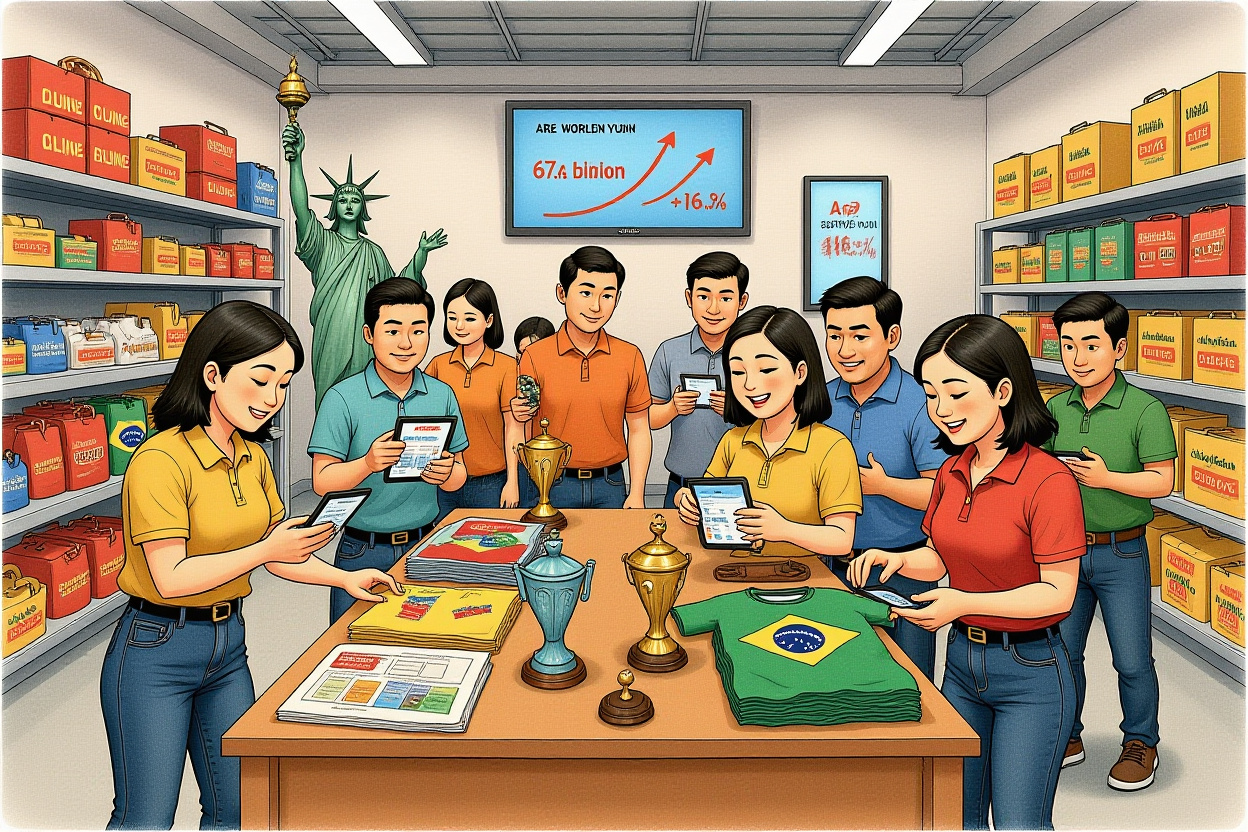
Executive Summary: Key Takeaways from the Pre-World Cup Order Surge
The upcoming FIFA World Cup is already driving significant economic activity for Chinese sellers, with orders skyrocketing months before the first match. Here are the critical insights for investors and market participants:
– Chinese sellers report a World Cup order surge, with online sales increasing nearly 50% and offline sales up 30% compared to the previous tournament, highlighting robust demand for sports merchandise.
– Demand has shifted geographically; while the 2022 Qatar World Cup saw strong Asian orders, the 2026 North American edition is driven by orders from the Americas, particularly the U.S., Canada, and Mexico.
– Supply chain agility in hubs like Yiwu (义乌) enables rapid response to orders, with sellers using AI tools for design, communication, and efficiency gains, maintaining China’s competitive edge.
– Export data underscores growth: China’s sports goods exports hit $281.63 billion in 2025, with Yiwu Customs reporting a 16.8% year-on-year increase in sports equipment exports in early 2025.
– This cyclical boost presents opportunities in Chinese equities tied to manufacturing, e-commerce, and logistics, but requires monitoring of inventory risks and post-tournament sustainability.
The Early Kickoff: How Chinese Sellers Are Capitalizing on World Cup Anticipation
Months before the FIFA World Cup kicks off in the U.S., Canada, and Mexico, Chinese sellers are already experiencing a dramatic spike in orders. This pre-tournament boom reflects the deep integration of China’s manufacturing sector into global event-driven economies, offering a case study in supply chain responsiveness and market forecasting. For investors, understanding this World Cup order surge provides insights into consumer trends, export resilience, and the health of Chinese small and medium enterprises (SMEs) in the face of global demand shifts.
Case Study: Chen Ning’s Decade-Long Jersey Business Adapts to New Markets
Chen Ning (陈宁), a Guangdong-based seller with ten years in football apparel, exemplifies this trend. He notes that orders began flowing as early as May last year, peaking in October 2024 when factories worked overtime until 2-3 a.m. for two weeks straight. “The sales cycle for World Cup products lasts a year, and we’re now preparing for the second wave expected in late spring,” Chen told First Financial News (第一财经). His business has pivoted from Asian clients during the Qatar World Cup to American clients this time, with a U.S. customer placing a single order for over 60,000 items. Chen estimates producing 150,000 units for this cycle, up from 60,000 in 2022, driven by products featuring national elements like Brazil’s Christ the Redeemer statue.
Market Shifts: From Asia to the Americas and the Role of Digital Channels
The geographic shift in demand underscores the adaptability of Chinese sellers. Zhang Zhouping (张周平), Executive Dean of BenSe Think Tank (本色智库), explains that as the tournament progresses, orders for underdog or advancing teams will spike, especially around the finals. Chinese sellers thrive due to flexible supply chains and digital prowess. Online platforms have seen a 50% sales increase, partly because sellers efficiently use live streaming, social media, and cross-border e-commerce to create viral products. This digital edge, combined with a physical manufacturing base, positions China to dominate the World Cup order surge.
Supply Chain Agility: The Backbone of China’s Export Success
China’s ability to meet volatile, event-driven demand hinges on its sophisticated supply chain networks. Hubs like Yiwu (义乌) in Zhejiang Province are epicenters of rapid production and delivery, enabling sellers to handle large orders with short lead times. This agility is not just about speed; it’s about cost-effectiveness, quality control, and customization—all critical for capitalizing on the World Cup order surge.
The Yiwu Manufacturing Hub: A Model of Efficiency and Scale
Chen Xianchun (陈显春), head of Yiwu Jinzun Trophies and Medals (义乌金尊奖杯奖牌), details how order timing varies by product. Bulky items like trophies were shipped early, while smaller peripherals like keychains and pins continue to receive orders, with a new peak expected at kickoff. “Yiwu manufacturing advantages are expanding,” she says, citing better packaging, functional design, and reliable delivery schedules. Many clients, including new ones flying directly to Yiwu, trust Chinese sellers for their mature operational systems and product development advice. This trust translates into tangible growth: offline sales are up 30%, and online sales have surged 60% compared to the last World Cup.
Digital and Operational Efficiency: Leveraging Cross-Border Expertise
Chinese sellers excel in digital operations, navigating global e-commerce rules and integrating marketing channels. According to Zhang Zhouping, this includes:
– Fast response capabilities that match tournament timelines, with supply chains capable of scaling production within weeks.
– Extensive foreign trade experience, allowing sellers to handle diverse order types and consolidate international competitiveness.
– Data-driven insights from platforms like Alibaba’s Tmall Global (天猫国际) or Amazon, which help predict demand spikes and optimize inventory.
For instance, Chen Ning’s team uses AI tools for product listings and translation, a common practice to stay competitive. This blend of physical and digital efficiency ensures that the World Cup order surge is met without major disruptions, reinforcing China’s role as the world’s factory for event merchandise.
AI Integration: Boosting Productivity and Fostering Innovation
Artificial intelligence is transforming how Chinese sellers operate, from design to customer service. In the context of the World Cup, AI tools help streamline processes, reduce costs, and enhance creativity, giving sellers an edge in a crowded market. This technological adoption is not a luxury but a necessity, as sellers who ignore it risk falling behind.
AI in Design, Communication, and Market Research
Chen Xianchun reports that AI aids in market research, inspiration generation, and client communication, saving time and improving outcomes. For example, AI can analyze trending World Cup motifs or generate design prototypes, allowing teams to focus on production. Similarly, Chen Ning’s use of AI for translation and image creation speeds up cross-border transactions. Key applications include:
– Product design: AI algorithms suggest color schemes and elements based on national flags or team logos, reducing design cycles.
– Customer interaction: Chatbots and AI-driven tools handle inquiries, freeing up human resources for complex orders.
– Marketing: AI analyzes social media trends to identify potential bestsellers, optimizing ad spend for the World Cup order surge.
Competitive Edge Through Technology and Future Trends
The widespread use of AI among Chinese sellers underscores a broader trend towards smart manufacturing. As Zhang Zhouping notes, this technological leverage complements China’s existing advantages in scale and cost. For investors, it signals growth sectors within Chinese equities, such as AI software providers or industrial automation firms. However, the reliance on AI also highlights the need for continuous innovation, as competitors in Southeast Asia and elsewhere adopt similar tools. The World Cup order surge thus serves as a testing ground for China’s tech-driven export model.
Economic Impact and Export Growth: Data-Driven Insights
The pre-World Cup boom is reflected in robust export statistics, demonstrating China’s enduring strength in sports goods manufacturing. According to the China Sporting Goods Federation (中国体育用品业联合会), the industry exported $281.63 billion worth of goods in 2025, exceeding expectations despite global pressures. More granular data from Yiwu Customs (义乌海关) shows that in the first seven months of 2025, sports equipment exports totaled 67.8 billion yuan, a 16.8% year-on-year increase, with exports to the three host nations—U.S., Canada, and Mexico—rising 10% to 18.8 billion yuan.
Export Statistics and Long-term Market Development
These numbers validate the anecdotal reports from sellers like Chen Ning and Chen Xianchun. The growth is not merely cyclical; it reflects deeper trends:
– Diversification: Sellers are expanding beyond tournaments, using World Cup exposure to build lasting presence in regions like North America and Latin America.
– Value addition: Products are becoming more customized and premium, moving beyond cheap commodities to branded items with higher margins.
– Sustainability: Post-tournament, sellers aim for steady growth rather than spikes, as Chen Ning emphasizes, to improve inventory management and operational rhythm.
For a deeper dive into customs data, refer to the General Administration of Customs of China (中国海关总署) website for updates.
Implications for Global Trade and Chinese Equities
The export surge bolsters China’s trade balance and supports sectors like textiles, plastics, and electronics. Investors should watch stocks of companies involved in these supply chains, such as Li Ning (李宁) for apparel or Shenzhen Inovance Technology (汇川技术) for automation solutions. However, risks include overreliance on event-driven demand and potential tariffs in host countries. The World Cup order surge thus offers a microcosm of China’s export economy—resilient but vulnerable to external shocks.
Strategic Insights for Investors: Navigating Opportunities and Risks
For institutional investors and fund managers, the pre-World Cup activity in Chinese markets presents both short-term gains and long-term strategic considerations. By analyzing the World Cup order surge, one can identify undervalued equities, assess supply chain robustness, and gauge consumer sentiment ahead of broader economic indicators.
Opportunities in Chinese Equities and Related Sectors
Focus on companies benefiting directly or indirectly from the surge:
– E-commerce platforms: Alibaba Group (阿里巴巴集团) and JD.com (京东) see increased transaction volumes from cross-border sales.
– Logistics firms: SF Express (顺丰速运) and ZTO Express (中通快递) handle shipping for time-sensitive orders.
– Manufacturing stocks: Firms in the Yiwu industrial cluster or those producing raw materials like polyester for jerseys.
– AI and tech providers: Companies offering design software or automation tools, such as iFlytek (科大讯飞).
Data from the China Securities Regulatory Commission (中国证监会) shows increased trading volumes in consumer goods stocks ahead of major events, suggesting market anticipation.
Risks and Considerations for Sustainable Investment
While the surge is promising, investors must remain cautious:
– Inventory glut: Post-tournament, unsold merchandise could lead to write-downs, affecting profitability.
– Geopolitical tensions: Trade disputes with host nations might impact tariffs or supply chain flows.
– Currency fluctuations: The yuan (人民币) volatility could erode export margins.
Zhang Zhouping advises that long-term success depends on sellers’ ability to transition from event-driven spikes to stable growth, leveraging digital tools and market diversification. Thus, the World Cup order surge should be viewed as a catalyst, not a standalone driver, for investment decisions.
Synthesizing the Pre-World Cup Momentum: Key Takeaways and Forward Guidance
The pre-FIFA World Cup order surge among Chinese sellers underscores the dynamism of China’s export economy, driven by agile supply chains, digital innovation, and strategic market adaptations. With online sales up 50% and exports to host nations growing, this phenomenon offers valuable lessons for global investors. The integration of AI tools and the shift to American markets highlight China’s capacity to evolve with global demand, reinforcing its position in sports merchandising.
Looking ahead, monitor quarterly earnings reports from Chinese consumer goods companies and export data from the General Administration of Customs for confirmation of this trend. Consider diversifying portfolios into sectors that benefit from event-driven demand, but balance this with investments in companies demonstrating post-event sustainability. For actionable insights, subscribe to market analyses from reputable sources like the People’s Bank of China (中国人民银行) or financial news outlets covering Asian equities. By staying informed, investors can capitalize on the World Cup order surge while mitigating risks in a volatile global landscape.