



Executive Summary
- Chinese manufacturers of World Cup merchandise are experiencing a significant pre-tournament sales surge, with orders spiking months before the first match, driven by flexible supply chains and digital cross-border strategies.
- Key sellers report order increases of 30-60% compared to the previous World Cup cycle, with particular strength in online channels and demand from the Americas.
- The phenomenon underscores China’s export resilience in the sports goods sector, with 2025 data showing robust growth, offering insights for investors monitoring consumer and manufacturing equities.
- Advanced technologies like AI are being leveraged to enhance design, communication, and operational efficiency, solidifying competitive advantages in fast-response production.
- This pre-World Cup sales boom presents both immediate opportunities and long-term strategic implications for market expansion in North and Latin America post-tournament.
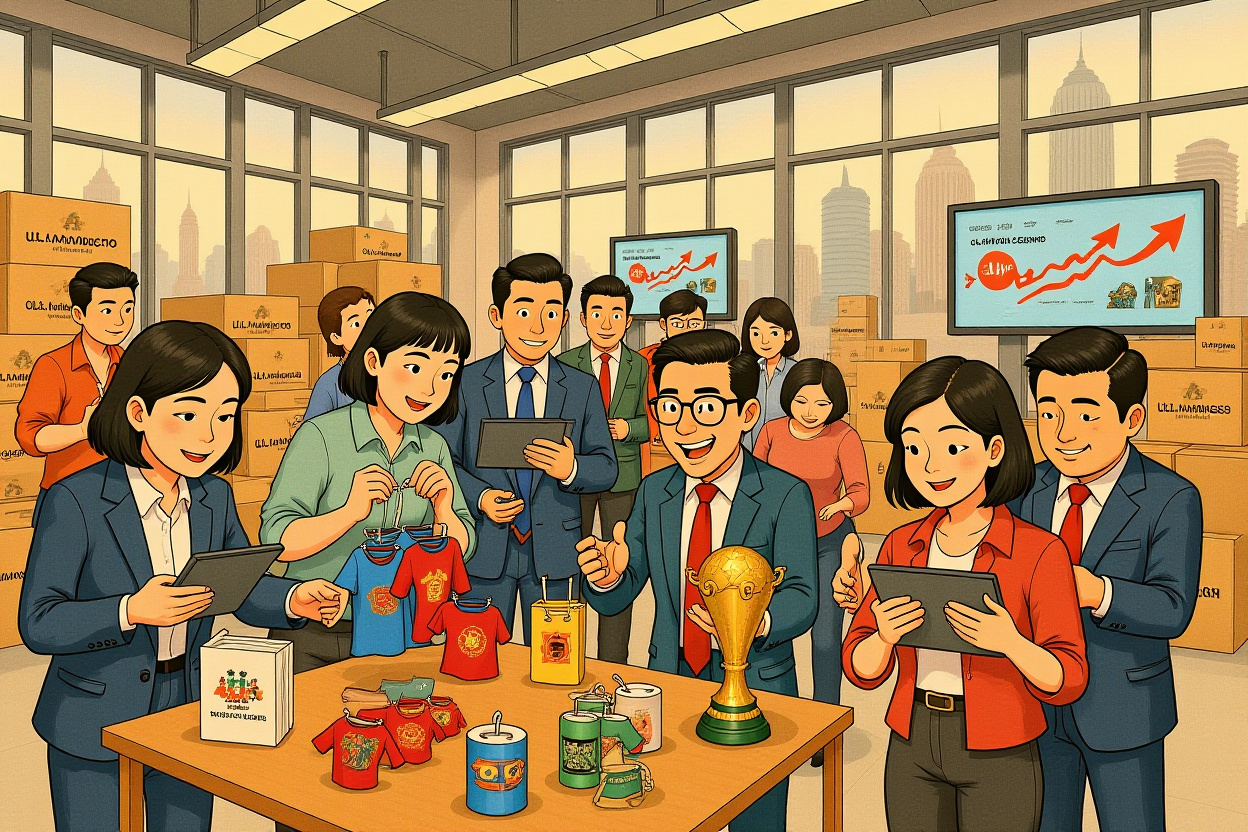
The global spotlight is turning toward the 2026 FIFA World Cup, but for China’s vast manufacturing ecosystem, the game has already begun. While fans await the opening whistle, Chinese sellers entrenched in the sports merchandise supply chain are witnessing an extraordinary pre-World Cup sales boom, with order volumes surging months ahead of the tournament. This early surge is not merely a seasonal spike; it is a testament to the sophisticated orchestration of China’s export machinery, digital跨境 (cross-border) commerce capabilities, and the anticipatory strategies of sellers who have turned global sporting events into reliable growth engines. For international investors and analysts focused on Chinese equities, this activity offers a real-time barometer of consumer goods export vitality, supply chain agility, and the potential upside for related publicly listed companies.
The Early Kickoff: Capitalizing on World Cup Anticipation
Long before the tournament’s kickoff, Chinese sellers initiate a meticulous commercial playbook. The sales cycle for World Cup-related products spans nearly a full year, beginning with initial orders during the qualification phases and peaking around the group stages. This extended timeline allows for strategic inventory build-up, product iteration, and targeted marketing, creating a sustained pre-World Cup sales boom that buffers against post-event volatility.
A Decade in the Game: Chen Ning’s Football Apparel Strategy
Chen Ning (陈宁), a veteran football apparel seller from Guangdong with over a decade of experience, exemplifies this proactive approach. He reported to第一财经 (First Financial) that his first major order wave hit in October 2023, following the release of the tournament schedule. His factory operated extended shifts until 2-3 AM for half a month to fulfill demand. Chen anticipates a second, larger peak beginning in late April 2024, crescendoing through June as group matches commence. He has already prepared by launching 15 new best-selling designs, many featuring national team elements. "Sales for national-themed products exceeded our projections by 10-20%," Chen noted, planning to introduce European team designs in April to capture that market. One U.S. client alone placed orders exceeding 60,000 units, with 70% of a follow-up order comprising Mexico-themed merchandise, reflecting shifting geographic demand toward the host continent.
Order Dynamics and Geographic Shifts
The nature of orders reveals strategic adaptation. Compared to the Qatar World Cup, where Asian demand dominated, the 2026 event hosted by the U.S., Canada, and Mexico has pivoted focus westward. Chen Ning estimates his online sales have grown nearly 50% in this cycle, with offline channels up 30%. He projects total production to reach 150,000 units, more than double his 2022 volume. This pre-World Cup sales boom is not isolated. Zhang Zhouping (张周平), Executive Dean of BenSe Think Tank (本色智库), highlighted to First Financial that orders will further explode for "dark horse" and advancing teams as the knockout stages progress, with peaks expected around the finals.
Supply Chain Agility: The Engine of Fast Response
At the core of this success is China’s unparalleled supply chain flexibility. Centered on industrial clusters like Yiwu in Zhejiang province, manufacturers can rapidly prototype, scale production, and fulfill complex custom orders with short lead times. This agility is critical for matching the "fast fashion" pace of sporting event merchandise, where trends and team loyalties can shift overnight.
The Yiwu Advantage: Speed, Scale, and Sophistication
Chen Xianchun (陈显春), responsible person at Yiwu Jinzun Trophies and Medals (义乌金尊奖杯奖牌), detailed the phased order approach. Bulky items like trophies were ordered and shipped last year, while smaller peripherals like keychains, pins, and magnets continue to see steady orders and are expected to spike at kickoff. "The advantage of ‘Yiwu Manufacturing’ is expanding," she stated, attributing growth to superior packaging, functional design, and reliable quality control. Her business has seen offline orders grow 30% and online orders surge approximately 60% compared to the last World Cup. Clients value not just price but the entire package: quality, dependable delivery timelines, and product development consultancy from experienced sellers.
Digital Cross-Border Integration
Chinese sellers complement physical supply chains with deep digital expertise. They熟练地 (skillfully) navigate major e-commerce platforms, utilize live streaming, short videos, and social media for跨境营销 (cross-border marketing), and quickly identify and scale product trends. This digital operational capability allows them to efficiently reach global consumers, test markets, and convert interest into sales, amplifying the pre-World Cup sales boom. Zhang Zhouping emphasized that this combination of flexible manufacturing and digital savvy consolidates China’s international competitiveness in handling volatile, high-volume event-driven demand.
Economic Implications: Fueling Export Growth and Sector Resilience
The surge in World Cup orders is a microcosm of broader strength in China’s sports goods exports. It provides tangible data points on economic resilience and the effectiveness of the country’s manufacturing upgrade, offering signals for macroeconomic analysts and sector-specific investors.
Robust Export Data and Sector Performance
Official statistics underscore the trend. According to the China Sports Goods Association (中国体育用品业联合会), the industry achieved exports of $28.163 billion in 2025, exceeding expectations. More granular data from义乌海关 (Yiwu Customs) shows that in the first seven months of 2025, exports of sports goods and equipment from Yiwu totaled 6.78 billion yuan, a year-on-year increase of 16.8%. Exports to the three host nations—the U.S., Canada, and Mexico—reached 1.88 billion yuan, up 10%. This pre-World Cup sales boom directly contributes to these figures, highlighting the sector’s ability to capitalize on global events.
Long-Term Market Development Beyond the Tournament
For forward-thinking sellers, the World Cup is a launchpad, not just a windfall. Chen Ning expressed a desire for stable, long-term growth over sporadic booms. "After the last World Cup, we continued to develop in the Middle East market. We hope that after this one, we will see significant improvement in North and Latin American markets, so sales can grow year by year even after the World Cup ends," he told First Financial. This perspective points to strategic market entry and brand-building efforts that can outlive the tournament, potentially creating enduring revenue streams for businesses and, by extension, value for investors in related supply chains.
Technological Edge: AI Enhances Efficiency and Innovation
To maintain their competitive lead, Chinese sellers are increasingly integrating artificial intelligence into their workflows. AI tools are becoming standard operational assets, driving efficiency in design, customer interaction, and content creation, thereby supporting higher margins and faster turnaround during intense sales periods like the current pre-World Cup sales boom.
AI in Action: From Design to Customer Service
Chen Xianchun revealed that AI aids her team in market research, initial design inspiration, and提炼卖点 (extracting selling points). "It saves significant time costs," she noted. Similarly, Chen Ning’s team has long employed AI for generating product listings, creating images, and translation. "In our industry, basically everyone is using these functions. If you don’t, you get left behind," he stated. This widespread adoption indicates a productivity shift that enhances China’s manufacturing ecosystem’s responsiveness and innovation capacity.
Sustaining Competitive Advantages
The use of AI for customization and rapid iteration aligns with the demand for personalized World Cup merchandise. It allows sellers to quickly generate designs tailored to specific national teams or fan preferences, test them digitally, and move to production. This technological layer, built upon the physical supply chain, creates a formidable barrier to entry for competitors and ensures Chinese sellers can efficiently manage the complexities of the pre-World Cup sales boom.
Investment Perspectives: Navigating Opportunities in Chinese Equities
For institutional investors and fund managers, the visible pre-World Cup sales activity translates into potential equity market signals. The performance of manufacturers, exporters, and cross-border e-commerce platforms linked to this cycle warrants close observation.
Sectors and Companies to Monitor
Investors should consider companies within several interconnected sectors. First, manufacturers of textiles, apparel, and promotional products (especially those with exposure to international sports licensing) may see revenue uplifts. Second, logistics and supply chain management firms facilitating rapid export could experience increased volumes. Third, publicly traded cross-border e-commerce platforms (e.g., AliExpress overseen by Alibaba Group 阿里巴巴集团) that serve as primary channels for these transactions may report stronger GMV (Gross Merchandise Volume) in related categories. The pre-World Cup sales boom could serve as a positive catalyst for earnings revisions in these segments.
Strategic Considerations and Risk Assessment
While the trend is positive, investors must adopt a nuanced view. Key considerations include currency exchange fluctuations affecting exporter profitability, potential oversupply or inventory glut post-tournament, and broader geopolitical tensions that could impact trade flows. The long-term investment thesis should hinge not on a single event but on the sustained competitive advantages demonstrated: agile supply chains, digital integration, and technological adoption. Monitoring official export data from sources like the General Administration of Customs of China (中国海关总署) and quarterly reports from relevant listed companies will provide ongoing validation.
The current pre-World Cup sales boom is a powerful demonstration of China’s export engine operating at high efficiency. It showcases a mature ecosystem where manufacturers, digital platforms, and logistics networks synchronize to capture global demand pulses. For the global investment community, this activity is more than a seasonal story; it is a live case study in the resilience and adaptability of key segments of the Chinese economy. As the tournament approaches, savvy investors would be wise to look beyond the pitch and analyze the companies powering this commercial spectacle. The final whistle in 2026 will not mark an end, but rather a transition point for businesses aiming to convert World Cup momentum into lasting market share—a journey that equity markets will closely track.