



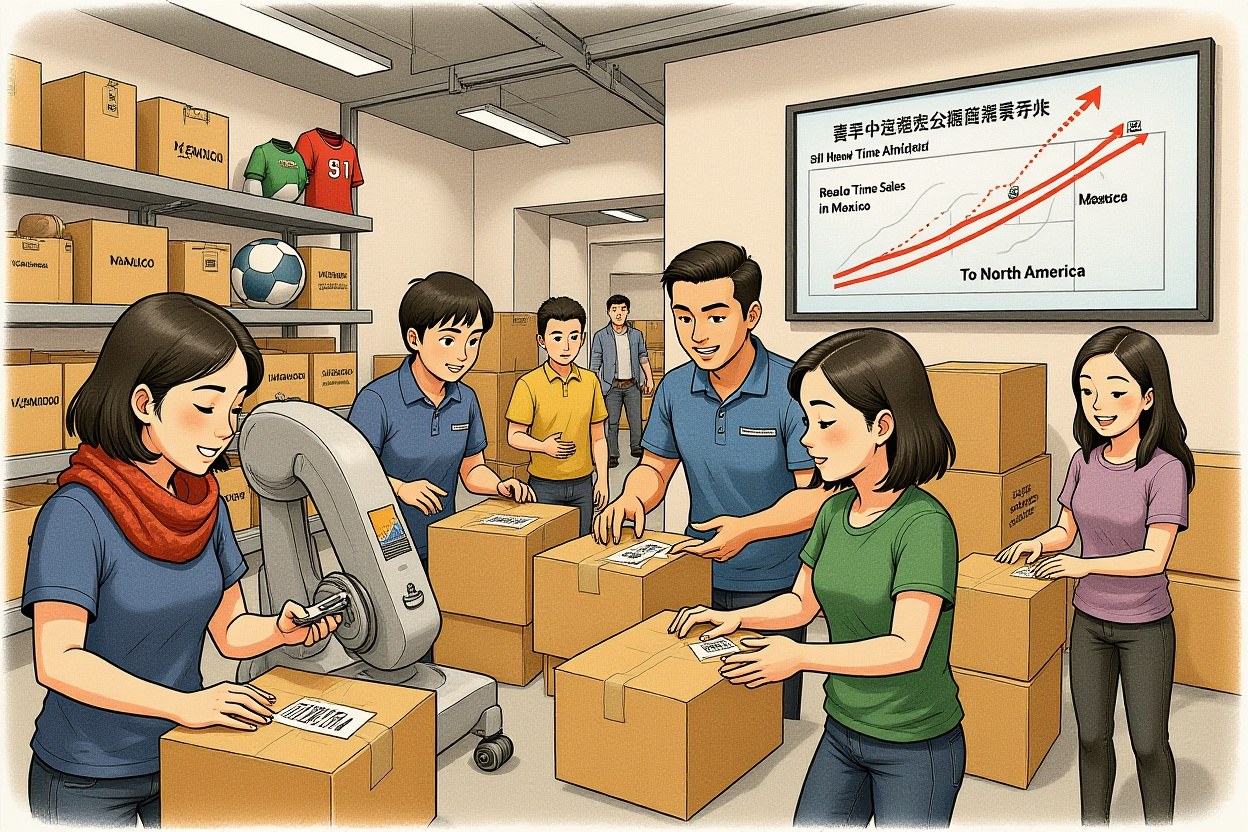
Executive Summary: Key Takeaways for Market Participants
– Chinese sellers are witnessing a significant pre-World Cup order surge, with some businesses reporting over 50% growth in online sales compared to the previous tournament cycle.
– Supply chain flexibility and digital operational prowess are key competitive edges, enabling rapid response to fluctuating demand during major global events.
– Artificial intelligence is increasingly leveraged to enhance design efficiency, customer communication, and product development, streamlining processes for cross-border e-commerce.
– Export data indicates robust growth in sports goods shipments, particularly to World Cup host nations, signaling strength in related manufacturing sectors.
– This trend presents tangible opportunities for investors monitoring consumer goods, export-oriented industries, and e-commerce platforms within Chinese equity markets.
The Early Kickoff: Chinese Sellers Capitalize on World Cup Anticipation
While the opening whistle for the FIFA World Cup in the U.S., Canada, and Mexico is still months away, the commercial match has already begun for Chinese manufacturers. A palpable pre-World Cup order surge is sweeping through factories and e-commerce hubs across China, from Guangdong to Yiwu, as international buyers stock up on jerseys, trophies, keychains, and countless other tournament-related products. This phenomenon isn’t merely seasonal hype; it’s a testament to the deep integration of China’s manufacturing ecosystem into global event-driven commerce and a critical indicator of export resilience. For investors focused on Chinese equities, understanding the dynamics behind this demand spike offers insights into consumer trends, supply chain vitality, and sectoral performance ahead of a major macroeconomic catalyst.
The current pre-World Cup order surge mirrors patterns observed before previous tournaments but with amplified scale and sophistication. Sellers report that the sales cycle for World Cup merchandise spans nearly a full year, beginning with initial orders during qualification phases and peaking around the group stages. This elongated timeline allows for strategic inventory management and phased production, but it also demands exceptional agility from suppliers. The ability to meet this demand underscores why Chinese sellers remain the go-to partners for global retailers and sports franchises, reinforcing their position in international trade networks. As orders flood in, the ripple effects are felt across logistics, raw material sourcing, and labor markets, providing a real-time barometer for the health of China’s export-oriented small and medium enterprises.
Case in Point: Football Apparel and the Surge in Custom Orders
Chen Ning (陈宁), a veteran football apparel seller from Guangdong with a decade of experience, exemplifies the scale of this pre-World Cup order surge. His business, which produces customized jerseys and football peripherals, has seen a dramatic shift in client geography. “During the last Qatar World Cup, we had more orders from Asia. This time, for the North American-hosted tournament, the demand is primarily coming from the Americas,” he explained. Chen Ning’s operation hit its first order peak in October of last year, requiring factory crews to work until 2 or 3 a.m. for two straight weeks to fulfill demand. He anticipates a second, larger wave of orders building from late spring, culminating in a June crescendo aligned with the tournament’s start.
The data from his business is staggering. One U.S.-based client has placed two orders totaling over 60,000 units, with 70% of the追加订单 (follow-up orders) featuring Mexican-themed designs. Chen Ning attributes this to growing market demand in Mexico and the cultural affinity for Mexican elements in many U.S. cities. He estimates that online sales channels have grown nearly 50% compared to the previous World Cup cycle, while offline sales are up approximately 30%. Overall, he projects producing 150,000 units during this World Cup period, more than double the 60,000 units sold during the Qatar tournament. This pre-World Cup order surge isn’t just about short-term gains; sellers like Chen Ning are using the momentum to establish long-term footholds in new markets, hoping for sustained growth in North and Latin America post-tournament.
Deconstructing the Supply Chain Advantage: Speed, Flexibility, and Scale
The consistent ability of Chinese sellers to harness event-driven demand hinges on a supply chain infrastructure that is both robust and remarkably adaptable. This pre-World Cup order surge highlights several structural advantages that have been honed over years of exporting consumer goods worldwide. At its core is the concept of 柔性供应链 (flexible supply chain), which allows manufacturers to rapidly scale production up or down, switch product lines, and accommodate last-minute customizations with minimal downtime. Industrial clusters, such as the Yiwu commodity market in Zhejiang Province, act as centralized hubs where everything from raw materials to finished goods can be sourced, assembled, and shipped with unparalleled efficiency.
Zhang Zhouping (张周平), Executive Dean of Bense Think Tank, notes that in major events like the World Cup, Chinese sellers excel due to their “flexible, fast supply chain response capability.” He points to regions like Yiwu as epitomizing the rapid delivery prowess that matches the fast-reaction needs of global sporting events. This capability is not incidental; it is built on a foundation of integrated logistics, dense supplier networks, and deep manufacturing expertise. When a team unexpectedly advances in the knockout stages, Chinese factories can produce and ship commemorative merchandise for that team before the next match, a turnaround time that competitors struggle to match. This agility transforms the pre-World Cup order surge from a simple spike in volume into a strategic demonstration of operational supremacy.
Digital Operations and Cross-Border E-commerce Integration
Beyond physical manufacturing, digital savviness is a critical multiplier. Chinese sellers are adept at leveraging major e-commerce platforms, social media, live streaming, and digital marketing to create and sustain product virality across borders. This digital fluency allows them to not only receive orders but also to forecast trends, engage directly with overseas consumers, and optimize sales funnels in real-time. During this pre-World Cup order surge, sellers are using data analytics to identify which national team designs are gaining traction and adjusting their production and marketing focus accordingly. For instance, Chen Ning mentioned that products featuring Brazilian elements—dominant yellow with green accents and imagery of Christ the Redeemer—have outperformed sales expectations by 10-20%, prompting plans to launch European national team designs in April.
The integration of cross-border e-commerce platforms like AliExpress, Amazon, and Temu provides a direct pipeline to global consumers, bypassing traditional wholesale intermediaries. This direct-to-consumer model increases margin potential and accelerates feedback loops. Chen Xianchun (陈显春), responsible for Yiwu Jinzun Trophies and Medals (义乌金尊奖杯奖牌), observed that many long-term clients now prefer placing orders online, while some new clients even fly to Yiwu for in-person negotiations. She reported that online sales for her World Cup-related products have surged about 60% compared to the last tournament, with offline sales up 30%. This blended approach underscores how digital tools are amplifying the pre-World Cup order surge, making it more measurable and manageable.
AI as a Competitive Catalyst: Enhancing Efficiency from Design to Delivery
Artificial intelligence is no longer a futuristic concept in Chinese manufacturing; it is an operational workhorse actively shaping this pre-World Cup order surge. Sellers are deploying AI tools across the value chain to compress timelines, reduce costs, and enhance creativity. In product design, AI algorithms can rapidly generate and test design concepts based on market trends, historical sales data, and cultural motifs. Chen Xianchun shared that her team uses AI for preliminary market research and to spark inspiration when designers face creative blocks. This accelerates the prototyping phase, allowing faster time-to-market for new products tailored to the evolving tastes of World Cup fans.
In customer-facing operations, AI-powered translation and communication tools break down language barriers with international buyers, facilitating smoother negotiations and order specifications. Chen Ning’s team extensively uses AI for creating product listings, generating images, and translating content. “In our industry, merchants are basically using these functions. If you don’t use them, you’ll be eliminated,” he stated bluntly. This widespread adoption creates a baseline of efficiency that raises the competitive bar for all participants. Furthermore, AI aids in提炼卖点 (extracting selling points) from product features, optimizing listings for search engines on global e-commerce platforms. By automating routine tasks, human workers can focus on complex problem-solving and strategic planning, making the entire system more resilient amidst the pre-World Cup order surge.
Data-Driven Decision Making and Inventory Optimization
The volatility of event-driven demand—where a team’s early exit can render thousands of units obsolete—makes inventory management a high-stakes endeavor. AI and data analytics play a crucial role in mitigating this risk. By analyzing real-time sales data, social media sentiment, and even sports betting odds, sellers can make more informed predictions about which teams and products will be in demand at various tournament stages. Chen Xianchun noted that her team plans to prepare more targeted inventory once the tournament reaches the semi-final stage, focusing on merchandise for the remaining teams. This precision reduces overstock and maximizes the profitability of the pre-World Cup order surge.
The application of AI extends to logistics and supply chain coordination, optimizing shipping routes, warehouse storage, and production schedules based on order patterns. This holistic integration ensures that the surge in orders translates smoothly into delivered products without crippling bottlenecks. For investors, the rapid AI adoption in these small and medium enterprises signals broader digital transformation trends within Chinese manufacturing, potentially boosting productivity and margins in the long term.
Economic and Market Implications: Reading the Export Signals
The pre-World Cup order surge is more than an anecdotal success story; it is reflected in hard export data that points to underlying strength in China’s light manufacturing and sports goods sectors. According to the China Sports Goods Industry Federation (中国体育用品业联合会), the sports goods industry achieved exports of $28.163 billion in 2025, demonstrating robust performance despite global economic headwinds. More specifically, Yiwu Customs (义乌海关) statistics show that in the first seven months of 2025, exports of sports goods and equipment from Yiwu totaled 6.78 billion yuan, a year-on-year increase of 16.8%. Exports to the three host nations—the United States, Canada, and Mexico—reached 1.88 billion yuan, up 10%.
This data is a vital indicator for investors monitoring Chinese equity markets. Publicly listed companies in consumer goods, textile manufacturing, e-commerce logistics, and retail may experience positive earnings momentum linked to this export activity. The pre-World Cup order surge can serve as a leading indicator for quarterly revenue growth in related sectors. Moreover, the sustained demand underscores China’s enduring role as the world’s factory, even as it shifts towards higher-value production. The ability to capture event-driven commerce reinforces the investment thesis for supply chain and export-focused stocks within major indices like the CSI 300 or Hang Seng.
Sectoral Impact and Investor Considerations
– Apparel and Textile Manufacturers: Companies producing synthetic fabrics, dyes, and finished garments likely see increased order volumes from downstream sellers. This could benefit firms with strong export portfolios.
– E-commerce and Logistics Platforms: Cross-border e-commerce giants like Alibaba Group (阿里巴巴集团) and JD.com (京东) facilitate many of these transactions, while logistics providers handle the surge in international shipping. Increased platform activity and transaction fees can contribute to revenue growth.
– Consumer Discretionary Stocks: The overall positive sentiment from strong export data can buoy broader consumer sectors, reflecting resilient external demand.
– Small and Medium Enterprise (SME) Lenders: Banks and financial institutions that provide working capital to these exporting SMEs may see healthier loan portfolios and transaction banking revenue.
Investors should monitor quarterly reports from relevant companies for commentary on World Cup-related sales and any guidance revisions. Additionally, tracking customs data and industry association releases can provide early signals of trend sustainability beyond the tournament.
Expert Insights and Forward-Looking Analysis
Industry observers emphasize that the current pre-World Cup order surge is part of a larger narrative about China’s evolving export capabilities. Zhang Zhouping (张周平) highlights that Chinese sellers possess “a powerful and complete supply chain network capable of efficient large-scale manufacturing and low-cost production, while also exhibiting agility in product iteration and customization.” He adds that years of foreign trade experience enable sellers to flexibly handle diverse order types, continuously solidifying international competitiveness. This expertise is crucial for navigating the unpredictable demand curves of global sporting events, where orders can explode for a “dark horse” team that advances further than expected.
Looking ahead, the peak of the pre-World Cup order surge is anticipated around the tournament’s kickoff and during the knockout stages. Zhang Zhouping predicts that “as group matches and elimination rounds progress,追加订单 (follow-up orders) for dark horse teams and advancing teams will erupt. Particularly around the final week, orders may reach their peak.” This phased demand allows for staggered production and inventory deployment, but it also requires meticulous planning. Sellers who have invested in digital tools and supply chain relationships will be best positioned to capitalize on these late-stage opportunities.
Sustaining Growth Beyond the Final Whistle
For astute businesses, the World Cup is a launchpad, not just a windfall. Chen Ning expressed a desire for stable long-term growth over sporadic spikes, as it benefits operational rhythm, inventory management, and sustainable expansion. After the Qatar World Cup, his business continued to develop in the Middle East market. Now, he aims to use the pre-World Cup order surge to establish a lasting presence in North and Latin America, ensuring sales continue to grow year-over-year even after the tournament concludes. This strategic perspective is essential for transforming temporary demand into permanent market share, a goal that aligns with China’s broader economic push towards brand building and value-added exports.
Strategic Takeaways for the Global Investment Community
The unfolding pre-World Cup order surge among Chinese sellers is a multifaceted case study in modern global commerce. It demonstrates the synergistic power of agile manufacturing, digital integration, and technological innovation. For international investors and fund managers, this trend offers several actionable insights. First, it reaffirms the resilience and adaptability of China’s export ecosystem, a critical component of the global economy. Second, it highlights specific sectors and companies likely to experience tangible revenue boosts from event-driven consumption cycles. Third, it underscores the importance of supply chain literacy when evaluating investments in consumer-facing industries.
As the World Cup approaches, market participants should watch for related data points: monthly export figures for sports goods, earnings surprises from manufacturers, and commentary from e-commerce platforms on cross-border activity. The pre-World Cup order surge is a timely reminder of China’s deep entanglement in global consumer trends and its capacity to turn geopolitical events into commercial opportunities. For those positioned correctly, this surge represents more than just orders; it signifies a vote of confidence in Chinese manufacturing’s future.
Engage with specialized research on export-oriented SMEs, consider ETFs focused on consumer discretionary or e-commerce sectors in China, and monitor regulatory announcements from bodies like the Ministry of Commerce (商务部) for policies supporting cross-border trade. The final whistle of the World Cup will blow, but the business fundamentals showcased during this period will continue to influence market dynamics long after the trophy is lifted.