



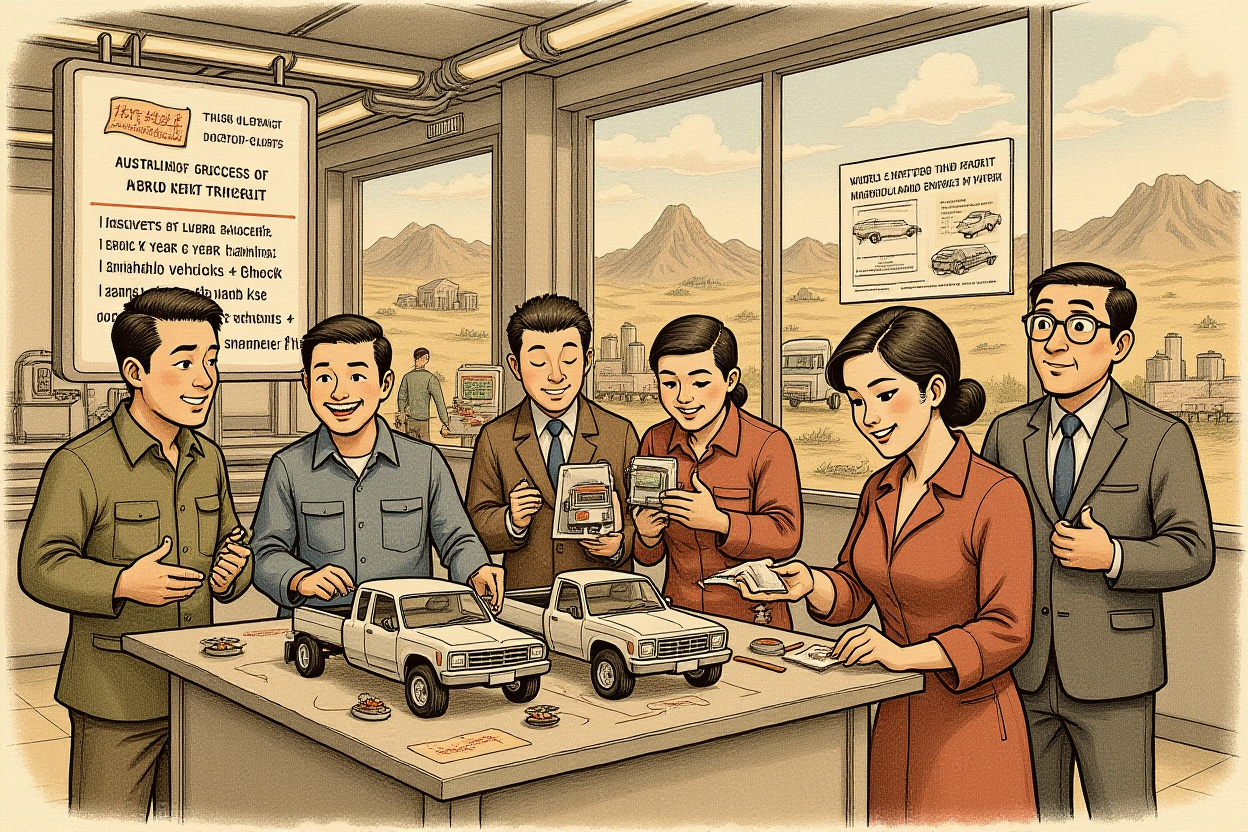
Executive Summary
– Chinese pickup truck exports have skyrocketed, with over half of production sold overseas in 2025, marking a 30% year-on-year growth in early 2025.
– Smart manufacturing and flexible production lines enable rapid customization for diverse global markets, from Australia to Latin America.
– New energy technologies, including pure electric and hybrid models, are becoming key competitive advantages in regions like Mexico.
– Localized R&D and performance modifications address specific regional needs, such as enhanced suspension for Brazil or high-altitude adaptability for Peru.
– Industry experts like Cui Dongshu (崔东树) highlight that Chinese manufacturing prowess is driving a global upgrade in pickup truck standards.
The Unstoppable Rise of Chinese Pickups on the World Stage
In a dramatic shift that underscores China’s evolving industrial might, pickup trucks bearing Chinese brands are no longer confined to domestic roads. They are now roaring across continents, from the outbacks of Australia to the mining regions of Peru, capturing market share with a blend of durability, innovation, and strategic adaptability. This Chinese pickup truck export surge is not a fleeting trend but a structural transformation, powered by decades of manufacturing refinement and a sharp pivot towards intelligent, customer-centric production. For global investors and auto industry executives, understanding this momentum is crucial, as it redefines competitive dynamics in the lucrative light commercial vehicle segment and offers a proxy for the broader ascent of Chinese advanced manufacturing.
The data speaks volumes. In the first two months of 2025, China exported 50,000 pickup trucks, a striking 30% increase compared to the same period last year, with exports consistently accounting for over half of total sales. This Chinese pickup truck export surge is accelerating, fueled by robust demand in key overseas markets and the industry’s agile response. The narrative has moved beyond mere cost advantages; it’s now about technological parity, superior value, and an uncanny ability to tailor products to local terrains and lifestyles. As Chinese automakers leverage their smart manufacturing ecosystems, they are not just shipping vehicles—they are exporting integrated solutions that resonate with farmers, miners, businesses, and adventurers worldwide.
From Utilitarian Workhorses to Versatile Lifestyle Partners
The global appeal of Chinese pickups stems from their successful evolution from basic transportation to multi-role companions. In markets like Peru, as highlighted by CCTV reporter Wang Lulu (王璐璐), these vehicles are indispensable across sectors, traversing the Andes mountains for agriculture, servicing high-altitude mines, and navigating coastal deserts. This versatility is a direct result of manufacturers listening to end-users. Dealers like Dinesh, who represents SAIC Maxus (上汽大通) in Sydney, report soaring sales—up 58.7% year-on-year in February—as consumers recognize the blend of payload capacity, comfort, and reliability. The South African Automotive Business Council (Naamsa) data further confirms the trend, with pickup and minibus sales growing 11.9% in February 2025, and Chinese brands nearing a 17% market share in South Africa, the fastest-growing segment.
Quantifying the Export Momentum
The scale of the Chinese pickup truck export surge is evident in logistics and production metrics. At the Yangzhou Yuanyang International Container Terminal, market department staff Liu Geng (刘赓) noted that port shipments for pickups reached approximately 6,000 TEUs (twenty-foot equivalent units) early this year, translating to around 18,000 vehicles—a 16% annual increase. This volume is just a snapshot of a nationwide ramp-up. With exports dominating order books, manufacturers are operating at full throttle, often running double shifts to meet demand that stretches months ahead. This export-driven growth is a testament to the global recognition of Chinese quality and the strategic importance of the pickup segment as a gateway for broader automotive brand building overseas.
Manufacturing Agility Meets Soaring Global Demand
To sustain the Chinese pickup truck export surge, producers are radically enhancing their operational capabilities. Factories across industrial hubs like Jiangsu and Wuxi are not just increasing output; they are reengineering production for flexibility and scale. On one assembly line, over 90% of vehicles rolling off are destined for international markets, spanning Australia, Europe, and Latin America. In just the first quarter of 2025, manufacturers have added nearly 20 new export destinations, indicating rapid market penetration. Zhao Aimin (赵爱民), Deputy General Manager of SAIC Maxus, emphasized breakthroughs in Africa, North Africa, and ASEAN regions, with order backlogs extending to May or June, necessitating two-shift operations.
The backbone of this responsiveness is smart manufacturing. Flexible production lines can seamlessly accommodate over a thousand configuration variants for a single pickup model, allowing for mass customization. This capability is critical as demand diversifies. Notably, the export of completely knocked-down (CKD) kits—where vehicles are shipped in parts for local assembly—has doubled, enabling tariff advantages and fostering local industry partnerships in importing countries. This dual strategy of exporting both finished vehicles and kits demonstrates a sophisticated, multi-pronged approach to global expansion, reducing logistical barriers and aligning with local content policies in emerging markets.
Engineering for the World: Tailored Solutions for Every Market
Global success in the automotive sector hinges on localization, and Chinese pickup manufacturers are mastering this art. Rather than offering one-size-fits-all models, they deploy engineering teams to dissect regional challenges and co-create solutions. This customer-centric adaptation is a core driver of the Chinese pickup truck export surge. In Peru, where high-altitude mining and rugged mountain roads are common, vehicles receive enhanced powertrain calibrations and improved climbing capabilities. For Brazil, with its unique road conditions and fuel specifications, suspensions are stiffened for durability, electronic stability programs are upgraded for wet and slippery surfaces, and fuel tanks are redesigned with barrier layers to meet stringent emissions standards and reduce vapor permeation.
Integrating Local Intelligence into R&D
The localization process extends beyond hardware tweaks. Chinese firms are establishing global R&D centers that actively recruit local talent, ensuring that product development is informed by firsthand market knowledge. This collaborative approach ensures that modifications are not just technical but cultural, aligning features with local usage patterns and consumer preferences. By embedding local engineers and designers into the development cycle, manufacturers accelerate innovation cycles and build deeper trust with regional distributors and end-customers. This strategy transforms Chinese brands from distant exporters to embedded partners, fostering long-term brand loyalty and insulating against market volatility.
New Energy Innovation: The Next Frontier for Global Dominance
While traditional internal combustion engines continue to fuel growth, the future of the Chinese pickup truck export surge is increasingly electric. Leveraging China’s world-leading battery technology and electric vehicle supply chain, manufacturers are rolling out a diverse portfolio of new energy pickups, including pure electric (BEV), plug-in hybrid (PHEV), and range-extended (EREV) models. This technological diversification is opening doors in environmentally conscious markets and regions with high fuel costs. In Mexico, for instance, hybrid Chinese pickups are gaining rapid adoption. Elias, a Mexico City owner, praised his new hybrid pickup for its fuel efficiency and lower emissions, showcasing how green technology can be a compelling selling point beyond mere economics.
From Niche to Mainstream: The Data on Green Exports
Industry data reveals a sharp uptick in new energy pickup exports. One major manufacturer reported that the share of新能源 (new energy) pickups in its export mix surged from zero to over 15% in just two years. This is enabled by proprietary intelligent platforms capable of supporting mixed production of six powertrain types—diesel, gasoline, pure electric, hybrid, and more—on the same assembly line. Such manufacturing flexibility allows companies to pivot quickly based on regional regulations and consumer trends. Cui Dongshu (崔东树), Secretary-General of the China Passenger Car Association (CPCA)乘联分会, attributes this growth to the overarching rise of Chinese manufacturing capabilities. He states, “The improvement in China’s manufacturing level, especially the substantial upgrade of component systems, supports the leap in整车 (whole vehicle) manufacturing, leading to export growth and the supercharged rise of new energy pickups. Chinese pickups, with their品类 (product category) and new energy advantages, are achieving跨级竞争 (cross-segment competition) internationally, effectively leading the global upgrade path for pickups.”
Market Implications and Strategic Outlook for Investors
The sustained Chinese pickup truck export surge carries profound implications for the global automotive landscape. For institutional investors, this trend highlights several key investment themes: the resilience of Chinese industrial upgrading, the export potential of niche vehicle segments, and the competitive threat to established Western and Japanese pickup brands in emerging markets. The growth is underpinned by tangible factors: relentless productivity gains, supply chain integration, and strategic state support for high-value exports under initiatives like “中国制造2025” (Made in China 2025). As Chinese brands like SAIC Maxus, Great Wall Motors (长城汽车), and others consolidate their overseas footprints, they are likely to leverage these platforms to introduce SUVs and EVs, creating a halo effect for their entire product portfolios.
Navigating Risks and Opportunities
While the outlook is bullish, savvy market participants must monitor risks such as geopolitical tensions, potential trade barriers, and currency fluctuations. However, the foundational strengths—cost competitiveness, technological agility, and deep manufacturing ecosystems—provide a robust buffer. The call to action for fund managers and corporate strategists is clear: deepen due diligence on Chinese automotive supply chains, consider direct investments in leading exporters or their suppliers, and track regulatory developments in high-growth import markets like Southeast Asia, Latin America, and Africa. The Chinese pickup truck export surge is more than an auto story; it’s a benchmark for the maturation of China’s advanced manufacturing sector and a compelling case study in global market capture through innovation and adaptation.
Synthesis and Forward Guidance
The trajectory of Chinese pickup trucks from domestic workhorses to global bestsellers is a microcosm of China’s broader economic transition. With over half of production now exported, driven by smart manufacturing, tailored engineering, and new energy innovation, this sector exemplifies how Chinese companies are competing on value, not just price. The data from Australia, South Africa, Peru, and Mexico consistently points to deepening market penetration and consumer acceptance. As Zhao Aimin (赵爱民) and Cui Dongshu (崔东树) underscore, the industry’s ability to respond to订单 (order) surges with flexible production and localized R&D is a sustainable competitive advantage.
For international investors and business professionals engaged in Chinese equities, this segment offers a high-growth avenue within the automotive category, often with higher margins than saturated passenger car markets. The next phase will likely see consolidation, increased M&A activity, and sharper technology competition, particularly in electrification. To capitalize, stakeholders should focus on companies with proven export track records, robust R&D pipelines in new energy, and strategic partnerships in key overseas markets. The road ahead is open, and Chinese pickup trucks are firmly in the driver’s seat, charting a course for the future of global mobility.